Application Guides
Knowledge Center

Knowledge Center
A complete plastic mold engineering review should be finished before steel is cut. The review must confirm part geometry, resin choice, wall thickness, draft, shrinkage, gate location, runner design, cooling, ejection, tolerances, mold steel, expected production volume, inspection plan, and shipment requirements. The objective is to prevent costly tooling changes, unstable cycle times, visible defects, weak weld lines, warpage, flash, sink marks, and assembly failures after the mold is built.
For the Global Market, the most practical approach is to involve the mold maker, part designer, material supplier, quality team, and production team during DFM approval. Buyers should compare local tooling specialists with qualified international suppliers, including Chinese manufacturers that provide relevant certification, responsive pre-sales engineering support, reliable after-sales support, and strong cost-performance for prototype, low-volume, and repeat-production tools.
Before issuing a purchase order, request a written DFM report, mold-flow recommendation where appropriate, steel specification, cavity count proposal, estimated cycle time, sample validation plan, spare-part list, ownership terms, and post-delivery service scope.
Injection mold design is not only a tooling task. It is a commercial, engineering, quality, and supply-chain decision that affects the total cost of every molded part. A low-cost mold can become expensive when it creates excessive scrap, long cycle times, unplanned maintenance, cosmetic defects, poor dimensional stability, or delayed product launch. Conversely, a properly engineered mold can support predictable output, stable quality, lower resin consumption, reduced labor, and faster market entry.
Global product teams commonly design in one country, source tooling in another, mold parts near an assembly plant, and distribute finished products across several regions. This makes pre-build communication particularly important. Different markets may have different requirements for product labeling, material traceability, medical-device documentation, flame ratings, food-contact requirements, electrical safety, recycling content, packaging, and shipment protection. The design review should therefore translate the product requirements into mold requirements before manufacturing begins.
Trade hubs such as Shenzhen, Dongguan, Ningbo, Shanghai, Singapore, Rotterdam, Hamburg, Los Angeles, Chicago, Monterrey, Birmingham, Munich, and Dubai connect international manufacturing programs. Yet shipping distance does not eliminate the need for engineering alignment. A mold shipped from China to Europe, North America, Southeast Asia, or the Middle East must match the selected molding machine, local resin supply, water connections, electrical requirements, hot-runner controls, and maintenance capability at the destination plant.
The most successful projects treat DFM as a decision gate rather than a formality. A written DFM review clarifies what will be changed, what will remain as designed, what risks are accepted, and how part quality will be measured. It also creates a reliable record for brand owners, distributors, OEM customers, contract manufacturers, and future engineering teams.
The following review areas should be addressed before tooling manufacture begins. Their relative priority depends on annual volume, part size, resin type, cosmetic expectations, regulatory requirements, and whether the part is a prototype, bridge-production item, or long-term production component.
Review AreaWhat to ConfirmCommon Risk if MissedRecommended ActionPart geometryUniform wall thickness, realistic radii, ribs, bosses, snap fits, undercuts, and assembly interfaces.Sink marks, warpage, short shots, stress cracking, or difficult ejection.Approve a DFM-marked CAD model before mold design starts.Draft angleDraft direction and degree based on resin, texture, part depth, and cosmetic surface class.Drag marks, scuffing, part sticking, or surface damage during ejection.Increase draft on textured, deep, and high-gloss surfaces.Material selectionApproved resin grade, shrinkage range, additives, recycled-content level, color system, and supplier availability.Dimensional variation, brittleness, inconsistent color, or unplanned material substitutions.Specify resin grade and acceptable alternatives in writing.Gate strategyGate type, gate location, vestige allowance, flow direction, weld-line position, and packing path.Visible gate marks, weak weld lines, uneven filling, or poor cosmetics.Use mold-flow analysis for large, thin-wall, or cosmetic-critical components.Cooling designCooling channel layout, baffles, bubblers, conformal cooling opportunities, and water-circuit identification.Long cycle time, warp, uneven shrinkage, and unstable dimensions.Review cooling separately from cavity and core geometry.Ejection systemEjector pin placement, sleeve ejectors, stripper plates, lifters, air ejection, and witness-mark tolerance.Pin push, deformation, cracking, or unreliable automatic running.Place ejectors on strong, non-cosmetic surfaces wherever possible.Mold steel and treatmentSteel grade, hardness, corrosion resistance, polishing level, texture, coating, and expected tool life.Premature wear, rust, poor surface finish, and excessive maintenance.Match steel selection to resin abrasiveness, volume, and finish requirements.Tolerance planCritical-to-function dimensions, datum structure, measurement method, shrinkage allowances, and inspection frequency.Assembly interference, inconsistent fit, disputes over acceptance criteria.Separate critical dimensions from general molded tolerances.This table should be used as a working review document, not merely a design checklist. For example, a nominal wall thickness may be acceptable in CAD but still create a sink risk if a boss is too thick, a rib is oversized, or the gate cannot pack the local area effectively. Similarly, a tight dimension may be theoretically achievable but unsuitable for long-term production if it is affected by resin moisture, post-mold shrinkage, cavity imbalance, or changing ambient conditions.
Part design determines most molding behavior. Tooling can solve many challenges, but it cannot fully compensate for a design that ignores resin flow, cooling, shrinkage, and ejection. The following rules should be evaluated together rather than independently.
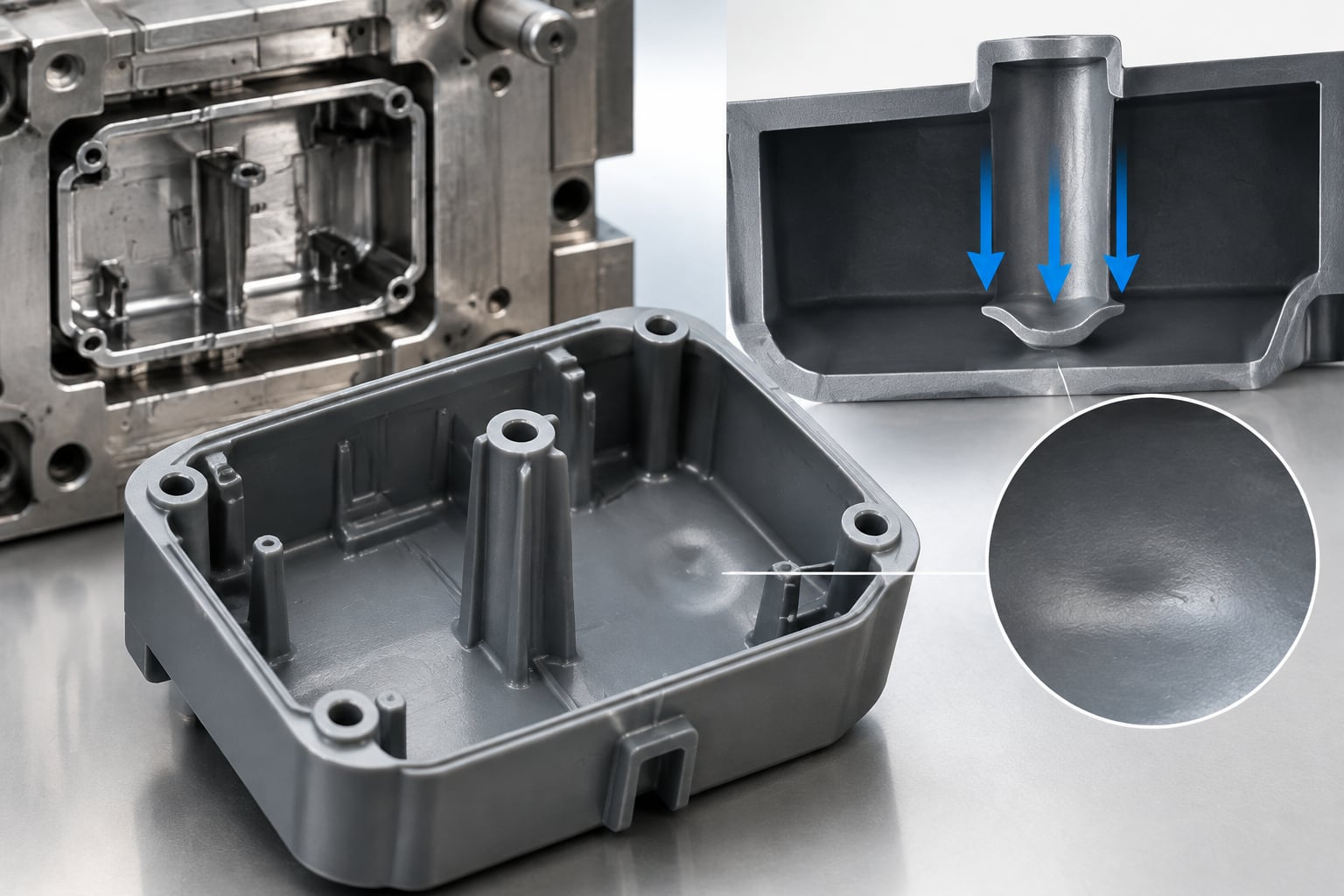
Uniform wall thickness is one of the most important rules in injection molded part design. Large thickness transitions create uneven cooling and differential shrinkage. When one area freezes earlier than another, the part may warp or develop visible sink marks. Thick zones also increase cooling time, which directly increases the cost of every cycle.
When a thick region is required for structural performance, consider coring out the section, adding ribs, using gussets, changing the load path, or selecting a higher-performance material. The exact solution depends on resin behavior. Glass-filled nylon, polycarbonate, ABS, polypropylene, POM, TPE, PC/ABS, PEEK, and flame-retardant compounds each respond differently to thickness, flow length, moisture, and processing temperature.
Draft is the angle that allows the molded component to release from the core and cavity without dragging. Smooth surfaces may need modest draft, while textured surfaces require more because the texture mechanically grips the mold surface. Deep housings, bins, covers, trays, enclosures, and large appliance panels often need more draft than early concept models include.
Cosmetic expectations must be defined in practical terms. Identify Class A surfaces, visible surfaces, hidden surfaces, allowed ejector marks, gate vestiges, parting lines, flow lines, and acceptable color variation. If an external housing will be painted, plated, laser-marked, or overmolded, those secondary operations should be discussed during mold design because they may affect material selection and surface specification.
Ribs improve stiffness without making the entire wall excessively thick. As a general engineering principle, ribs should be thinner than the nominal wall to reduce sink risk, while their height and spacing should support mold filling and ejection. Bosses should be supported by ribs or gussets where possible, especially when they receive screws, inserts, or repeated assembly loads.
Snap fits require special attention because they combine molding behavior with repeated mechanical deflection. Review root radius, strain level, assembly direction, tool split, potential undercuts, and environmental exposure. Living hinges are typically associated with polypropylene and require a suitable resin grade, gate orientation, controlled thickness, and validation through repeated flex testing.
The best mold configuration depends on projected volume, part complexity, resin, quality target, lead time, budget, and the intended location of production. A prototype mold for 100 samples does not require the same architecture as a hardened production mold designed for several hundred thousand cycles. However, even a rapid tool needs sufficient cooling, venting, alignment, and ejection to produce useful validation parts.
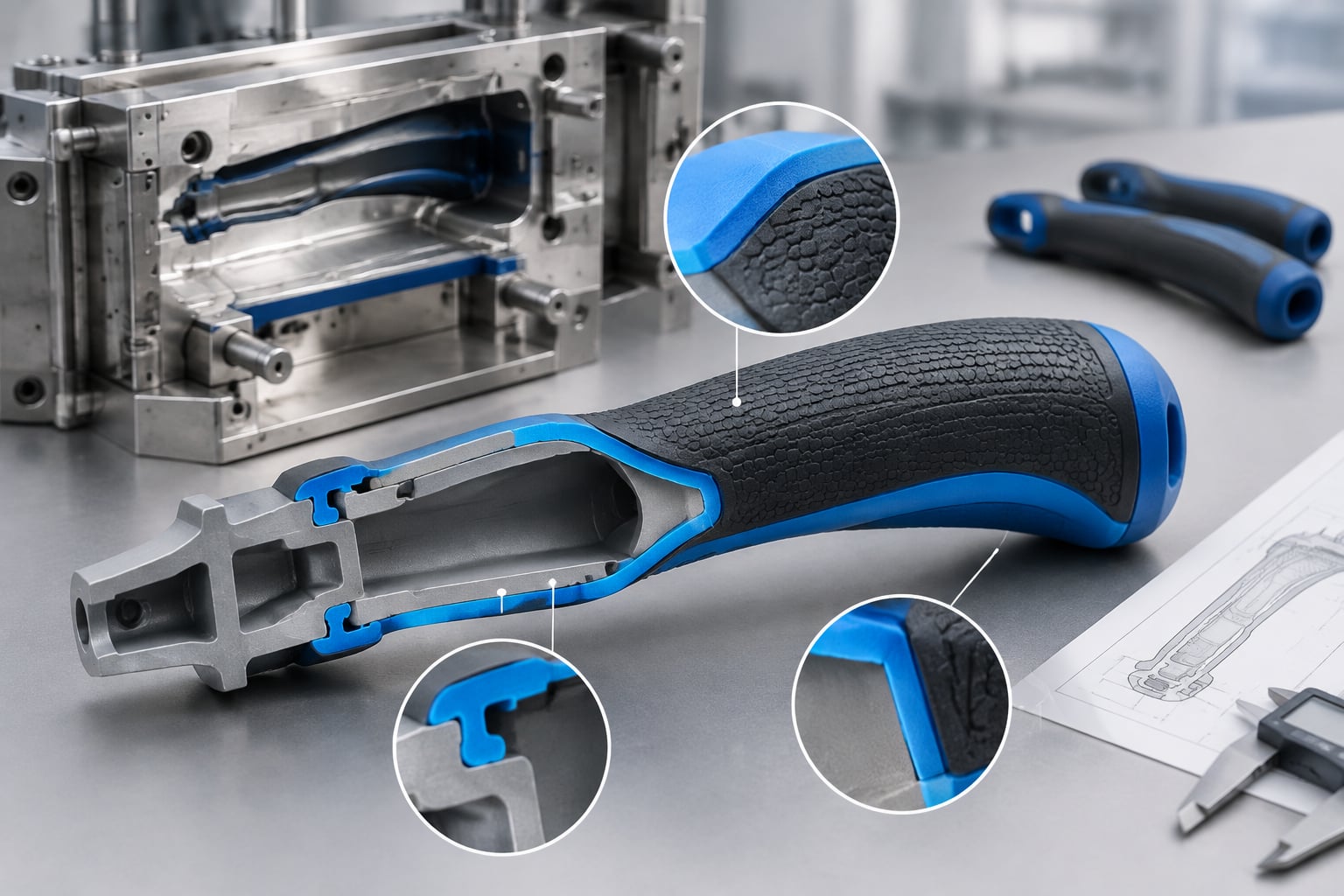
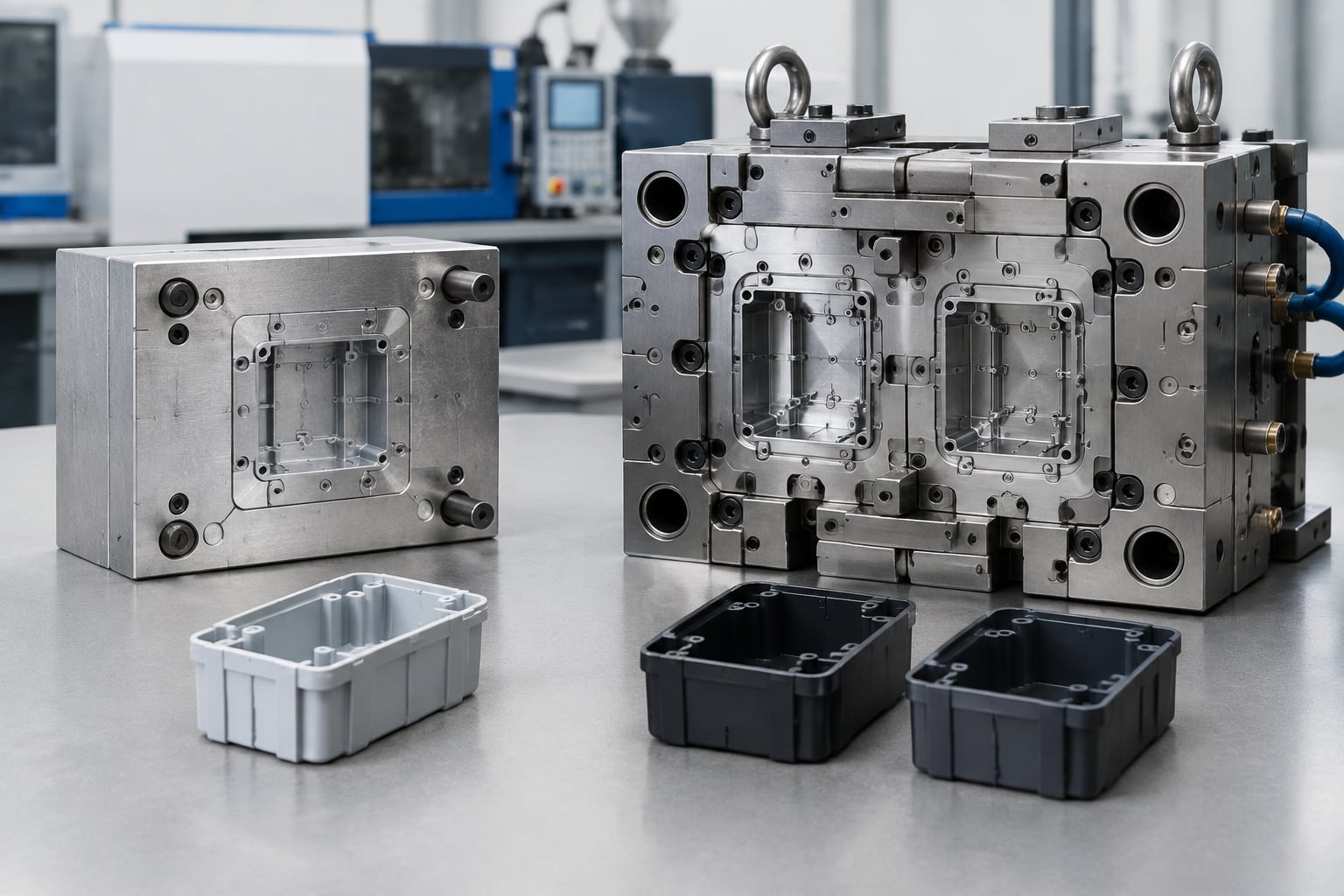
Mold ConfigurationBest UseTypical StrengthKey Review RequirementSingle-cavity moldLarge parts, prototypes, low-volume production, and high-value components.Lower initial tooling cost and simpler process control.Confirm whether output rate meets launch demand.Multi-cavity moldMedium and high-volume identical components.Higher output per cycle and lower part cost at scale.Verify cavity balance, runner balance, and inspection strategy.Family moldRelated components assembled in matched sets at low volume.Can reduce initial tooling investment.Review differing fill rates, cycle times, and scrap implications.Two-plate moldStandard cold-runner applications.Simple, durable, and widely supported globally.Assess runner waste and gate location.Three-plate moldParts requiring automatic point gating away from the parting line.Allows flexible gate placement and automatic degating.Confirm added complexity is justified by part requirements.Hot-runner moldHigher-volume production, engineering plastics, and reduced runner waste.Improves material efficiency and can shorten cycle time.Specify hot-runner brand, controller compatibility, and maintenance access.Insert moldMetal threads, contacts, reinforcement pieces, and electrical components.Creates secure integrated assemblies.Define insert tolerances, loading method, and retention testing.Overmold toolSoft grips, seals, protective surfaces, and multi-material products.Improves ergonomics and reduces assembly operations.Verify material bonding, substrate condition, and gate sequencing.This configuration comparison helps buyers avoid selecting cavity count based only on a desired part price. More cavities may reduce unit cost, but they increase mold complexity, maintenance requirements, machine tonnage, hot-runner investment, validation effort, and risk exposure. If market demand is uncertain, a lower-cavity rapid production tool can provide a more flexible commercial path.
Mold steel should be selected according to production volume, resin type, surface finish, corrosion risk, required hardness, maintenance plan, and shipment environment. Pre-hardened steel may be appropriate for many medium-volume tools, while hardened tool steels are commonly used for demanding, abrasive, or high-volume applications. Stainless steels may be necessary for corrosive resins, humid processing conditions, medical requirements, or polished surfaces requiring corrosion resistance.
Buyers should ask the toolmaker to identify the mold base material, cavity and core steel, slider and lifter materials, guide components, springs, ejector components, wear plates, coatings, and hot-runner system. For globally deployed tools, standard components can simplify replacement and maintenance. The final documentation should state what spare components are supplied and which parts should be stocked at the molding site.
A mold should not be accepted merely because it produces a part. The trial must demonstrate that the part can be molded consistently at an agreed process window. This is especially important for medical housings, electrical enclosures, automotive parts, safety-related components, threaded assemblies, sealing interfaces, and components with strict cosmetic requirements.
Validation StageMain PurposeRequired EvidenceBuyer DecisionDesign for manufacturability reviewIdentify risks before steel cutting.Annotated CAD, change list, resin assumptions, and tooling proposal.Approve design changes and freeze the manufacturing model.Mold design reviewConfirm mold layout and function.2D/3D mold layout, gate plan, cooling plan, ejection concept, and steel list.Approve the tool architecture before manufacturing.First trialVerify initial filling, ejection, and major mold operation.Sample parts, process settings, photos, defect observations, and trial report.Authorize modifications and define next trial priorities.Dimensional inspectionConfirm critical dimensions and assembly interfaces.Inspection report, CMM data where required, gauges, and measurement conditions.Accept, adjust tolerances, or revise tool geometry.Functional assembly testVerify fit with mating components.Assembly samples, torque data, leak test, snap-fit results, or electrical checks.Approve function or request engineering correction.Cosmetic reviewAssess surface quality under defined conditions.Approved limit samples, lighting conditions, texture comparison, and defect criteria.Define acceptable appearance and rework limits.Production capability runShow stable output over an extended run.Cycle time record, reject rate, cavity comparison, process window, and maintenance notes.Approve production release or require corrective action.Final acceptance and shipmentTransfer an operating, documented tool.Mold test video, packing list, spare parts, maintenance guide, and ownership record.Release final payment and arrange shipment or production.The validation table should be adapted to the project risk level. A simple storage tray may only need visual inspection, fit verification, and a practical production run. A medical device enclosure may need tighter documentation, resin traceability, detailed inspection reports, controlled surface requirements, and functional testing after sterilization or chemical exposure. A mold intended for automotive supply may require cavity identification, process discipline, capability studies, and formal change control.
Buyers should begin with a clear request-for-quotation package. At minimum, provide a native CAD file or neutral 3D file, 2D drawings where critical dimensions exist, annual volume forecast, resin grade, color, surface requirements, assembly requirements, expected machine location, target delivery date, and expected mold life. If the mold will be transferred to another country, specify the machine platen size, tie-bar spacing, nozzle radius, locating ring, ejector connection, water fittings, voltage, and hot-runner controller requirements.
Do not compare quotations only by total mold price. Compare cavity number, steel choice, mold base, runner system, expected cycle time, included trials, sample quantity, inspection level, shipping method, spare parts, engineering change policy, warranty, and post-delivery support. A quote that omits these items may create avoidable cost later.
For uncertain demand, consider phased investment. An aluminum rapid tool or lower-cavity steel tool may validate the market before a larger multi-cavity production tool is commissioned. This approach is often useful for startups, industrial design firms, medical-device developers, consumer-product brands, and companies launching new products through distributors or online retail channels.
Shipping logistics also need early planning. Molds are heavy precision assets and should be protected against moisture, corrosion, and transport damage. Confirm export crating, rust prevention, mold locking, lifting points, customs documentation, and whether the tool will be shipped by air, sea, rail, or truck. For projects moving through ports such as Shenzhen, Ningbo, Shanghai, Rotterdam, Long Beach, or Jebel Ali, packaging and handling details can affect both cost and delivery reliability.
Injection molding supports a wide range of products because it combines repeatable geometry, material versatility, high output potential, and compatibility with inserts, overmolding, textures, and automated assembly. The mold design checklist should be customized to the end-use environment.
Applications may also combine multiple manufacturing processes. A plastic enclosure can require CNC-machined inserts, molded bosses, ultrasonic welding, painting, printing, screws, foam, labels, final assembly, kitting, and retail packaging. Selecting a manufacturing partner capable of coordinating these steps can reduce handoffs and shorten the launch schedule.
A global consumer-product brand developed a handheld device housing with a high-gloss front surface, internal snap fits, screw bosses, and a painted logo area. The initial CAD included insufficient draft near the sidewalls and thick bosses behind a visible surface. During the engineering review, the mold maker recommended increasing draft, coring the bosses, adjusting rib thickness, moving the gate to a less visible location, and defining acceptable parting-line placement. The resulting tool produced lower sink risk, cleaner ejection, and fewer cosmetic adjustments during pilot production.
An industrial equipment developer needed 500 enclosures for field testing before committing to a large production run. Instead of investing immediately in a high-cavity hardened mold, the team selected a rapid tooling route with a practical cavity layout, production-grade resin, and inspection of critical mounting features. The low-volume run allowed the customer to validate installation, cable routing, gasket compression, and user access. After field feedback, the final production mold incorporated design improvements without requiring major changes to a large initial tool.
An electrical product required metal threaded inserts and conductive contacts to be molded into a compact plastic carrier. The pre-build review focused on insert tolerance, loading orientation, resin temperature, contact protection, retention force, and automated versus manual insertion. The mold design included support features to prevent insert movement during injection and ejection. Functional testing confirmed thread integrity and electrical alignment before the tool was released for recurring production.
The supplier landscape includes machine builders, mold makers, contract molders, rapid tooling specialists, and full-service manufacturing partners. The companies below are real organizations with international relevance. Buyers should still evaluate each supplier against their specific resin, component size, regulatory, production-volume, and logistics requirements.
CompanyService RegionsCore StrengthsKey OfferingsTEAM RapidChina, USA, UK, France, Germany, and customers in more than 25 countries.Rapid manufacturing integration, DFM support, rapid tooling, low-volume molding, and flexible production.Injection molding, rapid tooling, CNC machining, 3D printing, vacuum casting, finishing, assembly, packaging, and direct shipping.Husky TechnologiesGlobal operations serving packaging, medical, closure, and beverage producers.High-output injection molding systems and integrated production technology.Injection molding machines, hot runners, molds, controllers, and service for packaging applications.ENGELEurope, North America, Asia, and global industrial manufacturing markets.Injection molding equipment, automation, process technology, and digital production systems.Injection molding machines, robots, turnkey cells, process optimization, and automation solutions.ArburgGlobal network with strong European, North American, and Asian market presence.Precision molding technology and flexible production systems.Injection molding machines, automation, digital production support, and additive manufacturing systems.Rosti GroupEurope, Asia, and North America through international manufacturing operations.Contract manufacturing, injection molding, assembly, and supply-chain support.Plastic injection molding, medical and consumer manufacturing, assembly, and product industrialization.Nypro, a Jabil CompanyGlobal manufacturing locations serving healthcare and consumer markets.Complex healthcare manufacturing, engineering, and scalable production.Injection molding, precision components, medical manufacturing, automation, and assembly.FictivGlobal digital manufacturing network serving product development teams.Digital sourcing, prototyping, manufacturing coordination, and speed.Injection molding, CNC machining, 3D printing, urethane casting, and quality management support.This supplier comparison is intended to help buyers understand market positioning. Machine manufacturers such as ENGEL and Arburg are typically selected by companies operating molding facilities. Contract manufacturers such as Rosti Group and Nypro may support larger production programs with assembly requirements. Rapid manufacturing partners such as TEAM Rapid can be especially useful when a project needs fast design feedback, low-volume validation, tooling, machining, finishing, and flexible transition into production.
TEAM Rapid supports international product developers, engineers, startups, brand owners, distributors, OEM customers, and established manufacturers with rapid tooling, injection molding, insert molding, overmolding, CNC machining, 3D printing, vacuum casting, die casting, sheet metal fabrication, finishing, assembly, packaging, and direct shipping. Its ISO 9001:2015 quality management certification, more than 10 years of industry experience, more than 500 customers, more than 6,000 delivered projects, and service record across more than 25 countries provide practical evidence of its ability to manage prototype-to-production programs. The company does not promote a fixed captive list of branded mold components; instead, it specifies suitable mold bases, steels, resins, inserts, and production components according to the project requirements, while applying DFM analysis, inspection practices, machining tolerances down to 0.01 mm where applicable, and documented manufacturability reviews. TEAM Rapid supports OEM, ODM, wholesale, retail, regional distribution, and direct end-user projects with flexible order quantities from one prototype to more than 100,000 parts. Its delivery model includes turnkey and customer-owned tooling solutions, rather than BOO or on-site bulk supply services. While the company profile does not claim overseas subsidiaries or local warehouses, TEAM Rapid has established experience serving customers in the USA, UK, France, Germany, China, and other international markets through responsive online engineering communication, direct shipping, project coordination, packaging support, and after-sales follow-up. Customers can request a detailed rapid tooling service consultation for tooling strategy or submit part files through the global manufacturing quotation form for DFM feedback and pricing.
Injection mold design in 2026 will increasingly be shaped by faster development cycles, sustainability requirements, digital traceability, automation, and regional supply-chain resilience. Tooling teams will need to optimize not only part geometry but also energy use, resin selection, scrap reduction, data capture, and maintenance predictability.
Engineering teams are increasingly using AI-supported design analysis to identify draft problems, inconsistent wall thickness, possible undercuts, unsupported bosses, and likely warpage areas earlier in the design cycle. These tools do not replace experienced mold engineers, but they can speed up issue detection and help global teams review more design iterations before manufacturing begins.
Brands are under pressure to increase recycled content and reduce virgin plastic consumption. However, recycled resin can have wider property variation, altered flow behavior, contamination risk, color variability, and different shrinkage characteristics. Mold design reviews will need to address material consistency, gate size, venting, processing windows, and cosmetic acceptance criteria when recycled or bio-based polymers are specified.
Conformal cooling inserts manufactured through metal additive processes can follow complex cavity shapes more closely than traditional drilled channels. For suitable parts, this can improve cooling uniformity, reduce cycle time, and lower warpage. The technology is most valuable when the expected savings justify the added insert cost and when maintenance planning is considered.
Manufacturers increasingly track machine energy consumption, resin yield, runner waste, reject rate, and transport emissions. Hot-runner systems, optimized cooling, shorter cycles, reduced regrind dependence, and better cavity balance can contribute to lower resource use. Buyers should begin asking suppliers for practical process data rather than relying only on general sustainability claims.
Pressure sensors, cavity monitoring, cycle counters, cooling-flow monitoring, and digital maintenance records can improve production consistency. Predictive maintenance is especially useful for molds operating across multiple sites because it helps teams identify wear, blocked cooling channels, and process drift before a major production interruption occurs.
There is no single item that overrides all others, but wall thickness, draft, material selection, gate location, cooling, ejection, and tolerance requirements are usually the highest-impact areas. These factors strongly influence fill behavior, shrinkage, cycle time, part release, cosmetics, and long-term consistency.
DFM should be completed before steel is cut and ideally before the final product design is frozen. Early review allows changes to be made in CAD, where they are faster and less expensive than modifying a completed mold.
The required draft depends on resin, part depth, texture, surface finish, mold polish, and ejection direction. Smooth surfaces may need less draft than textured surfaces, while deep parts and highly textured exterior surfaces often need more. The mold maker should confirm draft recommendations during DFM.
A hot runner can reduce runner waste and support higher-volume production, but it adds initial cost, complexity, maintenance needs, and controller requirements. A cold runner may be more practical for low-volume parts, simpler tools, or projects where material changes are frequent. The right choice depends on annual volume, resin cost, part geometry, and production strategy.
A family mold can produce related parts in one cycle, but it should be used carefully. Parts with different sizes, wall thicknesses, fill behavior, or cooling requirements can create imbalance and higher scrap. Family molds are often most suitable for lower-volume matched sets rather than long-term high-output programs.
Request final mold drawings, steel and component information, trial reports, process settings, sample inspection data, spare-part list, maintenance instructions, mold photographs, shipping records, and clear ownership documentation. If the mold will be transferred internationally, also confirm water, electrical, controller, and machine-interface specifications.
Optimize wall thickness, reduce unnecessary material volume, use appropriate cavity count, improve cooling, minimize secondary operations, select the right resin, avoid overly tight non-functional tolerances, and approve DFM changes before tooling begins. Cost reduction is most effective when it improves manufacturability rather than simply lowering tool specifications.
Injection mold life is the number of molding cycles a tool can complete while producing parts within agreed dimensional, cosmetic, and functional requirements. In the global market, a well-designed and properly maintained mold may produce anything from a few thousand prototype parts to several million production parts. The correct expectation depends on the mold material, resin, part geometry, tooling quality, maintenance plan, production conditions, and required surface finish.
Most aluminum injection molds provide approximately 5,000 to 100,000 cycles, while production molds made from suitable pre-hardened or hardened tool steel commonly deliver 100,000 to more than 1,000,000 cycles. High-volume molds using hardened steel, replaceable wear components, balanced cooling, and disciplined maintenance can exceed several million cycles.
For prototypes and market testing, a short-run mold may be the most economical option. For recurring commercial production, steel selection, cavity design, cooling efficiency, ejection loads, resin abrasiveness, and preventive maintenance have a greater effect on total cost than the original mold price alone. A mold that costs more initially can produce a lower cost per part over its useful life.
When comparing suppliers in the global market, consider qualified international manufacturers, including experienced Chinese companies, when they provide relevant certifications, documented inspection, clear engineering communication, and strong pre-sales and after-sales support. Their cost-performance advantages can be significant without requiring a compromise in tooling control.
For a practical decision, identify the expected lifetime volume, annual production, resin type, dimensional tolerance, cosmetic requirements, and planned product life before requesting a quotation. A professional toolmaker should then recommend the appropriate mold base, steel grade, surface treatment, cavity count, cooling arrangement, and maintenance interval.
Tool life should not be confused with the number of times a mold can physically close. A mold may continue operating after its expected cycle count, but the resulting parts may show flash, dimensional drift, short shots, sink marks, scratches, poor texture transfer, or inconsistent ejection. The useful life of an injection mold ends when it can no longer produce acceptable parts economically and repeatably.
Manufacturers usually describe mold life in cycles. One cycle includes mold closing, injection, packing, cooling, mold opening, and part ejection. In a four-cavity mold, one cycle produces four parts, so the part output is four times the number of completed cycles, excluding rejects. This distinction is important when estimating capacity and return on tooling investment.
Several life definitions may appear in a tooling quotation:
A reliable quotation should state what is included in the life estimate. The same steel can deliver very different results when used with different resins, injection pressures, cycle times, mold temperatures, or maintenance practices.
Tooling material is one of the most visible factors affecting service life, but it is not the only one. Aluminum can be highly effective for low-volume production because it machines quickly and transfers heat efficiently. Hardened tool steel generally costs more and takes longer to manufacture, but it provides greater resistance to wear, corrosion, deformation, and repeated thermal cycling.
Typical mold life ranges by tooling materialTooling materialTypical cycle rangeCommon applicationMain advantageMain limitationRecommended production profilePrototype aluminum5,000–20,000 cyclesDesign validation and pilot runsFast machining and low initial costLower wear resistancePrototype and short-run productionProduction aluminum20,000–100,000 cyclesLow-volume commercial partsEfficient cooling and rapid deliveryMay wear under abrasive resinRecurring low-volume ordersPre-hardened P20 steel100,000–500,000 cyclesGeneral production toolingBalanced cost, machinability, and strengthLess wear resistance than hardened steelMedium-volume production420 or 2083 stainless steel200,000–1,000,000 cyclesMedical, optical, and corrosive-resin partsCorrosion resistance and good polishabilityHigher material and machining costClean environments and demanding finishesH13 or 1.2344 hardened steel500,000–2,000,000 cyclesHigh-volume technical componentsStrong wear and thermal-fatigue resistanceMore difficult and expensive to machineLong production programsS136 or equivalent hardened stainless steel500,000–2,000,000 cyclesHigh-polish and corrosive applicationsExcellent finish and corrosion performanceRequires controlled heat treatment and polishingCosmetic and precision partsCarburized or specialty tool steel1,000,000+ cyclesAutomotive and high-volume consumer productsVery high wear resistanceHighest tooling investmentLarge-volume and long-life programsThese ranges are planning estimates rather than universal guarantees. A mold with a simple geometry, moderate pressure, non-abrasive resin, and robust cooling can exceed the lower end of its expected range. A complex mold with thin walls, multiple slides, high glass-fiber content, aggressive surface texture, or frequent color changes may require repair much earlier.
Steel quality affects hardness, toughness, polishability, corrosion resistance, and dimensional stability. A mold that is too soft may wear rapidly around gates, shutoffs, slides, and parting lines. A mold that is excessively hard but poorly heat-treated may become brittle and crack under impact or thermal stress. The correct balance depends on the resin, mold design, cavity pressure, surface finish, and maintenance environment.
Unfilled polypropylene and polyethylene are usually less abrasive than glass-filled nylon, mineral-filled polycarbonate, flame-retardant compounds, or long-glass-fiber engineering plastics. Glass fibers and mineral fillers can erode gates, runners, cores, cavities, and ejector components. Corrosive additives can attack mold surfaces, particularly when the tool is not dried and protected after production.
Deep ribs, narrow cores, thin walls, undercuts, lifters, collapsible cores, and side actions increase mechanical and thermal loads. Sharp internal corners concentrate stress. Thin shutoffs can deform or chip. Small venting features can become blocked, causing gas burns and higher injection pressure. A design that is optimized for molding generally produces a longer-lived tool than one that forces the mold to compensate for difficult geometry.
Uneven cooling causes warpage, extended cycle times, thermal stress, and inconsistent shrinkage. Poorly positioned cooling channels can leave hot spots near thick sections or core pins. Over time, repeated thermal cycling can contribute to cracking, corrosion, and dimensional movement. Conformal cooling, baffles, bubblers, and carefully balanced conventional channels can improve productivity and reduce stress when applied appropriately.
Excessive pressure increases stress on parting lines, slides, inserts, sprue bushings, and mold bases. Insufficient venting often causes operators to raise pressure, which can accelerate wear and flash. Correct filling analysis, gate selection, vent design, and process validation reduce the need to run the machine at unnecessarily aggressive settings.
Preventive maintenance is one of the most cost-effective ways to extend tool life. Cleaning, lubrication, inspection of guide components, checking cooling channels, sharpening or replacing damaged components, and protecting polished surfaces can prevent small defects from becoming major repairs. A mold used every week requires a different maintenance frequency from a tool stored for months between production campaigns.
Incorrect mold opening speed, excessive ejector force, poor purging, improper clamping, and foreign particles on the parting line can damage a tool quickly. Stable process parameters reduce thermal and mechanical shocks. Operators should also follow documented procedures for mold installation, water connection, startup, shutdown, cleaning, and storage.
Different product categories place different demands on an injection mold. A simple tray may require only a two-plate mold with a basic edge gate. A medical housing may need stainless steel, mirror polishing, controlled venting, validated dimensional inspection, and strict contamination controls. A large automotive panel may require multiple hot runners, complex slides, high clamping force, and careful thermal balancing.
The product’s commercial life should guide the tooling strategy. If a product is expected to sell for three months, investing in a two-million-cycle mold may not be economical. If the product supports a ten-year aftermarket program, a low-cost prototype mold can create severe supply and quality risks later.
Start with the expected lifetime quantity, then add a practical allowance for rejects, engineering samples, maintenance trials, and future demand. The basic calculation is:
Required cycles = lifetime parts ÷ number of cavities ÷ expected utilization rate
For example, a four-cavity mold intended to produce 800,000 saleable parts with an estimated 92 percent utilization rate would need approximately 217,400 cycles. A P20 steel mold could be suitable in some conditions, but a corrosion-resistant or hardened insert may be more appropriate if the resin is abrasive or the product must remain in production for many years.
Also consider:
Ask the toolmaker to separate the expected life of the mold base, cavities, cores, slides, hot-runner system, cooling fittings, ejector system, and replaceable wear parts. These components rarely have identical service lives.
The global supply market includes specialist mold makers, digital manufacturing platforms, component suppliers, and integrated manufacturing partners. The best choice depends on whether the project requires rapid tooling, high-volume automotive molds, medical tooling, local production support, or a complete transition from prototype to finished parts.
Selected injection mold suppliers and their practical strengthsCompanyService regionsCore strengthsKey offeringsBest fitBuying considerationTEAM RapidChina, North America, Europe, Asia, and international export marketsFast engineering support, integrated tooling, and flexible productionRapid tooling, injection molding, CNC machining, 3D printing, finishing, assembly, and packagingPrototype-to-production programs from one part to 100,000+ partsRequest a DFM review and confirm steel, cycle target, inspection, and maintenance scopeProtolabsNorth America, Europe, and JapanDigital quoting, rapid manufacturing, and standardized workflowsInjection molding, CNC machining, 3D printing, and design analysisFast product development and repeatable low-volume ordersCheck material, texture, tolerance, and mold ownership termsXcentric Mold & EngineeringUnited States and international customersRapid injection molding and engineering-led toolingProduction injection molding, rapid tooling, CNC machining, and finishingU.S.-based development programs and bridge productionConfirm expected cycle life and production location before approvalFictivUnited States and international supply networksDigital sourcing, supplier coordination, and project visibilityInjection molding, CNC machining, sheet metal, and additive manufacturingCompanies needing managed multi-process sourcingClarify the assigned manufacturing partner and quality documentationStackTeckCanada, United States, Europe, and global automotive marketsHigh-cavitation and complex production toolingAutomotive molds, thin-wall packaging tools, hot-runner integration, and automationHigh-volume and technically complex programsBest suited to substantial production volumes and formal engineering reviewsTooling Tech GroupUnited States, Europe, and global automotive supply chainsLarge molds, automotive tooling, and program managementInjection molds, compression molds, tooling systems, and production supportAutomotive and industrial programs requiring large-scale toolingReview project timing, maintenance responsibility, and spare-component strategyRosti GroupEurope, Asia, and North AmericaIntegrated plastic manufacturing and contract productionTooling, injection molding, assembly, and supply-chain servicesBrand owners seeking regional manufacturing supportCompare plant location, resin approval, production capacity, and logistics costSupplier location should not be judged only by distance. A nearby supplier may offer convenient communication but higher tooling cost or limited process coverage. An international supplier may offer stronger price performance and broader capacity, provided it supplies traceable materials, inspection records, mold trials, spare-part plans, and responsive technical support.
Design for manufacturability analysis should identify uniform wall thickness, draft angles, parting-line options, gate location, venting, ejection, undercuts, cooling, shrinkage, and likely cosmetic risks. This review is especially valuable before steel is cut because many tool-life problems begin with a design that creates excessive pressure, difficult ejection, or fragile shutoffs.
Do not accept an undefined description such as “premium steel.” Request the actual grade, hardness range, heat-treatment method, corrosion protection, and location of hardened inserts. For a high-volume tool, ask whether the steel certificate and hardness report will be provided with the final documentation.
The contract should state who owns the mold, where it will be stored, whether it can be transferred, and who pays for refurbishment. If production may move from Asia to Europe or North America, the tool should be designed for transport, reinstallation, spare-part availability, and local machine compatibility.
Acceptance should cover first-shot samples, dimensional reports, appearance, cycle time, cavity balance, part weight, mold operation, and the quantity of approved samples. A mold can appear complete while still requiring major work on flash, filling balance, ejector marks, or cooling performance.
Critical spares may include ejector pins, return pins, springs, cavity inserts, core inserts, slide wear plates, seals, nozzles, gate components, and hot-runner heaters. Keeping these items available can reduce downtime and protect the production schedule.
Ask for a preventive maintenance schedule based on cycles, not only calendar time. The plan should identify daily, weekly, monthly, and annual checks. For abrasive or corrosive materials, inspection intervals should be shorter and wear components should be monitored more closely.
Good maintenance is a controlled production activity rather than an emergency repair response. After each run, remove resin residue, clean the parting line, dry water circuits when appropriate, protect polished surfaces, and record any abnormal noise, ejection resistance, flash, or dimensional shift. Never close and store a wet mold without corrosion protection.
Recommended maintenance actions for injection moldsMaintenance areaActionSuggested timingRisk reducedResponsible roleRecord to retainParting lineRemove flash, resin, dust, and foreign particlesEvery production runFlash and shutoff damageMachine operatorCleaning checklistEjector systemInspect pins, sleeves, return movement, and lubricationEvery run or defined cycle intervalSticking, bending, and pin breakageTooling technicianCycle-based service logCooling circuitsCheck flow, leaks, scale, fittings, and water qualityWeekly to monthlyHot spots, corrosion, and long cyclesProcess technicianFlow and temperature recordSlides and liftersInspect wear plates, lubrication, alignment, and movementDefined cycle intervalGalling, flash, and misalignmentTooling technicianInspection reportVentsClean and restore blocked vent featuresAs needed and during preventive serviceBurn marks, short shots, and high pressureMold technicianRepair historyPolished and textured surfacesClean with approved materials and protect from impactEvery runScratches, stains, and texture variationOperator and technicianCosmetic approval recordStorage protectionApply rust preventive, seal ports, and control storage conditionsBefore storageCorrosion and contaminationTooling departmentStorage release formWhen mold repairs are necessary, identify the underlying cause. Replacing a worn ejector pin without correcting excessive ejection force or insufficient draft may only postpone another failure. Similarly, polishing flash from a parting line without checking alignment can reduce shutoff thickness and shorten the remaining mold life.
Injection molds support products across automotive, medical, consumer, industrial, electrical, telecommunications, sanitary, and office-equipment sectors. The required mold life varies by industry because production volumes, regulatory requirements, product liability, and appearance standards are different.
Applications are not limited to finished plastic parts. Injection molding is also used for insert molding, overmolding, two-shot components, elastomer integration, and assemblies that combine metal and plastic. These processes may increase the number of loading operations and require additional mold alignment features.
A startup developing a handheld electronic product may need 5,000 to 15,000 parts for fit testing, user trials, and early sales. A machined aluminum mold can reduce lead time and make design revisions affordable. If the enclosure design is not yet frozen, investing in a hardened production mold may create unnecessary sunk cost. The mold should still include appropriate draft, venting, replaceable inserts, and a documented repair path.
An industrial equipment manufacturer may require 250,000 parts over several years. A P20 or equivalent pre-hardened steel mold may be suitable when the resin is not highly abrasive and the part geometry is moderate. Hardened inserts should be considered around gates, shutoffs, slides, and high-wear areas. Cycle records and periodic dimensional checks can confirm whether the tool is aging normally.
An automotive supplier may need several million components over the vehicle program and replacement-parts period. The tool may require hardened steel, hot-runner balancing, robust slides, automated handling, replaceable wear plates, and a formal maintenance schedule. The lowest initial quotation is rarely the lowest total-cost option in this situation.
A medical device housing may require stainless steel for corrosion resistance, high polish, controlled molding conditions, and detailed inspection records. Even when the lifetime volume is moderate, the required quality level may justify a more durable tool. Surface condition, cleanliness, traceability, and process validation can be more important than maximum cycle count.
TEAM Rapid combines rapid tooling, injection molding, CNC machining, 3D printing, finishing, assembly, packaging, and shipping support through an integrated manufacturing network in China. Its ISO 9001:2015 quality system, more than ten years of manufacturing experience, work for customers in over 25 countries, more than 500 satisfied customers, and record of over 6,000 delivered projects provide useful evidence for international tooling programs. The company uses DFM reports and manufacturability analysis to identify risks before steel cutting, including parting-line problems, difficult ejection, inefficient cooling, excessive resin use, and cycle-time opportunities. Customers can use flexible OEM and ODM-style cooperation for prototypes, low-volume production, recurring orders, or larger programs, while end users, distributors, dealers, brand owners, and individual product developers can request project-specific sourcing and production arrangements rather than a fixed one-size-fits-all package. Its capabilities cover projects from one prototype to more than 100,000 parts, with rapid tooling and molded parts commonly supported in approximately 5 to 25 days depending on requirements. TEAM Rapid does not present itself as a BOO or on-site bulk-supply operator; it provides EPC/Turnkey and customer-owned plant support models when required, including tooling, process coordination, procurement, assembly, packaging, limited warehousing, and direct shipping. The profile does not claim overseas subsidiaries or permanent local warehouses, so buyers should confirm regional stock and service arrangements for each project; however, the company supports international customers through responsive online engineering communication, pre-sales DFM review, inspection documentation, after-sales technical coordination, and experience working across Asian and Western business cultures. This combination makes it a practical option for customers comparing Chinese manufacturing against suppliers in the United States, Canada, Europe, or other global production hubs.
For tooling evaluation, customers can review TEAM Rapid’s rapid tooling services for global projects and submit technical files through the international manufacturing quotation page. A useful request should include the 3D model, 2D drawings, resin grade, expected volume, surface finish, tolerance, target cycle life, delivery location, and whether the mold will be customer-owned and transferred later.
Tooling cost should be measured against total cost per acceptable part, not only the purchase price. A low-cost aluminum mold may be ideal for a short product launch, while a hardened steel mold may be more economical for sustained demand. The calculation should include mold price, maintenance, repairs, downtime, scrap, machine time, part price, logistics, and the cost of replacing a failed tool.
Cavity count also affects economics. A single-cavity mold has a lower initial cost and is easier to modify, but it requires more cycles to meet the same volume. A multi-cavity mold increases upfront investment and requires careful cavity balancing, but it can lower machine time and part cost. The right choice depends on demand certainty, available machine capacity, part size, quality requirements, and expected product life.
Hot runners may reduce runner waste and improve cycle efficiency, but they add components that need maintenance and may be more expensive to repair. Cold runners can be simpler and more economical for some applications. The decision should be based on resin value, cavity count, part geometry, color changes, cycle targets, and service capability.
Several developments are shaping tooling decisions in 2026 and beyond.
Sustainability does not always mean choosing the cheapest or lightest mold. A durable tool that avoids repeated replacement, produces less scrap, and supports efficient cycle times can have a lower environmental impact over the complete product life.
An aluminum mold commonly lasts from approximately 5,000 to 100,000 cycles. The actual result depends on the aluminum grade, part complexity, resin abrasiveness, injection pressure, cooling design, and maintenance. Aluminum is often suitable for prototypes and low-volume production rather than very large lifetime quantities.
Yes. A properly designed and maintained steel mold can reach one million cycles or more. Hardened steel, suitable wear inserts, stable processing, effective cooling, and disciplined maintenance are usually required, especially for abrasive engineering resins or complex mechanisms.
Glass-filled nylon can reduce mold life because the fibers are abrasive. Gates, runners, cavities, cores, slides, and ejector components may wear faster. Hardened inserts, abrasion-resistant treatments, robust gate design, and shorter inspection intervals can reduce the impact.
Toolmakers normally measure life in cycles, but buyers should convert cycles into parts using the cavity count. A four-cavity mold producing 250,000 cycles can theoretically make one million parts before considering rejects, downtime, and maintenance.
There is no single task for every mold. Cleaning the parting line, lubricating moving components correctly, monitoring cooling circuits, inspecting ejection, and protecting the mold during storage are all essential. The maintenance plan should reflect resin type, production frequency, and mold complexity.
Choose aluminum when the design is still changing or the expected volume is limited. Choose steel when demand is substantial, the product will remain active for years, the resin is abrasive, or dimensional and cosmetic consistency are critical. A DFM and volume review can prevent over- or under-specifying the tool.
Often, yes. Inserts, slides, ejector components, guide systems, and hot-runner parts can be repaired or replaced. However, repair economics depend on the remaining condition of the mold base, cavity alignment, part design, steel availability, and the cost of downtime.
Compare the complete offer rather than the mold price alone. Review engineering support, steel documentation, trial samples, inspection capability, guaranteed life, spare parts, maintenance, shipping, communication, ownership terms, and after-sales response. A qualified international supplier with transparent controls may provide stronger value than a nearby supplier with limited technical scope.
Provide the 3D model, 2D drawings, resin and color, annual and lifetime volume, cavity preference, tolerance, surface finish, target cycle time, machine information, delivery destination, and required certifications. Also state whether you need only the mold or a turnkey package including molded parts, assembly, packaging, and shipping.
Injection mold life is best treated as a design and supply-chain decision rather than a simple steel specification. A short-run aluminum mold can be the most efficient choice for a new product, while a hardened steel tool with replaceable wear components is more appropriate for high-volume or long-term programs. The strongest results come from combining accurate demand planning, DFM analysis, suitable materials, balanced cooling, stable processing, preventive maintenance, and clear ownership terms.
For global buyers, evaluate both local and international suppliers. Review proven project experience, quality systems, engineering response, inspection records, production capacity, logistics support, and long-term maintenance capability. With the right specifications and an evidence-based life estimate, businesses can reduce downtime, control cost per part, and keep injection molding reliable throughout the product’s commercial life.
Aluminum injection molds are usually the better choice when speed, lower upfront tooling cost, frequent design changes, and low-to-medium production volumes matter most. Steel injection molds are the stronger option for long production runs, abrasive or high-temperature resins, tight repeatability requirements, complex multi-cavity tooling, and parts that must maintain consistent quality over hundreds of thousands or millions of cycles.
For most Global market buyers, select aluminum tooling for prototype validation, bridge production, market testing, and roughly 500 to 50,000 parts. Select steel tooling for stable products with higher annual demand, demanding engineering plastics, high cosmetic requirements, or production programs expected to exceed 100,000 parts. The best decision is not based on mold material alone: resin, part geometry, cavity count, cooling design, expected annual volume, tolerance, and maintenance planning all affect the total cost.
Leading suppliers commonly considered by international buyers include TEAM Rapid in China, Proto Labs in the United States and Europe, Xometry in North America and Europe, Fictiv in the United States, and FOW Mould in China. Qualified international suppliers, including Chinese mold makers with ISO-based quality systems, clear DFM communication, reliable pre-sales and after-sales support, and export experience, can offer compelling cost-performance advantages for Global market programs.
Injection mold sourcing is now a global engineering and logistics decision rather than a purely local purchasing exercise. Product teams in New York, London, Berlin, Singapore, Dubai, Melbourne, Toronto, São Paulo, and Johannesburg routinely source molds and molded parts from a mix of domestic suppliers, regional toolrooms, and experienced Chinese manufacturers. Major trade corridors through Shenzhen, Hong Kong, Shanghai, Ningbo, Rotterdam, Hamburg, Los Angeles, Long Beach, Singapore, and Jebel Ali support the movement of tooling, resin, components, and finished parts.
In this environment, aluminum versus steel injection molds is one of the earliest and most consequential choices in a product launch. It influences capital expenditure, project lead time, design flexibility, production output, part consistency, maintenance expectations, and the timing of a future tooling transfer. A low-cost mold can become expensive if it produces unstable parts, cycles slowly, requires repeated repair, or cannot accommodate a planned increase in demand. Conversely, an expensive hardened steel mold can lock capital into a product that is still changing or has not yet established commercial demand.
Aluminum molds are not simply “prototype molds,” and steel molds are not automatically “production molds.” Modern aluminum tooling can produce high-quality end-use parts when the tool is engineered correctly, cooling is adequate, and the resin is compatible. Likewise, pre-hardened steel tools can be a practical middle ground for medium-volume programs. Buyers should evaluate the entire manufacturing route, including tool construction, machine capability, inspection methods, resin management, finishing, assembly, packaging, and shipping.
The following comparison provides a practical starting point. Actual performance depends on alloy selection, mold design, resin type, press settings, cavity count, cooling circuits, surface treatment, and maintenance discipline.
Evaluation FactorAluminum Injection MoldSteel Injection MoldPractical Buying ImpactInitial tooling costUsually lower because aluminum machines faster and requires less machining time.Usually higher due to harder material, longer machining, heat treatment, and finishing requirements.Aluminum can reduce launch investment for uncertain or low-volume programs.Tooling lead timeOften faster, especially for simple prototype and bridge tools.Usually longer, particularly for hardened, multi-cavity, hot-runner, or high-polish tools.Aluminum is attractive when product validation or market entry is time-sensitive.Expected tool lifeCommonly suited to low and medium volumes; life varies widely by resin and design.Suitable for high-volume production and repeated long-term operation.Steel becomes more economical when demand is stable and accumulated part volume is high.Cooling performanceHigh thermal conductivity can support rapid heat transfer when cooling channels are well designed.Lower thermal conductivity than aluminum but highly durable and compatible with advanced cooling strategies.Cycle time should be validated through mold-flow review and production trials, not assumed.Wear resistanceLower resistance to abrasive fillers, aggressive glass-filled resins, and repeated sliding contact.Higher resistance, especially with suitable grades, coatings, and hardened inserts.Steel is generally safer for glass-filled nylon, mineral-filled materials, and high-volume wear conditions.Design-change flexibilityTypically easier and faster to modify during product development.Changes can require more time and expense, especially after hardening.Aluminum supports evolving products, pilot launches, and design optimization.Surface finishCan achieve good cosmetic results, but mirror polish durability may be limited over extended runs.Offers excellent long-term support for polished, textured, optical, and cosmetic surfaces.Steel is preferred for premium visible surfaces and sustained appearance requirements.Cavity countCan support multiple cavities, though high cavitation increases structural and maintenance demands.Well suited to high-cavity tools for large-scale output.Use steel when a high-output production cell is central to the business case.The key lesson is that aluminum and steel are not competing only on tool price. They represent different risk-management approaches. Aluminum prioritizes learning speed and capital efficiency. Steel prioritizes repeatability, longevity, output capacity, and long-term process stability.
Tooling suppliers may use several grades of aluminum and steel rather than one universal material. The designation matters because it affects machinability, polishability, corrosion resistance, heat treatment response, toughness, and the tool’s ability to tolerate pressure, temperature, and repeated cycles.
Tooling Material TypeTypical UseStrengthsLimitations7075 aluminumRapid tooling, prototype molds, low-volume production tools.Good machinability, relatively strong aluminum grade, fast manufacturing.Less wear-resistant than steel under abrasive resins and prolonged production.QC-10 aluminumHigh-performance aluminum mold bases and cavity blocks.Uniform material characteristics and useful thermal conductivity.May require steel inserts in high-wear zones.P20 steelMedium-volume production molds, mold bases, general-purpose tooling.Widely used pre-hardened mold steel with balanced performance.May not be the first choice for highly corrosive or highly abrasive resins.H13 steelHigh-temperature applications, inserts, demanding molding conditions.Strong toughness and heat resistance when properly processed.More expensive and slower to machine than aluminum or P20.420 stainless steelMedical, optical, clear plastic, and corrosion-sensitive tooling.Corrosion resistance and high polish potential.Higher tooling cost and more demanding machining requirements.S136 stainless steelPremium cosmetic, transparent, medical, and long-life molds.Excellent polishability, corrosion resistance, and stable long-term performance.Best justified where quality, appearance, and tool life justify the investment.Steel insert within aluminum baseBridge production and mixed-demand programs.Balances faster aluminum construction with durable wear surfaces.Requires careful engineering of fit, cooling, and thermal expansion.Hybrid tooling is increasingly common. For example, an aluminum mold base may use hardened steel gate inserts, core pins, slides, lifters, shutoffs, or cavity inserts. This approach can preserve fast lead times while protecting areas exposed to repeated friction, high injection pressure, or abrasive material flow. It is particularly useful for engineering enclosures, clips, housings, covers, trays, and functional components with localized wear points.
Upfront tooling price is visible, but total cost of ownership is more important. A practical calculation should include mold manufacturing, design engineering, DFM revisions, trial shots, part unit cost, cycle time, planned volume, scrap rate, maintenance, shipping, import duties where applicable, warehousing, and the expected probability of design changes.
Aluminum tooling often lowers the financial threshold for starting production. It can be ideal for a startup introducing a consumer product, a medical-device team validating an enclosure, an automotive supplier checking fit before a program release, or an industrial OEM testing regional demand. With good design, appropriate resin selection, and realistic production expectations, aluminum tools can deliver high-quality molded parts for pilot runs and commercial low-volume launches.
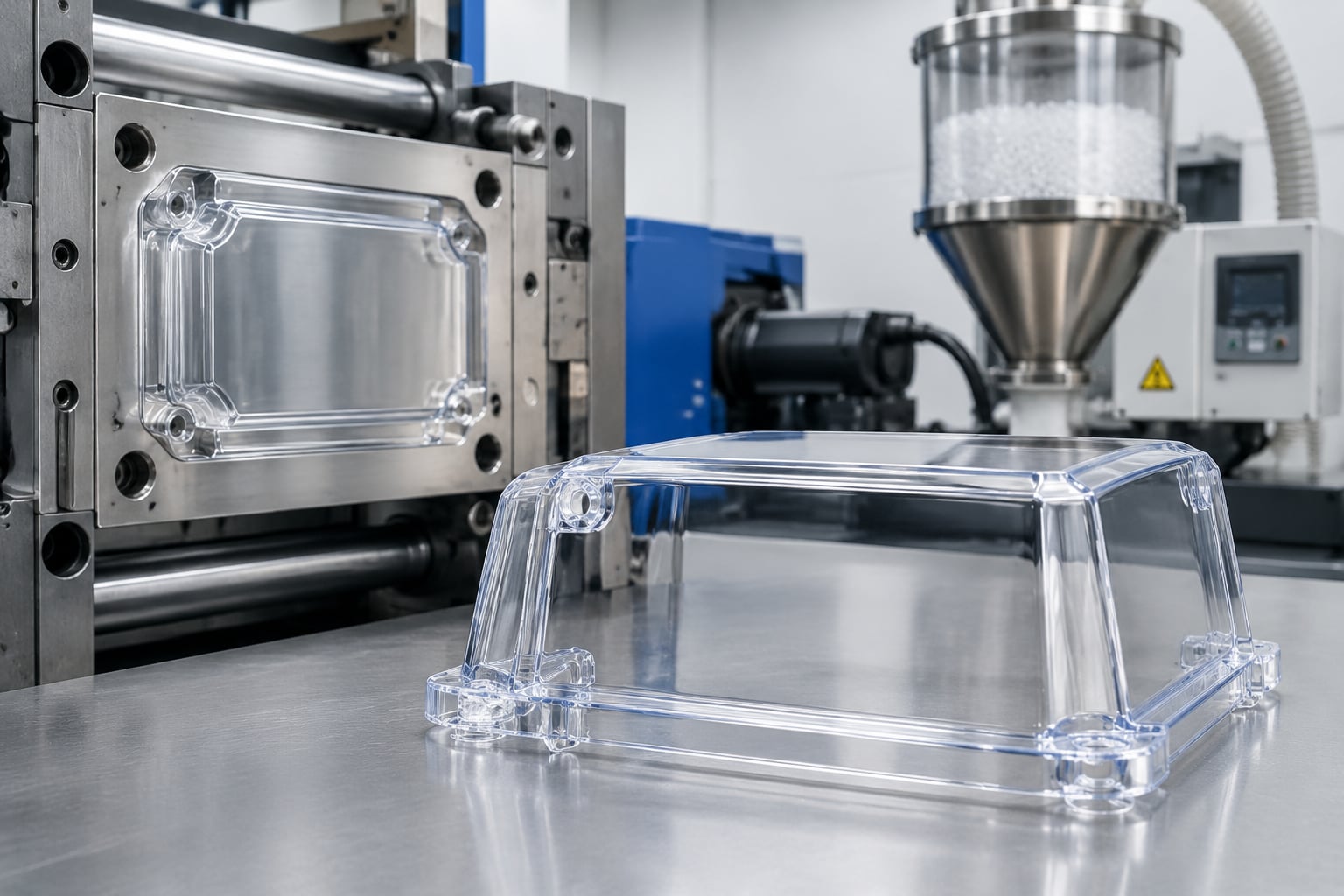
Steel tooling has a stronger business case when the part design is frozen and forecast volumes are high. Steel is better able to withstand repeated clamp force, injection pressure, sliding action, ejection cycles, and wear from filled compounds. It is also preferable when a product requires consistent texture, glossy finish, precision alignment, complex side actions, hot runners, close shutoffs, or long unattended production campaigns.
Production SituationRecommended Mold DirectionWhy It FitsKey Engineering CheckPrototype functional testAluminum or simplified rapid toolFast validation with lower investment.Confirm the resin and part geometry represent final-use conditions.Market launch under 10,000 partsAluminum toolAllows low-risk commercial entry and easier future changes.Check gate vestige, cosmetic areas, and expected rework cycles.Bridge production of 10,000 to 50,000 partsAluminum with steel inserts or pre-hardened steelBalances speed, durability, and investment.Review wear zones, cooling, and cavity layout.Annual production above 100,000 partsSteel production moldSupports durability, stable output, and automation planning.Validate cycle time, multi-cavity balance, and preventive maintenance intervals.Glass-filled nylon componentsHardened steel or steel insertsAbrasive fibers can wear aluminum rapidly.Specify wear-resistant gates, runners, shutoffs, and cores.Clear PC or optical partsHigh-polish stainless steelSurface quality and corrosion resistance are critical.Define polish standard, handling method, and inspection criteria.Frequent product revisionsAluminum or modular insert toolingModifications are generally faster and more economical.Design interchangeable inserts before first tool release.High-volume consumer enclosureSteel multi-cavity moldSupports high output and consistent cosmetic performance.Assess texture, weld lines, sink, warpage, and automated part handling.Part quality should be defined in measurable terms. Buyers should specify dimensional tolerances, cosmetic requirements, color standards, gloss level, texture, gate location, flash limits, sink marks, weld-line acceptance, warp limits, inspection frequency, material certificates, and packaging standards. A mold’s material alone does not determine quality. Good results come from sound DFM, stable process settings, capable molding machines, proper drying and handling of resin, disciplined inspection, and documented corrective action.
Start with the product’s commercial reality. If annual demand is uncertain, it is usually unwise to overinvest in a complex production steel tool before customer demand is confirmed. If a product is already committed to a multi-year purchase forecast, a steel mold can prevent capacity limitations and rising maintenance costs later.
A detailed rapid tooling service review can help identify whether an aluminum tool, steel tool, or hybrid configuration best suits the part before machining begins. DFM feedback is especially valuable when changing wall thickness, adding draft, relocating gates, increasing radii, or reducing unnecessary undercuts can reduce tooling cost and improve molding stability.
Both aluminum and steel molds are used across global industries. The correct choice depends on the operating environment, production forecast, resin type, cosmetic requirements, regulatory expectations, and product lifecycle.
IndustryTypical Molded PartsCommon Tooling ChoiceReason for SelectionAutomotiveInterior trim, clips, covers, connectors, under-hood components.Steel for production; aluminum for validation.Long programs, engineering resins, and repeatability often favor steel.Medical devicesInstrument housings, disposable components, treatment-unit covers.Stainless steel or controlled aluminum bridge tools.Traceability, surface quality, material control, and precision are important.Consumer electronicsCases, chargers, wearable housings, control panels.Aluminum for launch; steel for mature volumes.Fast product cycles often require early design flexibility.Industrial equipmentControl housings, guards, knobs, fluid-system covers.P20 or hardened steel.Durability and recurring spare-parts production support steel investment.Home appliancesHandles, bezels, appliance housings, trays, switches.Steel multi-cavity tooling.High unit volumes and visible surfaces demand consistent output.TelecommunicationsEnclosures, antenna covers, cable-management parts.Aluminum or steel depending on forecast.Prototype speed is useful, while established network equipment may need durable tools.Office equipmentPrinter covers, paper trays, mechanical linkages.Steel for recurring production.Dimensional stability and assembly consistency are essential.Startups and industrial designProduct shells, test fixtures, clips, functional prototypes.Aluminum or modular rapid tooling.Lower risk and faster iteration support early commercialization.For automotive and industrial customers, steel tooling is often the long-term destination. However, aluminum tools can reduce risk during early vehicle interior validation, accessory launches, aftermarket product tests, and limited regional releases. For medical and consumer applications, a bridge mold can help verify assembly, ergonomics, drop performance, sterilization compatibility, or user feedback before major tooling investment.
A product team developing a handheld electronic enclosure expects an initial launch of 8,000 units but anticipates possible changes to the battery door, button openings, and internal ribs. An aluminum mold with replaceable steel inserts is a practical solution. The company can test assembly, cosmetic texture, snap-fit performance, and customer response without committing to a high-cost multi-cavity steel tool. If demand accelerates after launch, the validated geometry can be transferred into a steel production mold.
An automotive supplier needs a glass-filled nylon retention clip for an engine-bay application. Although the part is small, it experiences heat, vibration, chemical exposure, and high assembly volume. Hardened steel inserts and a durable steel mold are normally more appropriate because the filled resin can wear softer cavity surfaces. The mold should be designed around resin shrinkage, fiber orientation, gate location, parting-line control, and repeatable dimensional inspection.
A medical-device manufacturer requires a clean, professional housing for a diagnostic instrument. The early market forecast is modest, but surface appearance and dimensional fit with internal electronics are critical. A carefully engineered aluminum bridge tool may support the first commercial batches, provided the resin, finish, and inspection plan are confirmed. If the product reaches wider hospital distribution, a stainless or hardened steel tool can support long-term appearance control and repeatable production.
An industrial equipment brand requires replacement covers and protective housings for machines already installed across multiple regions. Demand is steady but not extremely high. A pre-hardened P20 steel mold may offer a practical balance between cost and durability. The supplier should retain the tool, preserve production settings, control material lots, and maintain inspection records so replacement parts remain compatible with installed equipment over several years.
The supplier landscape includes specialized rapid-manufacturing providers, traditional mold makers, digital manufacturing platforms, and vertically integrated production partners. The right supplier should be evaluated on engineering capability, quality documentation, location, communication speed, mold ownership terms, export experience, machine capacity, tooling maintenance, and ability to deliver molded parts rather than only the mold.
CompanyService RegionsCore StrengthsKey OfferingsTEAM RapidGlobal customers across more than 25 countries; China-based manufacturing and direct international shipping.Rapid tooling, DFM support, low-volume to volume production, integrated plastic and metal manufacturing.Injection molding, rapid tooling, CNC machining, 3D printing, vacuum casting, die casting, finishing, assembly, packaging.Proto LabsNorth America and Europe, with global customer reach.Digital quotation workflows and fast-turn manufacturing programs.Injection molding, CNC machining, 3D printing, sheet metal fabrication.XometryNorth America and Europe, serving international sourcing programs.Large manufacturing network and online manufacturing procurement.Injection molding, CNC machining, sheet metal, additive manufacturing, finishing.FictivUnited States-focused customer support with global manufacturing resources.Digital manufacturing management and engineering-oriented sourcing.Injection molding, CNC machining, urethane casting, 3D printing, finishing.FOW MouldChina-based export mold manufacturing for international customers.Custom plastic injection mold design and production tooling.Automotive molds, household molds, industrial molds, plastic injection tooling.StackTeck SystemsNorth America and global packaging markets.High-performance tooling for packaging and high-output applications.Stack molds, closures tooling, thin-wall packaging molds, automation systems.Husky TechnologiesGlobal operations serving packaging and medical markets.Integrated high-volume molding systems and hot-runner technology.Injection molding systems, hot runners, PET preform molds, medical molding solutions.This table is a starting point rather than a substitute for supplier qualification. For lower-volume projects, the ability to provide responsive engineering feedback and flexible revisions may be more valuable than a supplier’s high-volume automation capability. For high-output packaging, automotive, or medical programs, machine integration, hot-runner expertise, validation documentation, and maintenance resources become more important.
TEAM Rapid supports innovators, product designers, engineers, startups, distributors, brand owners, established manufacturers, and individual product developers with an integrated path from prototype to repeatable production. Its ISO 9001:2015 quality management certification, more than 10 years of manufacturing experience, over 500 customers, more than 6,000 delivered projects, and service experience across more than 25 countries provide practical evidence of export-oriented manufacturing capability. The company combines in-house machining, mold manufacturing, injection molding, inspection, finishing, assembly, packaging, procurement support, and direct shipping from China, allowing customers to coordinate custom plastic and metal parts through one manufacturing partner. Rather than claiming unverified overseas warehouses or subsidiaries, TEAM Rapid provides global buyers with direct project communication, engineering responses within hours, DFM analysis before tooling, controlled manufacturing in China, and shipment support into markets including the United States, United Kingdom, France, Germany, and other international destinations. It offers OEM and ODM cooperation, wholesale supply, prototype orders, recurring production, distributor support, and customized manufacturing for end users and brand owners. TEAM Rapid provides turnkey and customer-owned production solutions, not BOO models or on-site bulk supply services, with each project managed around customer-owned drawings, specifications, approval standards, and commercial requirements.
Its relevant product strength for injection molding lies in the ability to connect rapid tooling, precision mold production, CNC machining, wire EDM, EDM, polishing, material handling, molding, finishing, inspection, and assembly in one workflow. Customers can request aluminum bridge tools, steel production tools, insert molding, overmolding, plastic housings, enclosures, trays, covers, fillers, cases, and complex functional parts. Tight-tolerance CNC capability down to 0.01 mm supports accurate tool components and secondary machining where needed. For projects requiring fast validation, rapid tooling and molded part production can be supported in approximately 5 to 25 days, depending on design complexity, material, tool structure, cavity count, and finishing needs.
Global buyers can begin by submitting CAD files, annual volume expectations, resin preferences, color and surface requirements, tolerance needs, and target delivery dates through the custom manufacturing quotation request. A clear request improves the accuracy of tooling recommendations and makes it easier to compare aluminum, steel, and hybrid mold options on a total-cost basis.
By 2026, the aluminum versus steel decision will increasingly be influenced by digital engineering, sustainability requirements, supply-chain resilience, and faster product release cycles. Mold-flow simulation, real-time production monitoring, automated visual inspection, cavity-pressure sensing, digital maintenance records, and AI-assisted DFM are helping suppliers identify risks earlier. These tools do not replace engineering judgment, but they can reduce trial cycles and provide more consistent decision-making.
Sustainability is also changing tooling decisions. Brands are introducing more recycled-content resins, bio-based polymers, lightweight designs, mono-material packaging, and parts designed for repair or recycling. Some recycled and filled materials may have different flow behavior, moisture sensitivity, shrinkage, or wear characteristics than virgin resins. This can increase the importance of steel inserts, corrosion-resistant materials, venting strategy, and process validation. Buyers should test production-intent resin rather than making tooling decisions based only on generic material data.
Policy and compliance expectations are growing across regions. Product traceability, recycled-content claims, chemical compliance, packaging regulations, medical documentation, and carbon-reporting requests increasingly affect material records and supplier selection. A global supplier should be able to discuss resin traceability, inspection plans, packaging methods, export documentation, and consistent communication across time zones.
Another important trend is distributed production planning. Companies may retain a production mold in one region while using aluminum bridge tooling in another region for temporary demand spikes, localized launches, or engineering changes. This strategy can reduce market-entry risk, although mold ownership, design file control, quality standards, and logistics responsibilities must be documented carefully.
Yes. Aluminum injection molds can produce end-use production parts when volume, resin, geometry, cosmetic expectations, and maintenance requirements are appropriate. They are especially effective for bridge production, pilot launches, and low-to-medium-volume commercial programs.
There is no universal number. Tool life depends on aluminum grade, part design, resin abrasiveness, injection pressure, temperature, cavity count, maintenance, and the presence of steel inserts. A supplier should provide a realistic expected range based on the specific part and material.
Use steel when the product has stable demand, high annual volume, abrasive or high-temperature resin, demanding cosmetic surfaces, tight tolerances, many cavities, or a long product lifecycle. Steel is also preferred for high-wear features such as slides, shutoffs, threads, and fiber-filled resin flow paths.
Some aluminum tools can be modified with steel inserts, replacement cavities, or reinforced wear areas. However, a full conversion to a high-volume steel production tool often requires a new mold because the structural requirements, cooling layout, and cavity design may differ.
No. Part quality depends on mold design, cooling, venting, gating, machine settings, resin preparation, operator control, inspection, and maintenance. A well-designed aluminum mold can outperform a poorly engineered steel mold in a low-volume application.
Provide 3D CAD files, 2D drawings if available, resin grade, color, annual volume, target quantity, tolerance requirements, cosmetic requirements, intended market, expected delivery date, assembly details, insert requirements, and packaging expectations. Photos of similar parts and critical assembly interfaces are also useful.
Yes. Many buyers prefer an integrated supplier because it reduces tool transfer risk and simplifies quality accountability. TEAM Rapid can support mold manufacturing, injection molding, finishing, assembly, packaging, and direct shipment for suitable programs.
Choose aluminum injection tooling when you need to move quickly, preserve capital, validate a changing design, or produce a controlled low-to-medium-volume launch. Choose steel injection tooling when your design is stable, your resin is demanding, your quality requirements are strict, and your forecast justifies long-term production infrastructure. For many Global market projects, the most commercially sensible route is aluminum or hybrid tooling first, followed by steel tooling after demand, design, and process capability have been validated.
Before placing a tooling order, compare suppliers on more than quote price. Ask for DFM feedback, tool material details, expected mold life, cavity plan, cooling strategy, trial process, inspection documentation, mold ownership terms, maintenance support, lead time, shipping plan, and communication responsibility. That disciplined approach will help turn aluminum and steel injection mold selection into a reliable product-launch advantage.
For the Global market, choose 3D printing when you need one to several hundred parts quickly, expect design changes, or need complex geometries without tooling. Choose injection molding when the design is stable and you need repeatable parts at medium-to-high volumes, usually from several hundred to several thousand units depending on material, mold complexity, finishing, and logistics.
The practical break-even point for injection molding versus 3D printing is often between 500 and 5,000 parts. Simple plastic parts can cross over earlier, while highly complex molds, low-cost printed parts, or uncertain demand can push the break-even volume higher. Calculate the decision using total delivered cost, not unit price alone: include mold cost, setup, material, labor, finishing, scrap, validation, freight, duties, and inventory risk.
Buyers in North America, Europe, Asia-Pacific, the Middle East, Latin America, and Africa can source from local specialists such as Protolabs, Xometry, Fictiv, Stratasys Direct, Jabil, and Quickparts. Qualified international suppliers, including Chinese manufacturers with ISO certification, transparent engineering support, strong pre-sales communication, and reliable after-sales handling, can also be competitive because tooling and labor costs may be lower while lead times remain practical for global shipping.
Injection molding forms parts by injecting molten polymer into a machined mold cavity under pressure. The mold may be aluminum for rapid or low-volume tooling, or hardened steel for long production runs. Once the tool is qualified, the process can produce thousands or millions of nearly identical components with fast cycle times. It is particularly effective for housings, clips, caps, trays, medical consumables, appliance components, automotive trim, packaging parts, and consumer-product enclosures.
3D printing, also called additive manufacturing, builds a part layer by layer from a digital file. Common polymer processes include SLA, SLS, MJF, FDM, DLP, and material jetting. Each process has a different balance of surface finish, strength, dimensional accuracy, material selection, build size, and cost. Because no mold is required, additive manufacturing is useful for prototypes, fit checks, low-volume custom parts, jigs, fixtures, medical models, functional validation, bridge production, and demand-driven spare parts.
The basic commercial difference is simple: injection molding has a high upfront cost and low marginal part cost; 3D printing has almost no tooling cost but a higher marginal part cost. The correct choice depends on demand certainty, engineering maturity, part geometry, regulatory needs, target material, time to market, and the cost of changing the design after production begins.
A useful comparison starts with total project cost. For injection molding, total cost combines mold design, DFM review, mold manufacture, trials, sampling, molding, secondary operations, inspection, packaging, freight, and any expected design revisions. For 3D printing, the total includes build preparation, machine time, material, support removal, post-curing or sintering, finishing, inspection, packaging, and freight. The cost curve changes as volume rises: printing usually starts lower, while molding becomes less expensive per unit after the tooling investment is absorbed.
Use this simplified calculation when planning a program:
Break-even quantity = Injection mold cost ÷ (3D printed unit cost − Injection molded unit cost)
For example, if an aluminum mold costs US$8,000, a printed part costs US$18, and an injection molded part costs US$4, the estimated break-even is 571 parts. In reality, the result should be adjusted for finishing, production yield, freight, packaging, design changes, and the value of receiving parts earlier. A lower printed unit cost or a more expensive multi-cavity mold will raise the break-even volume.
The following ranges are directional planning estimates for polymer parts. Actual quotations depend heavily on geometry, resin, tolerance, texture, color, mold cavities, production location, and destination.
Project ScenarioLikely Better ProcessTypical VolumeCost DriverLead-Time ConsiderationConcept model with frequent design changes3D printing1–20 partsNo tooling and fast file revisionsOften days rather than weeksFunctional prototype in nylon-like materialSLS or MJF printing10–100 partsStrength, complexity, no mold costFast build and finishing cycleMarket-test consumer enclosureRapid tooling or printing100–1,000 partsDemand uncertainty and appearance requirementsRapid aluminum tooling can be practicalStable product with repeated ordersInjection molding1,000–20,000 partsLower unit cost and repeatabilityTooling time is recovered through outputHigh-volume packaging or appliance componentInjection molding20,000–1,000,000+ partsCycle time, multi-cavity tooling, automationLonger tool launch, very low unit costCustomized replacement or service part3D printing1–500 partsAvoiding inventory and obsolete toolingDigital inventory supports on-demand supplyThese scenarios show why volume alone is not enough. A medical-device enclosure may require molded production at relatively low quantities because resin traceability, cosmetic consistency, sealing features, and validation requirements justify a tool. Conversely, a high-priced industrial spare part may remain printed even at hundreds of units because the inventory and tooling risks outweigh the unit-cost savings of molding.
Injection molding is strongest when a part requires production-grade thermoplastics, repeatable wall thickness, molded-in features, snap fits, living hinges, threaded inserts, surface textures, color control, and predictable mechanical behavior. Typical materials include ABS, PC, PC/ABS, PA6, PA66, POM, PP, PE, TPU, TPE, PBT, PPS, and glass-filled engineering polymers. The process can also support insert molding, overmolding, family molds, multi-cavity molds, hot-runner systems, and automated part handling.
3D printing is strongest when geometry would be expensive to machine or mold, such as internal channels, lattice structures, organic forms, custom ergonomic grips, low-volume fixtures, patient-specific devices, and consolidated assemblies. It is also valuable before tooling because an engineering team can physically validate draft angles, assembly access, wall thickness, grip feel, and component clearance before releasing a mold design.
Selection Factor3D Printing AdvantageInjection Molding AdvantagePractical Buying DecisionDesign maturityEasy and inexpensive revisionsBest after design freezePrint before committing to toolingPart quantityLow-volume and irregular demandMedium and high-volume demandModel expected annual demand and reorder patternGeometryComplex internal features and latticesConsistent draftable geometries with efficient cyclesReview geometry with DFM and additive engineersSurface qualityCan require sanding, coating, or vapor smoothingTool texture and polished surfaces are repeatableUse molded samples for final cosmetic approvalMaterial performanceSpecialized printed polymers availableBroad range of production thermoplasticsMatch resin data to heat, impact, chemical, and UV needsProduction consistencyBuild orientation can affect resultsStrong repeatability after tool validationUse molding for controlled long-term supplyTooling investmentNo dedicated mold requiredHigh initial cost, lower recurring costConsider demand certainty and product life cycleFor many global product launches, the best route is not strictly one process or the other. Teams often use SLA or SLS parts for early testing, CNC machining for accurate engineering prototypes, vacuum casting for presentation samples, rapid aluminum tooling for pilot production, and steel tooling for sustained production. This staged approach reduces the risk of discovering a design problem after a high-value production mold has been cut.
The Global market is shaped by different cost and supply-chain conditions across regions. North American buyers often prioritize short domestic lead times, supplier proximity, regulatory documentation, and fast engineering communication. European buyers may place additional emphasis on CE-related product compliance, recycling obligations, REACH considerations, energy use, and material traceability. Asia-Pacific manufacturing hubs, particularly Shenzhen, Dongguan, Ningbo, Suzhou, Singapore, Seoul, Tokyo, and Ho Chi Minh City, offer dense supplier networks for tooling, molding, electronics integration, and export logistics.
Ports and trade hubs matter when calculating delivered cost. Shenzhen and Hong Kong support rapid export for electronics and consumer-product programs; Ningbo-Zhoushan and Shanghai serve major industrial supply chains; Rotterdam, Hamburg, Los Angeles, Long Beach, Singapore, Jebel Ali, and Dubai are important gateways for containerized molding programs. For low-volume printed parts and prototype tools, air freight may preserve launch speed. For stable production volumes, sea freight, consolidated shipments, and regional fulfillment can significantly lower landed cost.
Exchange-rate movement, resin pricing, tariffs, carbon reporting rules, shipping disruptions, and local-content requirements can all influence the best sourcing route. Buyers should avoid selecting a supplier based only on the mold quote. A low-cost tool with poor cooling, unsuitable steel, weak venting, or inconsistent process control can create expensive downstream scrap, delays, rework, and customer returns.
Start with a production brief that states annual demand, first-order quantity, expected reorder frequency, material requirements, cosmetic expectations, tolerance-critical dimensions, target markets, certification needs, packaging, and shipment destination. If demand is uncertain, request a staged quotation: prototypes, rapid tooling, pilot molding, and production tooling. This gives the business team a decision path instead of forcing an early all-or-nothing tooling commitment.
Ask every injection molding supplier for a DFM report before tooling starts. The report should address draft angle, wall thickness, rib design, sink-mark risk, weld lines, gate location, parting line, ejection, shrinkage, warpage, undercuts, tooling steel, cavity count, expected cycle time, and inspection method. For printed components, ask about process orientation, support marks, anisotropic strength, dimensional tolerance, post-processing, color stability, and whether the selected material is a prototype-grade or production-capable polymer.
Use samples to validate assembly, function, appearance, and packaging. A part can be dimensionally correct yet fail in real use because of stiffness, snap-fit fatigue, odor, gloss variation, surface marks, chemical exposure, or heat deformation. For parts that interact with medical, food-contact, electrical, automotive, or industrial systems, establish the required material documentation and test plan before ordering production.
Evaluation AreaQuestions to AskWhy It MattersEvidence to RequestEngineering reviewWill the supplier issue DFM before tooling?Prevents avoidable mold and quality problemsAnnotated DFM report and revision historyQuality systemIs the manufacturer ISO 9001 certified?Supports controlled processes and traceabilityCurrent certification and inspection planMaterial controlWhich resin grade and supplier will be used?Ensures performance matches the specificationMaterial data sheet and batch recordsTooling ownershipWho owns, stores, maintains, and can transfer the mold?Protects long-term supply continuityWritten tooling ownership termsCapacity and deliveryCan the supplier support pilot and repeat orders?Reduces supply interruptions after launchProduction schedule and lead-time commitmentInspectionHow are critical dimensions measured?Confirms tolerance capabilityFAI, CMM report, gauges, and sampling planAfter-sales supportHow are defects, revisions, and reorders handled?Protects the buyer after shipmentCorrective-action and communication processWhen comparing quotations, normalize the scope. One supplier may quote molded parts only, while another includes mold trials, texture, assembly, packaging, inspection reports, and delivery. Compare like for like. The most economical program is the one that meets specification reliably at the lowest total lifecycle cost, not simply the one with the lowest initial line item.
Automotive programs use 3D printing for dashboards, fit-check models, jigs, fixtures, airflow studies, custom tools, and low-volume specialty parts. Injection molding supports durable interior trim, switch housings, clips, ducts, bezels, covers, sensor enclosures, under-hood components, and exterior details. Automotive manufacturers and suppliers typically need strong dimensional repeatability and production-grade heat, chemical, and impact performance.
Medical and laboratory sectors use printed models for anatomical visualization, device prototypes, custom fixtures, and low-volume development assemblies. Molding is selected for repeatable housings, diagnostic-device components, disposable consumables, instrument covers, cartridge bodies, and production assemblies. Material selection, cleanliness, documentation, and validation are essential where parts are used near patients, samples, or clinical workflows.
Consumer electronics and communications products frequently follow a hybrid route. Teams print early ergonomic models, machine precision components, use vacuum casting for presentation sets, and then move to injection molded enclosures, buttons, cable-management parts, optical covers, and accessory components. Shenzhen, Dongguan, and Hong Kong remain important connected hubs for this type of product because manufacturing, assembly, procurement, and export services are concentrated in the region.
Industrial equipment, office devices, electrical appliances, sanitary products, and commercial products use both technologies for housings, panels, trays, guards, brackets, cable guides, control-box covers, pump components, dispensers, and maintenance spares. For large housings, moldability, ribbing, warpage control, and shipping volume require careful review. For short-run replacement parts, additive manufacturing can reduce inventory while maintaining service availability.
A startup developing a handheld diagnostic device may print twenty enclosure iterations in SLA or SLS to improve ergonomics and internal PCB fit. Once the design is stable, it may order an aluminum rapid tool for 500 pilot units to verify assembly, packaging, and market feedback. If demand becomes predictable, the same product can transition to a multi-cavity steel mold with a production-grade PC/ABS resin for lower cost per unit.
An industrial automation company needing 150 customized cable-routing brackets across several machine models may retain 3D printing. The bracket geometry may differ by customer installation, and the cost of individual molds would not be justified. A nylon-based printed material can provide practical strength while the company keeps digital files instead of physical inventory.
A consumer-appliance brand launching a global accessory may use injection molding from the beginning if it has committed retailer orders for 30,000 units. A polished or textured mold can deliver a consistent visual surface, molded color can eliminate painting, and a multi-cavity tool can lower unit cost. Before cutting steel, the brand should still print or machine assembly models to validate the snap features, screw bosses, wall thickness, and interaction with mating components.
The companies below represent established options for buyers comparing digital manufacturing, rapid prototyping, tooling, and injection molding. Capabilities vary by site, material, destination, production volume, and program requirements, so buyers should verify current availability and quality documentation for their specific project.
CompanyPrimary Service RegionsCore StrengthsKey OfferingsProtolabsNorth America and EuropeFast digital quoting and rapid manufacturingInjection molding, CNC machining, sheet metal, 3D printingXometryUnited States, Europe, global sourcing networkBroad manufacturing marketplace and online procurement3D printing, injection molding, CNC machining, sheet metalFictivNorth America with global manufacturing networkDigital manufacturing platform and supply-chain supportCNC machining, injection molding, 3D printing, finishingJabilGlobal, including North America, Europe, and Asia-PacificLarge-scale manufacturing and product industrializationInjection molding, tooling, assemblies, regulated manufacturingStratasys DirectNorth America and international customersIndustrial additive manufacturing experienceSLA, FDM, SLS, PolyJet, production additive servicesQuickpartsNorth America and international marketsPrototype-to-production manufacturing services3D printing, CNC machining, injection molding, urethane castingTEAM RapidGlobal customers across more than 25 countriesChina-based rapid manufacturing, tooling, molding, and integrated support3D printing, CNC, vacuum casting, rapid tooling, injection molding, finishing, assemblyFor buyers in the Global market, regional proximity may be important for frequent engineering visits, urgent freight, or regulated projects. However, a cross-border supplier can be commercially attractive when it provides documented quality systems, clear DFM communication, manageable logistics, and a single-source route from prototype through production. This is particularly relevant for startups, product designers, distributors, brand owners, and established manufacturers balancing speed, cost, and supply resilience.
TEAM Rapid supports global product development and production programs with more than ten years of manufacturing experience, over 500 customers, and more than 6,000 delivered projects for clients in over 25 countries. Its ISO 9001:2015 quality system, in-house machining and tooling capability, tight-tolerance CNC capacity down to 0.01 mm, and DFM-led manufacturing review support practical control of materials, moldability, dimensions, and inspection requirements; the company works with diversified plastic and metal material options rather than claiming proprietary component brands, allowing specified resin grades and performance requirements to guide production. It serves end users, product designers, startups, distributors, dealers, brand owners, and individual buyers through flexible OEM/ODM-style custom manufacturing, wholesale-volume production, prototype orders, recurring supply, assembly, packaging, and regional distribution-oriented shipping arrangements. TEAM Rapid has established experience supporting customers in markets including the USA, UK, France, Germany, and wider international destinations through direct global shipping, fast responses within a few hours, one-to-one engineering communication, and coordinated pre-sale DFM and after-sales order support; while its stated manufacturing base and integrated resource network are in China rather than disclosed overseas subsidiaries or local warehouses, this operating model gives international buyers a defined point of accountability from quotation through delivery. For product-launch requirements, TEAM Rapid can coordinate turnkey and customer-owned manufacturing arrangements, including procurement, assembly, packaging, kitting, scheduling, and shipping, rather than BOO or on-site bulk-supply services.
For early-stage programs, the company can provide rapid prototyping services using SLA and SLS 3D printing, CNC machining, and vacuum casting, with typical project lead times of approximately two to eight days depending on the requirements. For a bridge between prototypes and recurring production, its rapid tooling and molding programs can support tooling and molded-part production in approximately five to twenty-five days. Once demand is clearer, customers can move into custom injection molding services for housings, cases, trays, covers, fillers, enclosures, insert-molded components, and overmolded parts.
TEAM Rapid is particularly relevant when the production route must remain flexible. A buyer can begin with one prototype, validate a design, revise it after DFM feedback, produce a low-volume pilot batch, and then scale toward 100,000 or more parts without moving between disconnected suppliers. Customers can request a project-specific cost comparison and manufacturability review through the company’s online manufacturing quotation request process.
By 2026, the distinction between injection molding and 3D printing will become less rigid because both methods are increasingly connected by digital workflows. Artificial intelligence-assisted DFM, automated quotation systems, simulation-based mold optimization, digital twins, in-process monitoring, and cloud-based production tracking will help teams make earlier and more accurate process decisions. Mold-flow analysis and conformal cooling strategies will continue to improve cycle time and warpage control, especially for technically demanding components.
Additive manufacturing is likely to expand in high-value, low-volume, customized, and distributed-production applications. More durable printed polymers, faster powder-bed systems, improved surface finishing, and automated depowdering will make printed parts more viable for end-use applications. At the same time, injection molding will remain the dominant choice for high-volume plastic products because its production speed, repeatability, broad resin options, and low marginal cost are difficult to match.
Sustainability will increasingly influence material and process selection. Buyers will ask for recycled-content resins, bio-based polymers, recyclable mono-material designs, lower-energy production routes, reduced packaging, and lower freight emissions. Design teams should understand that recycled content can affect color, shrinkage, flow, mechanical performance, and consistency, making supplier testing and material documentation important. Molded parts may reduce energy per unit at scale, while 3D printing can reduce material waste and obsolete inventory for low-volume parts. The better environmental option depends on the entire lifecycle, including tooling, yield, shipping, product lifespan, repairability, and end-of-life recovery.
Policy and trade conditions will also shape sourcing. Carbon reporting rules, product-safety expectations, plastics restrictions, extended producer responsibility requirements, import duties, and traceability obligations are encouraging buyers to use diversified suppliers and documented material chains. Global brands should build flexibility into their manufacturing plan by qualifying more than one route where practical: additive manufacturing for development and service parts, rapid tooling for controlled launch quantities, and production molding for mature, sustained demand.
3D printing is usually cheaper for prototypes and low volumes because it does not require a mold. Injection molding becomes cheaper per unit after the tooling cost is spread across enough parts. The break-even point can range from hundreds to thousands of units.
There is no universal quantity. Simple parts with modest tooling costs may justify molding at 500 to 1,000 units. Complex tools, large parts, or uncertain demand may require several thousand units before molding produces a lower total cost.
Yes, especially for low-volume industrial components, fixtures, customized products, service parts, and certain high-value applications. The selected printing process and material must be evaluated for strength, heat resistance, finish, chemical exposure, and long-term durability.
After the mold is built, each molding cycle can produce one or multiple parts in seconds or minutes. Material use, labor, and finishing can be highly controlled, allowing the fixed tooling cost to be spread across a large production quantity.
A printed prototype is useful for validating geometry, assembly, and appearance before mold manufacture. The mold itself is generally machined from aluminum or steel, although printed inserts may be used in limited specialist applications.
Include 3D CAD files, 2D drawings for critical dimensions, material requirements, quantity, color, finish, tolerance expectations, assembly needs, target delivery date, destination country, and any testing or certification requirements.
The answer depends on urgency, regulatory requirements, engineering access, total landed cost, and production volume. Local suppliers can simplify visits and short freight routes, while qualified China-based suppliers can offer competitive tooling and production pricing with integrated manufacturing services and international shipping.
China injection molding is a practical sourcing option for Global Market buyers who need competitive tooling costs, flexible production volumes, rapid engineering feedback, and access to broad plastic material choices. The best results come from selecting a supplier that can review DFM requirements, build and maintain tooling, validate first articles, control production quality, and coordinate export packaging and shipping.
For most projects, buyers should shortlist suppliers with demonstrated tooling capability, documented quality systems, transparent mold ownership terms, and experience shipping to their target regions. Established Chinese manufacturers such as TEAM Rapid, FOW Mould, TK Group, HLH Rapid, Richfields Plastics, and Rosti China are worth evaluating according to part complexity, annual volume, resin requirements, and destination-market compliance needs.
Qualified international suppliers, including China-based manufacturers with relevant certifications, responsive pre-sales engineering, and dependable after-sales support, can offer strong cost-performance advantages. They are especially suitable when buyers need prototype-to-production continuity, low-volume molding, rapid tooling, or an alternative to higher-cost domestic production.
Before placing an order, send a 3D CAD file, 2D drawing, annual forecast, resin specification, cosmetic standard, critical tolerance list, packaging expectation, and destination country requirements. Ask for a written DFM report, tooling proposal, sample approval plan, inspection approach, and a clear quotation separating mold cost, unit price, finishing, assembly, freight, and taxes.
China remains one of the most important manufacturing locations for injection molded plastic parts because it combines toolmaking capacity, resin supply networks, production labor, secondary processing, and export infrastructure. Major molding clusters around Shenzhen, Dongguan, Guangzhou, Ningbo, Taizhou, Suzhou, Shanghai, Xiamen, Qingdao, and Tianjin support projects ranging from a few bridge-production parts to multi-cavity tools running millions of cycles.
For Global Market buyers, the attraction is not simply a lower piece price. A capable China injection molding supplier can integrate mold design, CNC machining, EDM, wire EDM, polishing, texture coordination, mold assembly, molding trials, inspection, pad printing, painting, ultrasonic welding, assembly, packaging, and export logistics. This reduces the risk created by splitting the project among separate tool shops, molders, finishers, and freight providers.
China’s major ports also make international distribution practical. Shenzhen’s Yantian and Shekou terminals serve South China manufacturing; Ningbo-Zhoushan supports Zhejiang suppliers; Shanghai handles high-volume global container flows; and Qingdao, Xiamen, and Tianjin provide additional routing options. Buyers should still calculate the full landed cost, including ocean or air freight, customs duty, insurance, local transport, inventory holding, and possible tariffs.
The market is highly varied. Some factories specialize in low-cost commodity parts, while others focus on precision medical components, automotive connectors, optical plastics, consumer housings, or industrial equipment. The correct supplier is therefore the one whose equipment, engineering processes, quality discipline, and project scale match the specific product—not necessarily the factory with the lowest initial quotation.
Injection molding in China covers a wide range of plastic components. Product design, polymer behavior, mold steel selection, cavity count, surface finish, and production forecast all influence the recommended manufacturing approach. A low-volume enclosure for a market test may be best served by aluminum rapid tooling, while an automotive interior component may require hardened steel tooling, specialized texture control, and validation over a long production life.
Product TypeTypical MaterialsCommon ApplicationsKey Manufacturing ConsiderationElectronic enclosuresABS, PC, PC/ABS, flame-retardant gradesControllers, chargers, routers, smart devicesWall thickness, snap fits, cosmetic surface, EMI requirementsIndustrial housingsABS, nylon, PP, PBT, PCSensors, control boxes, machinery coversImpact resistance, inserts, sealing interfaces, dimensional stabilityMedical device componentsPC, ABS, PP, POM, medical-grade polymersHandheld instruments, laboratory devices, diagnostic equipmentTraceability, clean handling, resin documentation, validation needsAutomotive plastic partsPP, PA6, PA66, PBT, PC/ABSInterior trim, clips, ducts, covers, connectorsHeat resistance, durability, appearance, repeatable dimensionsConsumer product partsABS, PP, HIPS, TPE, silicone-compatible materialsAppliances, toys, kitchenware, personal productsColor consistency, texture, assembly fit, retail packagingInsert molded partsNylon, PBT, PC, ABS with metal insertsThreaded mounts, electrical components, handlesInsert retention, preheating, fixture design, cycle stabilityOvermolded componentsTPE, TPU, silicone-like elastomers over rigid plasticsGrips, seals, buttons, protective coversMaterial bonding, part positioning, gate location, shrink controlThis product mix shows why material choice must be considered early. A resin substitution may reduce cost, but it can also affect shrinkage, strength, chemical resistance, flame rating, surface appearance, and tool wear. Buyers should specify approved material manufacturers or acceptable equivalents when product performance or certification depends on a particular grade.
The following companies are examples of established providers that Global Market buyers may assess. Capabilities should always be confirmed directly because molding machine tonnage, tooling scope, certifications, export routes, and available production capacity can change by facility and project.
CompanyMain Service RegionsCore StrengthsKey OfferingsTEAM RapidChina, United States, United Kingdom, France, Germany, wider Global MarketPrototype-to-production integration, rapid tooling, DFM support, flexible volumesInjection molding, insert molding, overmolding, CNC machining, finishing, assembly, packagingFOW MouldChina, North America, Europe, Asia-PacificPlastic mold design and manufacturing for automotive and consumer applicationsInjection molds, multi-cavity molds, automotive tooling, plastic part productionTK GroupChina, Europe, North America, AsiaLarge-scale precision plastic component manufacturing and mold technologyPrecision molds, consumer electronics parts, medical-related plastic components, molding servicesHLH RapidChina, United Kingdom, Europe, North AmericaRapid manufacturing support for product development and lower-volume productionRapid tooling, injection molding, CNC machining, vacuum casting, 3D printingRichfields PlasticsChina, United States, Europe, Global MarketCustom plastic manufacturing with tooling and production supportInjection molding, mold manufacturing, plastic assemblies, finishing optionsRosti ChinaChina, Europe, North America, Asia-PacificEngineering-led injection molding for regulated and technical productsPrecision molding, manufacturing engineering, assembly, supply-chain supportSupplier comparison should go beyond company size. A specialized mold maker may deliver an excellent tool but not offer molding, while a production molder may prefer established high-volume programs. Buyers needing frequent design changes should look for a partner that can modify tools quickly and communicate engineering changes without ambiguity. Buyers with stable, high-volume demand should evaluate cavity strategy, automation, cycle-time optimization, preventive mold maintenance, and production backup plans.
A good sourcing decision begins with technical fit. Share a complete package rather than requesting a price from a single image or incomplete model. The supplier should be able to identify issues such as undercuts, weak snap features, non-uniform walls, sharp internal corners, insufficient draft, excessive length-to-thickness ratios, difficult ejection, potential sink marks, and tolerance conflicts caused by polymer shrinkage.
Ask whether the quoted mold will be aluminum, P20 steel, 718 steel, H13 steel, S136 steel, or another specified grade. The right answer depends on expected production volume, resin abrasiveness, glass-fiber content, surface requirements, and maintenance expectations. A low-volume rapid tool may be economical for functional verification, while a hardened steel tool can be more appropriate for recurring production and demanding resins.
Supplier Evaluation AreaQuestions for Buyers to AskWhat a Strong Answer Looks LikePotential Warning SignDFM engineeringWill you provide a formal design-for-manufacturing review?Written comments on draft, gates, wall thickness, shrinkage, ejection, and tooling riskQuotation issued with no technical reviewMold ownershipWho owns the tool after payment, and how is it stored?Clear ownership clause, mold identification, maintenance terms, and release procedureVague language about tool access or transferMaterial controlCan you use the named resin grade and provide lot information if needed?Approved resin sourcing, documented substitutions only, retained material recordsUnapproved “equivalent” material changesQuality inspectionWhat checks are completed before shipment?First-article inspection, dimensional checks, visual standards, sampling plan, reportsNo inspection documentation beyond verbal confirmationTool trial processHow many trial rounds are included and what samples are supplied?Defined T1/T2 process, sample quantity, change-control pathway, approval recordUnclear sample responsibilities and revision chargesProduction capacityWhat machine tonnage and production scheduling apply?Machine fit, planned cycle time, capacity estimate, realistic lead-time commitmentCapacity promised without equipment detailsExport supportCan you manage packaging, documents, and shipment coordination?Export-ready packing, labeling review, shipping options, commercial documentationPackaging and shipping discussed only after productionFor Global Market projects, communication discipline is equally important. Insist that CAD revision numbers, approved samples, color standards, inspection reports, packaging instructions, and shipment details are controlled in writing. If a drawing changes after tooling begins, obtain a documented engineering change quotation and revised delivery schedule before approving the modification.
Plastic resin is a functional engineering choice, not merely a purchasing line item. ABS is widely used for housings and consumer products because it balances impact performance and appearance. Polycarbonate is often selected for impact resistance and transparency. Nylon provides strength and wear resistance but requires attention to moisture and shrinkage. Polypropylene supports chemical resistance and living hinges, while POM is useful for low-friction mechanical parts.
Buyers should define color with a physical chip, Pantone reference where appropriate, or a signed master sample. For cosmetic parts, specify acceptable flow lines, gate witness marks, ejector marks, gloss level, texture reference, weld line criteria, and allowable color variation. For functional components, prioritize critical dimensions, assembly interfaces, torque requirements, leak performance, pull-out force, and environmental resistance.
Material FamilyUseful PropertiesTypical UsesBuyer Specification NotesABSGood impact resistance, processability, cosmetic potentialEnclosures, appliance housings, consumer productsDefine color, surface texture, UV requirement, flame rating where neededPCHigh impact strength, heat resistance, transparency optionsProtective covers, electrical housings, lensesConfirm stress-crack resistance and transparency expectationsPC/ABSBalanced toughness, heat resistance, appearanceElectronics, automotive interior parts, instrument housingsSpecify required fire rating and cosmetic classPPLow density, chemical resistance, flexible hinge performanceContainers, caps, automotive trim, consumer productsAccount for larger shrinkage and possible warpagePA6 or PA66Strength, wear resistance, thermal performanceGears, clips, structural parts, automotive componentsState glass-fill level, moisture conditioning, and dimensional requirementsPOMLow friction, stiffness, good wear behaviorMechanisms, latches, gears, valvesReview snap geometry and tight tolerance zones carefullyTPE or TPUSoft-touch grip, flexibility, elastic recoveryHandles, seals, overmolded grips, protective elementsConfirm hardness, bond compatibility, color, and compression performanceQuality assurance should match the risk of the product. For a promotional consumer item, visual inspection and dimensional spot checks may be sufficient. For a device enclosure containing electrical components, buyers may require material flame ratings, fit validation, assembly trials, and more detailed records. Medical, automotive, aerospace, food-contact, and safety-related products may require additional documentation, process controls, traceability, or customer-specific validation. Never assume that a supplier’s general quality certification automatically certifies a finished part for a regulated end use.
China injection molding suppliers serve a broad industrial base. Consumer electronics manufacturers use molded cases, bezels, battery doors, cable organizers, and internal supports. Industrial equipment brands source sensor housings, protective covers, terminal blocks, handles, fan components, and control-panel parts. Medical product developers use molded components for diagnostic equipment, laboratory devices, handheld instruments, and non-implantable appliance housings.
Automotive and mobility projects frequently require clips, trims, ducts, brackets, connector bodies, housings, and interior components. These programs usually demand more disciplined material control, visual requirements, long-term mold durability, and stable production scheduling. Commercial product brands may need low-volume market launch parts, while established distributors may require repeatable replenishment orders, barcode labeling, retail-ready packaging, and consolidated international shipments.
China-based molding is also useful for startups and engineering teams that need a staged path from proof-of-concept to market release. The first stage may involve CNC machining or 3D printing for fit checks. The next stage can use vacuum casting or rapid tooling for functional testing. Once demand is confirmed, production tooling can be developed with optimized cavities, automation, and dedicated quality controls.
A product team developing a compact smart-device enclosure may begin with CNC-machined samples to confirm board fit, button travel, connector access, and assembly screws. After design approval, a rapid injection mold can produce small batches in PC/ABS for pilot users and early sales. Feedback from this phase can reveal issues with snap-fit fatigue, gate location, texture appearance, or packaging damage. The revised design can then move to a production mold when volume and specifications stabilize.
An industrial equipment company may require an IP-oriented plastic housing with brass threaded inserts, a gasket channel, mounting features, and resistance to shop-floor handling. The molder should review insert placement, weld lines near fastening points, draft on textured surfaces, shrinkage around thick bosses, and sealing-surface flatness. A first-article inspection should verify critical assembly interfaces before the customer commits to a production release.
A medical-device developer may need several hundred to several thousand molded housings for clinical evaluation or a controlled launch. This type of project benefits from detailed resin confirmation, controlled cosmetic standards, dimensional inspection records, and documented engineering changes. The buyer should also specify whether components need particular handling, labeling, packaging cleanliness, or traceability practices before shipment.
For aftermarket automotive accessories, molded trim pieces and mounting brackets often require a balance between appearance, heat resistance, and cost. The supplier should assess UV exposure, vehicle temperature conditions, clip retention, assembly variation, texture matching, and packaging protection. Production samples should be fitted to representative vehicles or fixtures before final production approval.
TEAM Rapid supports Global Market customers with an engineering-led manufacturing route from prototype through repeat production. Its ISO 9001:2015 quality management system, in-house machining and tooling capability, molding resources, and more than 10 years of experience help customers control the transition from CAD model to custom plastic component. Rather than claiming unspecified proprietary component brands, TEAM Rapid works to customer-defined resin grades, drawings, tolerances, and inspection requirements, supported by DFM analysis that addresses draft, wall thickness, resin consumption, cavity planning, cycle time, and potential tooling risks before production. With more than 6,000 delivered projects and over 500 customers in more than 25 countries, the company supports end users, distributors, dealers, brand owners, engineering firms, startups, and individual inventors through OEM, ODM, wholesale, prototype, low-volume, recurring-production, and regional distribution cooperation models. Its China-based manufacturing network, limited warehousing support, direct shipping capability, and experience serving customers launching products in China, the United States, the United Kingdom, France, Germany, and other markets provide practical international service continuity. Buyers receive one-to-one engineering communication, rapid online quotation and technical feedback, production updates, inspection coordination, packaging support, and after-sales follow-up rather than a disconnected remote-export transaction. TEAM Rapid can also coordinate turnkey and customer-owned production tooling solutions for customers building their own supply pathway; it does not operate BOO models or on-site bulk-supply services.
For projects requiring bridge production, TEAM Rapid’s China injection molding service combines rapid tooling, conventional molding, insert molding, overmolding, finishing, and assembly support. This approach is useful when a buyer needs to validate the market before investing in high-volume tooling, or when annual demand is too variable for a rigid mass-production model.
TEAM Rapid can support parts ranging from a single prototype to more than 100,000 pieces, depending on project requirements. Typical rapid tooling and molded-part production can be supported in approximately 5 to 25 days, while selected prototype processes may be completed more quickly. Customers can also combine injection molding with CNC machining, SLA or SLS 3D printing, vacuum casting, die casting, sheet metal fabrication, painting, plating, anodizing, assembly, kitting, blister packaging, clamshell sealing, poly bagging, shrink filming, and direct shipping.
There is no meaningful universal unit price for injection molded parts because the total cost is determined by mold complexity, material, annual volume, machine size, labor content, cycle time, finish requirements, inspection level, assembly, packaging, and logistics. Buyers should compare quotations using the same assumptions. A very low part price may rely on a lower-grade resin, fewer quality checks, a longer production schedule, or omitted packaging and freight costs.
Cost DriverHow It Affects PriceHow Buyers Can Control ItTrade-Off to UnderstandMold complexitySlides, lifters, unscrewing features, and complex ejection increase tool costSimplify undercuts and review DFM earlyLower tooling cost may require design changesCavity quantityMore cavities increase mold cost but can reduce unit costMatch cavities to realistic demand forecastsOverbuilding capacity ties up capitalResin gradeEngineering polymers and certified grades cost more than commodity plasticsSpecify performance requirements, not unnecessary premium gradesCheaper resin may affect safety or durabilityPart geometryThin walls, deep ribs, tight tolerances, and inserts raise processing difficultyUse uniform walls and practical tolerance zonesDesign simplification can affect aesthetics or functionSurface finishHigh polish, texture, painting, printing, and plating add labor and control needsApply premium finish only to visible areasReduced finishing can change brand appearanceProduction volumeHigher volumes spread tooling cost across more partsUse phased orders if demand is uncertainSmall batches usually have higher unit pricesFreight and packagingProtective packing, air freight, and destination duties affect landed costPlan carton density, shipping mode, and consolidation earlyCheapest packaging may increase damage riskFor commercial evaluation, ask suppliers to quote at several annual-volume tiers. For example, request pricing for pilot volume, low-volume production, and forecast production. This makes the effect of cavities, material ordering, setup time, and logistics visible before committing to a particular tool design.
A structured workflow protects both buyer and supplier. The process should begin with design review rather than a purchase order issued solely against a preliminary quotation. Tooling work should only begin after the technical file, commercial terms, mold concept, and revision status are agreed.
Project StageSupplier ActivityBuyer Approval PointTypical DeliverableRFQ reviewChecks CAD, drawing, resin, volume, and manufacturing risksConfirms commercial and technical scopeQuotation, initial DFM comments, lead-time estimateDFM and mold conceptDefines gates, parting line, ejection, cavity count, and mold structureApproves design direction before cutting steelDFM report and mold-flow-related recommendations where applicableTool manufacturingMachines mold components, performs EDM, polishing, fitting, and assemblyReceives progress updates for critical programsTooling schedule and production statusFirst trialMolds T1 samples and records process observationsReviews samples, dimensions, appearance, and assembly fitSample photos, inspection report, physical samplesTool correctionAdjusts tool based on approved engineering feedbackSigns off revised sample requirementsChange record and T2 sample planProduction releaseRuns approved parts under agreed process and inspection planApproves first article or pre-shipment standardProduction records, inspection report, packing detailsShipment and supportPackages, labels, prepares export documents, and coordinates dispatchConfirms shipping method and destination documentationCommercial invoice, packing list, shipment informationFor a new supplier relationship, a pilot order is often the most sensible first step. It enables the buyer to evaluate communication, dimensional consistency, cosmetic quality, packaging discipline, and schedule performance before placing a larger recurring order.
In 2026, the China injection molding sector is expected to continue moving toward faster engineering cycles, greater automation, more data-driven process control, and stronger sustainability expectations. Buyers will increasingly request digital DFM feedback earlier in development, especially for projects involving multiple product variants, tight launch windows, or expensive engineering resins.
Automation will remain important for stable high-volume programs. Robotic part handling, insert loading, in-mold labeling, automated visual inspection, and connected production monitoring can reduce handling variation and improve repeatability. However, automation should be selected based on production volume and product geometry; for low-volume or frequently changing programs, flexible manual or semi-automated cells can remain more economical.
Sustainability will affect resin selection, packaging design, and supplier evaluation. Global Market buyers may increasingly ask for recycled-content options, bio-based material alternatives, resin traceability, reduced packaging volume, reusable transit packaging, and better scrap management. These options must be technically verified because recycled or alternative materials can affect color, mechanical behavior, shrinkage, odor, regulatory status, and long-term consistency.
Policy and compliance pressures will also increase attention to product safety, chemical restrictions, packaging waste rules, carbon reporting requests, and supply-chain transparency. Buyers selling into Europe, North America, the United Kingdom, or other regulated markets should define their compliance requirements at the RFQ stage. A molder can support the manufacturing evidence requested, but the brand owner remains responsible for confirming that the complete finished product meets the applicable destination-market obligations.
Another trend is regional inventory planning. Rather than ordering a full year of stock, some buyers will use staged production and shipment schedules supported by limited warehousing, consolidated freight, and forecast-based replenishment. This model can reduce cash tied up in inventory while preserving the cost advantages of consolidated manufacturing in China.
Yes. Rapid tooling, aluminum tooling, and lower-cavity tools can make China injection molding practical for pilot runs, bridge production, startup launches, and low-volume industrial components. The best choice depends on part geometry, resin, finish, expected revisions, and forecast demand.
Lead time depends on mold size, complexity, material, surface finish, slides, lifters, cavity count, and revision cycles. TEAM Rapid can support certain tooling and molded-part projects in approximately 5 to 25 days, while complex production molds may require longer planning and validation.
Send a 3D CAD file in STEP, IGES, X_T, or another accepted format, plus a 2D drawing showing critical dimensions and tolerances. Include resin grade, color, annual volume, finish requirements, assembly details, packaging needs, and target delivery country.
Many China injection molding suppliers can provide both services. This is often beneficial because the same engineering team can connect mold design decisions with molding performance, part quality, maintenance, and future revisions.
Use a purchase order and tooling agreement that states the buyer owns the mold after agreed payment, identifies the mold with a unique number, defines storage and maintenance terms, and explains the procedure for tool release or transfer if required.
Request documents appropriate to the product risk, such as a first-article inspection report, dimensional inspection report, material confirmation where required, approved color or cosmetic standard, packing list, and pre-shipment photos. Regulated products may require additional customer-defined documentation.
Yes. Buyers can submit CAD models, drawings, material requirements, expected quantities, finishing needs, and destination details through the TEAM Rapid quotation request page. The team can review manufacturability and recommend a suitable route from rapid prototype and tooling through injection molding, finishing, assembly, packaging, and shipment.
For the global market, choose a plastic injection molding partner that can prove its tooling capability, resin traceability, quality-control process, engineering support, production capacity, and export reliability before you commit to a mold. The best choice is not always the lowest quoted unit price; it is the supplier that reduces total risk across DFM review, mold construction, sampling, inspection, packaging, shipping, and repeat orders.
Start with suppliers that have a documented quality system, clear mold ownership terms, measurable dimensional-control procedures, and experience serving your industry. For global programs, prioritize companies that can support prototype validation, bridge tooling, low-volume molding, and scalable production without forcing a supplier change at every stage.
Well-known international manufacturers worth considering include TEAM Rapid in China, Protolabs in the United States and Europe, Xometry in the United States and Europe, Rosti in Europe and Asia, EVCO Plastics in North America, and Nypro, a Jabil company, across global manufacturing markets. Qualified Chinese manufacturing partners can also be a strong option when they combine internationally recognized quality practices, responsive pre-sales and after-sales support, export experience, and competitive cost performance.
Before placing a production order, request a DFM report, material specification, preliminary mold-flow assumptions where applicable, sample inspection plan, tolerance confirmation, packaging proposal, production lead time, and shipping terms. These documents reveal much more than a quotation alone.
Injection molding is a repeatable manufacturing process, but repeatability only appears when the mold, material, machine settings, process controls, and inspection methods work together. A supplier may produce an attractive first sample while still being unable to maintain the same dimensions, appearance, and assembly fit over thousands of cycles. This is why global buyers should evaluate the complete manufacturing system rather than choosing only on mold price or quoted cycle time.
The global market has made supplier selection more complex and more flexible. Product teams in Berlin, London, Chicago, Singapore, Dubai, Sydney, Shenzhen, and Toronto can source molded parts from several regions, compare tooling costs, and manage projects through digital collaboration. At the same time, distance adds requirements around technical communication, customs paperwork, logistics planning, part protection, supplier responsiveness, and corrective-action support.
Global trade routes also shape the decision. Manufacturers near Shenzhen, Dongguan, Ningbo, Shanghai, and Hong Kong can provide efficient access to major Chinese export hubs. European buyers may value local production near Germany, the Czech Republic, Poland, France, or the United Kingdom for shorter transport distances. North American buyers may prefer molding near Chicago, Milwaukee, Monterrey, Atlanta, or Southern California when demand is volatile or when domestic replenishment is important. The right region depends on demand volume, part complexity, local-content expectations, speed requirements, and total landed cost.
A capable plastic molding manufacturer should help you make decisions before tooling begins. It should identify weak ribs, undercuts, sharp corners, insufficient draft, inconsistent wall thickness, unrealistic tolerances, and difficult cosmetic surfaces. Good supplier involvement at this stage can eliminate expensive tool modifications later.
A dependable molding source should provide more than press time. For most engineered products, the preferred partner is able to support design-for-manufacturing analysis, mold design, steel selection, mold machining, molding trials, dimensional inspection, finishing, assembly, and international shipping. The exact range of services will vary, but a coordinated process reduces handoffs and helps control accountability.
Ask whether the supplier can support both development and production. A startup may need ten prototype parts for a fit check, then 500 units for a pilot launch, followed by 20,000 units after market validation. An established manufacturer may require recurring orders with stable quality documentation. A supplier that can accommodate each phase helps avoid costly requalification when demand changes.
CapabilityWhy It MattersWhat to Ask the SupplierDFM engineering reviewPrevents avoidable mold changes, warpage, sink marks, and difficult ejection.Will you provide a written DFM report before mold approval?Tooling design and manufactureTool design determines part consistency, maintenance needs, and production speed.What steel, gate system, cooling design, and expected mold life are proposed?Material controlResin grade, drying, additives, and color control affect performance and appearance.Can you provide resin grade confirmation and material traceability?Process validationDocumented settings improve repeatability during production and reorders.How are first articles, process parameters, and change controls managed?Inspection capabilityMeasurement verifies critical dimensions, cosmetic quality, and assembly function.Which inspection tools and sampling plans apply to my part?Assembly and packagingIntegrated downstream work reduces handling errors and supply-chain complexity.Can you perform inserts, labeling, kitting, final assembly, and export packaging?Export logistics supportReliable documentation and packing prevent delays at ports and destination customs.Which Incoterms, shipping options, and export documents can you support?This capability checklist is useful because each item affects the total project outcome. For example, a low-cost mold with inadequate cooling may produce a longer cycle time, unstable dimensions, and higher unit costs for the life of the program. Similarly, a supplier without material traceability may create compliance or product-liability problems if a resin substitution occurs without approval.
Plastic injection molding supports a wide range of product categories, from simple caps and clips to technical housings, medical device components, electrical enclosures, automotive interior parts, industrial covers, trays, handles, structural brackets, and consumer-product shells. The process is suitable when a part requires repeatable geometry, a consistent surface finish, and scalable unit economics.
Product requirements determine the best molding method. Standard single-shot molding is often sufficient for a basic housing or bracket. Insert molding is appropriate when threaded inserts, terminals, pins, or other components must be permanently captured in plastic. Overmolding is used when a soft thermoplastic elastomer grip is molded over a rigid substrate. Family molds can produce related components in one tool, while multi-cavity tools increase output for stable, high-volume demand.
Process TypeTypical ProductsMain AdvantageImportant Buying ConsiderationSingle-shot injection moldingHousings, covers, clips, containers, bracketsEfficient option for most rigid thermoplastic components.Confirm draft angle, wall thickness, gate location, and cosmetic-surface requirements.Rapid toolingPilot-run parts, market-test products, bridge-production componentsShortens the path from design validation to limited production.Confirm expected tool life and whether the tool is suitable for future scale-up.Insert moldingThreaded inserts, electrical connectors, metal-reinforced componentsReduces secondary assembly and improves retention.Specify insert tolerances, loading method, pull-out requirements, and inspection points.OvermoldingSoft-touch grips, sealed interfaces, ergonomic handlesCombines rigid and flexible materials in one component.Verify material bonding compatibility and substrate handling during molding.Multi-cavity moldingCaps, fittings, small consumer parts, high-volume componentsRaises output and can reduce per-part cost at scale.Balance cavity filling and define cavity-specific quality monitoring.Family moldingMatched product sets, enclosure halves, small assembliesCan reduce initial tooling investment for related parts.Evaluate fill balance because different part sizes may affect consistency.Two-shot moldingSealed buttons, dual-color components, functional gripsCreates multi-material parts with fewer assembly steps.Assess tooling complexity, cycle time, and material compatibility early.Material selection is equally important. ABS is commonly used for durable consumer housings. Polycarbonate offers impact resistance and dimensional stability. Polypropylene is valued for chemical resistance and living hinges. Nylon can provide strength and wear resistance, while glass-filled nylon supports more demanding structural applications. POM is often chosen for low-friction moving components. TPU and TPE are useful for flexible grips, seals, and protective features. Medical, food-contact, flame-retardant, UV-stabilized, recycled-content, and electrically conductive grades require additional documentation and process care.
The companies below illustrate different sourcing models available to international buyers. Some specialize in rapid production and digital quoting, while others operate large-scale production networks for regulated or high-volume programs. Suitability depends on part design, annual volume, regulatory requirements, budget, and desired geographic footprint.
CompanyService RegionsCore StrengthsKey OfferingsTEAM RapidGlobal customers, with manufacturing resources in China and export support to North America, Europe, Asia, and other marketsRapid tooling, engineering-led DFM support, low-volume to production-scale flexibility, competitive China-based manufacturing costsInjection molding, insert molding, overmolding, CNC machining, 3D printing, vacuum casting, finishing, assembly, packaging, and direct shippingProtolabsNorth America and EuropeFast digital manufacturing workflow and rapid production support for product development teamsInjection molding, CNC machining, sheet metal fabrication, and 3D printingXometryUnited States, Europe, and broad partner-network coverageLarge manufacturing network and online sourcing platform for diverse part requirementsInjection molding, CNC machining, 3D printing, sheet metal, urethane casting, and finishingRostiEurope, Asia, and North AmericaTechnical polymer molding, complex assembly, and support for industrial and consumer programsInjection molding, multi-shot molding, assembly, supply-chain services, and product industrializationEVCO PlasticsNorth America, with international customer supportLarge-part and custom injection molding experience with broad resin-processing capabilityCustom molding, tooling support, engineering, assembly, decorating, and logistics servicesNypro, a Jabil CompanyGlobal manufacturing locations across major marketsComplex, high-volume programs and regulated-product manufacturing within a large global organizationPrecision molding, healthcare manufacturing support, automation, assembly, and supply-chain integrationICOMoldUnited States-focused sourcing with overseas manufacturing optionsAccessible custom molding programs for startups, product developers, and small-to-medium production requirementsCustom injection molding, prototype tooling, production tooling, and mold-related servicesThis comparison should be treated as a starting point rather than a final supplier shortlist. A large global manufacturer may be ideal for a regulated, high-volume medical program, while a flexible rapid manufacturer may be better for a product launch involving several iterations, low initial volume, and a need for combined CNC, molding, finishing, and assembly services.
Injection molding quotations are often difficult to compare because suppliers may include different assumptions. One quotation may include a hardened steel mold, hot runner, spare inserts, first article inspection, and export packaging. Another may quote a lower initial cost but exclude engineering changes, texture, inspection reports, mold maintenance, shipment preparation, or even the final resin grade. Ask every supplier to quote against the same technical package.
The most useful quote package includes a 3D CAD model, 2D drawing with critical dimensions, annual quantity estimate, target resin and color, cosmetic requirements, material compliance needs, expected use environment, preferred mold life, packaging specifications, and destination location. If the design is not finalized, ask for a DFM-led preliminary quote and clearly mark the tooling assumptions.
Quote ElementQuestions to AskRisk if Not ClarifiedMold constructionIs the tool aluminum, pre-hardened steel, or hardened steel? Is it single cavity or multi-cavity?Unexpected limits on tool life, quality consistency, or output capacity.Mold ownershipWho owns the mold after payment? Can it be transferred? Where will it be stored?Disputes over future production rights and tool access.Material gradeWhat exact resin manufacturer, grade, color specification, and additive package are included?Performance variation, certification issues, or unauthorized substitutions.Part tolerancesWhich dimensions are critical, and what process capability is expected?Assembly failures caused by unrealistic or undocumented requirements.Sampling and inspectionHow many first articles are included, and what reports will be supplied?Unclear acceptance criteria and delayed production approval.Secondary operationsAre printing, painting, ultrasonic welding, insert installation, or assembly included?Hidden costs and multiple-supplier coordination problems.Lead timeDoes the timeline begin after DFM approval, deposit, material arrival, or final design freeze?Incorrect launch planning and missed market windows.Shipping termsIs pricing EXW, FOB, CIF, DDP, or another Incoterm? Who manages duties and customs clearance?Surprise landed costs and avoidable logistics delays.Cost should be evaluated across tooling cost, piece price, scrap rate, inspection burden, transport cost, import duties, inventory carrying cost, and the financial impact of delayed market entry. A supplier offering faster tooling and strong DFM support may reduce total cost even if its initial quote is not the lowest.
Begin by classifying your program. A prototype or market-validation project needs speed and flexibility. A low-volume industrial product needs reliable tooling, tight tolerances, and controlled change management. A high-volume consumer product needs multi-cavity tooling, cycle-time optimization, reliable resin supply, and predictable shipping. A medical or automotive component requires added attention to material control, documentation, traceability, validation, and process discipline.
Then evaluate suppliers through direct technical communication. A useful test is to send a realistic CAD file and ask for a DFM response. Strong engineers will identify parting-line implications, draft concerns, gate positions, ejector-pin marks, weld-line risks, sink areas, steel-safe dimensions, undercuts, material concerns, and proposed revisions. A vague response that only repeats your requested quantity is a warning sign.
Use a phased approach when possible. Start with a prototype or rapid-tooling stage, inspect the samples, test the assembly, gather user feedback, and confirm the design before investing in high-cavitation production tooling. This approach is particularly valuable for startups, brand owners, and companies entering new markets where demand forecasts are uncertain.
Buyers should also ask about communication coverage. Global projects often involve design teams in one time zone, procurement in another, and end markets in a third. A supplier that provides prompt engineering feedback, organized records, clear approval gates, and named project contacts can prevent a small technical question from becoming a weeks-long delay.
Injection molding is used across nearly every product category that requires repeated plastic parts. Automotive applications include interior trim, switch housings, air-duct components, sensor enclosures, clips, under-hood parts, and lighting-related assemblies. Consumer products include appliance components, personal-care packaging, toys, tools, sporting goods, kitchenware, and electronic-device cases.
In medical-device manufacturing, the process supports equipment housings, handheld diagnostic-device components, instrument covers, trays, handles, and selected single-use products when appropriate material and quality requirements are met. Industrial equipment uses molded guards, control-panel housings, cable-management components, fixtures, fittings, machine covers, and durable brackets. Communications and electrical products rely on precision enclosures, connector-related components, battery housings, and protective shells.
The best supplier will understand the practical requirements of your sector. Automotive buyers may prioritize durability, cosmetic consistency, and long-term production control. Medical customers may need tighter documentation and material controls. Consumer brands may emphasize color matching, tactile finish, premium appearance, packaging, and launch speed. Industrial customers may focus on functional tolerances, chemical resistance, UV resistance, and economical low-volume production.
Typical custom molded parts include cases, enclosures, trays, covers, housings, fillers, bezels, clips, retainers, knobs, handles, brackets, caps, containers, and functional mechanical components. Most parts benefit from uniform walls, adequate draft, rounded internal corners, practical rib geometry, and carefully selected gate locations. A part that looks simple in CAD may become difficult to mold if it contains deep ribs, unsupported walls, hidden undercuts, or highly polished cosmetic faces near the gate.
For enclosures, define which exterior surfaces are customer-facing and whether visible ejector-pin marks, gate vestiges, parting lines, flow lines, or weld lines are acceptable. For mechanical components, identify the dimensions that control assembly fit and clarify how those dimensions will be inspected. For threaded interfaces, consider whether molded threads, metal inserts, or post-machining offer the best long-term performance.
For outdoor products, specify UV exposure, temperature range, moisture conditions, and expected service life. For electrical applications, identify flame-retardancy, insulation, conductivity, or shielding needs. For wearable or handheld products, consider texture, grip, skin-contact requirements, drop resistance, and aesthetic expectations. Clear application information enables a supplier to recommend better materials and more suitable tooling solutions.
A consumer electronics startup developing a handheld device may begin with CNC-machined prototypes to validate assembly and ergonomics. Once the design stabilizes, rapid tooling can produce several hundred molded housings for beta units and market testing. After feedback confirms the design, the company can move to production tooling with optimized gates, texture, and multi-cavity output. This pathway reduces the risk of paying for a production mold before the product has been tested in the field.
An industrial equipment manufacturer may need 2,000 chemical-resistant covers per year, with periodic design updates. In this case, a flexible manufacturer with DFM support, low-volume molding capability, and machining resources may provide better value than a high-volume-only supplier. The buyer should focus on resin compatibility, critical mounting dimensions, insert retention, packaging protection, and reorder consistency.
A global brand launching a consumer appliance accessory may require a polished surface, color control, barcode labeling, retail packaging, and shipment to several regional distribution centers. The preferred supplier should be able to coordinate molding, cosmetic finishing, assembly, kitting, packaging, quality checks, and direct international shipping. Managing these steps through one accountable manufacturing partner can reduce the risk of mismatched parts and packaging delays.
A medical-equipment developer may need a small batch of instrument housings with stable fit around internal electronics. The supplier should support careful DFM review, prototype testing, controlled resin selection, dimensional reports, and documented change approval. The focus is not merely producing a visually acceptable shell; it is producing parts that assemble predictably and support the final device’s functional requirements.
North American molding providers can offer shorter domestic transit times, easier on-site communication, and familiar regulatory or purchasing processes for buyers based in the United States, Canada, and Mexico. They may be especially suitable where local manufacturing, frequent engineering changes, or rapid replenishment is a priority. Cities such as Chicago, Milwaukee, Detroit, Monterrey, and Los Angeles remain important manufacturing and logistics areas for molded-product programs.
European providers offer advantages for buyers serving markets in Germany, France, the United Kingdom, Italy, the Netherlands, Poland, and the Nordic countries. European sourcing can simplify regional distribution and reduce transport time for products sold through EU or UK channels. Manufacturers close to ports such as Rotterdam, Hamburg, Antwerp-Bruges, and Felixstowe can also support efficient international shipment planning.
Chinese suppliers are highly relevant for global buyers seeking fast tooling, broad process coverage, cost-efficient production, and flexible low-volume manufacturing. Manufacturing centers around Shenzhen, Dongguan, Ningbo, Suzhou, Shanghai, and Xiamen have developed strong ecosystems for tooling, molding, machining, finishing, assembly, and export logistics. The key is to select a supplier with proven engineering communication, defined quality procedures, clear mold ownership, and transparent production controls rather than choosing solely by the lowest online price.
TEAM Rapid supports global product teams with an engineering-led route from prototypes to repeat production, combining in-house machining, tooling manufacturing, molding capability, and an integrated China-based manufacturing resource network. Its ISO 9001:2015 quality-management certification, detailed DFM reports, manufacturability analysis, tight CNC tolerance capability down to 0.01 mm, controlled material options, and inspection-focused production process provide practical evidence for customers needing reliable custom plastic and metal parts. The company serves end users, distributors, dealers, brand owners, startups, engineers, and individual product developers through flexible OEM, ODM, wholesale, retail, regional distribution, and project-based manufacturing models, from one prototype to more than 100,000 parts. TEAM Rapid has delivered more than 6,000 projects for over 500 customers in more than 25 countries, including customers connected to the United States, United Kingdom, France, Germany, China, and other global markets. Its service assurance is built around rapid online engineering response within a few hours, direct project communication, export-ready packaging and shipping support, and coordinated offline manufacturing operations in China rather than fragmented supplier handoffs. It offers EPC, turnkey, and customer-owned plant solution support where relevant to manufacturing projects, and does not operate BOO or on-site bulk supply services. This operating model gives international buyers a practical long-term manufacturing partner with proven export experience, responsive pre-sales and after-sales coordination, and a clear pathway from design review through delivery.
For projects requiring a fast transition from design to molded components, TEAM Rapid can support rapid tooling and molded-part production in approximately 5 to 25 days depending on design, material, tooling complexity, and order quantity. The company also offers 3D printing, vacuum casting, CNC machining, die casting, sheet metal fabrication, finishing, assembly, procurement support, limited warehousing, packaging, kitting, and direct shipping. This integrated model is useful when a product contains both plastic and metal components or when a buyer wants to avoid managing multiple disconnected vendors.
Customers can explore custom injection molding services for global product programs when they need rapid tooling, insert molding, overmolding, or repeat production support. For an initial manufacturing review, buyers can also request a tailored molding quotation with CAD files, material preferences, target quantities, and destination requirements.
By 2026, injection molding procurement will increasingly be shaped by faster digital engineering, higher traceability expectations, material sustainability, and regional supply-chain resilience. Buyers will expect suppliers to provide earlier design feedback, more transparent production status, and better documentation around materials, inspection, and change control.
Artificial intelligence-assisted DFM tools and process-monitoring systems will help manufacturers identify potential warpage, filling imbalance, sink marks, and cycle-time inefficiencies earlier. These systems will not replace experienced mold designers or process engineers, but they can speed up technical reviews and help teams compare design alternatives before steel is cut.
Sustainability will remain a major purchasing factor. More customers will request recycled-content resins, bio-based materials, mono-material designs that improve recyclability, lower-packaging waste, and reduced energy use per part. However, sustainability claims must be tested against real product requirements. Recycled-content resin may behave differently from virgin material, and manufacturers should verify mechanical properties, color consistency, odor, moisture sensitivity, and regulatory suitability before approving it for production.
Policy trends will also affect supplier selection. Product traceability, chemical compliance, packaging rules, extended producer responsibility programs, and carbon-reporting requirements are likely to influence material documentation and supply-chain reporting. Global buyers should prepare by requesting clearer resin records, country-of-origin information, packing data, and documented change-control procedures.
Another 2026 trend is the continued use of hybrid sourcing models. Companies may develop tooling in one region, produce initial batches in another, and maintain a secondary source for resilience. This can reduce disruption risk, but it requires disciplined mold documentation, compatible material specifications, shared inspection criteria, and clear intellectual-property protections.
Compare total landed cost, engineering communication, lead time, production volume, quality requirements, logistics risk, and the need for local inventory. Local suppliers may offer shorter transport times and easier in-person collaboration. Overseas suppliers can offer strong cost performance and broad manufacturing capability when they provide reliable engineering support, quality controls, and export coordination.
Send a 3D CAD model, 2D drawing when available, target material, color, annual quantity, critical dimensions, surface-finish requirements, assembly details, packaging needs, destination country, and expected launch date. State whether the project is prototype, pilot production, or full production.
Lead time depends on mold size, number of cavities, steel selection, undercuts, surface texture, required tolerances, and supplier workload. Simple rapid tooling can be completed relatively quickly, while hardened multi-cavity production molds require more time for design, machining, fitting, sampling, and validation.
Mold ownership should be written into the purchase agreement. Clarify whether the buyer owns the mold after payment, where the tool is stored, how maintenance is handled, whether the supplier can use it only for authorized production, and what happens if the buyer requests transfer.
Yes. Rapid tooling, simplified mold designs, and carefully chosen cavity counts can make molding practical for pilot runs and low-volume programs. The best approach depends on the part geometry, expected design changes, desired material, and forecast demand. For very low quantities, CNC machining, 3D printing, or vacuum casting may be more appropriate.
Request the DFM report, material specification, first article inspection report, dimensional inspection results for critical features, appearance approval standards, change-control process, and packing details. Regulated applications may require additional documentation depending on the product and destination market.
Improve the design before tooling by using consistent wall thickness, adequate draft, practical tolerances, minimized undercuts, and material choices matched to the real application. Consider cavity count carefully, avoid unnecessary cosmetic requirements, and select a supplier that can identify cost-saving DFM opportunities before mold construction.
Before approving your molding partner, confirm that the supplier understands the application, has reviewed the part for manufacturability, can provide the required resin and quality documentation, has defined mold ownership, and can meet the real delivery schedule. Verify that its production capacity matches your expected volume and that it can handle inspection, finishing, assembly, packaging, and shipping requirements.
A successful global injection molding project depends on early engineering alignment and clear commercial terms. Select the supplier that communicates openly, documents assumptions, protects your tooling and design requirements, and provides a scalable path from prototype to production. That approach creates better parts, more stable supply, lower lifecycle cost, and a smoother route to market.
The most reliable way to reduce injection molding cost is to make cost decisions before steel is cut: simplify geometry, maintain consistent wall thickness, reduce undercuts, choose commercially available resin grades, set realistic tolerances, and match the mold strategy to the expected production volume. A low-cost mold is not always the lowest-cost solution; the right answer depends on total part cost, reject risk, cycle time, tool life, logistics, and the likelihood of design changes.
For buyers in the Global market, start by requesting a DFM review before approving tooling, then compare at least three supplier quotations using the same annual-volume assumptions, resin specification, cosmetic standard, and inspection plan. Consider rapid tooling for validation and low-volume launch, then move to production tooling when demand and design stability are proven.
Established suppliers such as Protolabs, Xometry, ICOMold, Fictiv, Rosti, and TEAM Rapid can be evaluated according to project needs. Qualified international manufacturers, including Chinese suppliers with ISO-aligned quality systems, documented engineering support, and responsive pre-sales and after-sales communication, are also practical options because their cost-performance can be compelling for prototype, bridge, and recurring production programs.
Injection molding is highly economical when parts are repeatable, volumes are sufficient, and the mold is engineered for stable cycles. The financial challenge is that a large share of the investment is committed before the first production part is molded. Tooling architecture, gate location, cooling layout, ejection method, steel selection, surface texture, cavity count, and part geometry all affect the initial investment and the long-term unit price.
In the Global market, companies frequently compare suppliers across manufacturing centers in Shenzhen, Dongguan, Ningbo, Suzhou, Singapore, Chicago, Toronto, Munich, Birmingham, Rotterdam, and Mexico City. The quote comparison can be misleading if one supplier includes hardened tooling, full inspection, texture, freight preparation, and sampling while another quote excludes these items. A meaningful cost-reduction program therefore evaluates the complete manufacturing route rather than the mold price alone.
The basic cost model includes five categories: design and engineering, mold construction, resin and additives, molding labor and machine time, and post-molding operations. Freight, duties, storage, packaging, quality inspection, assembly, and revision risk can also be significant. A good supplier helps the buyer identify which cost category has the greatest leverage for the expected production quantity.
For example, reducing a part weight by 8% may create a recurring resin saving for every molded piece. Shortening the cycle by four seconds may increase output significantly during a large production run. Removing one side action may reduce tool complexity, maintenance exposure, and lead time. By comparison, choosing a cheaper mold base may save money only once while creating recurring quality and uptime risks.
Every injection molded component has a unique cost profile, but several variables consistently influence total spend. Buyers should review them as connected choices rather than isolated line items. A highly polished surface may require a premium steel grade. A tight tolerance can require more tool fitting, processing control, measurement, and scrap management. A high-performance resin can require elevated mold temperatures and longer cycle times.
Cost DriverHow It Raises CostPractical Cost-Control MethodBest Time to ActPart geometryDeep ribs, uneven walls, sharp corners, and complex shapes increase tooling and molding difficulty.Use uniform walls, generous radii, practical draft, and simplified feature transitions.Concept and CAD reviewUndercutsSlides, lifters, unscrewing systems, and manual inserts increase mold cost and maintenance.Redesign clips, holes, and openings to release with straight-pull tooling where possible.DFM stageResin selectionEngineering polymers, filled materials, flame-retardant grades, and custom colors can increase price.Match properties to actual operating requirements and confirm approved alternatives.Material specificationWall thicknessThick sections use more resin and lengthen cooling time.Core out thick areas and replace mass with ribs or gussets where strength permits.Part designCavity countMore cavities require larger molds, more machining, and more complex balancing.Select cavities based on forecast volume, machine availability, and required delivery rate.Tooling strategySurface finishHigh polish, detailed texture, and cosmetic masking requirements add mold and inspection work.Apply cosmetic requirements only on visible customer-facing surfaces.Appearance reviewTolerance requirementsVery tight tolerances increase process control, metrology, and rejection risk.Apply critical tolerances only to interfaces that affect fit, function, or safety.Drawing releaseThis table shows why cost reduction should begin with engineering. A supplier cannot fully compensate for a design that requires difficult mold actions, excessive material mass, or tolerances beyond the functional need. The highest-value review is normally a joint discussion between the product designer, quality owner, procurement team, and mold engineer.
Design for manufacturability, commonly called DFM, converts a CAD model into a part that can be molded predictably. The goal is not merely to make a part moldable; it is to make it moldable with a stable process, reasonable tooling investment, acceptable appearance, and repeatable dimensional performance.
Consistent wall thickness is one of the strongest ways to reduce injection molding expenses. Thick-to-thin transitions create uneven cooling, sink marks, voids, warpage, and longer cycles. When a design needs stiffness, use ribs, gussets, corrugation, or a boxed structure instead of making the full wall heavier. Typical wall thickness depends on resin, part size, impact requirements, and cosmetic expectations, but consistency matters more than selecting one universal number.
Draft helps the molded part release without scuffing, deformation, or excessive ejector force. Smooth surfaces may need modest draft, while textured areas generally need more. Adding draft early can prevent expensive tool changes, cosmetic defects, and labor-intensive part handling. Areas that appear vertical in CAD can become a major issue when they have texture, deep ribs, or a long draw depth.
Undercuts are not always avoidable, especially on closures, housings, connectors, and retention features. However, they should be treated as a deliberate cost decision. A side action can be justified for a high-volume component with no viable alternative. For a low-volume enclosure, a minor redesign that allows straight-pull molding may save substantial tooling cost and reduce maintenance.
Ribs improve stiffness, but oversized ribs can cause sink marks opposite the rib. A common approach is to keep rib thickness below the nominal wall thickness and use appropriate radii at the rib base. The correct dimensions depend on resin shrinkage, appearance requirements, and loading conditions. Mold-flow assessment or experienced DFM feedback is especially useful for large flat covers, instrument housings, and consumer-product shells.
Assembly costs often hide outside the molding quotation. Molded-in snaps, alignment pins, screw bosses, hinge features, and poka-yoke geometry may eliminate additional fasteners or labor. However, overly complicated snap designs can introduce undercuts or fatigue risks. The best design reduces total assembly cost while remaining serviceable, durable, and easy to mold.
Tooling should be selected according to demand uncertainty, product life, dimensional requirements, resin abrasiveness, and planned production cadence. A startup validating a new device does not need the same tool architecture as an appliance company ordering hundreds of thousands of identical housings annually. Choosing too much tooling too soon consumes capital; choosing insufficient tooling for a mature product can raise the unit cost and delay delivery.
Tooling ApproachSuitable Volume RangeTypical StrengthCost ConsiderationCommon Uses3D printed prototype toolingVery limited trialsFast visual and early functional evaluationLowest entry cost but limited durability and accuracyConcept checks and simple prototype samplesAluminum rapid toolingLow to medium volumeFast manufacturing and efficient heat transferGood bridge option when designs may still changeMarket testing, pilot production, bridge programsPre-hardened steel toolingMedium volumeBalanced durability, price, and repeatabilityAppropriate for recurring commercial ordersEnclosures, covers, trays, consumer componentsHardened production toolingHigh volumeLong tool life and support for demanding resinsHigher initial investment but lower long-run riskAutomotive, appliances, industrial equipmentFamily moldRelated low-volume partsCan mold matching components in one cycleMay create balancing and scheduling compromisesProduct kits and matched left-right componentsMulti-cavity moldStable high volumeHigher output per molding cycleRequires higher tool investment and careful balanceCaps, fittings, repeat components, packaging partsInsert or overmolding toolSpecialized applicationsCombines plastic with metal or another polymerAdditional handling is offset by fewer assembliesHandles, seals, electrical and medical componentsThe table provides a planning framework, not a substitute for a moldability review. A 5,000-part program with a highly abrasive glass-filled resin may require a different tool material than a 30,000-part polypropylene part. Similarly, a product requiring fast delivery into the Global market may benefit from a rapid tool even when its long-term demand eventually justifies hardened steel.
Material selection should begin with function, regulations, environment, and expected life. Buyers sometimes pay for properties the part does not need, such as extreme heat resistance, chemical resistance, flame performance, ultraviolet stability, or impact strength. Conversely, selecting an inexpensive resin that cannot meet real use conditions often creates costly field failures, returns, or redesigns.
Commodity materials such as polypropylene, polyethylene, ABS, and general-purpose polystyrene can offer favorable economics for appropriate applications. Engineering materials such as PC, PA, POM, PBT, PPS, and high-temperature polymers support more demanding environments but may require higher processing temperatures, controlled drying, specialized tool steel, or tighter molding controls. Filled materials can improve stiffness and dimensional stability but may increase tool wear and affect surface appearance.
When seeking lower plastic injection molding expenses, ask the supplier to compare material alternatives against measurable requirements: tensile strength, impact resistance, heat deflection temperature, chemical exposure, electrical characteristics, food-contact needs, biocompatibility where applicable, and cosmetic appearance. This permits a controlled comparison rather than a vague request for “cheaper plastic.”
Material CategoryCost PositionUseful PropertiesCost-Saving OpportunityTypical ApplicationsPolypropyleneLowChemical resistance, fatigue resistance, low densityLightweight parts and living hinges can reduce material and assembly needs.Containers, caps, housings, laboratory consumablesPolyethyleneLowToughness, moisture resistance, chemical resistanceUseful for durable non-cosmetic parts where precision demands are moderate.Caps, protective components, packaging itemsABSModerateBalanced impact strength, surface finish, machinabilityPractical choice for many painted or textured housings.Consumer shells, electronic enclosures, handlesPolycarbonateModerate to highImpact resistance and transparency optionsUse only where impact, clarity, or heat performance is required.Guards, lenses, equipment coversNylonModerate to highWear resistance, strength, fatigue resistanceUse targeted reinforcement instead of overbuilding all features.Gears, clips, automotive and industrial partsPOMModerateLow friction and dimensional stabilityCan reduce secondary lubrication or metal component use.Mechanisms, valves, precision moving partsGlass-filled engineering resinHighStiffness, thermal performance, strengthOptimize geometry first because filler can increase tool wear and processing costs.Structural brackets, equipment componentsThe table highlights a key principle: material price per kilogram is only one part of the decision. Density, cycle time, drying requirements, scrap rate, tool wear, and achievable wall thickness influence the final piece price. A lower-density material may reduce part mass; a stronger resin may permit thinner walls; a more stable material may reduce dimensional rejects. The correct comparison is total delivered part cost.
After tooling is complete, cycle time becomes a primary driver of unit economics. The molding cycle includes clamping, filling, packing, cooling, mold opening, ejection, and sometimes robot handling. Cooling is often the longest portion, which is why wall thickness and cooling-channel design affect both quality and cost.
Cycle-time improvements should not be pursued by simply reducing cooling until parts deform. The aim is a validated process window that delivers stable dimensions and appearance. Proper cooling circuits, balanced runners, correct gate sizing, optimized packing pressure, controlled mold temperature, and consistent resin drying can reduce variation. Automation can also lower handling cost, especially for high-volume parts or components that require immediate packaging to avoid scratches or contamination.
Scrap is another hidden expense. Short shots, flash, splay, sink, warpage, burns, and color variation may each indicate a design, tooling, material, or process issue. A supplier should document first-article results, identify critical dimensions, maintain process parameters, and provide inspection evidence appropriate to the product risk. For a non-critical promotional item, a basic sampling plan may be enough. For a medical-device housing or safety-relevant industrial component, traceability and controlled validation are more important.
Supplier selection affects cost, engineering risk, project speed, and communication quality. The following companies are recognized participants in prototype, tooling, and injection molding supply chains. Buyers should verify current regional coverage, certifications, resin availability, export terms, and technical suitability for their individual program before placing an order.
CompanyService RegionsCore StrengthsKey OfferingsBest FitTEAM RapidGlobal customers across more than 25 countries, with China-based manufacturing and international shipping supportIntegrated prototyping, DFM, rapid tooling, molding, machining, finishing, assembly, and competitive China-based pricingRapid tooling, injection molding, CNC machining, vacuum casting, die casting, packaging, and shipment coordinationStartups, product developers, and global buyers moving from prototype to low-volume or recurring productionProtolabsNorth America and Europe, with online manufacturing access for international customersFast digital quotation and accelerated production workflowsInjection molding, CNC machining, sheet metal fabrication, and 3D printingTeams needing rapid prototype and bridge-production feedbackXometryNorth America, Europe, and international digital sourcing networksBroad supplier network and online manufacturing platformInjection molding, CNC machining, additive manufacturing, sheet metal, and finishingBuyers comparing multiple manufacturing processes and capacitiesICOMoldUnited States and international manufacturing customersCustom plastic injection molding focus with support for varied order sizesCustom molds, production molding, insert molding, and overmoldingCompanies seeking a dedicated custom molding sourceFictivUnited States, Asia, and global supply programsDigital manufacturing management and quality-focused sourcingInjection molding, CNC machining, urethane casting, and 3D printingEngineering teams requiring program visibility and multi-process supportRostiEurope, North America, and Asia manufacturing locationsComplex molding, assembly, and regulated-product experienceInjection molding, clean manufacturing support, assembly, and supply-chain servicesEstablished companies with complex, quality-sensitive programsThis supplier comparison is intended to make procurement conversations more concrete. Large global platforms may offer speed and geographic reach, while specialized molders can provide deeper process focus. China-based integrated manufacturers can be especially attractive when tooling, molded parts, machining, finishing, assembly, and export packaging need to be coordinated through one supplier.
Request quotations with enough information for suppliers to make comparable assumptions. Send a current 3D file, 2D drawing where critical dimensions apply, expected annual volume, resin and color requirements, cosmetic surfaces, texture specifications, assembly requirements, testing needs, packaging instructions, destination country, and target production timing. If the part is still evolving, say so. A transparent supplier can recommend rapid tooling or prototype methods rather than building a costly production mold prematurely.
When comparing quotes, ask whether the price includes mold design, steel type, mold base, cavities, sliders or lifters, hot or cold runner system, mold trials, T1 samples, texture, surface finish, inspection reports, resin certification, packaging, export documentation, tool maintenance, spare inserts, and mold storage. Also clarify who owns the tool and how tool transfer will be handled if future production changes location.
For shipping lanes serving the Global market, logistics planning matters. Buyers importing through ports such as Los Angeles, Long Beach, Rotterdam, Hamburg, Felixstowe, Singapore, Jebel Ali, and Sydney should decide whether air freight is needed for first articles and whether sea, rail, or consolidated freight is more suitable for production. The molded-part price can be excellent but lose its advantage if cartons are poorly optimized or if production schedules require repeated urgent air shipments.
Cost-optimized injection molding is relevant across many industries because molded plastics offer repeatability, low mass, corrosion resistance, electrical insulation, and complex geometry. The best approach changes with the product environment and commercial model.
For all of these applications, the lowest cost is achieved when the molding design reflects real functional requirements. A device housing that will be painted may not require premium mold polish on every surface. A non-visible bracket may use a different resin than the external cover. A product expected to change after field testing should not necessarily begin with a high-cavity hardened mold.
A product team developing a handheld electronics enclosure initially specified thick walls, high-gloss finishing on all surfaces, several side-action openings, and multiple separate internal brackets. During DFM review, the walls were cored to a more consistent thickness, internal ribs were optimized, the side openings were redesigned for straight-pull molding, and cosmetic requirements were limited to user-facing surfaces. Mold complexity decreased, the cooling time improved, and the internal brackets were integrated into the housing design. The result was lower tooling investment and fewer assembly steps without compromising fit or appearance.
An industrial equipment company needed several hundred housings for field trials across multiple countries. Because the electronics layout was still subject to change, a hardened multi-cavity mold would have created unnecessary revision risk. The company used rapid tooling and molded functional resin parts for qualification. Once the mounting pattern and cable entry positions were validated, it upgraded the tooling strategy for recurring orders. The staged approach preserved capital and prevented expensive tool modification.
A supplier needed a durable molded component exposed to heat, vibration, and fluids. The initial request used an expensive reinforced resin with tight tolerances throughout the drawing. Engineering review separated critical fit zones from non-critical areas, adjusted datum strategy, and validated an alternative material grade that still met operating conditions. The mold steel and gate design were selected to manage the filled resin. Cost was reduced by avoiding over-specification while protecting actual performance requirements.
TEAM Rapid supports customers in the Global market from digital concept through prototype, tooling, molded production, finishing, assembly, packaging, and direct shipping. Its ISO 9001:2015 quality management certification, in-house machining and tooling capability, tolerance capability down to 0.01 mm for relevant CNC work, and experience across more than 6,000 delivered projects provide practical evidence of controlled manufacturing rather than simple order brokerage. The company works with diverse plastic and metal materials selected for functional requirements and uses DFM reports to identify concerns involving wall thickness, draft, shrinkage, resin consumption, cavity utilization, cycle time, and dimensional risk before production begins. TEAM Rapid serves end users, product designers, distributors, dealers, brand owners, startups, established manufacturers, and individual innovators through flexible OEM and ODM support, wholesale and recurring production arrangements, prototype orders, regional distribution cooperation, and custom project-based manufacturing. Its China-based operations support customers in more than 25 countries with fast online quotation responses, one-to-one engineering communication, inspection coordination, export packaging, and direct shipping; the company does not claim overseas subsidiaries or local warehouses not stated in its operating profile, but it has established international delivery experience and communication practices for customers in the USA, UK, France, Germany, and other markets. Its customer support is designed around pre-sale design review, online and offline project communication, tool and sample feedback, production follow-up, and after-sales issue resolution. TEAM Rapid provides EPC, turnkey, and customer-owned plant solutions where manufacturing coordination is required; it does not operate BOO or on-site bulk supply service models.
For buyers seeking a practical path from validation to production, TEAM Rapid can provide custom injection molding services alongside CNC prototypes, 3D printing, vacuum casting, rapid tooling, die casting, sheet metal fabrication, finishing, and assembly. This integrated approach can reduce supplier handoffs, shorten communication loops, and make design changes more manageable before a product enters larger-volume production.
Customers can also request a detailed feasibility review through the custom manufacturing quotation page. Sharing CAD data, annual demand, material requirements, destination, and target timing enables a more accurate tool recommendation and a clearer comparison between rapid tooling, production tooling, and alternative prototyping processes.
In 2026, injection molding cost management is increasingly connected to digital engineering, regional supply resilience, sustainability requirements, and automated quality control. Companies that build these factors into early product development are better positioned to control both direct molding costs and commercial risk.
Manufacturers are expanding the use of AI-assisted design analysis, simulation, and quoting tools to identify sink, warpage, flow imbalance, material overuse, and excessive cycle time earlier. These tools do not replace experienced mold engineers, but they can accelerate the first review and help designers compare alternatives before committing to a tool design.
Brand owners are under greater pressure to reduce virgin plastic use and document environmental performance. Post-consumer recycled, post-industrial recycled, and bio-based materials may offer sustainability benefits, but they must be validated for mechanical performance, color consistency, odor, shrinkage, and supply availability. Cost optimization requires realistic testing because recycled-content variability can affect scrap and process stability.
Electric and hybrid injection molding machines, improved insulation, efficient dryers, process monitoring, and optimized cooling systems can lower energy use. For high-volume programs, energy consumption is becoming a more visible part of supplier selection, especially where carbon reporting requirements or customer sustainability targets apply.
Rather than relying on one production location, many buyers are using a mix of regional production, China-based tooling, and dual-source qualification. The best approach depends on order volume, customs exposure, freight volatility, intellectual-property requirements, and required response time. A global sourcing plan should measure total landed cost rather than factory price alone.
Medical, automotive, industrial, and electrical-product programs increasingly require clearer material records, inspection evidence, lot traceability, and documented change management. These controls may add direct cost, but they reduce recall exposure, warranty claims, and unexpected qualification delays. Buyers should specify the appropriate evidence level instead of applying either excessive or inadequate quality controls.
The fastest high-impact action is a DFM review before mold construction. Simplifying undercuts, controlling wall thickness, adding adequate draft, and removing unnecessary tight tolerances can reduce both tool cost and per-part cost.
Aluminum tooling often has a lower initial cost and faster manufacturing lead time, making it useful for prototypes, bridge production, and low-volume programs. Steel tooling generally offers better durability for higher volumes, abrasive materials, and long-term repeat production. The better option depends on part quantity and expected design stability.
More cavities increase mold investment but can reduce unit cost by producing more parts per cycle. A high-cavity tool is economical when demand is stable and volume is sufficient to recover the higher tooling expense. For uncertain demand, a lower-cavity tool may be financially safer.
No. A lower-cost resin may require thicker walls, have a longer cycle, produce higher scrap, or fail functional testing. The correct comparison includes material weight, density, processing requirements, mechanical performance, appearance, and expected product life.
Rapid tooling is suitable when a design needs market testing, pilot production, engineering validation, or low-volume supply before demand is proven. It is especially useful when product revisions remain likely and capital needs to be protected.
Provide a 3D CAD model, 2D drawing for critical dimensions, projected quantity, resin and color, surface finish, texture, assembly requirements, inspection needs, packaging instructions, delivery destination, and requested timeline. State whether the design is final or still under review.
Use suppliers that provide clear DFM feedback, documented quotations, sample approval processes, material controls, inspection records, responsive communication, export packaging, and defined responsibility for tooling ownership and changes. Review total landed cost and lead time, not only the initial mold price.
Before approving a mold, confirm that the design has been reviewed for draft, wall consistency, undercuts, ribs, bosses, gate location, ejection, shrinkage, and assembly. Confirm that the selected resin meets actual use conditions without unnecessary over-specification. Match tool steel, cavity count, runner system, and automation level to the production forecast. Define cosmetic surfaces and critical dimensions clearly. Finally, choose a supplier that can explain the cost drivers, document quality expectations, and support the product through prototype, tooling, production, packaging, and shipment.
Reducing injection molding cost does not mean selecting the cheapest quotation. It means making informed design and manufacturing decisions early enough to prevent avoidable mold complexity, material waste, quality losses, and supply-chain disruption. With disciplined DFM, appropriate tooling, optimized resin use, and a capable manufacturing partner, buyers in the Global market can improve both product economics and launch reliability.
Injection molding cost in the Global Market is driven primarily by mold tooling, material selection, part geometry, cycle time, production quantity, quality requirements, finishing, assembly, and international logistics. A simple low-volume rapid-tooling project may cost a few thousand US dollars, while hardened multi-cavity production tooling for high-volume programs can cost tens of thousands or substantially more. The lowest unit cost normally appears after the upfront mold investment has been spread across a larger production run.
For a practical buying decision, first define annual volume, target resin, required tolerances, cosmetic expectations, and expected product life. Then compare the total landed cost rather than comparing only the quoted part price. Buyers should request DFM feedback before approving tooling, because small design revisions to wall thickness, draft, undercuts, ribs, gates, and parting lines can prevent expensive mold changes later.
Five established suppliers that Global Market buyers commonly evaluate include TEAM Rapid, Protolabs, Xometry, ICOMold, and Fictiv. Qualified international suppliers, including China-based manufacturers with ISO certification, capable engineering support, responsive pre-sales communication, and dependable after-sales support, can be highly competitive when cost performance, speed, and flexible production volumes matter.
Injection molding is often described as a low-cost production process, but that statement is only true after the mold cost has been distributed across sufficient quantities. The process has a high initial investment because a mold must be engineered, machined, assembled, tested, adjusted, and validated before stable production begins. Once the mold is approved, each additional part can be produced efficiently, especially when automation, optimized cooling, and multiple cavities are used.
A complete injection molding budget should include more than the mold and molded part. It should account for design engineering, DFM review, mold flow considerations where required, prototype sampling, resin procurement, color additives, inserts, secondary machining, decoration, painting, texture, assembly, inspection, packaging, freight, customs duties, and contingency for engineering changes. A quote that appears low can become expensive if it excludes sampling, surface finishing, post-molding assembly, or transportation from major export hubs such as Shenzhen, Hong Kong, Ningbo, Shanghai, Rotterdam, Los Angeles, Hamburg, or Singapore.
The right cost target depends on the commercial stage of the product. A startup validating product-market fit may prioritize low tooling expense and fast changes. A medical-device developer may prioritize material traceability, dimensional control, validation documentation, and clean cosmetic surfaces. An established consumer-products brand may prioritize unit cost, high-cavity tooling, automated packaging, and delivery consistency across multiple markets.
Cost ElementWhat It CoversTypical Cost ImpactHow Buyers Can Control ItMold toolingMold base, cavities, cores, slides, ejectors, cooling, machining, fitting, and trialsUsually the largest upfront costUse simple geometry, adequate draft, sensible tolerances, and appropriate tool steelPart materialCommodity resin, engineering plastic, recycled content, colorant, flame retardant, fillers, additivesVaries by resin price and part weightReduce unnecessary wall thickness and select a material matched to actual performance needsCycle timeFilling, packing, cooling, mold opening, ejection, and handlingDirectly influences machine-hour costOptimize wall thickness, cooling design, gate position, and part geometryCavity quantityNumber of parts produced per mold cycleHigher tool cost but lower unit cost at volumeMatch cavity count to annual demand, budget, and product-life forecastSecondary operationsPainting, printing, plating, ultrasonic welding, insert installation, assembly, inspectionCan exceed molding cost for complex productsDesign features for automation and consolidate parts where practicalLogistics and dutiesPackaging, export documents, air freight, sea freight, customs clearance, local transportImportant for international programsUse optimized packaging, planned shipment schedules, and clear IncotermsQuality and validationFirst article inspection, dimensional reports, material documentation, functional testingHigher for regulated or critical applicationsDefine critical dimensions and acceptance criteria before tooling beginsThis table shows why a meaningful molding quote should be reviewed as a cost structure rather than a single number. The lowest mold price is not necessarily the lowest total program cost. For example, a cheaper tool with weak cooling may create longer cycle times, unstable dimensions, more rejects, and delayed shipments. Conversely, a well-engineered rapid tool may cost more initially but reduce risk during pilot production.
Tooling is selected according to production volume, resin type, part complexity, expected mold life, lead time, and budget. Rapid aluminum tooling is commonly used for prototypes, bridge production, market testing, and low-volume orders. Steel tooling is typically chosen for higher volumes, abrasive filled materials, demanding tolerances, long-term programs, or multi-cavity automation.
There is no single “correct” mold material. Aluminum molds can be an excellent commercial choice when the program needs speed and flexibility. Pre-hardened or hardened steel tooling is more suitable where volume, wear resistance, and repeatability justify the investment. A professional supplier should recommend tooling based on the buyer’s commercial forecast instead of automatically pushing the highest-cost option.
Tooling TypeBest Production RangeTypical Lead-Time ProfileCost PositionCommon ApplicationsPrototype soft toolSmall validation quantitiesFast, depending on geometry and materialLowest upfront investmentDesign reviews, fit checks, early functional samplesRapid aluminum toolLow-volume to bridge productionFast compared with production steel toolingModerate upfront investmentLaunch testing, startup orders, limited market releasesP20 steel toolMedium-volume programsModerate production scheduleMid-range tooling costConsumer housings, industrial parts, repeat ordersH13 hardened steel toolLong-run productionLonger due to heat treatment and precision finishingHigher upfront investmentHigh-volume engineering components and demanding resinsMulti-cavity production moldLarge recurring volumesLonger engineering and validation periodHigh initial cost, low unit cost potentialCaps, enclosures, clips, packaging, consumer productsFamily moldRelated components produced togetherDepends on balancing and part differencesCan reduce initial tooling countSmall product assemblies and coordinated launch setsInsert mold or overmold toolPrograms involving metal or multiple materialsRequires added engineering attentionHigher because of handling and complexityElectrical connectors, handles, seals, embedded fastenersThe tooling choice should reflect the risk of design changes. If the product is not fully validated, investing immediately in a high-cavity hardened steel mold may create unnecessary exposure. A staged approach can be more economical: use CNC machining, SLA or SLS printing, or vacuum casting for early prototypes; move to rapid tooling for functional molded parts; then commission production tooling after the design and demand forecast are more stable.
The molded part price is determined by machine time, resin consumption, labor, yield, inspection, and downstream handling. Two parts with identical external dimensions can have very different costs if one has deep ribs, hidden undercuts, strict appearance requirements, threaded inserts, tight flatness specifications, or a flame-retardant engineering resin.
Wall thickness is one of the most influential design factors. Thick walls consume more resin and require longer cooling time. Thin walls can be difficult to fill and may require higher injection pressure, optimized gates, and a carefully selected material. Uniform wall thickness is generally the best path toward predictable cycle times and fewer sink marks, warpage issues, or internal stresses.
Draft angles also affect cost. Insufficient draft can cause parts to stick to the core or cavity, increasing the risk of cosmetic damage and ejection problems. Adding appropriate draft early may eliminate the need for expensive textures, special coatings, or complex ejection features. The same principle applies to undercuts: a small geometry change can sometimes remove the need for a side action or lifter, substantially reducing the mold price.
Design or Production FactorEffect on Injection Molding CostPractical RecommendationRisk If IgnoredWall thicknessChanges resin usage and cooling timeKeep walls as uniform as product performance allowsSink marks, warpage, long cycles, excess material useDraft angleInfluences ejection reliability and surface qualityAdd draft based on resin and texture requirementsScuffing, sticking, damaged surfaces, mold wearUndercutsMay require slides, lifters, or collapsible coresRemove or simplify undercuts where function permitsHigher tooling cost and more maintenance pointsTolerance levelRaises machining, inspection, and process-control needsApply tight tolerances only to functional critical featuresHigher reject rate and unnecessary quote escalationSurface finishCan add polishing, texturing, coating, and handling costSpecify cosmetic zones separately from hidden areasOverpaying for appearance where it is not neededResin selectionChanges raw material price, molding conditions, and shrinkageSelect based on temperature, impact, chemical, and regulatory needsMaterial failure or excessive material expenseInsert requirementsAdd handling, fixtures, and cycle timeStandardize insert types and automate where volume supports itAssembly errors and higher labor contentAnnual volumeDetermines whether high-cavity tooling is economicalProvide realistic forecasts and reorder expectationsTooling that is underbuilt or overbuilt for demandFor Global Market buyers, unit price should also be evaluated at realistic order quantities. A supplier may quote a very attractive price at 100,000 pieces while the actual first order is only 2,000 pieces. Ask for price breaks at several quantities, such as pilot quantity, initial order, quarterly forecast, and annual volume. This reveals where tooling amortization, purchasing leverage, and automation begin to make a meaningful difference.
Resin selection should be based on application performance rather than material familiarity alone. Commodity plastics such as PP, PE, PS, and ABS may be cost-effective for many consumer and packaging components. Engineering plastics such as PC, PA, POM, PBT, PPS, and high-temperature polymers can offer improved strength, heat resistance, dimensional stability, chemical resistance, or electrical performance, but often increase both resin cost and molding complexity.
Filled and reinforced materials deserve particular attention. Glass-filled nylon can provide excellent stiffness and durability, but it is abrasive and may require more robust tool steel. Flame-retardant grades can affect flow behavior, surface appearance, and processing windows. Recycled-content materials can support sustainability goals, but their consistency, color control, and mechanical performance should be validated for the intended use.
Color can also affect total cost. Standard black, natural, or commonly available colors are often easier to source. Custom color matching may require minimum material quantities, masterbatch development, approval samples, and additional inventory management. If a brand color is mandatory, buyers should provide recognized color standards and confirm whether the specified resin supplier can meet the color target consistently across production lots.
Supplier selection should combine technical fit, production capacity, communication quality, commercial terms, quality systems, lead time, and ability to support the full product lifecycle. The following companies are recognized options for buyers seeking injection molding services across international markets. Each should be evaluated against the specific resin, tooling, volume, certification, and delivery requirements of the project.
CompanyService RegionsCore StrengthsKey OfferingsTEAM RapidGlobal customers in more than 25 countries, including the USA, UK, France, Germany, and ChinaRapid manufacturing integration, competitive China-based pricing, engineering-led DFM supportRapid tooling, injection molding, CNC machining, 3D printing, vacuum casting, finishing, assembly, packaging, shippingProtolabsNorth America, Europe, and international customersDigital quoting, rapid manufacturing, established prototype-to-production supportInjection molding, CNC machining, 3D printing, sheet metal fabricationXometryNorth America, Europe, and broad international sourcing networksLarge supplier network, online procurement, scalable production accessInjection molding, CNC machining, sheet metal, urethane casting, finishingICOMoldNorth America and international production programsCustom molding focus and support for production plastic partsInjection molding, insert molding, overmolding, mold manufacturing, assembly supportFictivGlobal engineering and manufacturing customersDigital manufacturing workflow, supplier management, project visibilityInjection molding, CNC machining, urethane casting, finishing, production managementRTP CompanyGlobal material and manufacturing marketsEngineering thermoplastics and custom compound expertiseSpecialty compounds, reinforced materials, color solutions, performance polymer supportRosti GroupEurope, Asia, and international manufacturing programsLarge-scale molding, medical and industrial manufacturing experienceInjection molding, contract manufacturing, assembly, supply-chain supportThe supplier table is intended as a practical shortlist, not a substitute for technical qualification. Buyers should request a DFM report, tooling specification, sample plan, inspection method, resin documentation, production lead time, packaging proposal, and logistics terms. For higher-risk programs, it is sensible to compare at least three technically comparable quotes and review the assumptions behind each quotation.
Start with a production-ready design package. This should include 3D CAD files, 2D drawings where critical dimensions need clarification, material specifications, color requirements, surface finish standards, annual volume forecast, assembly requirements, and packaging expectations. If a supplier receives only a 3D model and a rough quantity estimate, the quote may contain assumptions that later create cost increases.
Request DFM before cutting steel or aluminum. A useful DFM report should identify draft concerns, thickness variation, potential sink marks, weld-line locations, gate recommendations, ejection concerns, shrinkage risks, difficult-to-measure features, and likely tooling mechanisms. DFM is not merely a supplier formality. It is a cost-reduction tool that helps buyers make informed decisions before changes become expensive.
Define quality requirements in a commercially sensible way. Not every feature needs a precision tolerance, cosmetic polish, or detailed inspection report. Clearly identify critical-to-function dimensions, critical-to-appearance surfaces, mating components, and regulatory requirements. This allows the mold maker and molder to apply attention where it protects product performance instead of charging premium rates across the whole part.
Consider freight early. Air freight is valuable for urgent samples, corrective actions, and launch-critical shipments, but it can materially raise landed cost for large molded parts. Sea freight through ports such as Shenzhen, Yantian, Ningbo-Zhoushan, Shanghai, Long Beach, Rotterdam, and Hamburg is usually more economical for planned production. Buyers should also confirm packaging density, carton strength, palletization, moisture protection, labeling, and import documentation.
Finally, separate prototype economics from production economics. A prototype order should be optimized for learning speed. A production program should be optimized for repeatability, yield, unit cost, and supply continuity. Treating both stages as identical often leads either to overinvestment too early or underinvestment when the business is ready to scale.
Injection molding supports a broad range of sectors because it produces repeatable, lightweight, durable, and complex plastic components at scale. The process is common in consumer products, medical devices, automotive systems, electronics, telecommunications, appliances, office equipment, industrial machinery, sanitary products, packaging, and commercial equipment.
In automotive applications, molded components can include interior trim, clips, air-duct elements, sensor housings, under-hood covers, console parts, and electrical connectors. These parts may require heat resistance, impact performance, dimensional stability, and strict visual quality. In medical applications, the priorities can include biocompatible materials, cleanability, traceability, controlled manufacturing procedures, and precise assembly features.
Consumer electronics often demand thin walls, attractive cosmetic finishes, snap-fit features, display windows, button interfaces, and carefully controlled color. Industrial equipment may prioritize impact resistance, UV stability, flame retardancy, chemical resistance, and long-term durability. Each market changes the cost equation because material grade, inspection level, tooling construction, and documentation requirements differ.
Typical molded products include cases, enclosures, covers, trays, caps, housings, handles, knobs, brackets, fillers, clips, electrical components, medical-device shells, appliance panels, automotive trim, storage components, cable-management parts, and functional mechanical assemblies. Insert molding is used where metal threaded inserts, terminals, pins, or reinforcements must become integrated into a plastic part. Overmolding is used where a soft-touch material, grip, seal, or second material is molded over an existing component.
Part consolidation can reduce total cost. A design that combines several separately assembled pieces into one moldable component may remove fasteners, assembly labor, inventory complexity, and quality failure points. However, consolidation should be balanced against mold complexity. A single highly complex component with multiple slides may cost more to tool and maintain than two simple parts assembled together. DFM analysis is the best way to evaluate that trade-off.
A startup developing a handheld consumer device may begin with 3D printed housings for ergonomics, followed by rapid-tool molded ABS or PC-ABS parts for functional testing and a limited launch. This approach controls the upfront injection molding cost while allowing modifications to button locations, snap fits, battery access, and cosmetic surfaces. Once demand is confirmed, the company can move to a higher-life steel tool and potentially add cavities.
An industrial-equipment manufacturer may require a glass-filled nylon housing with threaded inserts, gasket features, and outdoor UV resistance. The mold will likely cost more because the material is abrasive, inserts require robust positioning, and the housing may need controlled flatness for sealing. However, investing in the right mold steel, cooling design, and inspection process can reduce warranty risk and field failures.
A medical-device company producing a diagnostic instrument enclosure may need precise mating surfaces, controlled color, smooth touch areas, and repeatable assembly. The cost plan should include material qualification, first article measurements, cosmetic approval samples, assembly fixtures, and packaging validation. The lowest initial tooling quote may not be suitable if it lacks traceability, disciplined process controls, or clear quality documentation.
A consumer-products brand launching through online channels may prioritize fast initial inventory and market feedback. Rapid tooling can be especially valuable because it enables real molded parts for customer testing without committing immediately to a large production mold. If the product receives strong demand, a production tool can then be built with cavity count matched to actual sales velocity.
TEAM Rapid supports Global Market customers with an integrated path from prototype to scalable production, including rapid tooling, injection molding, CNC machining, vacuum casting, 3D printing, finishing, assembly, packaging, procurement support, limited warehousing, and direct shipping. Its ISO 9001:2015 quality management certification, more than 10 years of manufacturing experience, delivery record of more than 6,000 projects, and customer base spanning more than 25 countries provide measurable evidence of process discipline and export experience. Rather than relying on unverified proprietary component brands, the company works with customer-specified and application-appropriate plastic and metal materials, supported by DFM review, manufacturability analysis, dimensional control, and production testing standards tailored to the project. TEAM Rapid serves end users, product designers, distributors, dealers, brand owners, startups, established manufacturers, and individual innovators through flexible OEM, ODM, wholesale, prototype, low-volume, recurring-production, and regional distribution support models. Its China-based integrated manufacturing resource network supports customers in the USA, UK, France, Germany, and other markets through rapid online quotation responses, one-to-one engineering communication, pre-sale DFM review, production updates, inspection coordination, after-sales issue handling, packaging, and direct international shipment. The company profile does not claim overseas subsidiaries or local warehouses, so buyers should evaluate its practical service assurance through documented project communication, shipment planning, quality records, and responsive remote engineering support rather than assuming physical local facilities. For product programs, TEAM Rapid provides turnkey manufacturing and customer-owned production solutions; it does not operate BOO or on-site bulk-supply service models. Buyers can review its injection molding services and request a project-specific manufacturing quotation for tooling, molded parts, finishing, assembly, and logistics.
In 2026, injection molding cost planning will be increasingly shaped by automation, sustainability, digital engineering, regional supply-chain resilience, and regulatory scrutiny. Manufacturers are adopting more automated handling, in-mold sensing, vision inspection, robotic insert loading, and production monitoring to improve consistency and reduce labor dependence. These investments can raise initial production setup costs but lower long-term unit costs and improve traceability.
Sustainability is becoming a commercial requirement rather than only a marketing preference. Buyers are asking for recycled-content resins, bio-based materials, mono-material designs, reduced packaging, lower scrap rates, and improved end-of-life recyclability. The lowest-cost resin may not be the best choice if customers, retailers, or regional policies require recycled content or material disclosure. Companies should validate recycled polymers carefully because melt flow, color, impact resistance, and consistency can vary by supplier and recycled-content percentage.
Digital DFM and mold simulation will continue to reduce expensive trial-and-error. Early analysis can identify potential weld lines, air traps, sink marks, warpage, clamp-force requirements, and cooling issues before machining begins. Artificial intelligence-assisted quoting and process monitoring will help suppliers respond faster, but buyers should still confirm assumptions with experienced engineers, especially for critical functional parts.
Trade conditions and regional regulations will also influence landed cost. Buyers should maintain awareness of import duties, product safety requirements, environmental obligations, packaging rules, material restrictions, and customs documentation in their destination markets. A flexible supply plan may combine rapid overseas tooling, regional warehousing, planned sea freight, and selective air shipments for urgent replenishment.
For new products, mold tooling is usually the largest initial expense. For long-term high-volume production, resin cost, machine time, labor, secondary operations, logistics, and quality control may become more important than the initial tool cost.
Use DFM before tooling, maintain uniform wall thickness, add proper draft, avoid unnecessary undercuts, specify tight tolerances only where function requires them, select the right resin grade, and match mold type and cavity count to realistic demand.
Yes. Rapid tooling is often suitable for bridge production, low-volume commercial orders, pilot launches, market validation, and programs that may still require design updates. The appropriate volume depends on material, geometry, quality requirements, and mold construction.
Choose aluminum tooling when speed, lower initial investment, and design flexibility are important. Choose steel tooling when the program requires higher volumes, longer mold life, abrasive materials, multi-cavity output, or more demanding repeatability.
Material can significantly affect price through resin cost, processing conditions, shrinkage, drying requirements, wear on the mold, and scrap rates. Commodity resins are generally less expensive than engineering plastics, but performance requirements should determine the final choice.
Provide a 3D CAD model, drawings for critical dimensions, resin specification, color, finish, annual volume, expected order quantities, inspection requirements, assembly requirements, packaging needs, target delivery location, and any regulatory or certification expectations.
Yes. An integrated manufacturing partner can manage mold making, injection molding, machining, painting, printing, assembly, packaging, inspection, and shipping. This can reduce supplier coordination work and improve accountability across the production chain.
A reliable plastic injection molding supplier audit should verify six essentials before a purchase order is awarded: quality-system control, engineering and DFM capability, mold design and maintenance, production capacity, material traceability, and communication accountability. Ask for measurable evidence rather than promises: ISO certificates, inspection records, sample reports, machine lists, mold-flow or DFM feedback, resin certificates, corrective-action examples, and realistic lead-time commitments.
For Global market sourcing, established providers worth comparing include TEAM Rapid in China, Proto Labs in the United States and Europe, Xometry in the United States and Europe, ICOMold in the United States and China, EVCO Plastics in the United States and Mexico, and Nolato in Europe, North America, and Asia. The appropriate supplier depends on whether the project needs rapid tooling, low-volume bridge production, high-volume production, medical-grade controls, multi-cavity tools, or integrated assembly.
Qualified international suppliers, including Chinese manufacturers with ISO certification, documented process controls, export experience, and responsive pre-sales and after-sales support, should be considered alongside local options. For many Global market buyers, this route provides a strong cost-performance advantage when tooling, engineering review, inspection, packaging, and direct shipping are managed as one accountable program.
Before award, run a pilot project using representative geometry and material. Do not approve a supplier based only on a low quoted unit price. Confirm total landed cost, first-article capability, mold ownership terms, resin sourcing, inspection plan, replacement-part response, and escalation contacts.
Injection molding is repeatable only when the process behind it is controlled. A part can look acceptable in an initial sample run while still carrying hidden production risks: inadequate gate design, variable resin drying, unstable barrel temperatures, poor venting, unrecorded process changes, weak mold maintenance, or inconsistent inspection. These weaknesses may appear later as warpage, sink marks, flash, short shots, dimensional drift, cosmetic defects, cracking, or unexplained batch-to-batch variation.
Global supply chains add further audit requirements. Buyers may be coordinating design teams in London, Berlin, Paris, Chicago, Shenzhen, Singapore, or Dubai while parts move through major trade hubs such as Shanghai, Ningbo, Shenzhen, Hong Kong, Rotterdam, Hamburg, Los Angeles, and Long Beach. In this environment, technical clarity and document control are as important as molding machinery. A supplier must be able to interpret drawings, identify ambiguous tolerances, confirm resin grades, communicate revision changes, preserve records, package goods correctly, and support corrective action across time zones.
A useful audit is not simply a compliance exercise. It is a risk-reduction method that compares the supplier’s claimed capability with verifiable operating evidence. It should answer practical questions: Can the factory make this part? Can it make the required quantity at the required quality level? Can it prove what material and process were used? Can it recover quickly if a defect occurs? Can it support design changes without confusion or undocumented cost exposure?
For buyers launching a product, the best supplier is rarely the one with the largest factory or lowest nominal molding rate. The best fit is the supplier whose engineering, tooling, quality plan, commercial terms, and logistics model match the program stage. A startup requiring 500 housings for market validation has a different need from an appliance brand requiring 200,000 cosmetic covers per year, or a medical-device manufacturer requiring disciplined lot traceability and controlled validation.
The following companies are real, established providers serving international customers. This comparison is intended as a starting point for a structured request-for-quotation and audit process, not as a substitute for project-specific qualification. Service coverage and capabilities should always be confirmed directly with each company because factory allocation, certifications, materials, and available capacity can vary by site and program.
CompanyPrimary Service RegionsCore StrengthsKey OfferingsBest-Fit ProgramsTEAM RapidChina manufacturing base; serves customers in the United States, United Kingdom, France, Germany, and more than 25 countriesRapid tooling, DFM support, flexible low-volume to volume production, integrated plastic and metal manufacturingInjection molding, rapid tooling, insert molding, overmolding, CNC machining, finishing, assembly, packaging, direct shippingPrototype-to-production transitions, bridge production, custom housings, enclosures, trays, covers, and functional componentsProto LabsUnited States and Europe; international customer baseDigital manufacturing workflows, fast quotation, rapid production turnaroundInjection molding, CNC machining, 3D printing, sheet metal manufacturingFast development cycles, engineered prototypes, low- to medium-volume productionXometryUnited States, Europe, and global manufacturing networkBroad supplier network, digital sourcing platform, multiple production processesInjection molding, CNC machining, sheet metal, additive manufacturing, finishingBuyers needing sourcing flexibility, multi-process projects, and online procurement supportICOMoldUnited States customer support; manufacturing operations in ChinaCustom plastic injection molding and tooling support for export programsPrototype and production molds, custom molded parts, insert molding, overmoldingNorth American buyers seeking China-based tooling and molding coordinationEVCO PlasticsUnited States, Mexico, and international marketsLarge-scale custom injection molding, technical molding experience, broad industry coverageInjection molding, engineering support, assembly, decorating, logistics supportMedium- and high-volume consumer, industrial, packaging, and automotive programsNolatoEurope, North America, and AsiaAdvanced polymer products, regulated-industry experience, integrated manufacturingInjection molding, clean manufacturing support, assembly, technical polymer componentsMedical, pharmaceutical, industrial, and complex technical product programsUse this supplier list to create a short list based on your actual requirements. For example, rapid product validation may favor a supplier with in-house toolmaking and fast DFM feedback, while a regulated product may require deeper review of quality documentation, validation procedures, environmental controls, and traceability. A high-volume product should place extra emphasis on cavity strategy, automation, cycle-time evidence, preventive mold maintenance, and contingency capacity.
A meaningful audit reviews the supplier’s complete operating system. Quality certificates are useful, but certification alone does not prove that a factory can mold your part successfully. Review actual work instructions, production records, calibration labels, inspection fixtures, mold-maintenance logs, and examples of corrective actions. Where an on-site audit is not practical, request live video walkthroughs, time-stamped photographs, document packages, sample reports, and remote meetings with the quality and engineering teams.
Audit AreaEvidence to RequestWhat Good Control Looks LikeCommon Warning SignsQuality managementISO certificate, quality manual, internal audit records, corrective-action reportsCurrent ISO 9001 system, clear responsibility, documented nonconformance closureExpired certificates, generic documents, no root-cause examples, unclear ownershipEngineering and DFMSample DFM report, mold-flow input, drawing-review procedure, design-change recordsSpecific feedback on draft, wall thickness, ribs, gates, shrinkage, tolerances, and ejection“No issue” responses without analysis or a quote issued before design reviewToolroom capabilityMachine list, mold-design examples, tool steel specifications, trial reportsDefined tool steel, cooling layout review, cavity and core strategy, trial iterations recordedUnclear mold ownership, no steel details, no maintenance plan, vague tool lead timesMolding process controlProcess sheets, setup records, machine list, maintenance records, process monitoring examplesControlled temperatures, pressures, cycle times, drying conditions, approved parameter windowsOperators rely only on experience, no parameter records, inconsistent cycle-time dataMaterial managementResin certificates, incoming inspection, drying records, lot labels, regrind policyLot traceability from resin receipt to packed product and documented limits for regrindMixed material storage, unlabeled bags, unverified substitutions, no dryer recordsInspection and testingFAI reports, control plan, calibration certificates, CMM reports, cosmetic standardsDefined sampling plan, calibrated gauges, traceable results, approved golden samplesVisual-only inspection, no gauge calibration, measurements missing datums or revision statusCapacity and planningProduction plan, press tonnage list, utilization data, backup plan, shift structureCapacity aligned to demand, realistic production windows, preventative scheduling for moldsPromises without scheduling data, no backup press options, conflicting lead-time claimsPackaging and logisticsPackaging specification, export examples, labeling samples, Incoterms optionsPart protection, lot labels, carton traceability, clear shipment responsibility and documentationGeneric packaging, no moisture or scratch protection, unclear customs and freight responsibilitiesThe audit table should be adapted to the part category. Cosmetic consumer-product housings need defined appearance boundaries, gloss standards, color control, gate-vestige requirements, and scratch-protection packaging. Industrial components need emphasis on dimensions, load performance, material consistency, and assembly fit. Medical or safety-relevant parts may require further evaluation of validation, change control, clean conditions, biocompatibility requirements, and customer-specific regulatory obligations.
Different molded product types demand different supplier controls. A general-purpose audit is a foundation, but the checklist should become more specific as the part becomes more complex, regulated, cosmetic, or production-critical.
Product TypeTypical ExamplesCritical Audit FocusUseful Validation MethodCosmetic housingsConsumer electronics covers, appliance panels, handheld-device casesSurface finish, color consistency, weld-line management, gate location, packing protectionApproved appearance board, gloss checks, color samples, assembly reviewPrecision functional partsGears, clips, latches, brackets, connectorsTolerances, shrinkage control, tool wear, material properties, repeatabilityFAI, CMM inspection, functional gauge testing, capability studies where requiredInsert-molded partsThreaded inserts, electrical terminals, reinforced fastenersInsert positioning, retention force, metal-plastic interface, operator-proofing or automationPull-out testing, torque testing, section analysis, fixture verificationOvermolded componentsSoft-grip handles, sealed connectors, cable assembliesSubstrate preparation, material adhesion, shot sequence, flash and seal integrityPeel testing, adhesion testing, leak testing, environmental cyclingThin-wall packagingTrays, caps, containers, disposable product componentsHigh-speed process stability, cavity balance, weight control, cycle time, automationWeight checks, cavity studies, stack tests, drop tests, production-run reviewTechnical or heat-resistant partsAutomotive under-hood components, electrical enclosures, industrial fittingsResin selection, moisture control, annealing needs, heat resistance, long-term dimensional behaviorMaterial certification, thermal testing, fit checks, environmental exposure testingMaterial selection should be part of the supplier audit, not a separate purchasing decision. The resin grade affects shrinkage, mold steel selection, surface finish, drying requirements, cycle time, strength, chemical resistance, and end-of-life recyclability. Ask suppliers to quote the exact resin manufacturer and grade, not only a generic label such as “ABS” or “PC.” If an alternative material is proposed, require written approval and a documented comparison of mechanical, thermal, cosmetic, regulatory, and processing effects.
Material traceability is essential for consistent molded parts. A supplier should identify incoming resin lots, retain supplier certificates where applicable, store materials in controlled locations, follow drying requirements, define whether regrind is permitted, and ensure that finished cartons can be linked to production records. This is especially important for engineering plastics, flame-retardant grades, food-contact applications, medical components, and products exposed to heat, chemicals, UV light, or mechanical loading.
Material FamilyTypical UseAudit QuestionsSustainability ConsiderationsABSHousings, consumer products, appliance componentsWhat grade is used? How is color matched? What are the regrind limits?Evaluate recycled-content options while validating impact strength and appearancePolypropyleneCaps, containers, living hinges, household partsHow are flow variation and shrinkage managed? Is food-contact documentation needed?Widely recyclable in many systems; design for mono-material recovery where possiblePolycarbonateTransparent covers, impact-resistant enclosures, electrical partsHow is moisture controlled? What drying records are retained? How are optical defects managed?Consider service life and reuse; verify recycling pathways by regionPA nylonGears, structural clips, automotive and industrial componentsIs the resin conditioned? Is glass-fiber content controlled? How is moisture managed?Long service life can reduce replacement demand; assess bio-based grades where suitablePOM acetalPrecision moving parts, latches, valves, gearsHow are dimensional tolerances verified? Are resin handling and venting controlled?Use material-efficient design and evaluate recycling compatibility with the final assemblyTPU or TPESoft grips, seals, wear-resistant flexible componentsWhat adhesion testing is used? Is the material compatible with the substrate in overmolding?Assess durability, repairability, and separation from rigid substrates at end of lifeSustainability reviews are increasingly relevant in the Global market. Buyers should ask about energy monitoring, scrap segregation, regrind controls, recycled resin availability, packaging reduction, shipment consolidation, and compliance with applicable chemical restrictions. However, sustainability claims must not override technical validation. Recycled-content resins can be effective for suitable applications, but the supplier should confirm lot consistency, mechanical performance, color stability, contamination control, and regulatory suitability before production approval.
Start with a complete technical package. Provide a current 3D model, controlled drawing, material specification, surface-finish requirement, color standard, expected annual volume, target launch date, critical dimensions, quality expectations, packaging needs, and destination market. If the design is still evolving, say so clearly. A capable supplier will distinguish between prototype intent, bridge-production intent, and long-term production intent rather than forcing every project into the same tooling approach.
Request a formal DFM review before freezing the tool design. The report should discuss wall thickness, draft angle, undercuts, parting-line location, gate position, ejection, venting, sink risk, warpage risk, expected shrinkage, weld lines, cosmetic zones, and tolerance feasibility. For complex parts, ask how the supplier will manage slides, lifters, unscrewing mechanisms, inserts, family-mold trade-offs, and cooling performance.
Review the commercial scope line by line. Separate mold cost, molding price, material cost, finishing, assembly, inspection, packaging, freight, duties where applicable, and engineering changes. Confirm whether the price includes mold trials, T1 samples, modifications after DFM approval, spare components, mold maintenance, mold storage, and export packing. Ensure that mold ownership, transfer rights, maintenance responsibility, and end-of-program disposition are written into the purchase agreement.
It is also wise to establish a quality agreement. This should define the approved drawing revision, acceptance criteria, inspection method, sample size, control of nonconforming material, deviation approval process, corrective-action timing, change-notification requirements, retention period for records, and response steps if field returns occur. A supplier that welcomes these controls is generally more prepared for repeatable international supply.
When selecting between local and overseas options, calculate total value rather than just factory price. Consider tooling quality, cycle time, scrap rate, inspection capability, air versus sea freight options, lead time, duty exposure, packaging, communication speed, replacement-part availability, and the cost of engineering changes. Ports such as Ningbo and Shanghai can support competitive export routing, while regional warehouses or local fulfillment partners may improve response for recurring programs. The correct model depends on annual demand and the commercial need for inventory close to end markets.
Automotive programs require durable materials, dimensional consistency, cosmetic control, and documented change management. Typical applications include interior trim, clips, HVAC components, electrical housings, sensor covers, and under-hood polymer parts. Audit questions should address long-term heat exposure, vibration, assembly forces, resin validation, and production continuity.
Medical-device and laboratory-product programs require special care because product requirements can involve traceability, clean handling, controlled documentation, and customer-specific validation. Examples include handheld-device enclosures, instrument housings, diagnostic trays, non-implantable components, and equipment covers. The buyer remains responsible for determining applicable regulatory requirements, but the molder must demonstrate disciplined records and controlled processes.
Consumer electronics and commercial products depend heavily on appearance and assembly fit. Enclosures, buttons, covers, bezels, cable-management components, and small functional parts often require tight tolerance interfaces plus controlled color, texture, gloss, and packaging. A supplier should provide photos or samples of comparable cosmetic work and define how scratches, splay, sink marks, gate vestige, and weld lines are judged.
Industrial equipment, office devices, communication products, sanitary products, and electrical appliances frequently need a practical balance of cost, durability, and repeatable fit. In these categories, a supplier’s ability to combine molding with CNC machining, sheet metal, die casting, finishing, and assembly can reduce handoffs and simplify supply-chain management.
A European product-development company launching a compact electrical enclosure may initially request 1,000 units for market testing, followed by recurring orders. A good audit would first confirm whether the supplier recommends rapid tooling rather than a high-cost hardened production mold. The buyer would review DFM feedback on snap fits, wall thickness, ribs, texture, and assembly screw bosses, then approve T1 samples against an appearance standard and functional test fixture. The supplier should document the exact PC-ABS grade, color code, molding parameters, inspection results, and packing method before scaling.
An industrial equipment manufacturer sourcing glass-filled nylon brackets for global distribution faces different risks. The audit should focus on resin drying, fiber orientation, warpage, dimensional stability, tool wear, and load testing. The supplier should explain its steel selection, cooling approach, inspection datums, conditioning process if needed, and lot-traceability procedure. A lower molding price is not beneficial if poorly controlled moisture or variable filler content causes assembly failures in the field.
A consumer brand developing an overmolded soft-touch handle should test more than visual appearance. The supplier must prove adhesion between the rigid substrate and the TPE or TPU overmold, maintain consistent shot alignment, control flash, and protect parts during shipping. A validation plan may include peel or pull testing, temperature cycling, chemical exposure where relevant, and packaging trials to prevent deformation or surface damage.
These examples show why the audit must be aligned with end use. The same factory may be fully capable of a simple polypropylene cap but unsuitable for a high-gloss appliance panel, precision medical enclosure, or high-load technical nylon component unless it can demonstrate the relevant controls.
TEAM Rapid supports Global market customers with an engineering-led manufacturing model that connects prototypes, rapid tooling, injection molding, machining, finishing, assembly, packaging, and direct shipment. Its ISO 9001:2015 quality management certification, more than 10 years of manufacturing experience, more than 6,000 delivered projects, and customer base across more than 25 countries provide practical evidence of export-oriented process discipline. The company uses structured DFM analysis to identify risks involving tolerances, resin use, cavity planning, cycle time, and part performance before tooling begins, while its integrated China manufacturing resources support custom plastic and metal components from one prototype to more than 100,000 parts. TEAM Rapid works with end users, product designers, startups, distributors, dealers, brand owners, and established manufacturers through flexible OEM, ODM, wholesale, recurring-production, and regional supply partnership models; it provides EPC, turnkey, and customer-owned plant solutions where manufacturing programs require coordinated delivery, but does not offer BOO or on-site bulk supply services. Although its profile does not claim overseas subsidiaries or local warehouses, it has established delivery experience serving customers in the United States, United Kingdom, France, Germany, and other international markets through fast online engineering communication, direct project support, export packaging, procurement coordination, and shipment management. This combination of pre-sale DFM review, documented quality control, responsive engineering contact, and after-sales issue handling gives buyers a practical safeguard when sourcing internationally rather than dealing with a remote order-taking exporter.
For projects needing a controlled transition from prototype to molded production, explore rapid prototyping services before committing to production tooling. Buyers who need fast bridge tools, lower initial investment, and design flexibility can review rapid tooling solutions. For molded housings, trays, covers, insert-molded components, and production parts, TEAM Rapid’s custom injection molding services provide a direct route from DFM review to toolmaking, sampling, and production delivery.
TEAM Rapid is particularly suitable when a buyer needs one accountable manufacturing partner rather than separate prototype, tooling, molding, finishing, and packaging suppliers. Its services include CNC machining, 3D printing, vacuum casting, rapid tooling, injection molding, die casting, sheet metal fabrication, surface finishing, assembly, kitting, procurement support, limited warehousing, and direct shipping. This helps reduce supplier handoffs during product launch, especially for global programs with frequent design updates or mixed plastic-and-metal assemblies. More information about the operational model is available on the TEAM Rapid company profile, and project teams can request DFM feedback or a quotation through the manufacturing inquiry channel.
In 2026, supplier audits will increasingly include digital process evidence. Buyers are asking for more than static certificates; they want traceable production records, digital inspection reports, photo-based work instructions, revision-controlled approvals, and faster communication on deviations. Manufacturers that can provide structured data without delaying production will have an advantage in international sourcing.
Automation will continue to influence audit priorities. Automated material feeding, robotic part handling, camera-based inspection, cavity monitoring, and automated packing can improve consistency, but only when equipment is maintained and process limits are defined. Auditors should ask how automation failures are detected, how manual fallback is controlled, and how the supplier prevents mixed lots or incorrect packaging during high-throughput production.
Sustainability requirements will also become more specific. Brand owners are increasingly evaluating recycled content, lower-carbon materials, energy efficiency, packaging reduction, and transport emissions. Future-ready suppliers should be able to discuss material alternatives honestly, identify risks to performance or appearance, segregate waste streams, and support lighter, more recyclable packaging. A credible sustainability program is based on measured controls and validated materials, not broad environmental claims.
Policy and market uncertainty will keep supply resilience high on the agenda. Tariff changes, regional compliance requirements, shipping interruptions, and customer pressure for shorter replenishment cycles may lead buyers to use dual-source strategies or combine overseas production with regional inventory planning. Supplier audits should therefore review business continuity, alternative machine availability, resin sourcing options, mold backup components, shipping routes, and documented escalation plans.
The most important item is proof of process control for your specific part. ISO certification is valuable, but the supplier should also show DFM capability, material traceability, process parameters, inspection records, mold-maintenance practices, and corrective-action examples relevant to the product you are buying.
Start with a preliminary technical and commercial screening before requesting a detailed quotation. Conduct the deeper audit before awarding tooling or production. For complex or high-risk projects, request DFM feedback and sample documentation during the quotation stage so capability can be assessed early.
Typical documents include the approved drawing and 3D-model revision, DFM report, mold specification, material certificate or resin identification, first-article inspection report, control plan, packaging specification, and production timeline. Depending on the project, additional testing or validation documents may be required.
Require the supplier to identify the resin manufacturer, grade, color, lot number, and applicable certificate. The factory should retain incoming material records and link production lots to packed finished goods. Any substitution should require your written approval before use.
Rapid tooling can be highly suitable for prototype validation, bridge production, market testing, and many low-volume programs. The best option depends on part complexity, material, surface requirement, annual volume, expected design changes, and desired mold life. A DFM review should define the appropriate tool strategy.
Effective overseas suppliers provide clear engineering communication, export-quality documentation, controlled tooling and molding processes, agreed inspection standards, suitable packaging, reliable shipping coordination, and a defined after-sales response process. Time-zone responsiveness and a named project contact are especially important for international programs.
The agreement should define who owns the mold, where it is stored, maintenance responsibility, storage duration, transfer conditions, permitted use, confidentiality, replacement-part responsibility, and disposition at the end of the program. These terms should be written before tooling begins.
Compare total project value: engineering support, tool quality, unit cost, lead time, freight, duties, communication, inspection, replacement response, and capacity. Local production can simplify short replenishment cycles, while a qualified China-based partner can offer strong cost efficiency and integrated manufacturing for prototype-to-production programs.
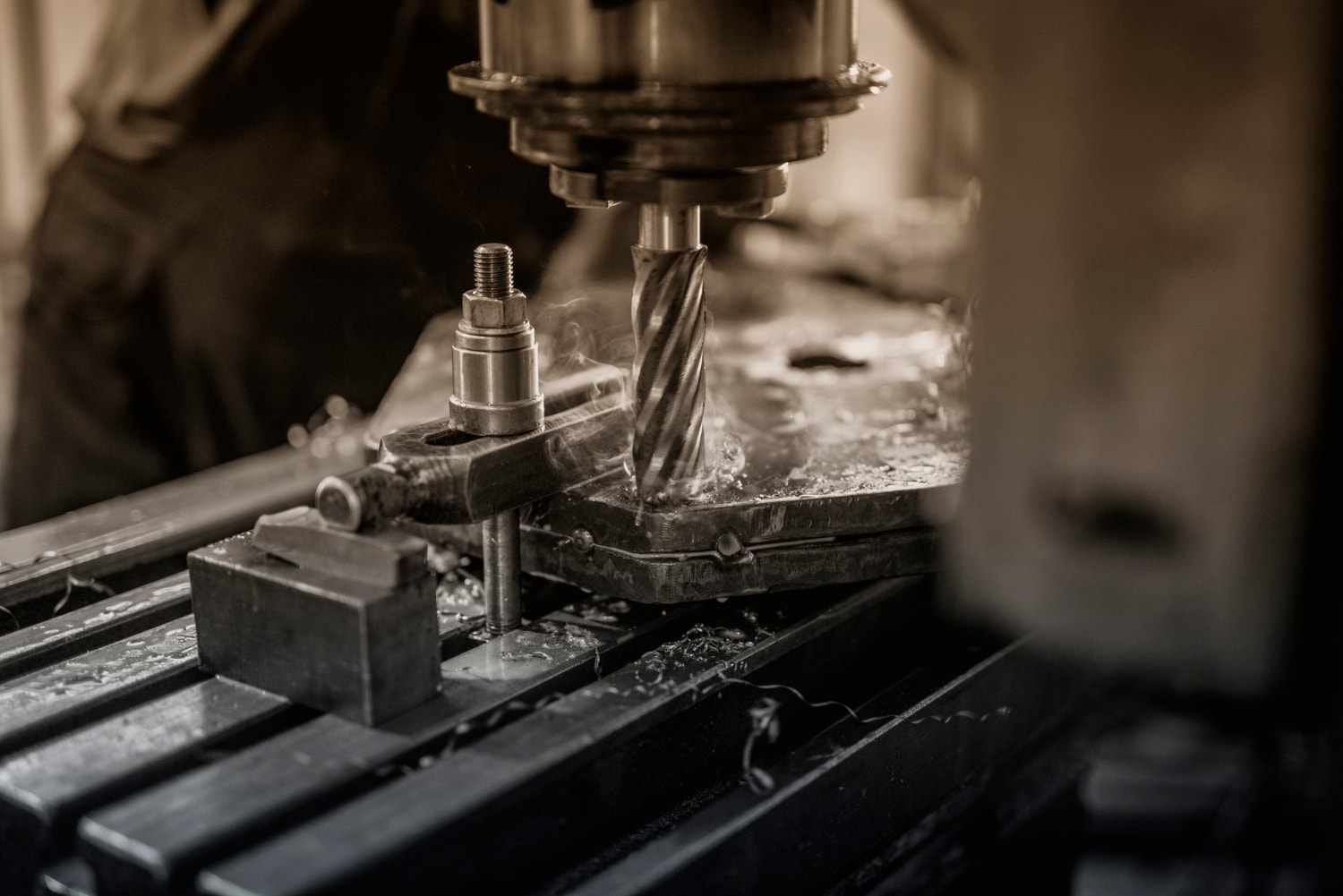
Talk to our engineering team about design optimization, material selection, cost reduction, and production planning. We support global customers from prototype to production with fast, reliable manufacturing solutions.