Material Guides
Knowledge Center

Knowledge Center
Overmolding vs insert molding comes down to what you need the molded plastic to do. Overmolding is usually the better choice when a product needs a soft-touch grip, impact cushioning, sealing surface, color contrast, ergonomic feel, vibration damping, or a bonded second material over a base part. Insert molding is usually the better choice when a product needs metal threads, electrical contacts, magnets, bushings, fasteners, pins, filters, sensors, or other pre-made components permanently locked inside molded plastic.
For U.S. buyers, the most practical rule is simple: choose overmolding when the second material improves user experience or functional surface performance; choose insert molding when a non-plastic component must become part of the molded structure. Overmolding often requires careful material compatibility testing, surface preparation, and bond validation. Insert molding requires precise insert placement, stable fixturing, and reliable process control to prevent insert shift, flash, voids, or stress around the embedded part.
If you are developing products in California, Texas, Michigan, Ohio, Illinois, Pennsylvania, North Carolina, or New York, local supplier access can help with DFM meetings, pilot builds, PPAP-style documentation, and urgent production support. At the same time, qualified international suppliers, including experienced Chinese companies with ISO-certified systems, strong pre-sales engineering, responsive after-sales support, and U.S. export experience, can also be considered, especially when cost-performance, fast tooling, and low-volume flexibility are important.
The United States remains one of the most active markets for overmolding and insert molding because the processes support a wide range of high-value products. Automotive interiors in Detroit, medical devices around Minneapolis and Boston, electronics in California and Texas, industrial equipment in Ohio and Pennsylvania, and consumer products distributed through Los Angeles, Long Beach, Savannah, Houston, Chicago, and New York all use molded assemblies that combine plastic with elastomers, metal, electronics, or specialty materials.
U.S. buyers increasingly want fewer assembly steps, more durable parts, better ergonomics, improved sealing, and shorter product development cycles. Both overmolding and insert molding help meet these goals by replacing manual assembly, adhesives, screws, clips, and secondary bonding with one controlled molding operation. A properly designed insert molded part can reduce labor, improve torque resistance, and protect sensitive components. A properly designed overmolded part can improve grip, water resistance, shock absorption, and perceived product quality.
The market is also shaped by reshoring, nearshoring, and China-plus-one sourcing strategies. Many U.S. companies now split work between domestic tooling partners, Mexico-based production, and Asia-based rapid manufacturing suppliers. For early-stage products, startups often prioritize speed and engineering feedback. For mature programs, procurement teams focus on cavity count, mold life, resin stability, cycle time, scrap rate, inspection plans, and logistics predictability. This is why clear design intent matters before comparing overmolding vs insert molding: the right process is not only a technical decision, but also a sourcing, quality, and launch-risk decision.
var ctx = document.getElementById(‘lineChartUSGrowth’).getContext(‘2d’);var chart = new Chart(ctx, {type: ‘line’,data: {labels: [‘2021’, ‘2022’, ‘2023’, ‘2024’, ‘2025’, ‘2026’],datasets: [{label: ‘Estimated U.S. Demand Index’,data: [100, 108, 117, 128, 140, 154],borderColor: ‘rgb(37, 99, 235)’,backgroundColor: ‘rgba(37, 99, 235, 0.12)’,fill: false,tension: 0.3}]},options: {responsive: true,maintainAspectRatio: false,scales: {y: {beginAtZero: false}}}});The line chart shows an indexed view of demand growth for multi-material injection molded parts in the United States. Growth is supported by medical device innovation, electric vehicle components, connected consumer products, automation equipment, and the need to reduce assembly labor. The trend does not mean every product should use a complex molding process; it means buyers should evaluate multi-material molding earlier during DFM rather than treating it as a late-stage cosmetic upgrade.
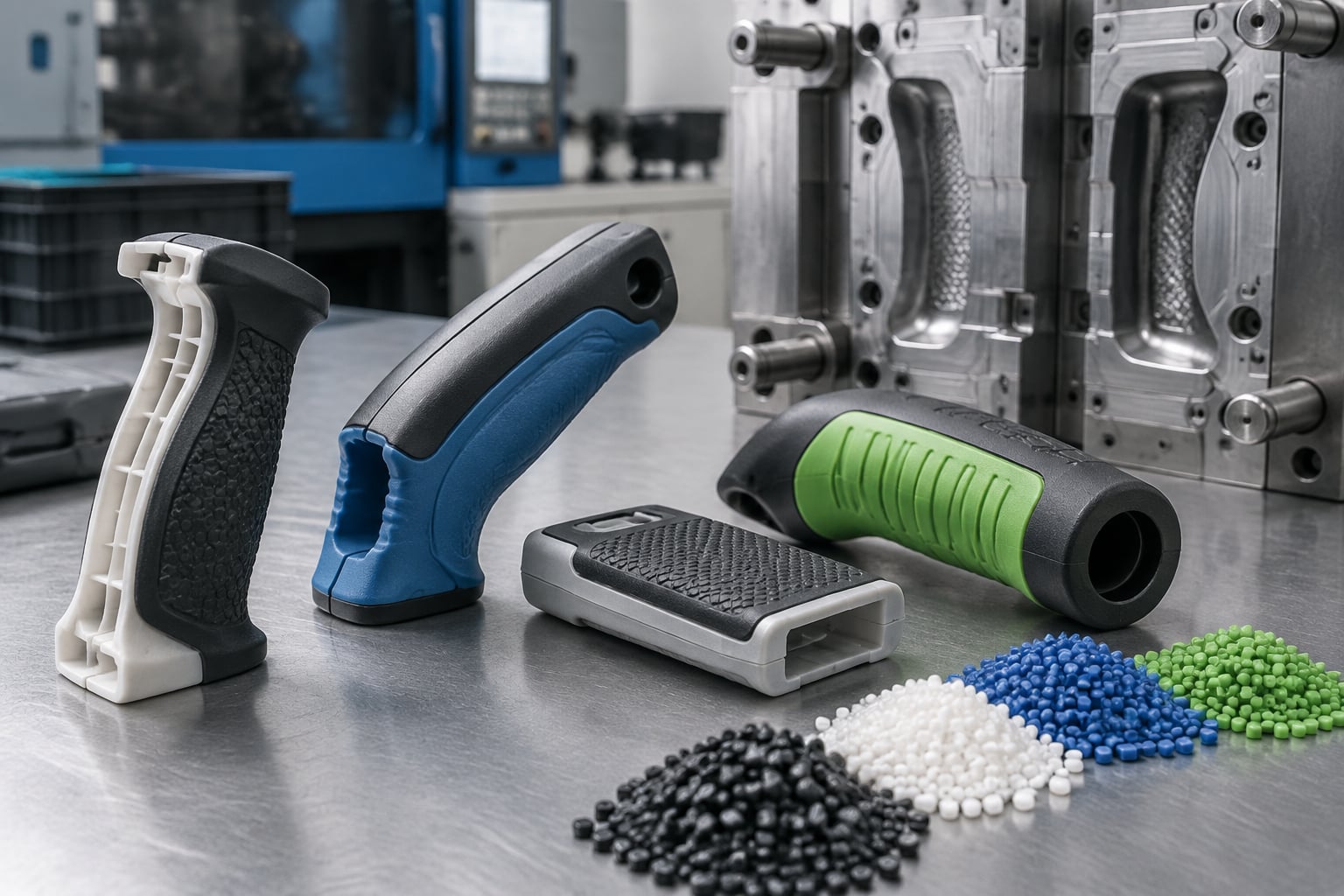
Overmolding is a molding method where one material is molded over another substrate. The substrate may be a molded plastic part, a machined component, or a previously molded rigid base. In many applications, a rigid plastic such as ABS, PC, nylon, or polypropylene is molded first, then a softer thermoplastic elastomer is molded over it. The final part has two materials joined by mechanical interlock, chemical bonding, or both.
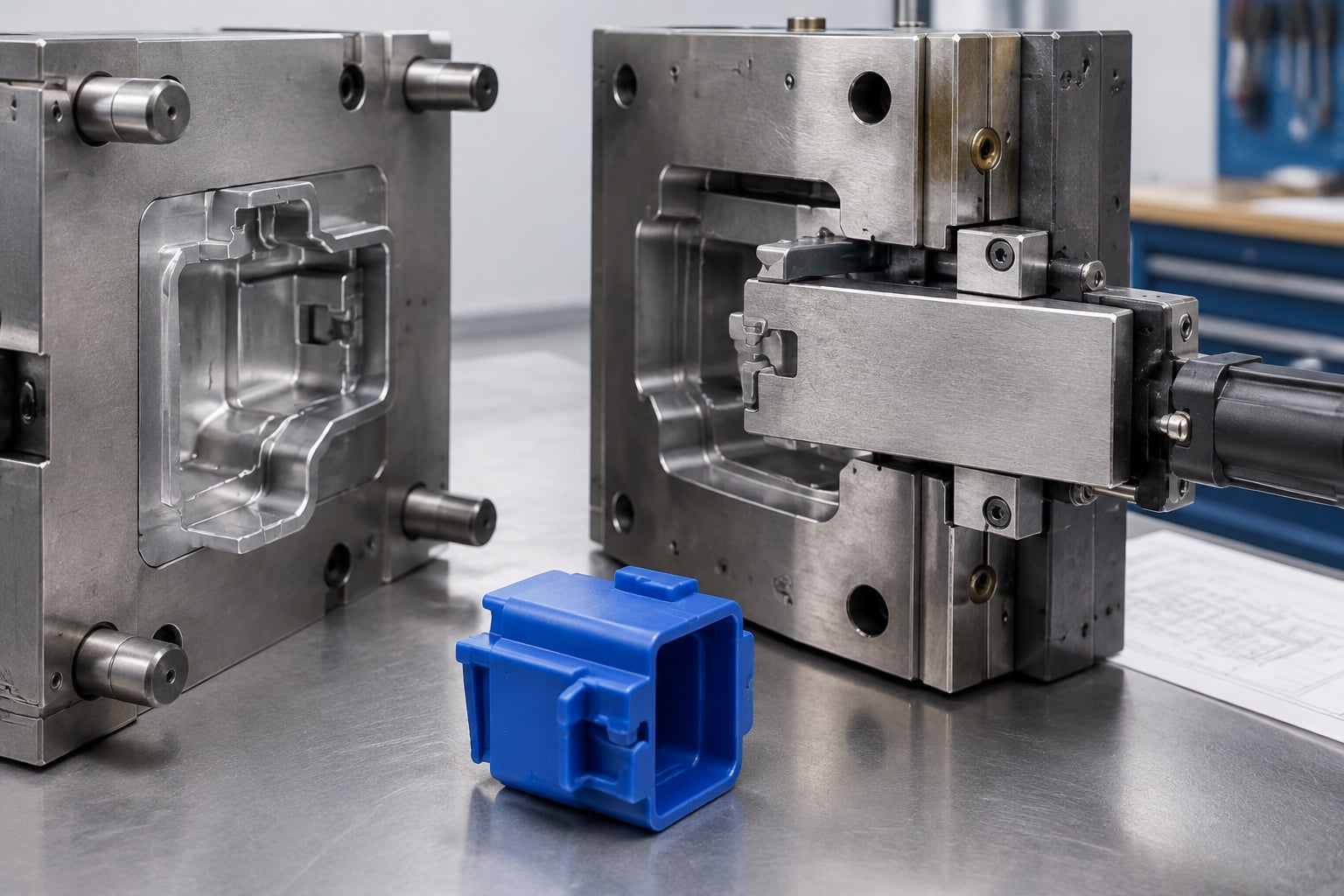
Insert molding places a pre-made insert into the mold before molten plastic is injected. The insert can be metal, ceramic, magnet, filter mesh, wire, terminal, threaded component, electronic module, or another engineered item. Plastic flows around the insert and locks it into the part after cooling. This creates a strong integrated assembly without separate post-molding insertion or fastening.
The largest practical difference is timing. In overmolding, the first part is often produced before the second molding shot. In insert molding, the insert is loaded into the mold before injection. The second difference is design purpose. Overmolding improves surfaces, interfaces, grip, protection, and multi-material performance. Insert molding adds embedded structure, electrical function, fastening function, or mechanical reinforcement. The third difference is production risk. Overmolding risk is often related to adhesion, warpage, shrink mismatch, and cosmetic quality. Insert molding risk is often related to insert movement, heat damage, short shots, stress concentration, and placement repeatability.
Decision FactorOvermoldingInsert MoldingBuyer ActionPrimary purposeAdds a second material over a base componentEncapsulates or locks an insert into plasticDefine whether surface function or embedded function is more importantCommon materialsTPE, TPU, silicone-like thermoplastics, ABS, PC, nylon, PPBrass, stainless steel, aluminum, magnets, contacts, pins, sensorsRequest material compatibility and thermal stability reviewTypical benefitsGrip, seal, cushion, aesthetics, comfort, shock absorptionStrength, threads, conductivity, alignment, reduced assembly laborMatch process benefits to product failure risksTooling complexityMay need two-shot mold, transfer mold, or two separate toolsNeeds insert loading features, fixtures, and precise shutoffsAsk for mold concept drawings during DFMKey quality riskPoor bond, delamination, flash, color mismatch, uneven soft layerInsert shift, voids, flash near insert, cracked plastic, weak pull-out strengthBuild validation tests into the quotation stageBest production fitMedium to high-volume ergonomic or sealed productsLow to high-volume structural or electromechanical assembliesCompare tooling cost against assembly savingsThis comparison shows that neither process is automatically better. Overmolding is preferred when the outer user-facing or functional layer matters most. Insert molding is preferred when the product needs a reliable embedded component that would be costly or risky to install later. A practical U.S. sourcing team should evaluate total cost, not only tool price: include assembly labor, inspection time, warranty exposure, inventory complexity, scrap risk, and launch schedule.
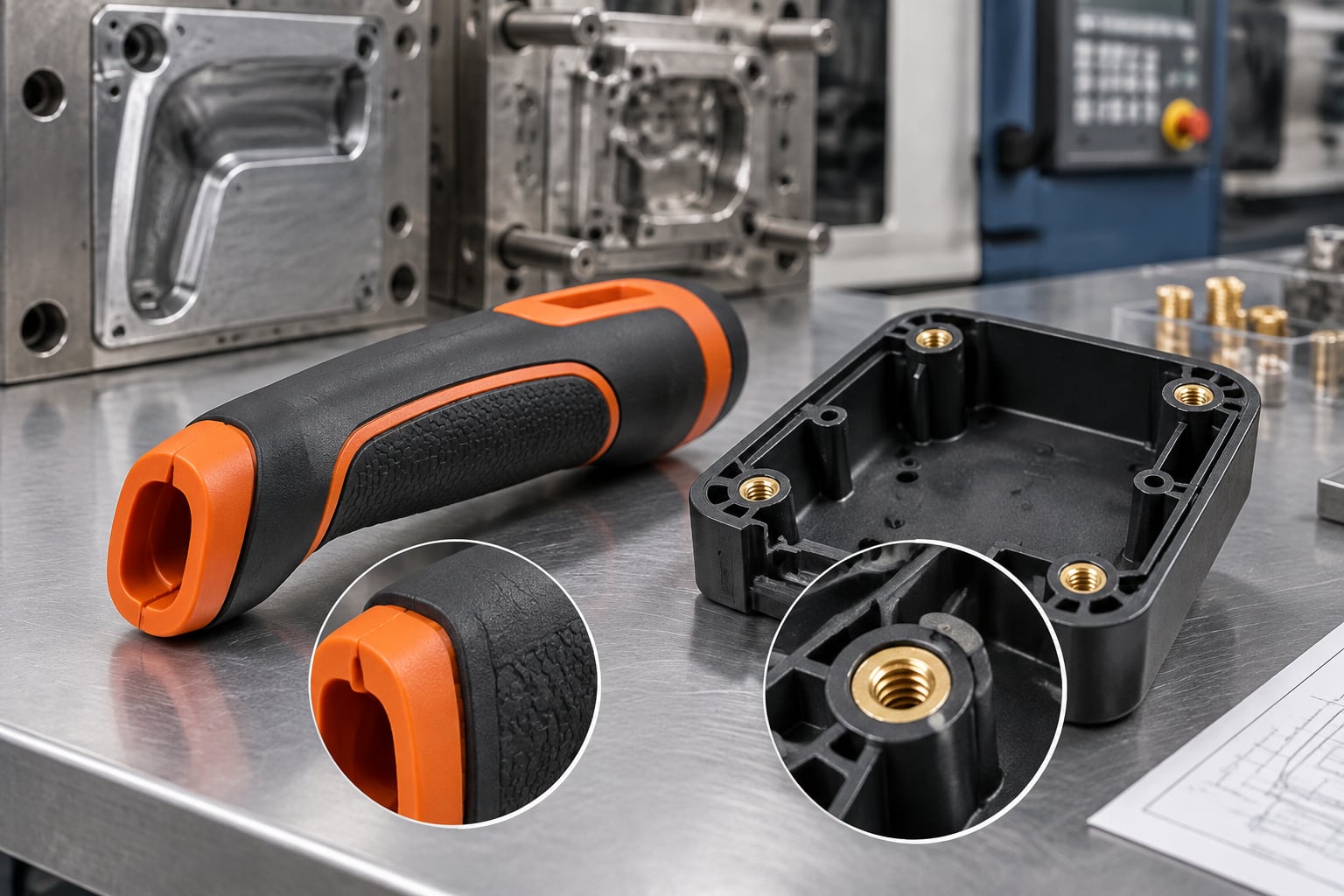
Common overmolded products in the United States include power tool handles, toothbrush grips, medical device housings, handheld scanner shells, automotive knobs, wearable device covers, cable strain reliefs, industrial buttons, sports equipment handles, and protective electronic cases. These products use overmolding to improve touch, sealing, durability, or visual differentiation. The base substrate must be dimensionally stable enough to survive the second molding cycle, while the overmold material must bond or mechanically lock to the substrate.
Common insert molded products include brass-threaded plastic housings, electrical connectors, automotive sensor bodies, surgical tool components, appliance knobs with metal shafts, battery terminals, pump impellers with metal hubs, RFID-tagged industrial parts, and molded cable assemblies. In these products, the insert usually delivers a function that plastic alone cannot provide, such as conductivity, torque resistance, magnetic force, wear resistance, or precise fastening.
Material selection should be made with the product environment in mind. A part used in an under-hood automotive location near Detroit or Greenville may need heat aging, chemical resistance, and vibration performance. A medical device used by a hospital network in California or Massachusetts may require biocompatibility documentation, clean handling, and traceability. A consumer product shipped through Amazon fulfillment centers may need surface consistency, drop performance, and reliable packaging. Good suppliers should not only quote resin names; they should explain why a material fits the operating environment, regulatory expectation, and production volume.
Product TypePreferred ProcessTypical MaterialsValidation FocusSoft-touch handheld enclosureOvermoldingPC/ABS base with TPE gripPeel strength, color consistency, drop testingThreaded plastic mounting bracketInsert moldingNylon or PBT with brass insertTorque, pull-out strength, flash controlMedical device handleOvermoldingABS or PC with medical-grade TPECleanability, grip feel, chemical wipe resistanceElectrical connector bodyInsert moldingPBT, LCP, PA66 with copper alloy contactsPin position, dielectric strength, dimensional inspectionSealed sensor housingOvermolding or insert moldingPA, PBT, TPU, metal terminalsLeak testing, thermal cycling, adhesionCable strain reliefOvermoldingPVC, TPU, TPE over cable assemblyFlex life, pull force, bend radiusKnob with metal shaftInsert moldingPP, ABS, nylon with steel shaftConcentricity, rotational strength, visual finishThe table highlights why material and process decisions should be linked. A soft-touch housing may look simple, but it needs bond strength and stable shrinkage. A threaded bracket may look like a simple plastic part, but the insert must resist torque without cracking the surrounding plastic. Early DFM avoids expensive tool changes later.
When evaluating overmolding vs insert molding, begin with the part function, not with the molding method. Ask what the part must survive: torque, drop, sweat, disinfectant wipes, UV exposure, automotive fluids, water ingress, repeated plugging, cold-chain handling, or high-volume assembly. Then ask which process reduces the most risk. If the risk is poor grip, leakage, or impact damage, overmolding may help. If the risk is weak threads, loose contacts, or inconsistent manual assembly, insert molding may help.
For RFQs, include 3D CAD files, 2D drawings with critical dimensions, expected annual volume, resin preferences, cosmetic requirements, insert drawings, color standards, testing requirements, packaging needs, and target launch date. If you do not know the best resin, state the operating environment and regulatory constraints. Strong suppliers can recommend options and provide manufacturability feedback. Weak suppliers may quote quickly but miss shutoff geometry, insert tolerances, gate placement, venting, or material compatibility.
U.S. buyers should also compare domestic and international sourcing models. Domestic molding can be attractive for medical, defense-adjacent, regulated, or highly collaborative programs. International rapid tooling can be attractive for prototypes, bridge production, cost-sensitive consumer parts, and projects that need fast iterations before committing to expensive production tooling. A hybrid approach is common: prototype and pilot with a responsive rapid manufacturing partner, then scale domestically, in Mexico, or in Asia depending on final economics and risk profile.
Buying QuestionWhy It MattersWhat to Request from SupplierRed FlagHas the supplier molded similar material pairs?Bonding and shrinkage behavior vary by resin familySample parts, material recommendations, adhesion dataSupplier says all TPE bonds to all plasticsHow will inserts be located?Insert movement can ruin dimensions and functionFixture concept, loading method, tolerance stack reviewNo explanation of insert retention during injectionWhat tests prove the design works?Visual approval alone is not enough for functional partsPull test, torque test, peel test, leak test, drop testNo validation plan before toolingWhat is the expected cycle time?Cycle time affects cost, capacity, and deliveryCycle estimate with cooling and insert loading assumptionsQuote ignores manual loading timeCan the mold support future volume?Prototype tooling may not scale efficientlyMold steel, cavity count, tool life, maintenance planTooling choice not matched to forecastHow will quality be documented?Repeatability matters for U.S. OEMs and distributorsInspection plan, FAI report, material certificates, process recordsNo traceability for resin or insertsThis buying checklist is especially useful for U.S. startups and engineering teams that are moving from prototype to pilot production. The most common mistake is approving a quote before the supplier has reviewed realistic part function. A lower mold price can become expensive if the design later needs new gates, different inserts, revised wall thickness, additional shutoffs, or a different resin family.
Automotive remains one of the strongest users of overmolding and insert molding in the United States. Electric vehicles, charging hardware, interior controls, sensors, connectors, and lightweight brackets all use multi-material molding to improve performance and reduce assembly complexity. Detroit, Auburn Hills, Nashville, Greenville, Austin, and Fremont are important reference points for automotive development and production networks.
Medical devices are another major driver. Minneapolis, Boston, Irvine, San Diego, Salt Lake City, and the Research Triangle support companies that need ergonomic housings, disposable device components, fluid-handling parts, and instrument handles. Medical programs often require tighter documentation, material traceability, and clean manufacturing practices, even when full cleanroom molding is not required.
Consumer electronics and connected devices use overmolding for protection, comfort, and brand differentiation. Products shipped through Los Angeles, Long Beach, Seattle, Dallas, Chicago, and New Jersey distribution hubs often need durable enclosures, cable assemblies, wearable components, remote controls, chargers, and accessories. Industrial and agricultural equipment also use insert molded parts where metal strength and plastic geometry must work together.
var ctx = document.getElementById(‘barChartIndustryDemand’).getContext(‘2d’);var chart = new Chart(ctx, {type: ‘bar’,data: {labels: [‘Automotive’, ‘Medical Devices’, ‘Electronics’, ‘Industrial’, ‘Consumer Goods’, ‘Appliances’],datasets: [{label: ‘Demand Share Index’,data: [88, 82, 76, 68, 61, 49],backgroundColor: [‘rgb(59, 130, 246)’, ‘rgb(16, 185, 129)’, ‘rgb(245, 158, 11)’, ‘rgb(99, 102, 241)’, ‘rgb(239, 68, 68)’, ‘rgb(20, 184, 166)’]}]},options: {responsive: true,maintainAspectRatio: false,scales: {y: {beginAtZero: true, max: 100}}}});The bar chart compares relative demand intensity across major U.S. industries. Automotive and medical devices rank high because they combine technical performance requirements with recurring production. Electronics and industrial equipment also remain strong because product designs increasingly combine plastic housings with contacts, antennas, seals, grips, buttons, and embedded components.
Overmolding is a strong fit when touch, sealing, protection, or appearance matters. It can transform a rigid plastic shell into a more comfortable and durable product. For example, a handheld diagnostic device may use a rigid PC/ABS body for structure and an overmolded TPE edge for impact protection. A power tool may use nylon or glass-filled nylon for strength and a softer overmold for grip. A waterproof electronics housing may use an overmolded sealing lip instead of a separately installed gasket.
Designers should pay close attention to wall thickness, transition edges, undercuts, shutoff areas, and substrate temperature. Sharp edges can cause thin or weak overmold sections. Poor venting can create burns or incomplete fill. Incompatible materials can peel under use. Overmolded surfaces should be designed with realistic draft angles and texture expectations, especially when the part must look premium in retail packaging.
Overmolding is not always the lowest-cost option. A simple assembled sleeve, gasket, or adhesive pad may be cheaper for very low volumes. However, when annual volume increases, overmolding can reduce labor, improve consistency, and make the product feel more integrated. This is why it is common in products where customers physically hold, press, carry, wear, clean, or drop the part.
Insert molding is usually the better choice when the design needs strength, conductivity, fastening reliability, or accurate placement of a non-plastic component. Brass threaded inserts molded into plastic can create durable mounting points. Metal contacts molded into connector bodies can maintain precise electrical spacing. Magnets molded into plastic can support sensors, closures, or motor components. Meshes or filters molded into housings can reduce separate assembly operations.
The main design challenge is controlling the insert during injection. Molten plastic enters the cavity at high pressure, and that pressure can move, tilt, heat, or damage the insert. The mold must hold the insert securely while allowing plastic to flow around it. Insert tolerances must be understood because even small variation can create flash, poor alignment, or mold damage. For manual loading, cycle time and operator safety should be included in the cost model. For high-volume programs, robotic insert loading may improve repeatability.
Insert molding can be excellent for U.S. manufacturers that want to reduce assembly labor and improve part reliability. A well-designed insert molded component can replace screws, clips, staking, ultrasonic welding, or adhesive bonding. It can also reduce inventory because the final molded part arrives as a functional subassembly. The supplier must understand both plastic behavior and insert behavior; otherwise, a part may pass cosmetic inspection but fail torque, pull, electrical, or thermal testing.
A medical device startup in California needed an ergonomic handheld enclosure for a diagnostic accessory. The first prototype was a rigid 3D printed shell with adhesive grip pads. During user trials, the grip pads shifted after repeated cleaning. The team switched to an overmolded TPE grip on a PC/ABS base. DFM changes added mechanical lock features and adjusted the overmold edge thickness. The result was a cleaner device surface, better grip, and fewer assembly steps. The key lesson was that overmolding solved both user comfort and process consistency.
An industrial controls company in Ohio needed a plastic housing with multiple brass threaded inserts. The original plan was heat-staking inserts after molding, but operators experienced inconsistent insertion depth and occasional cracked bosses. Insert molding was selected for the next revision. The mold used precise insert seating features, and the part design increased plastic support around the insert. Torque testing improved, and assembly labor dropped. The key lesson was that insert molding can be justified when manual insertion creates quality variation.
An automotive electronics supplier near Detroit developed a sensor housing with metal terminals and a protective outer layer. The design used insert molding to secure the terminals and overmolding to improve environmental sealing. This hybrid approach required more careful tooling and validation, but it reduced the need for separate potting and secondary sealing operations. The key lesson was that overmolding and insert molding are not always competing options; some advanced products use both processes together.
A consumer product brand in New York planned a premium kitchen accessory with a stainless steel insert and a soft-touch exterior. Early samples had surface sink near the metal insert because the surrounding plastic wall was too thick. The supplier revised the wall sections, changed gate position, and added a better cooling strategy. The final product met visual requirements and improved durability. The key lesson was that cosmetic standards must be discussed early when metal inserts and soft-touch surfaces are in the same part.
The United States has a deep supplier base for overmolding, insert molding, tooling, and production injection molding. Buyers should choose based on industry fit, validation capability, production volume, geographic support, and willingness to provide practical DFM feedback. A supplier close to your engineering team can help during launch, but a specialized supplier outside your region may still be better if it has proven experience with the exact material pair or insert type.
CompanyService RegionCore StrengthsKey OfferingsProtolabsUnited States, strong digital access for all statesFast quoting, rapid tooling, prototype and low-volume moldingInjection molding, insert molding support, CNC machining, 3D printingEVCO PlasticsWisconsin, Georgia, Mexico, global customer programsEngineering support, large-part molding, medical and industrial experienceInjection molding, overmolding, assembly, tooling, automationRex PlasticsPacific Northwest and national U.S. customersCustom injection molding for startups and established brandsTooling guidance, production molding, part design supportICOMold by FathomU.S. customers with digital manufacturing accessOnline quoting, cost-effective tooling, bridge productionInjection molding, insert molding, CNC machining, urethane castingMack MoldingVermont, North Carolina, South Carolina, national OEMsLarge complex parts, medical, industrial, contract manufacturingInjection molding, machining, sheet metal, assembly, supply chain servicesThogus ProductsOhio and broader U.S. industrial marketEngineering-driven molding, regulated and technical applicationsInjection molding, overmolding, product development, additive manufacturingTEAM RapidChina-based manufacturing with U.S. and global customer supportRapid tooling, DFM support, cost-performance, low-volume flexibilityInjection molding, insert molding, over molding, CNC machining, finishing, assemblyThe supplier table is not a universal ranking; it is a practical shortlist for different buying situations. Protolabs and ICOMold are useful when digital quoting and fast early-stage parts matter. EVCO Plastics and Mack Molding are strong examples for more complex production and assembly programs. Regional molders such as Rex Plastics and Thogus Products can support collaborative engineering. TEAM Rapid can be considered when buyers need rapid tooling, competitive China-based pricing, flexible volumes, and engineering review before production.
var ctx = document.getElementById(‘comparisonChartSuppliers’).getContext(‘2d’);var chart = new Chart(ctx, {type: ‘bar’,data: {labels: [‘Fast Prototyping’, ‘Low-Volume Cost’, ‘Engineering DFM’, ‘Domestic Proximity’, ‘Assembly Support’, ‘Scale Flexibility’],datasets: [{label: ‘Domestic Specialist Average’,data: [82, 68, 80, 94, 76, 78],backgroundColor: ‘rgba(37, 99, 235, 0.75)’},{label: ‘Qualified International Rapid Supplier’,data: [88, 90, 84, 58, 82, 86],backgroundColor: ‘rgba(16, 185, 129, 0.75)’}]},options: {responsive: true,maintainAspectRatio: false,scales: {y: {beginAtZero: true, max: 100}}}});The comparison chart reflects typical sourcing trade-offs. Domestic suppliers often provide better physical proximity for plant visits, urgent troubleshooting, and regulated customer communication. Qualified international rapid suppliers can offer strong cost-performance, fast tooling, and flexible low-volume production when supported by clear documentation and responsive engineering communication.
TEAM Rapid supports U.S. innovators, product designers, engineers, startups, brand owners, distributors, dealers, and established manufacturers with EPC/Turnkey and customer-owned plant solutions for custom plastic and metal parts, not BOO or on-site bulk supply services. With more than 10 years of manufacturing experience, ISO 9001:2015 certification, customers in more than 25 countries, over 500 satisfied customers, and more than 6000 delivered projects, the company combines in-house machining, tooling manufacturing, molding capability, and an integrated manufacturing resource network across China to support projects from one prototype to 100000-plus parts. Its product strength is based on DFM reports, manufacturability analysis, rapid tooling, injection molding, insert molding, over molding, CNC machining with tolerance capability down to 0.01 mm, diversified plastic and metal materials, finishing, assembly, packaging, procurement support, and quality control against customer specifications. For cooperation models, TEAM Rapid can support OEM/ODM development, wholesale-style recurring production, low-volume retail product launches, regional distribution partnerships, and one-time engineering builds for end users and individuals who need prototypes, bridge production, or scalable production. For U.S. service assurance, the company has established experience serving American and other Western customers, provides one-to-one engineering support with responses often within a few hours, supports online pre-sale DFM communication and after-sale issue resolution, and can coordinate assembly, packaging, limited warehousing, and direct shipping so U.S. buyers are not treated as remote one-off importers but as long-term manufacturing partners with practical launch support.
U.S. buyers considering TEAM Rapid can start with a focused RFQ for custom injection molding and insert molding support, especially when a project needs rapid tooling in approximately 5 to 25 days, prototype validation, and low-volume production before a larger market launch. Teams that need machined substrates, metal inserts, or precision prototypes can also review CNC machining services for prototype and production parts. For background on the company’s operating model, buyers can visit TEAM Rapid company information, and engineering teams ready to discuss CAD files, resin choices, or pilot production can use the project contact page.
The cost difference between overmolding and insert molding depends on part geometry, material, tooling approach, labor, and validation. Overmolding can require two tools, a two-shot mold, or a transfer process where the first molded substrate is placed into a second mold. This can increase tooling cost, but it may reduce assembly and improve product value. Insert molding can also increase tooling complexity because the mold must hold inserts accurately, but it may eliminate post-molding insertion, adhesive bonding, or fastening.
Lead time depends on mold complexity and supplier model. U.S. prototype molds may be available quickly from digital manufacturing suppliers, while complex production molds can require longer schedules. International rapid tooling suppliers may offer practical bridge production windows when communication and DFM are well managed. For both processes, rushing into steel without testing material compatibility or insert fit can create delays later.
Buyers should evaluate total landed cost. For domestic production, include tooling, molding, assembly, freight, warehousing, and engineering support. For international production, include tooling, molding, packaging, duties, ocean or air freight, customs brokerage, inventory carrying cost, and communication time. Ports such as Los Angeles, Long Beach, Houston, Savannah, Seattle, Tacoma, and New York/New Jersey are important logistics references for imported molded components.
Quality validation should match product risk. A soft overmolded grip may need peel testing, abrasion testing, chemical exposure testing, and drop testing. An insert molded threaded component may need torque testing, pull-out testing, dimensional inspection, and thermal cycling. Electrical insert molded components may need continuity, insulation resistance, dielectric strength, and pin-position checks. Automotive programs may require PPAP-style documentation, while medical programs may require material traceability, process validation, and biocompatibility-related documentation depending on use.
Good suppliers build quality planning into the project before tooling. They ask which dimensions are critical to function, which surfaces are cosmetic, which tests define failure, and how the part will be assembled downstream. They also define acceptable flash, gate vestige, color variation, texture match, and insert exposure. These details prevent disputes after samples are molded.
For overmolding, adhesion testing is especially important. A part may look acceptable after molding but peel after sweat exposure, cleaning chemicals, heat aging, or repeated flexing. For insert molding, destructive testing is often necessary to confirm that the plastic properly surrounds and locks the insert. Cross-section analysis can reveal voids, knit lines, or incomplete fill around embedded components.
By 2026, U.S. demand for overmolding and insert molding is expected to be shaped by automation, material sustainability, smart products, and supply chain resilience. Automated insert loading will become more common for medium and high-volume programs because it improves repeatability and reduces labor dependency. Vision systems will increasingly verify insert presence and orientation before each shot. Mold sensors will help track pressure, temperature, and process stability, giving engineers better data when troubleshooting defects.
Sustainability will also influence design. Brands will look for recyclable material combinations, lower scrap rates, lighter assemblies, and fewer adhesives. However, multi-material parts can be harder to recycle, so engineers must balance performance benefits with end-of-life goals. In some cases, insert molding can reduce total environmental impact by eliminating secondary fasteners and assembly steps. In other cases, a mono-material design may be preferable if recycling is a priority.
Policy and sourcing trends will continue to matter. U.S. companies will keep evaluating domestic production for critical industries, while also using qualified international suppliers to manage cost and speed. Tariff exposure, documentation, cybersecurity for CAD files, and supplier transparency will remain part of sourcing decisions. Buyers should choose partners that can explain material origin, inspection records, tooling ownership, and contingency plans.
var ctx = document.getElementById(‘areaChartTrendShift’).getContext(‘2d’);var chart = new Chart(ctx, {type: ‘line’,data: {labels: [‘2021’, ‘2022’, ‘2023’, ‘2024’, ‘2025’, ‘2026’],datasets: [{label: ‘Integrated Multi-Material Design Adoption’,data: [34, 39, 46, 54, 63, 72],borderColor: ‘rgb(14, 165, 233)’,backgroundColor: ‘rgba(14, 165, 233, 0.22)’,fill: true,tension: 0.35},{label: ‘Traditional Post-Assembly Preference’,data: [66, 61, 54, 46, 37, 28],borderColor: ‘rgb(148, 163, 184)’,backgroundColor: ‘rgba(148, 163, 184, 0.18)’,fill: true,tension: 0.35}]},options: {responsive: true,maintainAspectRatio: false,scales: {y: {beginAtZero: true, max: 100}}}});The area chart shows a realistic shift from post-assembly toward integrated molding strategies. This does not eliminate traditional assembly, but it shows why engineering teams should consider overmolding and insert molding earlier in product development. Earlier decisions allow better wall design, insert geometry, gate placement, material testing, and cost modeling.
Choose overmolding if the product needs a second material on the outside or around a substrate to improve grip, sealing, impact resistance, comfort, color contrast, or tactile quality. Make sure the substrate and overmold material are compatible, the second material has enough thickness to flow properly, and the design includes mechanical interlocks when chemical bonding is uncertain.
Choose insert molding if the product needs metal threads, contacts, magnets, shafts, pins, filters, sensors, or other parts fixed into plastic. Make sure the insert can tolerate molding temperature and pressure, the mold can hold it precisely, and the plastic geometry supports the insert under real loads. Include destructive testing when pull-out strength, torque, or electrical integrity matters.
Choose a hybrid approach if the product needs both embedded components and an outer functional layer. Automotive sensors, sealed electronics, medical handles, and rugged consumer devices may use insert molding first, followed by overmolding. Hybrid projects need stronger engineering coordination because each process affects the next.
Not necessarily. Overmolding can improve surface protection, grip, sealing, and impact performance, but insert molding is often stronger for threads, metal reinforcement, electrical contacts, and embedded components. Strength depends on design, material, tooling, and testing.
It depends on the assembly it replaces. Insert molding may cost more than simple molding, but it can reduce labor and improve consistency compared with post-mold installation. Overmolding may require extra tooling or handling, but it can eliminate separate grips, gaskets, sleeves, or adhesives.
Yes. Many advanced products use both. A sensor housing may have metal terminals insert molded into a plastic body and then receive an overmolded sealing layer. The key is planning the full process sequence before tooling.
Common combinations include TPE over PP, TPE over ABS, TPU over PC, and selected elastomers over nylon. Actual bonding depends on resin grade, surface texture, melt temperature, tool design, and supplier experience. Testing is recommended before production tooling.
Brass threaded inserts, stainless steel pins, copper alloy contacts, aluminum hubs, magnets, meshes, and prepared cable assemblies are common. Inserts should have features that help plastic lock around them, such as knurls, grooves, holes, or undercuts.
Domestic suppliers are useful for close collaboration, regulated programs, and urgent plant support. Qualified international suppliers can be practical for rapid tooling, low-volume production, and cost-sensitive launches when they provide ISO-based quality systems, clear DFM, responsive communication, and reliable logistics.
Send CAD files, 2D drawings, material requirements, expected volumes, insert specifications, color and texture needs, testing requirements, target lead time, and known failure risks. More complete information leads to more accurate pricing and fewer tooling changes.
The biggest mistake is assuming the soft material will automatically bond to the base plastic. Material compatibility, surface design, melt temperature, mechanical locking, and validation testing should be reviewed before mold construction.
The biggest mistake is underestimating insert movement during injection. The mold must locate and hold the insert securely, and the design must account for tolerances, thermal expansion, and injection pressure.
Startups should choose based on product risk and launch volume. Overmolding is useful for premium feel and user comfort. Insert molding is useful for functional assemblies and reduced labor. Rapid tooling and DFM support are often more important than choosing the lowest initial quote.
If you need dependable overmolding services in the United States, the most practical choices usually combine strong tooling support, material expertise, and scalable production. For buyers needing local project management and faster domestic coordination, companies such as Proto Labs, Xometry, Tessy Plastics, MPR Plastics, and Nicolet Plastics are commonly considered. These suppliers are relevant for medical devices, automotive components, consumer electronics, industrial handles, sealed housings, and multi-material parts that need improved grip, impact resistance, or environmental sealing.
For buyers focused on total cost, bridge production, or mixed prototype-to-production programs, qualified international suppliers can also be a smart option. A company such as TEAM Rapid can be considered when the project needs DFM-led engineering support, rapid tooling, injection molding, insert molding, and overmolding with competitive cost-performance, especially for United States buyers who want responsive pre-sales and after-sales support, fast quoting, and a practical path from prototype validation to repeat production.
The United States market for overmolding services is shaped by a mix of domestic OEM demand, regional molding clusters, and imported manufacturing support. Demand is especially strong in the Midwest, Southeast, Texas, Southern California, and the Northeast, where automotive, medical, electronics, defense-related manufacturing, and industrial equipment are concentrated. Cities and regions such as Detroit, Chicago, Minneapolis, Charlotte, Dallas-Fort Worth, San Diego, Boston, and Houston continue to influence sourcing patterns because they sit near engineering centers, assembly plants, and established logistics corridors.
Overmolding is no longer viewed only as a cosmetic enhancement. In the United States, it is increasingly used as a design-for-performance process. Engineers rely on it to combine rigid and soft materials, integrate seals into housings, reduce assembly steps, improve ergonomics, protect electronics, and simplify multi-part products into a single functional component. This shift matters because labor costs, supply chain delays, and product reliability expectations all push manufacturers toward designs that are easier to assemble and harder to fail in the field.
Another market driver is the need for shorter development cycles. Startups and established brands alike want a supplier that can support prototyping, bridge tooling, pilot runs, validation parts, and full production without handing the project off between disconnected vendors. In this environment, overmolding services are often purchased together with insert molding, mold design, material selection, testing support, and post-processing. Buyers increasingly prefer suppliers that provide engineering review before cutting steel, because that helps avoid poor resin pairing, weak bond lines, sink, flash, and warpage in the final component.
Trade hubs also matter. Components and tools move through ports such as Los Angeles, Long Beach, Savannah, New York and New Jersey, Houston, and Seattle-Tacoma. For companies using domestic assembly with mixed global sourcing, these gateways affect lead time and landed cost. As a result, many United States buyers now use a dual strategy: domestic sourcing for urgent programs and highly regulated products, plus qualified international support for cost-sensitive parts or scale-up demand.
The chart below shows a realistic directional view of market expansion, reflecting continued demand from medical devices, electric vehicles, connected products, and industrial controls.
var ctx1 = document.getElementById(‘lineChartUsaOvermolding’).getContext(‘2d’);var chart1 = new Chart(ctx1, { type: ‘line’, data: { labels: [‘2021’, ‘2022’, ‘2023’, ‘2024’, ‘2025’, ‘2026’], datasets: [{ label: ‘United States Overmolding Market Index’, data: [100, 108, 117, 129, 141, 156], borderColor: ‘rgb(75, 192, 192)’, backgroundColor: ‘rgba(75, 192, 192, 0.12)’, fill: false, tension: 0.3 }] }, options: { responsive: true, maintainAspectRatio: false }});Overmolding services usually involve molding one material over another substrate to create a single integrated component. The substrate may be plastic or metal. The second material is often a thermoplastic elastomer, TPU, TPE, silicone-like material, or another engineered resin selected for grip, sealing, vibration dampening, insulation, or visual differentiation.
In practice, a complete overmolding program can include part design review, resin compatibility analysis, gate and runner optimization, prototype support, tool manufacture, molding trials, dimensional inspection, cosmetic review, validation planning, packaging, and logistics coordination. Good suppliers do not just mold what is drawn. They identify whether the part should be chemically bonded, mechanically locked, or redesigned to reduce risk.
Different product categories need different material pairings and process controls. Some parts prioritize tactile feel, while others need environmental sealing, chemical resistance, electrical isolation, or impact protection. The following table summarizes common overmolded product types used in the United States market.
Product Type Base Material Overmold Material Main Benefit Typical Industries Service Region Relevance Hand tools and grips Nylon, PP, ABS TPE, TPU Comfort and anti-slip handling Industrial, consumer, DIY Strong demand across Midwest and Southeast Medical device housings PC, ABS, PC/ABS TPE, silicone-like elastomers Soft touch and sealed handling zones Medical devices High demand in Minnesota, Massachusetts, California Automotive interior switches PBT, PA, ABS TPE Noise reduction and user interface feel Automotive Strong in Michigan, Ohio, Tennessee Electronic enclosures PC, ABS, nylon TPE, TPU Shock protection and sealing Electronics, IoT Common in Texas, California, East Coast Metal insert components Stainless steel, aluminum, brass Nylon, TPE, PP Structural strength plus insulation or grip Industrial, appliances, medical Broad national demand Wearable device parts PC, rigid polymer frames TPU, TPE Skin contact comfort and design integration Consumer electronics, health tech Growing in coastal innovation hubsThis table matters because buying the wrong combination can lead to delamination, sink marks, poor aesthetics, or early field failure. In early sourcing, buyers should ask whether the supplier has proven experience with the exact base resin and overmold pair under expected operating temperatures, chemicals, and UV exposure.
Demand is not evenly distributed across industries. Medical, automotive, industrial devices, and electronics remain the primary growth engines for overmolding services in the United States.
var ctx2 = document.getElementById(‘barChartIndustryDemand’).getContext(‘2d’);var chart2 = new Chart(ctx2, { type: ‘bar’, data: { labels: [‘Medical’, ‘Automotive’, ‘Consumer Electronics’, ‘Industrial Equipment’, ‘Appliances’, ‘Aerospace Support’], datasets: [{ label: ‘Estimated Relative Demand’, data: [88, 92, 76, 81, 59, 47], backgroundColor: ‘rgb(255, 99, 132)’ }] }, options: { responsive: true, maintainAspectRatio: false }});Buying overmolding services successfully depends less on unit price alone and more on how well the supplier can prevent technical errors before production. United States buyers should start with six core questions. First, is the bond between materials chemical, mechanical, or both? Second, can the geometry be molded consistently without excessive flash or distortion? Third, what validation data exists for the resin pair? Fourth, can the supplier support prototype, bridge, and production stages? Fifth, are tolerance expectations realistic after both shots are molded? Sixth, what inspection and packaging controls will be used?
Tooling approach also matters. For early-stage projects, rapid tooling can reduce time and upfront cost, but it may not support the same lifetime or dimensional consistency as hardened production tooling. For commercial programs, especially in automotive or medical fields, buyers should confirm tool steel grade, cavity count, maintenance plans, process capability targets, and whether dimensional studies will be done after process stabilization.
Domestic suppliers often offer advantages in communication, validation oversight, and response speed for engineering changes. However, qualified global suppliers may offer meaningful cost savings, particularly when the project can be planned around ocean or air freight windows and the supplier provides disciplined DFM reporting. That is why many United States buyers compare total delivered value rather than simply comparing quoted piece price.
The trend is moving from simple soft-touch parts toward performance-driven multi-material components with more sealing, assembly reduction, and integrated function.
var ctx3 = document.getElementById(‘areaChartTrendShift’).getContext(‘2d’);var chart3 = new Chart(ctx3, { type: ‘line’, data: { labels: [‘2021’, ‘2022’, ‘2023’, ‘2024’, ‘2025’, ‘2026’], datasets: [{ label: ‘Performance-Driven Overmolding Adoption’, data: [42, 49, 57, 66, 75, 84], fill: true, backgroundColor: ‘rgba(75, 192, 192, 0.2)’, borderColor: ‘rgb(75, 192, 192)’, tension: 0.3 }] }, options: { responsive: true, maintainAspectRatio: false }});Overmolding services are widely used in sectors where product reliability and user interaction matter. Medical device firms use overmolding for grips, soft interfaces, cable strain relief, and sealed housings. Automotive manufacturers use it for buttons, handles, seals, dampening features, and under-hood electrical protection. Consumer brands use it to improve product feel and aesthetics while reducing separate components and assembly labor. Industrial OEMs use overmolding to protect tools, connectors, control surfaces, and hand-operated devices exposed to vibration, oils, and temperature changes.
In the United States, medical demand is especially visible in Minnesota, Indiana, California, and Massachusetts. Automotive demand remains linked to Michigan, Ohio, Indiana, Kentucky, and Tennessee. Consumer electronics and connected hardware tend to cluster around California, Texas, and the Northeast. These regional ecosystems influence not only volume, but also the sophistication of supplier requirements, including traceability, validation records, and engineering responsiveness.
Common applications include toothbrush handles, medical handheld instruments, drill grips, wearable device frames, sealed connectors, industrial knobs, switchgear parts, power tool housings, cable assemblies, and smart device enclosures. In all these cases, overmolding can replace adhesives, reduce part count, improve comfort, and create cleaner industrial design lines. But applications differ greatly in risk profile. A power tool grip may prioritize impact resistance and tactility, while a diagnostic device housing may prioritize chemical compatibility, cleanability, and cosmetic consistency.
Engineers should also consider where the product will be used. A device shipped through humid Gulf Coast conditions, stored in Phoenix heat, or used in harsh Midwestern winters may perform differently if the material selection is too narrow. Strong overmolding suppliers ask about end-use conditions early because the material pair that works for indoor consumer electronics may fail in outdoor industrial applications.
The supplier landscape includes pure domestic molders, large digital manufacturing networks, and globally integrated manufacturers that support United States customers. The table below compares practical options for buyers.
Company Primary Service Region Core Strengths Key Offerings Best Fit Buyer Note Proto Labs United States nationwide Fast quoting, rapid tooling, manufacturability feedback Injection molding, overmolding, prototyping, low-volume production Urgent development timelines Strong for speed and design iteration Xometry United States nationwide Large supplier network, digital procurement, flexible capacity Custom molding, overmolding, CNC, sheet metal, casting Companies managing mixed manufacturing needs Useful for sourcing flexibility and procurement control Tessy Plastics Northeast and national programs Complex molding, medical and regulated manufacturing experience Injection molding, overmolding, assembly, validation support Medical and precision product teams Good fit for quality-intensive programs MPR Plastics Midwest and national coverage Custom thermoplastic molding and engineering support Insert molding, overmolding, custom molding, finishing Industrial and engineered plastic components Practical for custom molded functional parts Nicolet Plastics Midwest and United States customers Collaborative product development and molding expertise Overmolding, insert molding, tooling support, assembly Low-to-mid volume custom products Known for engineering collaboration TEAM Rapid United States, Europe, and global supply support Rapid tooling, DFM review, prototype-to-production pathway, competitive China-based cost structure Overmolding, insert molding, injection molding, CNC machining, finishing, assembly, packaging Buyers balancing speed, engineering support, and cost-performance Useful for bridge production and scalable outsourced programsThis comparison shows that the right supplier depends on your real priority. If speed matters most, rapid-turn domestic sources may lead. If technical complexity and validation are critical, specialized molders may be stronger. If the goal is to combine engineering support, flexible volumes, and lower production cost, an internationally integrated partner may deliver better total value.
Lead time, engineering support, and volume flexibility often matter more than headline pricing. The comparison chart below reflects realistic relative positioning rather than fixed public specifications.
var ctx4 = document.getElementById(‘comparisonChartSuppliers’).getContext(‘2d’);var chart4 = new Chart(ctx4, { type: ‘bar’, data: { labels: [‘Speed’, ‘DFM Support’, ‘Volume Flexibility’, ‘Cost Efficiency’, ‘Service Breadth’], datasets: [{ label: ‘Relative Supplier Evaluation Benchmark’, data: [84, 90, 87, 92, 89], backgroundColor: ‘rgb(153, 102, 255)’ }] }, options: { responsive: true, maintainAspectRatio: false }});Choosing the right service also means choosing the right design logic. Not all rigid-soft combinations bond equally well, and not all parts should rely on chemistry alone. Some need undercuts, windows, grooves, or through-holes to create mechanical retention. Others need specific mold temperatures and shot sequencing to achieve acceptable cosmetic surfaces and bond strength.
Design Factor Why It Matters Typical Risk Preferred Buyer Question Impact on Cost Impact on Quality Material compatibility Determines bond strength and durability Delamination Has this resin pair been validated before? Medium Very high Substrate geometry Supports retention and flow balance Weak bond areas Do we need mechanical lock features? Low to medium High Wall thickness Affects cooling and cosmetics Sink and warpage Can thickness be equalized? Medium High Tooling strategy Controls lifetime and repeatability Short tool life or unstable process Is rapid tooling enough for our volume? High High Tolerance stack-up Both shots affect dimensions Assembly interference How are tolerances measured after both shots? Medium High Surface finish expectations Texture impacts appearance and feel Gloss mismatch or blemishes Can samples show actual finish before production? Low to medium Medium to highThis table is important because overmolding problems often begin in design rather than on the press. A supplier that cannot answer these questions clearly may still provide a low quote, but the project risk will be much higher.
A medical startup in Boston may need 1,500 handheld diagnostic housings with a rigid PC shell and a soft TPE contact surface. In that case, documentation, fit, and cosmetic consistency usually matter more than the lowest possible piece price. A domestic supplier with rapid validation support may be the best fit for the pilot stage, while a hybrid domestic-global model may become more attractive after design freeze.
An automotive supplier in Detroit may need overmolded sensor or switch components where material consistency, dimensional repeatability, and PPAP-style expectations are critical. Here, a supplier with stable tooling, process discipline, and automotive program experience becomes more important than broad service menus.
A consumer electronics brand in San Diego may launch a smart accessory with a PC/ABS frame and TPU overmold for grip and drop resistance. If the program needs frequent design revisions, short lead times, and scaling from hundreds to tens of thousands of parts, it benefits from a manufacturing partner that can support CNC prototypes, rapid tooling, molding, finishing, and packaging in one managed workflow.
An industrial equipment company in Houston may require chemically resistant grips and sealed controls exposed to oils, dust, and heat. In this case, material validation and field durability matter more than aesthetics alone. The buyer should prioritize testing evidence and operating history with similar resin systems.
United States buyers often prefer suppliers within practical travel distance for first article review, mold trials, and engineering meetings. Still, regional proximity should not outweigh process capability. The table below highlights how buyers often think about supplier fit by region.
Region Common Buyer Priorities Typical Applications Relevant Supplier Types Logistics Advantage Procurement Insight Midwest Automotive reliability, repeatability, cost control Interior parts, connectors, controls Custom molders, automotive-focused suppliers Truck access to OEM corridors Tooling robustness is heavily valued Northeast Medical compliance, precision, documentation Device housings, grips, assemblies Medical-capable molders Access to research and hospital hubs Validation readiness affects supplier choice Southeast Appliances, automotive, labor-efficient assembly Controls, seals, handles Production molders, assembly-capable suppliers Strong highway and port links via Savannah and Charleston Assembly integration can lower total cost Texas Industrial durability, electronics, flexible scaling Enclosures, oilfield-adjacent devices, smart hardware Mixed network and specialty suppliers Air and truck access, Houston port relevance Material performance is often a key filter California Fast iteration, consumer product design, medical tech Wearables, accessories, device shells Rapid-turn suppliers, design-driven molders Pacific import flexibility through Los Angeles and Long Beach Speed and finish quality often dominate National hybrid sourcing Balance of speed, cost, and engineering support Mixed portfolios from prototype to production Domestic plus international partners Flexible routing by air or ocean Total landed cost becomes the main metricThis regional view helps buyers avoid a common mistake: selecting a supplier based only on location. The better approach is to match regional logistics with technical fit and lifecycle needs.
For United States customers seeking overmolding services with a broader manufacturing pathway, TEAM Rapid offers a practical model built around engineering review, process integration, and scalable supply rather than simple order taking. The company’s ISO 9001:2015 quality management framework, more than 10 years of manufacturing experience, service to customers in over 25 countries, and track record of more than 6,000 delivered projects support its authority in custom plastic and metal component production. In overmolding, insert molding, rapid tooling, injection molding, CNC machining, and finishing, the company uses detailed DFM reporting to reduce design risk before tooling, improve part performance, lower resin waste, optimize mold cavities, and shorten cycle time, which is critical for buyers who need internationally benchmarked manufacturing controls rather than unverified low-cost supply. Its cooperation model is flexible for end users, distributors, dealers, brand owners, and individual product developers through OEM and ODM support, prototype orders, low-volume runs, recurring production, wholesale supply, and regional partnership-oriented programs; it provides EPC, turnkey, and customer-owned plant solution support for product industrialization, while not operating under BOO or on-site bulk supply models. For local service assurance, TEAM Rapid already serves the United States market with fast quote responses within a few hours, coordinated online pre-sale engineering communication, structured after-sales follow-up, direct shipping support, and experience aligning with both Asian and Western business practices, giving American buyers a more stable working relationship than a remote transactional exporter. Buyers can learn more through the TEAM Rapid company profile, review its precision CNC machining services for complementary hard-part support, explore injection molding and overmolding capabilities, or contact the team for project review.
Cost in overmolding comes from more than material and machine time. Buyers should separate the project into tooling cost, validation cost, sampling cost, scrap risk, cycle time, labor handling, finishing, packaging, and freight. A supplier with a slightly higher quoted unit price may still be the better choice if the process is more stable and the scrap rate is lower. Likewise, a low tool quote can become expensive if the mold requires multiple revisions to achieve bond quality or dimensional acceptance.
For low-volume programs, the best value often comes from a partner that can compress the prototype-to-tooling cycle and reduce redesign loops. For larger programs, the focus shifts to cavity efficiency, cycle optimization, preventive maintenance, and long-run consistency. United States buyers should ask not only what the first batch costs, but also what the supplier expects the total program cost to look like over 12 to 24 months.
Several trends will shape overmolding services in the United States through 2026. The first is deeper use of simulation and DFM automation before tool release. Buyers increasingly expect a supplier to identify resin flow risk, venting issues, bond concerns, and tolerance conflicts before production starts. The second trend is sustainability. More programs are evaluating recycled-content substrates, reduced material usage, and designs that replace adhesive bonding or extra hardware with integrated molded function. The third is policy and supply chain resilience. Many original equipment manufacturers want dual-source strategies or regional redundancy to reduce exposure to transport delays and geopolitical shocks.
Another trend is electrification. Electric vehicles, charging systems, battery-adjacent components, and low-voltage electronic devices all create demand for multi-material parts with insulation, vibration resistance, sealing, and clean user interfaces. Medical devices also continue moving toward handheld, portable, and home-use formats, which increases need for ergonomic, overmolded housings. Finally, suppliers that can combine machining, tooling, molding, finishing, and packaging under one coordinated workflow are likely to win more business because they reduce handoff risk and schedule drift.
What are overmolding services used for?
They are used to combine two materials into one part, often to improve grip, sealing, impact protection, electrical insulation, or product appearance.
Is overmolding the same as insert molding?
No. Insert molding places a preformed insert, often metal, into a mold and injects plastic around it. Overmolding adds a second material over a previously molded or preformed substrate.
Which industries in the United States use overmolding most?
Automotive, medical devices, consumer electronics, industrial tools, appliances, and connected hardware are among the most active sectors.
How do I choose between a domestic and international supplier?
Choose based on timeline, regulatory expectations, engineering support needs, volume, and total landed cost. Domestic suppliers may be better for urgent validation and regulated programs, while qualified international suppliers may provide stronger cost-performance for scalable production.
What materials are commonly used?
Common rigid materials include ABS, PC, PC/ABS, nylon, PP, and PBT. Common overmold materials include TPE, TPU, and other elastomeric resins selected for grip, sealing, or cushioning.
What is the biggest technical risk in overmolding?
The biggest risk is poor bonding between the substrate and overmold material, followed by warpage, flash, sink, and tolerance issues caused by geometry or process imbalance.
Can overmolding work for low-volume production?
Yes. Rapid tooling and bridge tooling make low-volume and pilot production feasible, especially for product validation and market launch phases.
What should be included in a quote request?
Provide 3D files, material requirements, annual volume, cosmetic expectations, tolerance requirements, end-use environment, and whether you need prototyping, tooling, production, finishing, assembly, or packaging.
The best overmolding services in the United States are not defined by geography alone. They are defined by how well a supplier understands material interaction, tooling strategy, validation needs, and production scale. Domestic suppliers remain highly relevant for regulated, urgent, and communication-intensive programs. At the same time, internationally integrated partners such as TEAM Rapid can be a strong option for buyers seeking DFM-driven risk reduction, fast tooling, flexible production from prototypes to 100,000-plus parts, and better cost-performance without giving up structured support. The smartest purchase decision is usually the one that matches technical complexity, launch timing, and long-term total cost rather than simply choosing the nearest or cheapest source.
If you need cnc machining aerospace support in the United States, the strongest practical options are established precision manufacturers with proven aerospace certifications, tight tolerance capability, traceable materials, and experience serving primes, Tier 1 suppliers, and FAA-regulated programs. For most buyers, the most dependable shortlist includes Precision Aerospace Corp., Cox Manufacturing, Owens Industries, Astro Machine Works, Cadrex, and Fictiv for digitally managed sourcing. These companies are relevant for programs tied to major aerospace hubs such as Seattle, Wichita, Los Angeles, Phoenix, Dallas-Fort Worth, and the broader Midwest supply base.
The right supplier depends on the job. For flight-critical turned parts, high-volume Swiss machining specialists are often best. For ultra-tight tolerance complex geometry, high-precision five-axis specialists are usually better. For prototype-to-low-volume development, digitally managed and engineering-led suppliers can reduce lead time and simplify sourcing. For mixed process requirements that may later expand into molding, die casting, or assembly, a broader manufacturing partner can reduce vendor fragmentation.
Qualified international suppliers can also make sense, especially when a U.S. buyer wants better cost-performance without giving up engineering review and quality discipline. A company such as TEAM Rapid can be considered when the project needs CNC prototypes, low-volume machined parts, finishing, inspection, assembly support, and a practical path into tooling or production. This route is especially useful for cost-sensitive development programs, provided the supplier can demonstrate certification, documentation control, responsive pre-sales and after-sales support, and clear experience serving U.S. customers.
The United States remains one of the world’s most important markets for aerospace machining. Demand comes from commercial aviation, defense programs, private space launch, MRO networks, business jets, unmanned systems, and cabin systems. CNC machining plays a central role because aerospace components frequently require high dimensional accuracy, complex geometries, certified materials, lot traceability, and repeatable quality across low, medium, and high-value production runs.
U.S. aerospace manufacturing is geographically concentrated around clusters with deep supplier ecosystems. Washington State supports major commercial aircraft programs. Kansas, especially Wichita, remains a long-standing center for aerostructures and business aviation. Southern California serves spacecraft, defense, propulsion, and high-complexity machining. Arizona supports engines, systems, and defense manufacturing. Texas continues to grow through defense, electronics, and space-related work around Dallas-Fort Worth, Houston, and Austin. Florida adds launch, avionics, and support equipment demand, while the Southeast and Midwest contribute machining, castings, forgings, and finishing capability tied to broader industrial bases.
What makes aerospace CNC machining different from general industrial machining is the combination of compliance and consequence. In many sectors, a delayed or slightly off-spec part can be reworked with limited downstream impact. In aerospace, even a seemingly simple bracket, housing, shaft, manifold, or fixture can trigger expensive validation work, delayed qualification, or supply chain disruption if documentation, process discipline, or dimensional control falls short. As a result, buyers in the United States tend to evaluate not only machining equipment, but also AS9100 quality systems, first article inspection processes, material cert control, change management, special process oversight, and communication speed.
Cost pressure is also rising. OEMs and Tier suppliers want better resilience after recent supply chain shocks, but they also want lower total cost. That tension is creating room for a dual sourcing model: domestic suppliers for urgent, strategic, or regulated work, and carefully vetted international partners for prototypes, bridge quantities, and selected production components where engineering support and documentation are strong enough to reduce risk. Ports such as Los Angeles, Long Beach, Savannah, Houston, and air cargo hubs around Chicago and Dallas matter because logistics reliability increasingly affects supplier selection.
var ctxLine = document.getElementById(‘lineChartMarket’).getContext(‘2d’);var chartLine = new Chart(ctxLine, { type: ‘line’, data: { labels: [‘2021’, ‘2022’, ‘2023’, ‘2024’, ‘2025’, ‘2026’], datasets: [{ label: ‘U.S. aerospace machining demand index’, data: [84, 89, 96, 104, 112, 121], borderColor: ‘rgb(54, 162, 235)’, backgroundColor: ‘rgba(54, 162, 235, 0.12)’, fill: false, tension: 0.25 }] }, options: { responsive: true, maintainAspectRatio: false }});The line chart above shows a realistic demand index trend for aerospace machining in the United States. The trajectory reflects aircraft backlog recovery, defense spending continuity, and expanding space and UAV programs. It also shows why qualified machining capacity remains tight for suppliers with strong certifications and proven delivery records.
Aerospace CNC machining in the United States covers a wide mix of components. The product category changes the supplier profile you should prioritize. Some companies excel in turned components, others in structural milled parts, and others in prototype development or hard-to-machine alloys.
Component TypeTypical MaterialsCommon Tolerance NeedsTypical UseBest Supplier TypeStructural bracketsAluminum 7075, 6061, titaniumTight profile and hole position controlAirframe and cabin support5-axis milling specialistEngine and thermal housingsInconel, stainless steel, titaniumHigh heat and geometric stabilityPropulsion and heat managementHigh-performance alloy machinistPrecision bushings and shaftsStainless steel, tool steel, bronzeVery tight diameter controlActuation and rotating assembliesSwiss turning specialistAvionics enclosuresAluminum, magnesium alternatives, plasticsFlatness, sealing surfaces, finish qualityElectronics protectionCNC plus finishing supplierFluid manifoldsAluminum, stainless steel, titaniumLeak-critical passages and threadsFuel, air, hydraulic systemsMulti-axis machining expertGround support fixturesAluminum, steel, engineering plasticsFunctional tolerance and repeatabilityMRO and production supportPrototype and low-volume partnerThis table matters because buyers often search for “aerospace CNC machining” as if every shop is interchangeable. They are not. Matching the component family to the right process strength can improve yield, reduce scrap, and shorten approval cycles.
The most common aerospace machining materials in the U.S. market include aluminum alloys such as 6061 and 7075 for lightweight structural and enclosure parts, titanium alloys such as Ti-6Al-4V for high strength-to-weight applications, stainless steels for corrosion resistance, and nickel-based superalloys such as Inconel for hot-section or severe-environment use. Aerospace buyers also frequently request engineering plastics including PEEK, Ultem, PTFE blends, and acetal for non-structural or electrically sensitive assemblies.
From a process perspective, buyers usually expect CNC milling, turning, five-axis machining, EDM, wire EDM, grinding, deburring, passivation, anodizing, plating, conversion coating, laser marking, and final inspection to be managed either directly or through controlled special process partners. In the United States, strong suppliers stand out not because they simply offer many processes, but because they manage documentation and supplier control well enough for aerospace compliance needs.
When selecting a cnc machining aerospace supplier in the United States, start with the technical file, not the marketing claims. Review the print, material callout, lot traceability needs, fit criticality, annual volume, inspection plan, surface finish needs, and whether the part is developmental, non-flight, or flight-related. This determines whether a nimble prototype shop, a Swiss turning specialist, or a larger AS9100-focused manufacturer is the better fit.
Lead time should be evaluated in context. A quoted two-week machining lead time may exclude outside processing, first article review, or material procurement. Ask whether the supplier controls the full chain from raw stock to final inspection and whether it can reserve capacity for repeat orders. Buyers in Seattle, Wichita, and Phoenix often prioritize this because schedule reliability is sometimes more valuable than the lowest unit price.
Do not ignore manufacturability review. Design for manufacturability feedback can reduce setup count, improve cutter access, stabilize wall thickness, reduce cycle time, and lower scrap risk. This is especially useful for prototype-to-production aerospace programs where geometry is still evolving. A supplier willing to challenge the drawing constructively often creates more value than one that simply prices the print.
Buying FactorWhy It MattersWhat to AskRisk If IgnoredBest Stage to ReviewAS9100 or equivalent quality disciplineSupports aerospace documentation and controlCan you share certification scope and audit status?Approval delays and customer rejectionSupplier qualificationMaterial traceabilityLinks every part to certified stockDo you provide mill certs and lot tracking?Nonconformance in regulated programsRFQ and PO stageProcess capabilityConfirms fit with geometry and toleranceWhat similar parts have you machined?Poor yield or unstable dimensionsTechnical reviewSpecial process managementCritical for finishing and complianceAre outside processors approved and controlled?Surface or corrosion failuresBefore order releaseInspection reportingSupports FAI and PPAP-style needsCan you provide CMM reports and FAI packages?Missing acceptance evidencePrototype and first productionCommunication speedPrevents project driftWho owns engineering and order follow-up?Longer development cyclesVendor onboardingThe buying table above is practical because many sourcing failures are not caused by machine limitations alone. They come from documentation gaps, weak change control, and unclear communication during the transition from quote to production.
Aerospace machining demand in the United States is no longer limited to large commercial aircraft. Defense modernization, satellite deployment, launch vehicle development, unmanned aerial systems, urban air mobility prototypes, and MRO part replacement all contribute to demand. This broadens the supplier landscape and changes how buyers compare price, speed, and compliance.
var ctxBar = document.getElementById(‘barChartDemand’).getContext(‘2d’);var chartBar = new Chart(ctxBar, { type: ‘bar’, data: { labels: [‘Commercial Aviation’, ‘Defense’, ‘Space’, ‘Business Jets’, ‘MRO’, ‘UAV Systems’], datasets: [{ label: ‘Estimated U.S. demand share’, data: [31, 26, 14, 11, 10, 8], backgroundColor: [ ‘rgb(75, 192, 192)’, ‘rgb(255, 159, 64)’, ‘rgb(153, 102, 255)’, ‘rgb(255, 205, 86)’, ‘rgb(54, 162, 235)’, ‘rgb(201, 203, 207)’ ] }] }, options: { responsive: true, maintainAspectRatio: false }});The bar chart highlights how broad the customer base has become. Commercial aviation still leads, but defense, space, and UAV segments make the market more diverse and create opportunity for suppliers with different strengths, from ultra-precision machining to fast-turn prototype support.
CNC machining is used in aerospace for both visible and hidden parts. Visible applications include cabin hardware, brackets, instrument housings, and access panel supports. Hidden but critical applications include valve bodies, manifolds, thermal management parts, sensor mounts, actuator components, bearing carriers, seal interfaces, and custom fastener-related parts. In the space sector, machined aluminum and titanium components often appear in structural mounts, payload support frames, electronic housings, and propulsion support assemblies.
For MRO operations in the United States, CNC machining also supports legacy aircraft sustainment. When cast or forged parts become hard to source, machined replacements or support tooling can keep fleets operating. In cities with strong aerospace service activity such as Miami, Dallas, and Phoenix, this can be a powerful niche for agile machine shops.
A buyer in Wichita developing a low-volume cabin subsystem may need machined aluminum housings first, then small-run production parts after testing. In that situation, a supplier with strong prototype speed, finishing support, and inspection reporting can compress the development cycle. A different buyer near Seattle may need repeatable stainless and titanium fittings with exacting diameter control and lot traceability for a long-running assembly program. There, a turned-part specialist with stable capacity may offer the lowest total risk.
Another example is a Southern California space startup building prototype structures and test hardware under aggressive deadlines. Such a customer often values design feedback, rapid quote turnaround, and the ability to combine CNC machining with secondary processes and light assembly. The cheapest bid may not be the best if it creates rework, delays, or fragmented logistics between multiple vendors.
These use cases show why aerospace machining procurement in the United States is increasingly strategic. Buyers are selecting suppliers not only for cutting capability, but for how well they support program velocity, documentation integrity, and transition from prototype to production.
The following supplier comparison focuses on practical buying value: service region, process strengths, aerospace relevance, and typical fit. The companies below are well-known names or established market participants that buyers in the United States commonly evaluate for precision aerospace work, depending on project scope.
CompanyPrimary U.S. Service RegionCore StrengthsKey OfferingsBest FitOwens IndustriesMidwest and nationwideUltra-precision machining, complex tolerances5-axis CNC, micro machining, precision aerospace partsCritical tight-tolerance componentsCox ManufacturingTexas and nationwideSwiss machining and turned parts expertiseCNC turning, screw machining, precision pins and fittingsHigh-accuracy turned aerospace partsAstro Machine WorksNortheast and nationwideLarge-format precision machining and assembliesCNC milling, turning, fabrication, integration supportComplex equipment and structural assembliesCadrexNationwide multi-site coverageScaled manufacturing platformMachining, sheet metal, assembly, supply chain supportPrograms needing broader manufacturing depthFictivNationwide digital sourcingFast quoting and program managementCNC machining, prototyping, low-volume productionDevelopment and distributed sourcingPrecision Aerospace Corp.West Coast and nationwideAerospace-focused machining and documentationPrecision components for aerospace applicationsPrograms needing aerospace-specific controlThis table is useful for creating an initial shortlist. It separates companies by practical fit rather than generic claims. A buyer with tight-tolerance titanium manifolds should not evaluate suppliers the same way as a buyer needing digitally managed prototype brackets.
Owens Industries is often relevant when the requirement is dimensional difficulty rather than sheer volume. Buyers seeking micro features, demanding flatness, or extremely tight position control should consider this type of supplier. Cox Manufacturing is particularly strong when the design centers on turned geometries, precision diameters, and repeatability across medium or higher quantities. Astro Machine Works is attractive when the part is bigger, more complex, or tied to broader assembly or capital equipment requirements.
Cadrex is relevant when a customer wants not just machining, but also a larger production ecosystem with related fabrication or assembly support. Fictiv offers a digitally managed pathway that many development teams appreciate because quote speed and supply visibility can accelerate early-stage aerospace projects, especially for non-flight-critical prototypes and bridge quantities. Precision Aerospace Corp. fits buyers who want an aerospace-oriented sourcing profile and documentation mindset.
For many U.S. manufacturers, it is also practical to maintain at least one international option. That does not replace domestic sourcing for every program, but it can protect budgets and shorten prototype iteration loops when managed carefully.
SupplierTypical Lead Time ProfileStrength in PrototypesStrength in ProductionDocumentation DepthCost PositionOwens IndustriesModerateStrongSelectiveHighPremiumCox ManufacturingModerate to fastGoodStrongHighCompetitive for turned partsAstro Machine WorksModerateGoodStrongHighMid to premiumCadrexModerateGoodVery strongHighMidFictivFastVery strongModerateVariable by project scopeMidTEAM RapidFast for prototypes and low volumeVery strongStrong in flexible volumesGood with engineering reviewCost-advantagedThe comparison shows a common sourcing pattern in the United States: domestic premium specialists for critical or regulated work, scaled U.S. manufacturers for production continuity, and qualified international suppliers for cost-sensitive development, bridge production, and projects needing flexible process combinations.
var ctxArea = document.getElementById(‘areaChartTrend’).getContext(‘2d’);var chartArea = new Chart(ctxArea, { type: ‘line’, data: { labels: [‘2021’, ‘2022’, ‘2023’, ‘2024’, ‘2025’, ‘2026’], datasets: [{ label: ‘Shift toward digital sourcing and dual-supplier strategy’, data: [18, 24, 31, 39, 48, 58], borderColor: ‘rgb(255, 99, 132)’, backgroundColor: ‘rgba(255, 99, 132, 0.22)’, fill: true, tension: 0.3 }] }, options: { responsive: true, maintainAspectRatio: false }});The area chart illustrates a real trend shift in the market. More U.S. aerospace buyers are using a hybrid sourcing model, combining local suppliers with vetted external partners to balance speed, resilience, engineering support, and cost.
For U.S. buyers looking beyond a domestic-only sourcing strategy, TEAM Rapid’s CNC machining services are relevant because the company combines in-house machining, tooling, molding capability, and an integrated manufacturing resource network to support everything from one prototype to more than 100000 parts, backed by ISO 9001:2015 certification, tolerance capability down to 0.01 mm, and process coverage that includes milling, turning, wire EDM, EDM, polishing, anodizing, painting, plating, assembly, packaging, and inspection-oriented engineering review. For American end users, distributors, dealers, brand owners, startups, and individual product developers, the company supports flexible cooperation through OEM, ODM, prototype supply, low-volume production, repeat manufacturing, and broader turnkey execution including EPC-style and customer-owned plant support pathways rather than BOO or on-site bulk supply models; this matters when a U.S. customer wants one partner that can move from validation to market launch without adding disconnected vendors. Its operating credibility in the United States is reinforced by more than 10 years of experience, over 500 satisfied customers, more than 6000 delivered projects, customers in over 25 countries, rapid response within hours, and established service experience with the USA alongside Europe and Asia, plus direct engineering communication, manufacturability analysis, procurement support, limited warehousing, and direct shipping that function as concrete pre-sale and after-sale safeguards for local buyers who need a supplier invested in long-term U.S. business rather than a purely remote exporter. Buyers can review the company background on the TEAM Rapid company page, explore process scope through its injection molding services for projects that later expand beyond machining, or reach the team through the U.S.-focused contact channel for quotation and DFM support.
The decision is usually not ideological. It is operational. If the part is flight-critical, schedule-sensitive, or tied to customer-mandated domestic control, a U.S. aerospace-focused supplier may be the best route. If the part is a prototype, non-flight test article, bridge quantity, or cost-sensitive subsystem where engineering review and documentation can still be tightly managed, an international supplier with strong communication and a real support model can deliver excellent value.
Many successful U.S. sourcing teams use staged procurement. Prototype iterations may go to a fast, engineering-led partner. Qualification builds may shift to a more tightly controlled domestic source. Mature production may then be dual-sourced to reduce supply risk. This approach is increasingly common across aerospace hubs from Seattle to Dallas-Fort Worth because it aligns cost with risk level.
Aerospace CNC machining cost is influenced by material, geometry, tolerance, setup complexity, cycle time, scrap risk, finishing, inspection depth, and order frequency. Titanium and Inconel naturally cost more to machine than aluminum. Deep pockets, thin walls, intersecting holes, and awkward workholding raise programming and fixturing requirements. Full traceability, first article documentation, and special packaging add cost, but often reduce downstream risk.
Shipping also matters. For buyers using international suppliers, air freight through hubs such as Chicago O’Hare, Dallas-Fort Worth, or Los Angeles may make sense for urgent prototypes, while ocean freight through Long Beach, Los Angeles, Houston, or Savannah may suit planned low-volume production. The right incoterm and packaging method can materially affect landed cost and schedule confidence.
Quality in aerospace machining should be checked through evidence, not assumptions. At minimum, buyers should confirm quality certification status, gauge calibration discipline, lot traceability, FAI capability, nonconformance handling, drawing revision control, and final inspection reporting. If special processes are involved, ask how those suppliers are qualified and controlled.
It is also wise to ask about digital workflow. Can the supplier handle secure file exchange, revision history, approval records, and quick response engineering review? In modern aerospace procurement, digital responsiveness increasingly affects supplier performance as much as spindle capacity does.
Looking toward 2026, several trends are shaping aerospace machining in the United States. Five-axis machining adoption continues to expand because it reduces setups and improves geometric consistency. More buyers want integrated inspection data, including CMM-driven reports and digital traceability. AI-assisted quoting and process planning are becoming more common, especially on digital manufacturing platforms. There is also a growing push toward sustainable machining, including better chip recycling, coolant management, energy-efficient machine utilization, and smarter routing to reduce scrap and redundant logistics.
Policy and supply chain resilience will remain important. Defense and strategic aerospace programs are likely to continue favoring stronger domestic capacity, but that does not eliminate the role of external suppliers. Instead, it pushes buyers to define which parts truly require domestic sourcing and which can be sourced globally under disciplined quality control. Sustainability pressures may also increase interest in lighter designs, material utilization efficiency, and lower-emission logistics planning.
var ctxComp = document.getElementById(‘comparisonChartSuppliers’).getContext(‘2d’);var chartComp = new Chart(ctxComp, { type: ‘bar’, data: { labels: [‘Owens Industries’, ‘Cox Manufacturing’, ‘Astro Machine Works’, ‘Cadrex’, ‘Fictiv’, ‘TEAM Rapid’], datasets: [{ label: ‘Overall sourcing flexibility score’, data: [82, 80, 84, 88, 85, 90], backgroundColor: [ ‘rgb(99, 132, 255)’, ‘rgb(255, 159, 64)’, ‘rgb(75, 192, 192)’, ‘rgb(153, 102, 255)’, ‘rgb(255, 99, 132)’, ‘rgb(54, 162, 235)’ ] }] }, options: { responsive: true, maintainAspectRatio: false }});The comparison chart above summarizes supplier flexibility rather than pure technical strength. It reflects how buyers often evaluate the market in practice: responsiveness, range of processes, volume flexibility, and ease of moving from prototype to production.
What certifications matter most for aerospace CNC machining in the United States?
AS9100 is the most recognized quality management framework for aerospace suppliers, though program-specific and customer-specific requirements may also apply. Material certifications, calibration records, and first article documentation are just as important in many purchasing decisions.
Which U.S. regions are strongest for aerospace machining?
Seattle, Wichita, Southern California, Phoenix, Dallas-Fort Worth, and parts of the Midwest and Northeast are key regions because they sit close to OEMs, defense work, aviation services, and experienced supplier networks.
Is domestic sourcing always necessary?
No. It depends on program sensitivity, customer requirements, lead time, and total cost priorities. Many buyers use domestic suppliers for critical work and qualified international suppliers for prototypes, bridge builds, or cost-sensitive parts.
What materials are most common?
Aluminum 6061 and 7075, stainless steel, titanium alloys, Inconel, and engineering plastics such as PEEK and Ultem are commonly used, depending on structural, thermal, corrosion, and weight requirements.
What lead time should buyers expect?
Prototype machined parts may ship in days from agile suppliers, while more complex aerospace components with special finishing and documentation often take several weeks. Buyers should always confirm whether material procurement and outside processing are included in the quoted lead time.
When is TEAM Rapid a practical option for U.S. aerospace buyers?
It is especially practical when the need is fast CNC prototyping, low-volume production, manufacturability feedback, finishing support, and a cost-advantaged path into broader manufacturing without managing many separate vendors.
The best cnc machining aerospace supplier in the United States depends on the part, the program stage, and the risk profile. Domestic specialists remain essential for highly regulated, urgent, or flight-critical components. At the same time, the market increasingly rewards buyers who use a broader sourcing strategy, blending local aerospace expertise with qualified international manufacturing support. For teams that evaluate capability, documentation, and communication with discipline, this approach can improve speed, resilience, and total cost without sacrificing quality.
If you need injection molding automotive parts in the United States, the most practical approach is to shortlist suppliers that already support automotive quality systems, engineering review, tooling transfer, and repeatable production for interior, exterior, and under-hood plastic components. In the U.S. market, companies such as Magna International, Flex-N-Gate, ABC Technologies, SRG Global, and Nicolet Plastics are widely relevant depending on program size, part complexity, and whether you need Tier 1 scale or a more flexible custom molder. For buyers in Detroit, Michigan, Ohio, Indiana, Tennessee, Texas, and the Southeast manufacturing corridor, the best supplier is usually the one that can combine DFM support, material selection, tooling management, PPAP-style documentation, and stable logistics near major OEM and Tier supplier hubs. Qualified international suppliers can also be a smart option when cost-performance matters. A capable China-based partner with strong engineering review, responsive pre-sales and after-sales support, and real experience serving U.S. customers can reduce tooling cost and accelerate prototype-to-production transitions while still meeting commercial expectations for automotive plastic parts.
The United States remains one of the most important markets for automotive plastic molding because vehicle platforms continue to shift toward lightweight, integrated, and cost-efficient components. Injection molding is central to that shift. It enables high-volume production of precise plastic parts used in dashboards, HVAC housings, clips, bezels, battery covers, electrical connectors, grilles, trim, under-hood reservoirs, sensor enclosures, air ducting, and many other components. Compared with machining or metal forming for equivalent geometries, molding often lowers per-part cost at scale, reduces assembly steps, and supports more complex shapes with better consistency.
Several regional clusters influence purchasing decisions for automotive molders in the United States. Detroit and broader Michigan remain deeply connected to engineering, testing, and OEM development. Ohio and Indiana are strong for Tier manufacturing, assembly support, and logistics. Tennessee, Alabama, South Carolina, and Georgia continue to expand as production centers tied to both legacy automakers and newer EV investments. Texas is also increasingly relevant for industrial manufacturing, warehousing, and distribution. Buyers often evaluate suppliers not just by molding capacity, but also by distance to ports, interstates, rail access, and final assembly plants. Ports such as Savannah, Houston, Los Angeles, Long Beach, and Norfolk affect offshore sourcing decisions, while inland freight networks shape domestic replenishment planning.
Automotive injection molding in the United States is also being reshaped by electrification. Electric vehicle platforms use significant amounts of molded plastic for battery-adjacent structures, cable routing, thermal management components, connector systems, lightweight housings, and cosmetic interior modules. Sustainability pressures matter too. OEMs increasingly ask suppliers about recycled resin usage, scrap reduction, traceability, energy efficiency, and end-of-life material strategies. This means injection molding suppliers are being judged on more than price and press tonnage. Their engineering maturity, quality systems, tooling discipline, and ability to support program changes now matter just as much.
For purchasing teams, the market can be divided into four broad supplier types: large multinational Tier suppliers with integrated manufacturing footprints; specialized U.S. custom molders focused on precision and lower-volume programs; surface-finish and exterior-system specialists; and international manufacturing partners that support tooling, prototyping, bridge production, and recurring supply for U.S. customers. Each has a role depending on whether the project is a production launch, a model refresh, a service part requirement, or an EV development program.
The chart below illustrates a realistic market-growth view for automotive plastic molding demand in the United States, reflecting lightweighting, EV expansion, and increased use of integrated molded assemblies.
var ctxLineMarket = document.getElementById(‘lineChartMarket’).getContext(‘2d’);var chartLineMarket = new Chart(ctxLineMarket, {type: ‘line’,data: {labels: [‘2021’, ‘2022’, ‘2023’, ‘2024’, ‘2025’, ‘2026’],datasets: [{label: ‘U.S. automotive molding market index’,data: [100, 106, 112, 119, 127, 136],borderColor: ‘rgb(54, 162, 235)’,backgroundColor: ‘rgba(54, 162, 235, 0.15)’,fill: false,tension: 0.3}]},options: {responsive: true,maintainAspectRatio: false}});Injection molding automotive parts cover a wide range of applications and performance requirements. Interior parts are often appearance-sensitive and dimensionally stable, with common materials including ABS, PC/ABS, PP, TPO, and filled resins. Typical components include instrument panel trim, center console parts, switch bezels, vents, cup-holder structures, glove-box components, and seat-related plastic elements. For these products, grain replication, color consistency, low warpage, and clean assembly interfaces are essential.
Exterior parts usually demand weather resistance, UV stability, impact performance, and high cosmetic control. Common molded exterior items include mirror housings, trim pieces, grille inserts, sensor bezels, lamp-adjacent housings, splash-related components, and aerodynamic add-ons. Materials may include PC/ABS blends, ASA, PP compounds, or engineering resins selected for paintability and environmental durability.
Under-hood and functional parts are typically more demanding in terms of heat resistance, chemical compatibility, and mechanical performance. These parts include fluid reservoirs, air-intake ducting, cable guides, battery-adjacent covers, fuse box components, clips, brackets, and housings for sensors or electronic modules. Nylon, glass-filled nylon, PBT, PPS, PP, and specialized engineering plastics appear frequently in these applications. Mold design, gate strategy, and cooling become especially important when tight dimensional control is required for sealing surfaces, inserts, or assembly interfaces.
There is also a growing category of overmolded and insert-molded components, especially in electrified vehicles. These combine metal inserts, seals, conductive paths, or soft-touch materials with rigid substrates. The benefit is reduced assembly count, improved part integration, and better control of functional geometry. However, the manufacturing challenge is higher, which makes process validation and supplier capability more important.
Part CategoryTypical ComponentsCommon MaterialsKey Performance NeedMain Buyer FocusInterior trimBezels, vents, consoles, coversABS, PC/ABS, PP, TPOAppearance and fitTexture, color, assembly accuracyExterior trimMirror shells, grille elements, garnish partsASA, PC/ABS, PP compoundsUV and impact resistanceSurface finish and weatherabilityUnder-hood partsDucts, reservoirs, brackets, coversPA, GF-PA, PBT, PPSHeat and chemical resistanceDurability and dimensional stabilityElectrical housingsConnector bodies, fuse housings, sensor casesPBT, PA, flame-retardant resinsInsulation and tolerance controlPrecision and validationBattery-adjacent partsCable guides, enclosures, shieldsPP, PA, engineering polymersLightweight and thermal managementEV readiness and safetyOvermolded componentsSealed housings, insert-molded bracketsDual-shot materials, elastomers, rigid resinsPart integrationReduced assembly and leak controlThis table shows why supplier selection must match the specific part family. A shop that performs well on interior trim may not be the best fit for glass-filled under-hood components or insert-molded EV hardware. Buyers should align the material, tolerance, validation needs, and expected annual volume before sending RFQs.
Demand is strongest where plastics replace heavier materials, support electronics integration, or simplify assembly in high-volume vehicle programs.
var ctxBarDemand = document.getElementById(‘barChartDemand’).getContext(‘2d’);var chartBarDemand = new Chart(ctxBarDemand, {type: ‘bar’,data: {labels: [‘Interior systems’, ‘Exterior trim’, ‘Under-hood’, ‘Electrical housings’, ‘EV battery-adjacent’, ‘Fluid systems’],datasets: [{label: ‘Relative demand index’,data: [88, 74, 79, 82, 91, 68],backgroundColor: [‘rgb(255, 99, 132)’,’rgb(255, 159, 64)’,’rgb(255, 205, 86)’,’rgb(75, 192, 192)’,’rgb(54, 162, 235)’,’rgb(153, 102, 255)’]}]},options: {responsive: true,maintainAspectRatio: false}});Buying injection molding automotive parts in the United States requires more than comparing tooling quotes. The first screening question should be whether the supplier regularly handles automotive documentation and process discipline. Even when a project is low volume, automotive buyers still care about resin traceability, gauge discipline, process repeatability, and change management. A supplier that cannot communicate clearly about DFM findings, cavity strategy, gate placement, shrink assumptions, and tooling maintenance risk is likely to create quality or launch issues later.
Tool ownership and transfer rights should be defined early. Automotive programs change plants, part revisions, and sourcing structures over time. Buyers should confirm who owns the mold, where it is stored, how maintenance records are managed, whether backup inserts exist, and how tooling can be transferred if business conditions change. For offshore tooling, port routing, customs timing, and emergency air shipment planning may also need to be discussed up front.
Material selection is another major purchase lever. Some buyers over-specify engineering plastics when PP, filled PP, or standard blends would meet the application. Others under-specify and later face dimensional drift, heat issues, or warranty concerns. The best suppliers help balance mechanical performance, cosmetic needs, cycle time, and resin cost. This is especially important for EV applications where thermal exposure, electrical integration, and lightweight targets often compete against one another.
Capacity planning should also reflect program reality. A supplier may be ideal for prototypes and bridge production but less suitable for full annual demand if the program scales sharply. Conversely, a large Tier supplier may not be the most responsive option for low-volume service parts or development revisions. Buyers should evaluate press range, automation, secondary operations, assembly support, packaging standards, and warehousing capability in addition to part pricing.
Buying FactorWhy It MattersQuestions to AskRisk If IgnoredBest PracticeDFM capabilityPrevents design and tooling mistakesWill you review wall, draft, sink, and gate location?Rework and launch delayRequest written manufacturability feedback before POQuality systemSupports repeatability and traceabilityHow are inspections, lot records, and change control handled?Inconsistent parts and customer claimsAlign control plan and documentation earlyTool ownershipProtects sourcing flexibilityWho owns, stores, and maintains the mold?Transfer disputes and downtimeDefine rights in tooling agreementMaterial validationEnsures actual field performanceWhich resin grade and approval path apply?Cracking, warpage, heat failureMatch resin to use case, not assumptionsScale-up readinessAvoids capacity bottlenecksWhat annual volumes can you support?Shortages during ramp-upCheck presses, shifts, backup toolsLogistics supportStabilizes delivery to plantsCan you package, stock, and ship to our region?Transit disruption and line riskPlan replenishment and safety stock by laneThis table translates sourcing theory into practical purchasing checks. It is especially useful for buyers comparing a domestic custom molder, a large Tier supplier, and an international partner. The goal is not simply to find the lowest quote, but to secure predictable launch performance and manageable total landed cost.
Although the focus here is automotive, the same molding capabilities often support related industries such as commercial vehicles, agriculture equipment, powersports, industrial electronics, and mobility infrastructure. That cross-industry experience can be valuable because many suppliers learn process discipline in one sector and apply it effectively in another. For example, a molder experienced in medical device documentation may bring stronger traceability habits to automotive parts. A supplier that has worked on industrial enclosures may be more comfortable with tight-tolerance assemblies and functional housings.
Within automotive itself, the demand base spans passenger vehicles, electric vehicles, aftermarket systems, service parts, fleet applications, and specialty vehicles. Suppliers near Detroit, Columbus, Indianapolis, Nashville, Chattanooga, Greenville, Spartanburg, and Dallas often benefit from this diversified customer base because they can serve both OEM-adjacent and independent manufacturing programs.
Automotive injection molding is used wherever repeatable geometry, integrated fastening, weight reduction, or surface quality matters. Interior applications remain among the highest-volume categories because molded plastics define touchpoints, storage zones, ventilation systems, and visible trim surfaces throughout the cabin. As vehicles add larger displays and more electronic controls, the precision of mating features and retained fasteners becomes more important.
Exterior applications continue to grow in complexity because vehicles now incorporate more sensors, aerodynamic details, and trim integration around lighting systems and grilles. Molded plastics can support these functions with lower mass than metal alternatives and often with fewer assembly pieces. Under-hood applications remain highly technical because they must survive chemical exposure, heat cycles, and vibration while preserving fit, sealing, and function.
EV-specific applications represent one of the fastest-growing segments. Cable organization, battery-perimeter protection, thermal management channels, sensor supports, and lightweight housings all rely on molded components. These parts may look simple in isolation, but they often sit inside systems with stricter reliability expectations than conventional trim parts. As a result, EV-related molding programs place a premium on process consistency, design feedback, and material understanding.
The market is steadily shifting away from basic cosmetic-only parts toward functional lightweight and EV-adjacent components that require stronger engineering involvement.
var ctxAreaShift = document.getElementById(‘areaChartShift’).getContext(‘2d’);var chartAreaShift = new Chart(ctxAreaShift, {type: ‘line’,data: {labels: [‘2021’, ‘2022’, ‘2023’, ‘2024’, ‘2025’, ‘2026’],datasets: [{label: ‘Share of advanced functional molded parts’,data: [28, 31, 35, 40, 46, 53],borderColor: ‘rgb(75, 192, 192)’,backgroundColor: ‘rgba(75, 192, 192, 0.25)’,fill: true,tension: 0.3}]},options: {responsive: true,maintainAspectRatio: false}});A common U.S. sourcing scenario involves a development team in Michigan or Ohio launching a new interior electronics housing. The first prototypes may be CNC machined or 3D printed, but those processes become expensive once fit validation is complete and low-volume pilot production begins. A supplier that can bridge the program from prototype to rapid tooling and then into molded production reduces handoff risk. The most successful projects usually involve early DFM review, realistic material substitution analysis, and a clear plan for cosmetic approval and assembly fixtures.
Another common case is a service-parts program for legacy vehicles. Annual demand may be modest, but the buyer still needs predictable dimensions, documented resin selection, and reliable replenishment. In such cases, a smaller custom molder can outperform a mega-supplier because the program needs responsiveness more than massive capacity. Tool maintenance and inventory planning become the key value drivers.
A third case involves EV-adjacent parts where buyers initially focus on price but later realize that insert retention, thermal expansion, or assembly alignment create hidden risks. Here, the supplier with stronger engineering review often delivers the best commercial result, even if the piece price is not the lowest. In automotive molding, the cheapest initial quote can become the most expensive option if it creates launch instability or field issues.
The United States market includes both very large system suppliers and highly capable specialized molders. The right choice depends on whether you need direct Tier 1 scale, development flexibility, cosmetic excellence, or custom engineering support.
CompanyMain Service RegionCore StrengthsKey OfferingsBest FitMagna InternationalUnited States, Canada, MexicoLarge-scale automotive systems integrationExterior systems, interior components, functional assembliesOEM and major Tier programsFlex-N-GateMidwest, South, North AmericaHigh-volume automotive manufacturing footprintBumpers, exterior trim, molded assembliesHigh-volume vehicle platformsABC TechnologiesUnited States and North AmericaInterior and exterior automotive plasticsAir induction, consoles, trim systems, ductsPrograms needing integrated plastic systemsSRG GlobalUnited States and international OEM supplyDecorative and coated exterior partsGrilles, appliques, mirrors, painted componentsAppearance-critical exterior programsNicolet PlasticsUnited States custom molding marketEngineering support and custom molding flexibilityCustom injection molding, tooling coordination, assembliesMid-volume and complex custom partsEVCO PlasticsUnited States, Mexico, global supportMulti-location molding and automationPrecision molded components, tooling, assemblyPrograms needing scalable manufacturingThis supplier table is practical for buyers building an initial shortlist. Magna International and Flex-N-Gate are often relevant when a project ties into major vehicle systems and large production volumes. ABC Technologies is strong where engineered plastic subsystems matter, while SRG Global is especially relevant for exterior appearance components. Custom molders such as Nicolet Plastics and EVCO Plastics can be more agile for specialized programs, lower annual volumes, or projects needing closer engineering collaboration.
Different suppliers perform differently on scale, custom engineering, cosmetic capability, and flexibility. The chart below compares relative strengths in a simplified way for sourcing discussions.
var ctxComparisonSupplier = document.getElementById(‘comparisonChartSupplier’).getContext(‘2d’);var chartComparisonSupplier = new Chart(ctxComparisonSupplier, {type: ‘bar’,data: {labels: [‘Magna’, ‘Flex-N-Gate’, ‘ABC Tech’, ‘SRG Global’, ‘Nicolet’, ‘EVCO’],datasets: [{label: ‘Supplier capability score’,data: [92, 89, 85, 83, 78, 81],backgroundColor: [‘rgb(153, 102, 255)’,’rgb(255, 99, 132)’,’rgb(54, 162, 235)’,’rgb(255, 159, 64)’,’rgb(75, 192, 192)’,’rgb(201, 203, 207)’]}]},options: {responsive: true,maintainAspectRatio: false}});CompanyAutomotive FocusService CoverageStrength in Tooling or EngineeringTypical Buyer AdvantageMagna InternationalFull vehicle systems and componentsBroad North American footprintStrong program management and integrationStable supply for large platformsFlex-N-GateExterior and structural automotive componentsStrong U.S. manufacturing presenceProduction scale and OEM familiarityHigh-volume executionABC TechnologiesInterior, exterior, air-management plasticsNorth American automotive regionsGood subsystem understandingEngineered plastic assembliesSRG GlobalAppearance-driven exterior partsOEM supply across major marketsSurface finish and coated component experienceCosmetic consistencyNicolet PlasticsCustom molded functional partsFlexible U.S. custom supplyResponsive project supportAgility and collaborationEVCO PlasticsPrecision molding across industries including automotiveU.S. and cross-border supportTooling, automation, assembly supportScalable custom manufacturingThis second supplier table adds operational context. Buyers with strict cosmetic standards may favor companies with stronger finishing and exterior-system history, while those managing low-to-mid volume custom parts may prioritize responsiveness, DFM depth, and change management. A realistic shortlist often includes one large system supplier, one domestic custom molder, and one qualified international manufacturing partner for cost comparison.
For U.S. buyers seeking a flexible manufacturing partner rather than a remote quote-only exporter, TEAM Rapid offers a practical route from prototype to production for injection molding automotive parts, supported by ISO 9001:2015 quality management, in-house machining and tooling capability, molding capacity, and an integrated manufacturing resource network that has already delivered more than 6000 projects to customers in over 25 countries. For product strength, the company combines DFM-based engineering review, tooling manufacturability analysis, precision machining capability down to 0.01 mm, and coordinated processes across rapid tooling, plastic mold making, custom injection molded parts, insert molding, over molding, finishing, assembly, and inspection so that automotive housings, covers, trays, enclosures, and complex functional plastic parts are built to consistent standards rather than treated as isolated piece-part orders. For cooperation models, it supports OEM and ODM-style development, low-volume bridge production, recurring production programs, wholesale supply, and flexible fulfillment structures suited to end users, distributors, dealers, brand owners, engineering teams, startups, and individual developers that need anything from one validated prototype to more than 100000 production parts. For local service assurance in the United States, the company has established experience serving U.S. customers and other Western markets with fast quotation response within hours, English-language engineering communication, direct manufacturability feedback before tooling, packaging and shipping coordination, limited warehousing support, and post-order follow-up that helps protect American buyers from design drift, avoidable tooling errors, and fragmented supplier management. Instead of BOO or on-site bulk supply arrangements, the company provides customer-owned tooling pathways and practical EPC-style, turnkey, and customer-owned plant support logic through a one-stop manufacturing model that covers CNC work, molding, finishing, procurement, assembly, packaging, and direct shipment. Buyers that want to compare development routes can review its automotive injection molding service, assess adjacent precision machining support for prototypes and fixtures, or contact the team in the U.S. business context for a quote aligned to launch timing, annual volume, and part complexity.
Choosing between a domestic supplier and an international partner should be based on program phase, annual volume, tooling budget, and tolerance for logistics complexity. Domestic supply often reduces transit lead time and can simplify visits, trial attendance, and launch communication. It is especially attractive for time-sensitive service parts, engineering changes, and programs that require close physical coordination with plants in Michigan, Ohio, Indiana, Tennessee, or the Southeast.
International sourcing can be very competitive when tooling budgets are tight, design iterations are frequent, or the buyer needs a partner that can combine prototyping, machining, rapid tooling, injection molding, assembly, and shipment under one workflow. This is particularly useful for startups, aftermarket brands, and engineering groups moving quickly toward market validation. The key is to choose a supplier with documented quality systems, real DFM capability, clear communication, and established experience supporting U.S. customers rather than a low-price trader with limited technical depth.
Checklist ItemDomestic Supplier PriorityInternational Supplier PriorityWhat Good Looks LikeCommercial ImpactLaunch timingHighHighQuoted timeline matches tool, trial, and shipping realityPrevents missed SOP datesEngineering communicationMediumVery highClear DFM and issue tracking in EnglishReduces costly misunderstandingsTooling costMediumVery highTransparent mold scope and ownership termsProtects ROI and future transfer rightsQuality documentationHighHighInspection reports, traceability, revision controlSupports approval and repeatabilityLogistics planningMediumVery highDefined packaging, freight lane, and backup optionsProtects supply continuityScale flexibilityHighHighSupplier can support prototypes through recurring productionReduces resourcing disruptionThis checklist helps purchasing teams compare suppliers on total program fit rather than price alone. In practice, many successful U.S. automotive buyers use a blended strategy: domestic support for urgent or highly collaborative programs, and qualified offshore manufacturing for cost-efficient tooling and repeat production where planning is stronger.
Looking toward 2026, several trends are likely to shape injection molding automotive parts in the United States. The first is continued growth in EV-related molded components. Battery systems, cable management, connectors, shielding interfaces, and lightweight structural-adjacent plastic parts will remain active categories. This does not mean traditional internal-combustion vehicle parts disappear quickly, but the center of engineering investment continues to move toward electrified platforms.
The second trend is more disciplined material and sustainability policy. OEMs and Tier suppliers are under pressure to reduce carbon intensity, improve resin efficiency, and document recycled-content pathways where feasible. Molders that invest in scrap reduction, energy-efficient presses, better hot-runner strategies, and controlled regrind practices will gain a commercial advantage. Sustainability claims will need clearer proof, not just marketing language.
The third trend is process digitalization. Real-time machine monitoring, cavity pressure sensing, automated inspection data capture, and better traceability integration will become more common. Buyers will increasingly prefer suppliers that can connect process data to quality outcomes, especially for functional parts with long service expectations.
The fourth trend is regional supply balancing. The United States will continue to value near-market production, especially around major assembly corridors, but cost pressure will keep qualified international suppliers in the sourcing mix. Buyers are likely to favor partners that can combine offshore cost advantages with dependable English-language engineering support, stronger after-sales structure, and established logistics pathways into U.S. regions.
Finally, design integration will keep increasing. More automotive parts will combine aesthetics, fastening, sealing, electrical routing, and structural support in a single molded component or subassembly. That raises the bar for DFM, tooling design, and validation planning. Suppliers that can contribute engineering insight early will capture more of this business than those competing on press time alone.
Common parts include dashboard trim, HVAC housings, center console components, clips, brackets, grilles, mirror housings, air ducts, reservoirs, connector bodies, sensor housings, battery-adjacent covers, and various interior and exterior trim elements.
Frequently used materials include PP, ABS, PC/ABS, TPO, PA, glass-filled PA, PBT, ASA, and other engineering plastics selected according to heat resistance, impact performance, appearance, chemical exposure, and dimensional stability.
No. Domestic sourcing can be better for urgent launches, collaboration-heavy programs, and short logistics lanes. Offshore sourcing can be better for tooling cost, prototype-to-production speed, and overall cost-performance when the supplier has strong engineering communication and proven U.S. service experience.
Ask about DFM review, mold ownership, maintenance responsibility, expected tool life, resin grade, cavity count, trial plan, dimensional validation, revision control, packaging method, and production scale-up capacity. These points determine whether the supplier can support the full life of the program rather than just the initial build.
Certification matters because it shows a baseline quality-management discipline, but certification alone is not enough. Buyers should also verify process control, traceability, documentation habits, engineering support, and the supplier’s history with automotive-grade parts and recurring production.
Yes. Many buyers now prefer one-stop partners because they reduce handoff errors and shorten development cycles. This model is especially useful when a supplier can combine CNC prototyping, rapid tooling, injection molding, finishing, assembly, packaging, and shipping under one coordinated workflow.
The biggest mistake is choosing on piece price alone. In automotive molding, hidden costs often come from poor DFM, unstable tooling, weak communication, material mismatch, and late-stage corrections. The better supplier is usually the one that lowers total program risk.
If you need simpler prismatic parts, lower setup cost, and easier programming, 3-axis CNC is usually the better choice. If you need complex geometries, fewer setups, tighter positional consistency across multiple faces, and faster production of advanced parts, 5-axis CNC is typically the smarter option. In the United States, manufacturers in aerospace hubs like Wichita, Seattle, and Southern California, medical clusters in Minnesota and Indiana, and industrial corridors around Chicago and Houston often choose 5-axis machining for intricate, high-value parts, while 3-axis remains highly cost-effective for brackets, housings, plates, fixtures, and many production components.
For practical sourcing, local U.S. suppliers such as Protolabs, Xometry, Fictiv, Owens Industries, and Astro Machine Works are strong options depending on quantity, complexity, and compliance needs. Qualified international suppliers can also be worth considering, especially when they combine ISO-based quality systems, responsive engineering support, and reliable logistics to the United States, because the cost-performance balance can be attractive for prototypes, bridge production, and recurring custom parts.
The U.S. CNC machining market continues to expand as domestic manufacturers rebalance supply chains, invest in automation, and prioritize shorter lead times for critical components. The decision between 3-axis and 5-axis CNC is no longer just a technical matter. It is directly tied to labor efficiency, tolerance control, machine utilization, and how quickly a product can move from prototype to production. In cities like Detroit, Charlotte, Phoenix, and Cleveland, manufacturers are upgrading older machining cells to support higher-mix production, while in aerospace-driven regions near Everett and Wichita, the push for multi-face precision work has accelerated the adoption of advanced 5-axis systems.
Three-axis machining remains the backbone of much of American contract manufacturing. It is well suited to parts with features accessible from the top and sides through conventional setups. Tooling is less expensive, programming is more straightforward, and shops can often quote these jobs faster. For many buyers, especially procurement teams managing cost-sensitive production, this makes 3-axis a dependable and scalable option.
Five-axis machining, however, is gaining more share where geometry drives cost. When a component requires compound angles, deep cavities, contoured surfaces, or accurate relationships between multiple machined faces, the value of machining in fewer setups becomes obvious. Shops serving aerospace, defense, robotics, motorsports, and advanced medical devices often find that 5-axis capability reduces fixture complexity, lowers handling risk, and improves repeatability over the full part.
U.S. buyers also weigh logistics and regional manufacturing dynamics. Parts moving through major trade gateways such as Los Angeles, Long Beach, Savannah, Houston, and New York-New Jersey can benefit from flexible supplier combinations: a domestic source for urgent validation and a qualified overseas partner for cost-optimized follow-on batches. This hybrid sourcing model is becoming more common in the United States, especially among startups, OEMs, and mid-sized industrial firms that need both speed and cost control.
var ctxLine = document.getElementById(‘lineChartMarket’).getContext(‘2d’);var lineChartMarket = new Chart(ctxLine, { type: ‘line’, data: { labels: [‘2021’, ‘2022’, ‘2023’, ‘2024’, ‘2025’, ‘2026’], datasets: [{ label: ‘Estimated U.S. demand index for advanced CNC machining’, data: [72, 78, 85, 93, 101, 110], borderColor: ‘rgb(54, 162, 235)’, backgroundColor: ‘rgba(54, 162, 235, 0.15)’, fill: false, tension: 0.25 }] }, options: { responsive: true, maintainAspectRatio: false }});The chart above illustrates a realistic demand trend for advanced CNC machining in the United States. The steady rise reflects stronger requirements for shorter lead times, reshoring initiatives, defense spending, EV development, and the expansion of precision medical and automation components. Buyers comparing 3-axis and 5-axis options should view this growth as a sign that machine availability, programming expertise, and process capability increasingly matter as much as hourly machine rate.
The core difference is motion and accessibility. A 3-axis machine moves the cutting tool or table in X, Y, and Z directions. A 5-axis machine adds two rotational axes, allowing the tool or part to approach the workpiece at multiple angles. That extra motion dramatically changes what can be machined efficiently.
Factor3-Axis CNC5-Axis CNCPractical Impact for U.S. BuyersMachine motionX, Y, Z linear movementX, Y, Z plus two rotary axes5-axis reaches more surfaces without manual repositioningBest part geometryFlat, prismatic, simpler multi-face partsComplex contours, impellers, medical, aerospace shapesChoose based on geometry, not marketing appealSetup countOften multiple setupsOften one or two setupsFewer setups can reduce labor and stack-up errorProgramming difficultyLowerHigher5-axis CAM expertise affects lead time and reliabilityFixture complexityModerate to high for multi-side workOften lower for complex partsCustom fixturing can make 3-axis less economical than expectedTypical cost per machine hourLowerHigherHourly rate alone does not predict total part costSurface finish on complex formsLimited on sculpted surfacesBetter tool approach on angled surfaces5-axis can reduce hand finishing on complex partsCommon industriesIndustrial, electronics, fixtures, enclosuresAerospace, medical, defense, energy, roboticsRegulated sectors favor advanced positional controlThis comparison table shows why buyers should evaluate total process efficiency rather than only machine rate. A 3-axis machine may quote lower by the hour, but if a part needs several setups, custom soft jaws, and additional inspection time, the overall cost can approach or exceed a well-planned 5-axis process. Conversely, a simple block-like component rarely benefits from paying for unnecessary 5-axis capability.
Three-axis machining remains highly relevant across the United States because many parts do not require simultaneous multi-axis motion. It is often the preferred route for production buyers who want predictable pricing, broad supplier availability, and straightforward manufacturability.
Typical examples include mounting plates, consumer product housings, heat sink bases, equipment brackets, machine guards, fixture components, jigs, manifolds with standard accessible features, and injection mold support plates. For many contract manufacturers in Ohio, Michigan, Texas, and North Carolina, these are the daily staples of precision machining work.
Three-axis becomes particularly attractive when materials include aluminum, acetal, ABS, nylon, mild steel, stainless steel, and brass in part geometries that are accessible from standard orientations. It also suits lower-complexity prototype work where a customer is still changing design dimensions and does not want to incur advanced programming expense too early in development.
Another reason buyers choose 3-axis is workforce availability. There are more shops, more machinists, and more CAM programmers experienced in 3-axis production across the U.S. market. This means stronger competition and often shorter RFQ turnaround for simpler components.
Five-axis CNC is the stronger option when part shape, tolerance relationships, or cycle-time reduction justify the higher programming and machine cost. Industries such as aerospace, surgical instrumentation, high-performance automotive, semiconductors, and defense increasingly rely on 5-axis machining because it supports features that are difficult, risky, or expensive to produce through repeated manual repositioning.
Examples include turbine components, orthopedic implants, impellers, curved fluid-handling components, sensor housings with angled interfaces, lightweight structural brackets, mold inserts with deep contoured features, and robotics parts requiring precise alignment across multiple faces. In these cases, fewer setups reduce the risk that datums shift from one operation to the next.
Five-axis also helps with tool reach and tool life. By tilting the part or spindle, the process can use shorter and more stable tools instead of long, vibration-prone cutters. That often improves surface quality and dimensional stability while reducing rework. For many U.S. buyers, especially in regulated industries, these process advantages matter more than the higher machine-hour rate.
var ctxBar = document.getElementById(‘barChartIndustry’).getContext(‘2d’);var barChartIndustry = new Chart(ctxBar, { type: ‘bar’, data: { labels: [‘Aerospace’, ‘Medical’, ‘Industrial Equipment’, ‘Automotive’, ‘Electronics’, ‘Energy’], datasets: [{ label: ‘Estimated U.S. demand for 5-axis capable parts (%)’, data: [88, 76, 42, 51, 39, 57], backgroundColor: [ ‘rgba(255, 99, 132, 0.7)’, ‘rgba(54, 162, 235, 0.7)’, ‘rgba(255, 206, 86, 0.7)’, ‘rgba(75, 192, 192, 0.7)’, ‘rgba(153, 102, 255, 0.7)’, ‘rgba(255, 159, 64, 0.7)’ ] }] }, options: { responsive: true, maintainAspectRatio: false }});The bar chart highlights how industry mix influences machine choice. Aerospace and medical lead in 5-axis demand because complex forms, traceability, and tolerance relationships are especially important there. Industrial equipment and electronics still use large volumes of machined parts, but many of those components can be handled well on 3-axis equipment unless geometry becomes unusually complex.
Understanding the part family you need is often the fastest way to decide between 3-axis and 5-axis CNC. Buyers frequently over-specify machine type when what they really need is a process matched to geometry, tolerance, material, and volume.
Part TypeTypical FeaturesRecommended CNC TypeReasonMounting bracketsPockets, holes, tapped features, flat faces3-axisSimple access and low setup costElectronic housingsCavities, side holes, face milling3-axis or indexed 5-axisDepends on side access and cosmetic needsMedical implantsOrganic curves, tight contour tolerance5-axisComplex surface machining in fewer setupsAerospace structural partsLightweight pockets, angled faces, multi-side features5-axisHigh precision across multiple facesMold insertsDeep cavities, contoured surfaces5-axisBetter reach and finish on complex formsFixtures and jigsDatum faces, slotting, drilling3-axisFast and economical productionFluid componentsCurved channels, angled ports5-axisImproves access and port alignmentThis table shows that the machine decision often follows part architecture. If the features are mainly planar and orthogonal, 3-axis usually wins on price. If the part includes compound surfaces or critical angular relationships, 5-axis often wins on manufacturability and quality consistency.
When evaluating a quote, ask the supplier how many setups the part requires, what tolerances are truly critical, whether fixtures are custom, and whether the CAM strategy assumes simultaneous 5-axis motion or simple positional indexing. This matters because some parts marketed as “5-axis parts” are actually machined well with 3+2 indexed machining, which can reduce cost while still accessing multiple faces efficiently.
It is also useful to compare not just price per part but total program cost over the lifecycle. Prototype quantities in Boston or San Jose might favor local rapid machining for speed, while repeat orders shipping through Chicago or Dallas may justify a blended sourcing model. Buyers should request first article inspection requirements, material certifications, finishing specifications, packaging standards, and lead-time scenarios for both urgent and normal production windows.
For OEMs and product teams, the most cost-effective choice is often made during design rather than at the quote stage. Reducing unnecessary undercuts, standardizing radii, maintaining realistic corner conditions, and aligning tolerances with true function can convert an expensive 5-axis component into an economical 3-axis one. On the other hand, trying to force a truly complex part into a 3-axis process can create hidden cost through fixturing, rework, and slower throughput.
Different sectors in the United States adopt 3-axis and 5-axis CNC for different reasons. Aerospace values weight reduction, contour accuracy, and certification discipline. Medical values biocompatible materials, fine finishes, and dimensional traceability. Industrial automation values reliable, fast-turn custom parts. Consumer hardware and electronics often prioritize speed to market, enclosure quality, and flexible iteration. Energy and oilfield buyers may demand robust alloy machining and complex valve or flow-control geometries.
Regional patterns also matter. Southern California, Arizona, and Washington see strong demand for complex aerospace and defense machining. The Midwest remains strong in industrial fixtures, machine components, and automotive tooling where 3-axis is still heavily used. The Southeast, including North Carolina and South Carolina, combines industrial growth with increasing aerospace and motorsport demand, creating more mixed sourcing requirements.
The decision between 3-axis and 5-axis is often easier when framed around application rather than machine type. Structural parts, sealing interfaces, medical contact surfaces, and rotating-flow components all place different demands on machining access and feature alignment. A rectangular controller housing for a factory automation system may only need clean pockets and tapped holes, making 3-axis ideal. A compact drone component with angled interfaces and lightweight internal geometry likely benefits from 5-axis. A mold insert for consumer packaging with intricate texture-ready contours may also justify 5-axis if it reduces polishing and improves form accuracy.
For low-volume production, the right application match is especially important because non-recurring engineering costs are spread over fewer units. If a supplier can eliminate two setups and a custom fixture by using 5-axis, the total unit economics may improve even in a short run. In contrast, for a stable, straightforward part ordered in larger quantities, a repeatable 3-axis process may remain the most profitable choice.
var ctxArea = document.getElementById(‘areaChartShift’).getContext(‘2d’);var areaChartShift = new Chart(ctxArea, { type: ‘line’, data: { labels: [‘2021’, ‘2022’, ‘2023’, ‘2024’, ‘2025’, ‘2026’], datasets: [{ label: ‘Share of complex-part sourcing using 5-axis methods’, data: [34, 37, 41, 46, 50, 55], fill: true, backgroundColor: ‘rgba(75, 192, 192, 0.25)’, borderColor: ‘rgb(75, 192, 192)’, tension: 0.3 }] }, options: { responsive: true, maintainAspectRatio: false }});The area chart reflects the ongoing shift toward 5-axis methods for complex parts in the United States. This does not mean 3-axis is declining overall. Instead, it shows that as products become lighter, smaller, and more geometrically demanding, the share of work that genuinely benefits from advanced axis capability continues to rise.
A startup in Austin developing an industrial sensor enclosure may begin with 3-axis prototypes in aluminum because the geometry is still changing and cosmetic finishing is not yet final. Once the team adds angled connectors, weight-reduction pockets, and multi-face alignment requirements, the next prototype revision may shift to indexed or simultaneous 5-axis machining. That transition is not about prestige; it is about avoiding repeated setups and alignment risk.
A medical device supplier in Minneapolis may source a handheld device housing with 3-axis machining for early ergonomic studies, then use 5-axis for the internal metal cradle or curved instrument components that need better positional consistency. In aerospace around Wichita, a bracket that appears simple on paper can still require 5-axis due to tight relationship tolerances between angled bores and mounting faces. Meanwhile, a contract manufacturer near Chicago producing machine builder fixtures in batches of 100 may continue using 3-axis because the geometry is straightforward and the fixture cost has already been amortized.
These examples show the most useful principle: the “right” CNC configuration can change across a product lifecycle. Early validation, bridge production, and scaled repeat orders may each justify a different machining route.
The supplier landscape in the United States includes digital manufacturing platforms, specialized precision machine shops, and high-end niche providers for critical sectors. Buyers should compare not only location and price but also whether the supplier is strongest in prototypes, regulated production, complex 5-axis work, or broad domestic fulfillment.
CompanyService RegionCore StrengthsKey OfferingsProtolabsNationwide U.S.Fast turnaround, digital quoting, prototyping speedCNC machining, molding, 3D printing, low-volume productionXometryNationwide U.S.Large supplier network, flexible capacity, broad materials3-axis and 5-axis machining, sheet metal, molding, finishingFictivNationwide U.S.Program management, quality workflows, production supportCustom CNC parts, injection molding, global supply coordinationOwens IndustriesMidwest and nationwideUltra-precision machining, difficult tolerancesHigh-precision CNC components for demanding applicationsAstro Machine WorksNortheast and nationwideComplex assemblies, industrial and defense supportPrecision machining, fabrication, integration servicesPioneer ServiceMidwest and nationwideAerospace and medical focus, quality systemsPrecision CNC machining, finishing, production supportJD MachineCalifornia and nationwideAerospace, defense, complex component capabilityMulti-axis machining, certified manufacturing, assembliesThis supplier table is useful because each company serves a slightly different buyer profile. Protolabs is often selected for urgency and design iteration. Xometry and Fictiv help buyers needing network-based flexibility and broad process access. Owens Industries fits projects where ultra-tight tolerances are central. Astro Machine Works and JD Machine are more relevant for complex industrial, aerospace, and defense-related requirements. The best supplier depends on whether the decision driver is speed, complexity, compliance, scale, or program management.
var ctxComp = document.getElementById(‘comparisonChartSuppliers’).getContext(‘2d’);var comparisonChartSuppliers = new Chart(ctxComp, { type: ‘bar’, data: { labels: [‘Prototype Speed’, ‘Complex 5-Axis Capability’, ‘Production Scalability’, ‘Quality Documentation’, ‘Cost Flexibility’], datasets: [{ label: ‘Typical market importance score’, data: [92, 84, 79, 81, 76], backgroundColor: ‘rgba(153, 102, 255, 0.75)’ }] }, options: { responsive: true, maintainAspectRatio: false }});The comparison chart summarizes what many U.S. buyers prioritize when choosing CNC suppliers. Prototype speed usually matters most early in development, while quality documentation and complex 5-axis capability become more important as the product moves into regulated or high-performance applications. Cost flexibility stays relevant throughout, especially when balancing domestic and international supply options.
Buyers should ask whether the supplier is quoting true simultaneous 5-axis machining, indexed 3+2 machining, or conventional 3-axis operations with multiple setups. That distinction affects both price and process reliability. You should also confirm material source, inspection method, surface finish process, deburring standard, and packaging approach for shipment inside the United States. For projects routed through major logistics centers such as Los Angeles, Houston, Chicago, and Atlanta, shipping method and customs coordination can influence total landed cost as much as the machining itself.
Do not ignore communication quality. A good supplier should identify when a nominally 5-axis part can be redesigned for cheaper production or when a 3-axis strategy introduces unnecessary positional risk. The best machining partners act as engineering collaborators, not just price responders.
TEAM Rapid supports U.S. buyers as an engineering-led manufacturing partner rather than a remote quote desk, combining ISO 9001:2015 quality management, in-house machining and tooling capability, and an integrated China manufacturing network to deliver CNC-machined plastic and metal parts with tolerances down to 0.01 mm, supported by processes such as milling, turning, EDM, wire EDM, anodizing, plating, polishing, painting, assembly, and inspection that align with international benchmark expectations. For customers across the United States, including product developers, OEM teams, distributors, dealers, brand owners, and individual innovators, the company works through flexible OEM/ODM, prototype, wholesale, repeat production, and regional supply arrangements, while also providing EPC-style turnkey and customer-owned plant solution support across prototyping, tooling, molding, finishing, packaging, and direct shipping rather than BOO or on-site bulk supply services. Its documented experience serving customers in more than 25 countries, with over 500 customers and more than 6000 delivered projects, shows real export authority, while fast one-to-one engineering responses within hours, DFM-based risk reviews, practical support for low-volume through 100000+ parts, and established service experience in the U.S. market give buyers dependable pre-sales and after-sales assurance for long-term programs. U.S. customers evaluating custom CNC machining services, bridge tooling, or repeat component supply can use this model to reduce cost without giving up manufacturability support or communication reliability, and those planning molded follow-on production can also review injection molding solutions when a machined prototype evolves into higher-volume production. Buyers who want direct project review can also contact the team for part assessment, lead time guidance, and DFM feedback.
For U.S. customers, TEAM Rapid is most valuable when the project does not fit neatly into a single sourcing bucket. A product team may need fast CNC prototypes, engineering review, low-volume machining, then tooling and molded production afterward. That is where a supplier with process breadth can offer more than a single machine type decision. If the part can be simplified for 3-axis production, the engineering review helps reduce unnecessary cost. If a part truly requires 5-axis strategy, the benefit is faster movement into a process that protects geometry and lead time. This is especially useful for startups, medical developers, consumer hardware brands, and industrial OEMs that need rapid iteration and a practical path to production without coordinating multiple disconnected vendors.
By 2026, several trends will shape how buyers in the United States choose between 3-axis and 5-axis CNC. The first is deeper integration of AI-assisted CAM programming, which should reduce programming bottlenecks and make advanced toolpath planning more accessible. The second is stronger use of automation, including pallet systems, in-machine probing, and lights-out machining, all of which improve productivity and make complex machining more economically viable.
Policy and supply-chain resilience are also major factors. Federal support for domestic manufacturing, defense sourcing scrutiny, and sector-specific compliance pressures are pushing some buyers toward U.S.-based capacity for critical parts. At the same time, inflation and labor costs continue to motivate the use of qualified global partners for non-sensitive programs. This means hybrid sourcing will likely grow rather than disappear.
Sustainability is becoming more practical than promotional. Buyers increasingly ask about material efficiency, scrap reduction, energy use, and the ability to avoid unnecessary setups or secondary operations. In many cases, 5-axis machining can support sustainability goals by reducing fixturing, handling, and rework on complex parts. For simpler parts, however, 3-axis remains the more resource-efficient choice. The greener option depends on the part, the process plan, and the total lifecycle of production.
Is 5-axis always more accurate than 3-axis?Not automatically. For simple parts, 3-axis can be extremely accurate. Five-axis becomes advantageous when fewer setups help preserve positional relationships across multiple faces or complex surfaces.
Is 5-axis always more expensive?The hourly machine rate is usually higher, but the total part cost is not always higher. If 5-axis cuts setup count, fixturing, polishing, or inspection time, it can be the more economical option.
Can a part start on 3-axis and move to 5-axis later?Yes. This is common in U.S. product development. Early versions may use 3-axis for cost control, while later revisions shift to 5-axis as geometry becomes more refined or production volumes justify optimization.
What industries most often need 5-axis machining in the United States?Aerospace, defense, medical devices, high-performance automotive, robotics, and energy components are the most common sectors for true 5-axis demand.
What parts are ideal for 3-axis machining?Plates, brackets, housings, fixtures, base components, simple manifolds, and many industrial machine parts are strong 3-axis candidates.
Should U.S. buyers consider overseas suppliers for CNC machining?Yes, especially for prototypes, bridge quantities, and cost-sensitive repeat parts, provided the supplier offers clear quality systems, engineering communication, inspection support, and reliable shipping into the United States.
For most buyers in the United States, the correct choice between 3-axis and 5-axis CNC is not about which technology is better in general. It is about which process best matches the part. Choose 3-axis when geometry is straightforward, budgets are tight, and production efficiency comes from simplicity. Choose 5-axis when the part is complex, setup reduction matters, and dimensional relationships across multiple faces drive quality and cost. The smartest sourcing strategy often combines strong local U.S. suppliers for urgent work with qualified international support for cost-performance, especially when the supplier can back that model with engineering depth, documented quality systems, and proven service to the U.S. market.
If you need reliable partners for injection molding medical devices in the United States, the strongest options typically include EVCO Plastics, Natech Plastics, Spectrum Plastics Group, Tessy Plastics, Phillips-Medisize, and Nypro, a Jabil company. These companies are well known for regulated manufacturing, cleanroom molding, tooling support, validation capability, and experience with diagnostic, surgical, drug delivery, and wearable device components.
For buyers that want an immediately actionable shortlist, EVCO Plastics is often a practical fit for custom medical molding and tooling support, Phillips-Medisize is a strong choice for complex device commercialization, Tessy Plastics is widely respected for high-volume healthcare manufacturing, Natech Plastics is suitable for precision molded components and engineering collaboration, Spectrum Plastics Group supports demanding medical applications, and Nypro offers large-scale global manufacturing resources for major device programs.
Qualified international suppliers can also be worth considering when they provide strong engineering review, transparent quality systems, responsive pre-sales and after-sales support, and experience serving U.S. buyers. Cost-performance is often a major advantage, especially for prototype tooling, bridge production, and low-to-mid volume molded medical parts, as long as the supplier can demonstrate process discipline, traceability, and dependable communication.
The United States remains one of the most important markets for medical injection molding because it combines large healthcare spending, advanced device innovation, and strict regulatory expectations. Demand comes from major medtech hubs such as Minneapolis-Saint Paul, Boston, San Diego, Orange County, the San Francisco Bay Area, Salt Lake City, and Raleigh-Durham. These regions concentrate OEMs, contract manufacturers, design firms, testing labs, and specialized material suppliers, creating a dense network for product development and scale-up.
Within this environment, injection molding plays a central role in producing medical housings, surgical handles, diagnostic cartridges, fluid management parts, connector systems, implantable instrument components, and single-use disposables. Buyers in the United States rarely evaluate price alone. They usually look at moldability feedback, resin expertise, validation discipline, cleanroom standards, documentation readiness, and the supplier’s ability to transition from prototype to production without quality drift.
Another defining feature of the U.S. market is the importance of regional logistics. Medical OEMs near Los Angeles and Long Beach often favor supply chains linked to Pacific trade lanes and West Coast assembly sites. Companies in Chicago, Cleveland, or Indianapolis may prioritize domestic freight speed and redundant production options across the Midwest. East Coast buyers in New Jersey, Pennsylvania, and Massachusetts often value close coordination with sterilization providers, packaging vendors, and FDA-facing quality teams.
Because medical programs can move from concept to pilot builds very quickly, manufacturers that combine tooling, molding, secondary operations, assembly, and packaging are increasingly preferred. A fragmented supply chain creates validation risk, scheduling delays, and communication gaps. As a result, contract manufacturers that offer integrated launch support have gained strategic importance across the United States.
var ctxLine = document.getElementById(‘lineChartMedicalMarket’).getContext(‘2d’);var lineChartMedicalMarket = new Chart(ctxLine, {type: ‘line’,data: {labels: [‘2021’, ‘2022’, ‘2023’, ‘2024’, ‘2025’, ‘2026’],datasets: [{label: ‘U.S. medical molding market index’,data: [100, 108, 117, 126, 136, 148],borderColor: ‘rgb(54, 162, 235)’,backgroundColor: ‘rgba(54, 162, 235, 0.15)’,fill: false,tension: 0.25}]},options: {responsive: true,maintainAspectRatio: false}});The market growth trend above reflects steady expansion driven by diagnostics, home healthcare, wearable devices, minimally invasive tools, and pharmaceutical delivery systems. Growth is not perfectly uniform by segment, but the overall direction supports continued investment in medical plastics, automation, and validation-ready production cells.
Injection molding is often the preferred manufacturing method for medical devices because it can deliver tight dimensional control, repeatability at scale, and cost efficiency once a design is stabilized. In healthcare products, this matters not only for economics but also for safety. Many medical components must fit precisely with sensors, tubing, electronic subassemblies, sealing features, or human-contact surfaces. Even small dimensional shifts can affect sterility, usability, or device performance.
Medical injection molding also supports a broad range of engineering plastics, including polycarbonate, PEEK, ABS, polypropylene, polyethylene, nylon, thermoplastic elastomers, and medical-grade resins selected for biocompatibility, sterilization resistance, clarity, strength, or chemical compatibility. Depending on the use case, a component may need to survive gamma sterilization, EtO sterilization, repeated cleaning, drug contact, or mechanical stress during clinical use.
For U.S. buyers, the value proposition is strongest when a supplier understands both manufacturability and compliance. That means the project is not treated as ordinary plastic molding. Gate location, wall thickness, venting, resin drying, mold steel choice, cavity balance, traceability, IQ/OQ/PQ support, and packaging controls all influence the success of the device program.
Medical injection molding covers a very broad product spectrum. Some parts are simple disposable items produced in extremely high volume, while others are highly engineered housings or instrument components requiring cosmetic control, dimensional precision, and assembly features. The right supplier depends on where your product falls on that spectrum.
Product TypeTypical MaterialsCommon U.S. ApplicationsKey Manufacturing NeedVolume PatternDiagnostic cartridgesPolycarbonate, COC, ABSPoint-of-care testing, lab consumablesPrecision micro-features and sealing surfacesMedium to very highSurgical instrument handlesGlass-filled nylon, ABS, PC/ABSReusable and disposable surgical toolsStrength, ergonomics, texture controlLow to highDrug delivery housingsPolypropylene, polycarbonate, POMAuto-injectors, inhaler componentsAssembly consistency and tight tolerancesHighWearable device enclosuresPC, ABS, TPE overmold systemsMonitoring patches, portable devicesCosmetic quality and multi-material integrationMedium to highFluid management partsPolypropylene, polyethylene, nylonPumps, tubing connectors, manifoldsChemical resistance and leak controlMedium to highEquipment covers and traysABS, HIPS, polypropyleneHospital devices, packaging traysSize stability and appearanceLow to mediumImplant procedure toolsPEEK, PPSU, nylonOrthopedic and spine support instrumentsMechanical performance and validationLow to mediumThis product mix shows why supplier selection must be tied to the actual device category. A company that excels at high-volume disposable consumables may not be the best fit for lower-volume precision instrument housings, and the reverse is also true.
The following suppliers are widely recognized in the U.S. market for medical molding capability. They vary in scale, specialization, geography, and commercialization model, so buyers should compare them against project stage, annual volume, compliance needs, and assembly complexity.
CompanyPrimary Service RegionCore StrengthsKey OfferingsBest FitPhillips-MedisizeUnited States and globalDrug delivery and complex medtech commercializationDesign support, tooling, cleanroom molding, assemblyAdvanced device programs and large launchesTessy PlasticsUnited StatesIntegrated manufacturing and healthcare production depthMolding, automation, assembly, packagingHigh-volume medical and diagnosticsEVCO PlasticsUnited States, Mexico, global supportCustom molding and engineering collaborationTooling, molding, validation support, automationMid-to-large custom medical programsNatech PlasticsUnited StatesPrecision custom molding for medical devicesDFM, tooling coordination, molding, clean manufacturingPrecision parts and OEM collaborationSpectrum Plastics GroupUnited States and internationalMedical component specialization across demanding applicationsMolding, extrusion, assemblies, specialty componentsComplex regulated device componentsNypro, a Jabil companyUnited States and globalScale, automation, supply chain depthMedical molding, assembly, global transfer supportLarge OEMs and multinational programsRogan CorporationUnited StatesInsert molding and engineered medical componentsCustom molded components, multi-material partsTechnically challenging component designsThese companies are practical benchmarks because they represent different sourcing paths. Some emphasize full device commercialization and assembly, some focus on custom molded components, and others are strongest in scale and multi-site redundancy.
Phillips-Medisize is often selected when a project involves drug delivery, connected health, or a complex regulated device that needs both molding capability and commercialization discipline. The company is especially relevant when device architecture, automation, and final assembly all need to be aligned early.
Tessy Plastics has a strong reputation in the United States for integrated molding, automation, and healthcare manufacturing. It is frequently considered by buyers seeking a domestic manufacturing base for diagnostics, disposables, and high-volume molded medical products.
EVCO Plastics is known for custom injection molding and broad manufacturing support. For medical OEMs, it can be attractive where tooling, process control, and engineered custom parts matter more than commodity volume alone.
Natech Plastics is a familiar name in precision medical molding discussions, particularly for OEMs that want close engineering collaboration and dependable production for custom components. Its profile is often strongest for device companies seeking a specialized rather than purely mass-market molder.
Spectrum Plastics Group serves a broad medical technology base and is often relevant for highly specialized component requirements. Buyers looking beyond standard housings and into performance-driven medical plastic parts may find the company particularly useful.
Nypro, part of Jabil, is frequently considered for large and globally integrated medical manufacturing programs. Its advantages are most visible when the project requires scale, automation, supply chain coordination, and the ability to support multinational demand patterns.
var ctxBar = document.getElementById(‘barChartIndustryDemand’).getContext(‘2d’);var barChartIndustryDemand = new Chart(ctxBar, {type: ‘bar’,data: {labels: [‘Diagnostics’, ‘Drug Delivery’, ‘Surgical’, ‘Wearables’, ‘Hospital Equipment’, ‘Dental’],datasets: [{label: ‘Estimated U.S. demand index’,data: [92, 88, 76, 81, 69, 57],backgroundColor: [‘rgb(255, 99, 132)’,’rgb(255, 159, 64)’,’rgb(255, 205, 86)’,’rgb(75, 192, 192)’,’rgb(54, 162, 235)’,’rgb(153, 102, 255)’]}]},options: {responsive: true,maintainAspectRatio: false}});The demand comparison highlights where molded medical components are especially active in the United States. Diagnostics and drug delivery remain leading categories because they combine recurring consumables with highly engineered device interfaces.
Choosing a supplier for injection molding medical devices should start with risk profile, not just quote comparison. A low-cost mold is not necessarily a low-cost project if part quality drifts, validation stalls, or the molder cannot support engineering changes without schedule damage. U.S. buyers should match suppliers against the following criteria: quality system maturity, medical material experience, mold transfer capability, documentation discipline, communication speed, launch support, and production scalability.
Ask how the supplier manages resin lot traceability, cavity validation, process window development, preventive maintenance, and dimensional inspection. Clarify whether they can support customer-owned tools, bridge tooling, pilot runs, and engineering changes during verification. If the part will enter a regulated workflow, ask early about cleanroom environment, process validation deliverables, and packaging controls. These topics should be discussed before tooling is released, not after first articles are molded.
Location still matters. For projects with frequent engineering revisions, a domestic or nearshore supplier can simplify travel, design reviews, and sample turns. For stable parts where cost pressure is significant, a qualified overseas supplier with strong U.S.-facing support can be highly competitive. The best decision is usually the one that balances launch speed, communication clarity, total landed cost, and compliance confidence.
Evaluation FactorWhy It MattersWhat to AskCommon Risk if IgnoredPriority LevelQuality systemSupports repeatability and traceabilityWhich certifications and records are maintained?Documentation gaps and audit problemsVery highMedical material expertiseEnsures correct resin handling and performanceWhich medical-grade resins are processed regularly?Part failure or sterilization issuesVery highTooling strategyAffects speed, cost, and future scaleCan you support prototype and production tooling?Delays and expensive redesignsHighValidation supportCritical for regulated devicesDo you support IQ/OQ/PQ and process studies?Slow approval and launch delaysVery highSecondary operationsReduces supplier fragmentationCan you assemble, finish, and package in-house?Extra handling and coordination riskHighCommunication speedImproves revision control and issue closureHow fast are engineering responses and sample updates?Missed deadlines and misunderstandingsHighSupply chain resilienceReduces disruption from logistics or demand spikesWhat redundancy or backup capacity exists?Stockouts and emergency expeditingMedium to highThis evaluation framework helps buyers avoid a common mistake: overemphasizing unit price while underestimating validation effort, tooling revisions, and program management burden.
The medical molding market in the United States is supported by several overlapping sectors. Traditional medical device OEMs remain the core source of demand, but pharmaceutical delivery, digital health, laboratory testing, and home-based care are growing strongly. Elective procedure recovery, aging population trends, and remote patient monitoring also contribute to a broader molded component opportunity.
Diagnostic companies need stable, repeatable micro-scale plastic parts for cartridges, housings, and reagent interfaces. Surgical and minimally invasive device firms seek ergonomic, robust components with dimensional accuracy and sterilization compatibility. Drug delivery companies often require precise moving parts, snap features, and assemblies that interact with formulations and patient-facing use patterns. Wearable health product makers prioritize compact housings, overmolding, comfort, and cosmetic consistency.
Applications for injection molded medical parts span bedside care, home care, diagnostics, treatment delivery, procedure support, and device packaging. In hospitals, molded parts appear in monitoring equipment, control interfaces, tubing connections, carts, panels, and disposable consumables. In laboratories, they form the physical architecture of test cartridges, sample handling trays, and analyzer subcomponents.
Home healthcare is a major growth area in the U.S. market. Auto-injectors, inhaler elements, wearable monitors, telehealth accessories, and patient-operated diagnostic devices all depend heavily on engineered plastic components. These products require a combination of low weight, durable snap fits, tactile quality, and reliable repeatability over many production cycles. For OEMs, a supplier’s ability to connect molding with assembly and packaging is increasingly important because many home-use products need a clean, retail-ready, end-user-friendly final presentation.
var ctxArea = document.getElementById(‘areaChartTrendShift’).getContext(‘2d’);var areaChartTrendShift = new Chart(ctxArea, {type: ‘line’,data: {labels: [‘2021’, ‘2022’, ‘2023’, ‘2024’, ‘2025’, ‘2026’],datasets: [{label: ‘Shift toward home healthcare devices’,data: [32, 38, 45, 53, 61, 70],borderColor: ‘rgb(75, 192, 192)’,backgroundColor: ‘rgba(75, 192, 192, 0.25)’,fill: true,tension: 0.25}]},options: {responsive: true,maintainAspectRatio: false}});The area chart illustrates a broader market shift rather than a single product statistic. It reflects how molded device demand is moving from purely institutional settings toward portable and patient-facing products that must be intuitive, compact, and production efficient.
A startup in Boston developing a handheld diagnostic reader often needs rapid iterations on enclosure geometry, internal mounts, and cartridge interface features. In that case, the best supplier is usually not the largest one, but the one that can provide fast DFM feedback, pilot tooling, and short-cycle revision support. A partner that bridges prototyping into low-volume molding without forcing a complete sourcing reset creates meaningful schedule savings.
An established OEM in Minneapolis launching a disposable surgical accessory may prioritize validated process capability, cavity expansion, automated inspection, and strong domestic logistics. Here, a supplier with robust healthcare scale and packaging integration may be the better fit than a smaller specialist.
A California drug delivery company planning annual demand growth may need staged sourcing: prototype and bridge tooling first, then hardened multi-cavity production tooling after design freeze. This phased path can lower risk by preserving capital early while still protecting long-term unit economics. It also shows why supplier flexibility matters as much as raw molding capacity.
An orthopedic instrument project near Warsaw, Indiana may involve lower volumes but higher mechanical and dimensional requirements. In such cases, precision tooling, engineering-grade materials, and careful process control matter more than high-volume automation. A supplier with technical depth in insert molding, assembly features, and demanding tolerances can outperform a larger but less specialized producer.
The U.S. supplier landscape is not uniform. Different regions have different strengths, labor markets, and customer concentrations. Understanding geography helps buyers choose vendors with realistic logistics and collaboration advantages.
RegionRepresentative CitiesSupplier AdvantagesTypical Medical FocusLogistics BenefitUpper MidwestMinneapolis, Milwaukee, ChicagoStrong medtech tradition and manufacturing talentDiagnostics, surgical, equipment componentsCentral domestic distributionNortheastBoston, New Jersey, PhiladelphiaDense regulatory and device innovation ecosystemDiagnostics, pharma-device combination productsFast access to major East Coast marketsSoutheastAtlanta, Raleigh-Durham, Florida hubsGrowing manufacturing footprint and lower operating costDisposables, equipment parts, consumer-medical crossoverEfficient regional expansionWest CoastSan Diego, Orange County, Bay AreaStrong innovation pipeline and design-heavy programsWearables, connected devices, diagnosticsPacific trade access via Los Angeles and Long BeachIndiana and Ohio corridorWarsaw, Indianapolis, ClevelandOrthopedic and precision manufacturing strengthsProcedure tools, specialty componentsGood Midwest and East accessTexasAustin, Dallas, HoustonGrowing medtech and electronics-manufacturing overlapPortable devices, enclosures, assembliesStrong national freight connectivityThis regional breakdown explains why buyers often shortlist suppliers based on travel convenience, launch timeline, and market adjacency rather than using a purely national search.
TEAM Rapid supports U.S. medical device developers as an engineering-led manufacturing partner for prototypes, bridge tooling, custom molded parts, and scalable production, with ISO 9001:2015 quality management, in-house machining and tooling capability, and experience across more than 6,000 delivered projects for customers in over 25 countries. For medical and healthcare-related plastic components, the company’s practical strength lies in DFM-based risk reduction, tight-tolerance machining down to 0.01 mm, rapid tooling and injection molding lead times that can move from tool build to molded parts in roughly 5 to 25 days, and an integrated process chain covering medical injection molding support, precision CNC machining, vacuum casting, finishing, assembly, packaging, procurement, and direct shipping. This makes the company useful not only for end users and product teams, but also for distributors, dealers, brand owners, and entrepreneurs that need flexible OEM/ODM, low-volume manufacturing, wholesale support, recurring production, and customer-owned plant style project execution through EPC and turnkey coordination rather than BOO or on-site bulk supply models. For U.S. buyers, the local service assurance comes from established experience serving customers in the USA and other Western markets, fast one-to-one engineering response within hours, support across both online project management and offline delivery coordination, and a practical operating model that reduces supplier fragmentation by connecting prototyping, tooling, molding, assembly, and shipment into one launch pathway. Buyers looking for a cost-performance alternative to domestic-only sourcing can contact TEAM Rapid for bridge production, rapid validation builds, or custom medical plastic parts that require responsive communication and long-term supply continuity.
Not every supplier fits every project. The comparison below is a practical way to frame selection based on scale, complexity, and supply model.
SupplierPrototype SupportProduction ScaleAssembly IntegrationCost PositionTypical Best UsePhillips-MedisizeStrongVery highVery strongPremiumComplex regulated devicesTessy PlasticsStrongHighVery strongMid to premiumHigh-volume healthcare productsEVCO PlasticsStrongHighStrongMidCustom engineered programsNatech PlasticsStrongMediumModerateMidPrecision custom componentsNypro, a Jabil companyStrongVery highVery strongPremiumLarge global OEM programsTEAM RapidVery strongLow to high flexible volumesStrongCost-competitiveRapid tooling, bridge production, cost-sensitive launchesThis comparison is especially useful for procurement teams balancing engineering needs against budget and timeline. Premium suppliers often bring broader compliance infrastructure and large-scale assembly resources, while cost-competitive engineering-led partners can offer faster prototype-to-production flexibility.
var ctxComparison = document.getElementById(‘comparisonChartSuppliers’).getContext(‘2d’);var comparisonChartSuppliers = new Chart(ctxComparison, {type: ‘bar’,data: {labels: [‘Prototype Speed’, ‘Cost Efficiency’, ‘Scale Capacity’, ‘Engineering Flexibility’, ‘Integrated Services’],datasets: [{label: ‘TEAM Rapid capability profile’,data: [92, 95, 78, 91, 88],backgroundColor: ‘rgb(153, 102, 255)’},{label: ‘Typical domestic premium supplier’,data: [76, 62, 94, 80, 90],backgroundColor: ‘rgb(99, 201, 132)’}]},options: {responsive: true,maintainAspectRatio: false}});This comparison chart does not attempt to rank every supplier universally. Instead, it illustrates a common sourcing tradeoff in the U.S. market: domestic premium manufacturers often lead in scale, while agile international partners can outperform on cost efficiency and early-stage turnaround when managed well.
Looking toward 2026, several trends are shaping the future of injection molding medical devices in the United States. The first is deeper automation. More suppliers are investing in closed-loop process monitoring, robotic part handling, vision inspection, and digital traceability. This reduces variation, supports labor efficiency, and improves compliance readiness for regulated device manufacturing.
The second trend is growth in home-use and connected healthcare products. As care continues moving outside hospitals, molded parts must support lighter weight, smaller footprints, and better user ergonomics. This will drive higher demand for overmolding, compact enclosure design, and plastic parts integrated with electronics.
The third trend is policy and supply chain resilience. U.S. buyers increasingly want dual-source strategies, domestic validation options, and more transparent material and tooling control. Regulatory pressure around documentation, cybersecurity-linked hardware ecosystems, and post-market reliability will indirectly increase the value of disciplined molding partners.
The fourth trend is sustainability. Medical products face obvious limits because sterility, safety, and regulation come first, but OEMs are still seeking lower resin waste, better runner strategies, lighter part designs, more efficient packaging, and manufacturing processes that cut energy use. Tooling and DFM decisions will play a bigger role in meeting these goals without compromising performance.
The fifth trend is faster program sequencing. Instead of treating prototyping, bridge production, and commercialization as disconnected phases, many buyers now want a supplier path that links them from the beginning. That is especially true for startups and mid-sized medtech firms trying to accelerate FDA-related development milestones while managing capital carefully.
What is the biggest challenge in sourcing injection molding medical devices in the United States?
The biggest challenge is balancing regulatory discipline, engineering responsiveness, and cost. Many suppliers do one or two of these well, but not all three. Buyers should prioritize validated process thinking and communication quality early.
Are overseas suppliers acceptable for medical molded parts sold in the United States?
Yes, if they can demonstrate traceability, documented quality processes, strong engineering support, consistent communication, and reliable shipping performance. They are especially useful for prototypes, rapid tooling, bridge production, and cost-sensitive custom parts.
Which materials are common in medical injection molding?
Common materials include polycarbonate, polypropylene, ABS, PC/ABS, nylon, polyethylene, TPE, PPSU, and PEEK. The correct choice depends on sterilization, mechanical requirements, clarity, chemical exposure, and biocompatibility expectations.
How important is cleanroom molding?
It is essential for some applications and unnecessary for others. Device class, contamination risk, assembly method, and end-use environment determine whether cleanroom molding should be mandatory.
When should a company choose rapid tooling instead of hardened production tooling?
Rapid tooling is ideal when design changes are still likely, validation quantities are limited, or the team needs bridge production before committing to full-scale steel tooling. It reduces upfront cost and shortens learning cycles.
What should be included in a supplier RFQ?
A strong RFQ should include 3D files, 2D critical dimensions, annual volume estimates, material requirements, sterilization method, cosmetic expectations, packaging requirements, validation needs, target timeline, and whether the project requires assembly or secondary operations.
How do U.S. buyers compare domestic and international suppliers fairly?
Compare total landed cost, engineering turnaround, sampling speed, tooling lead time, process documentation, validation support, defect response time, and freight reliability rather than just piece price.
What types of medical companies benefit most from flexible manufacturing partners?
Startups, mid-sized OEMs, diagnostic developers, wearable health brands, and firms with frequent design revisions usually benefit the most because they need quick iteration, practical DFM, and scalable low-to-mid volume production.
If you need reliable CNC machining for medical devices in the United States, the most practical approach is to shortlist suppliers that already serve regulated healthcare programs, can machine implant-grade and instrument-grade materials, maintain documented quality systems, and support validation-friendly production from prototype to low-volume release. For buyers seeking immediate options, strong U.S. names to review include Precision Medical Products, Tecomet, RMS Company, Orchid Orthopedic Solutions, Cretex Medical, and Jabil Healthcare. These companies are relevant for surgical instruments, orthopedic components, diagnostic housings, robotic surgery parts, and precision assemblies where traceability, dimensional repeatability, and finishing control matter.
For many U.S. buyers, the best supplier is not always the largest one, but the one that fits the project stage. A startup building a handheld diagnostic device may need fast CNC prototypes in aluminum, PEEK, or acetal with design-for-manufacturing feedback. An established OEM may need validated production lots, stable documentation, and multi-process support for machined parts plus molded plastic components. In both cases, a supplier that can bridge prototyping, pilot builds, and repeat production usually reduces qualification risk.
Qualified international suppliers can also be worth considering, especially when they combine medical project experience, documented process control, and responsive U.S.-market support. Cost-performance is often the reason U.S. teams compare domestic and overseas options. A capable partner such as TEAM Rapid can be attractive when lead time, engineering feedback, and low-to-mid volume pricing matter, provided the buyer confirms quality documentation, material traceability, finishing standards, and communication workflows before approval.
The U.S. market for CNC-machined medical components remains one of the most sophisticated in the world. Demand is driven by surgical tools, orthopedic systems, dental devices, imaging platforms, minimally invasive instruments, handheld diagnostics, therapeutic equipment, and automation used in hospitals, labs, and outpatient care centers. The United States is especially important because many medical OEMs, contract manufacturers, and regulatory decision makers are clustered in states such as Minnesota, California, Massachusetts, Indiana, Pennsylvania, Utah, and Texas. Cities including Minneapolis, San Diego, Boston, Warsaw, Irvine, Salt Lake City, and Houston remain central hubs for medical product engineering, supplier qualification, and production transfer decisions.
Several factors keep CNC machining critical in this market. First, many medical parts require tight tolerances, fine surface finishes, and stable repeatability that cannot be achieved economically with less precise methods. Second, CNC machining supports a broad mix of metals and engineering plastics used in healthcare, from 316L stainless steel and titanium to PEEK, Ultem, Delrin, and polycarbonate. Third, the medical sector often needs lower initial volumes than automotive or consumer electronics, making machining ideal for prototypes, pre-clinical units, validation builds, bridge production, and specialty production runs.
U.S. buyers also look beyond geometry. They care about process validation readiness, lot traceability, inspection records, cleaning compatibility, passivation or anodizing quality, packaging integrity, and the supplier’s willingness to collaborate during design reviews. That is why medical machining tends to favor vendors with disciplined quality systems rather than generic job shops focused only on throughput.
Another major market characteristic is the coexistence of domestic and international sourcing. Domestic manufacturing offers proximity, easier on-site audits, simpler logistics, and often more direct regulatory communication. International sourcing can bring cost advantages, broader process combinations, and additional capacity when U.S. programs scale rapidly. Ports and trade routes such as Los Angeles/Long Beach, Seattle, Savannah, and New York/New Jersey continue to influence landed cost and lead-time planning for parts entering U.S. assembly networks.
The chart below illustrates a realistic market growth pattern for CNC machining demand related to medical devices in the United States. The trend reflects continued investment in surgical robotics, patient-specific products, portable diagnostics, and localized supply resilience.
var ctxMedicalGrowth = document.getElementById(‘lineChartMedicalGrowth’).getContext(‘2d’);var chartMedicalGrowth = new Chart(ctxMedicalGrowth, { type: ‘line’, data: { labels: [‘2021’, ‘2022’, ‘2023’, ‘2024’, ‘2025’, ‘2026’], datasets: [{ label: ‘U.S. Medical CNC Market Index’, data: [100, 107, 114, 122, 131, 141], borderColor: ‘rgb(54, 162, 235)’, backgroundColor: ‘rgba(54, 162, 235, 0.15)’, fill: false, tension: 0.25 }] }, options: { responsive: true, maintainAspectRatio: false }});CNC machining remains indispensable because many medical parts are high-value, geometry-critical, and safety-relevant. A surgical tool hinge, an orthopedic guide, or an imaging mount can fail not because the design is wrong, but because the manufacturing process introduces hidden variation. Properly controlled machining reduces that risk by delivering consistent dimensions, repeatable hole locations, accurate thread quality, and dependable mating surfaces.
In the medical field, machining is not only used for final parts. It also supports testing and development at nearly every stage. Engineers machine concept parts to evaluate ergonomics. Clinical teams assess user interaction through functional prototypes. Regulatory teams require well-documented validation lots. Manufacturing engineers use CNC-produced bridge parts while a molded or cast process is still being finalized. This flexibility is why machining is often the backbone of early and mid-stage commercialization.
Another key advantage is material versatility. Medical OEMs frequently need to compare stainless steel, aluminum, titanium, and advanced polymers before selecting the best option for sterilization, weight, corrosion resistance, imaging compatibility, or cost. CNC machining allows those comparisons without the long tooling commitments that come with some other manufacturing methods.
Medical CNC projects in the United States cover a wide spread of component categories. Some are used directly in the sterile field, while others serve inside larger capital equipment systems or disposable-assisted platforms. Understanding the product type helps buyers choose the right supplier because the machining, finishing, and documentation needs can vary significantly.
Product TypeTypical MaterialsCommon Tolerance NeedsTypical Use CaseSpecial RequirementsPreferred Supply ModelSurgical instrument components17-4 PH, 420 stainless, 316LTight fit features and repeatable pivotsForceps, clamps, cutters, handlesPolishing, passivation, clean finishingPrototype to recurring productionOrthopedic partsTitanium, cobalt chrome, stainless steelHigh precision on mating and fixation areasImplant tools, guides, instrument traysTraceability and strict inspection recordsValidated low to mid volume lotsDiagnostic device housingsAluminum, PEEK, acetal, polycarbonateCosmetic and assembly-critical dimensionsPortable analyzers and handheld unitsAnodizing, EMI considerations, assembly fitRapid prototyping and bridge buildsRobotic surgery componentsAluminum, stainless steel, titaniumComplex geometry and positional accuracyArms, joints, sensor mountsMulti-axis machining and process stabilityEngineering-intensive partnershipDental device partsTitanium, stainless steel, PEEKFine detail and smooth finishingGuides, tool bodies, fixture partsBiocompatibility-focused material controlShort-run repeat ordersImaging and lab equipment partsAluminum, stainless, engineering plasticsStable flatness and alignment featuresFrames, brackets, test fixturesMechanical reliability and assembly supportLow volume productionThis table shows why supplier fit matters. A shop that excels at diagnostic housings may not be the best partner for implant-adjacent orthopedic instruments. Buyers should align supplier selection with product complexity, cleaning expectations, material expertise, and documentation burden.
Material choice affects not only performance but also manufacturability, lead time, and regulatory documentation. In medical devices, buyers typically balance corrosion resistance, mechanical strength, sterilization compatibility, patient contact risk, imaging behavior, weight, and total cost of ownership.
Stainless steels such as 316L are widely used because they offer corrosion resistance and are familiar to many quality systems. Titanium is preferred when weight reduction, strength, and corrosion resistance are essential, especially in orthopedic and surgical applications. Aluminum remains a common choice for non-implant device housings, fixtures, capital equipment structures, and portable instruments because it machines efficiently and supports quality anodized finishes. Engineering plastics like PEEK and acetal are increasingly important in devices that need chemical resistance, electrical insulation, or reduced weight.
Material selection should always be matched to the intended use environment. A part that sees repeated steam sterilization cycles may require a different alloy or geometry than a single-use procedure component. Likewise, if the device includes imaging functions, magnetic compatibility or radiolucency may affect the material decision.
The bar chart below highlights how machining demand typically distributes across major medical segments in the United States. Surgical and orthopedic programs remain leading users because they require precision metal parts, but demand from diagnostics and robotics is rising quickly.
var ctxMedicalDemand = document.getElementById(‘barChartMedicalDemand’).getContext(‘2d’);var chartMedicalDemand = new Chart(ctxMedicalDemand, { type: ‘bar’, data: { labels: [‘Surgical Tools’, ‘Orthopedics’, ‘Diagnostics’, ‘Imaging’, ‘Dental’, ‘Robotic Surgery’, ‘Lab Equipment’], datasets: [{ label: ‘Relative U.S. Demand Index’, data: [88, 84, 69, 58, 55, 73, 51], backgroundColor: [ ‘rgb(255, 99, 132)’, ‘rgb(54, 162, 235)’, ‘rgb(255, 206, 86)’, ‘rgb(75, 192, 192)’, ‘rgb(153, 102, 255)’, ‘rgb(255, 159, 64)’, ‘rgb(99, 255, 132)’ ] }] }, options: { responsive: true, maintainAspectRatio: false }});Procurement teams in the United States should treat medical CNC sourcing as a qualification exercise rather than a simple price comparison. Unit price matters, but late engineering clarification, missing documentation, unstable finishing, or unverified materials can erase any initial savings. Buyers should build an approval checklist that covers the full lifecycle of the part.
Start with design intent. Ask whether the part is for concept testing, functional verification, clinical evaluation, pilot launch, or recurring commercial supply. Suppliers often perform very differently depending on the phase. A shop that is excellent at urgent prototypes may not have the record discipline for validated production. Conversely, a larger contract manufacturer may be strong on documentation but too slow or expensive for iteration-heavy development work.
Then examine quality controls. Ask how incoming materials are verified, what certificates can be supplied, how first article inspections are documented, how nonconformances are handled, and what process controls apply to secondary finishing. For medical projects, finishing quality can be as important as the cut geometry because burrs, surface defects, contamination, or poor anodizing can compromise fit, performance, or cleaning.
Lead time planning is equally important. Buyers should distinguish between machining time, finishing time, inspection time, and shipping time. For imported parts, customs clearance and airport or seaport routing should also be considered. A supplier that can machine quickly but cannot coordinate finishing, packaging, and shipping may still create delays.
Buying FactorWhat to VerifyWhy It MattersRisk if IgnoredBest Stage to CheckBuyer TipMaterial traceabilityMill certs, lot control, material identificationSupports compliance and product reliabilityUnverifiable build historySupplier qualificationAsk for sample cert packages earlyTolerance capabilityInspection methods and CMM reportingEnsures assembly fit and functionField failures or costly reworkRFQ and FAI stageMark critical dimensions clearlySurface finish controlBurr removal, passivation, anodizing processProtects safety and appearancePremature corrosion or poor usabilityPrototype and pilot buildsApprove finish samples before releaseDocumentation disciplineInspection reports, revision control, NCR handlingSupports repeatability and auditsChange confusion and batch inconsistencyBefore first orderRequest document examplesScalabilityCapacity from prototype to productionReduces supplier switchingRe-qualification delaysSupplier selectionMap 6 to 12 month demand scenariosCommunication speedEngineering response and order status updatesImproves project controlMissed deadlines and unclear correctionsTrial project phaseEvaluate responsiveness before long contractsThis framework helps buyers compare suppliers on total project reliability, not just quotation speed. Especially in regulated device programs, the most efficient supplier is usually the one that prevents problems before they reach verification or market release.
Although the term medical devices often brings surgical tools to mind, the actual customer base is broader. Contract machining supports hospital equipment makers, diagnostic startups, dental manufacturers, robotics firms, rehabilitation equipment producers, in vitro testing companies, biotech instrument developers, and laboratory automation brands. U.S. demand is especially strong where engineering teams need fast iteration and where product value justifies precision manufacturing.
Hospitals and outpatient surgical centers indirectly influence machining demand by adopting more advanced treatment platforms. Dental practices drive demand for precision handpieces, guides, and supporting hardware. Academic medical centers and research institutions create opportunities for experimental device prototypes. Meanwhile, OEMs in Boston, Minneapolis, San Jose, and Orange County continue to push miniaturization, portability, and robotic precision, all of which increase the machining burden per product.
CNC machining supports nearly every commercialization stage. In concept development, it enables quick proof-of-function parts. During verification, it produces representative components that reflect production-like geometry. In pilot launch, it supports limited builds while tooling or broader supply chains are being finalized. In long-term production, machining remains important for premium low-volume products, configurable platforms, replacement components, and service parts.
For example, a U.S. company designing a handheld ultrasound accessory may machine aluminum housings during the prototype phase, transition to short-run machined polymer bodies for clinical testing, and later combine machined internal brackets with injection-molded outer covers in commercial production. In another case, a surgical robotics company may continue using machined structural parts for years because the quantities stay moderate and the geometry keeps changing.
The area chart below shows how demand is shifting from traditional standalone machining toward hybrid manufacturing models that combine CNC, molding, additive manufacturing, and assembly support. This is particularly relevant in the U.S. medical market, where OEMs want fewer suppliers and smoother transfer between development stages.
var ctxTrendShift = document.getElementById(‘areaChartTrendShift’).getContext(‘2d’);var chartTrendShift = new Chart(ctxTrendShift, { type: ‘line’, data: { labels: [‘2021’, ‘2022’, ‘2023’, ‘2024’, ‘2025’, ‘2026’], datasets: [{ label: ‘Hybrid CNC + Other Process Adoption’, data: [28, 34, 41, 49, 57, 66], fill: true, backgroundColor: ‘rgba(75, 192, 192, 0.25)’, borderColor: ‘rgb(75, 192, 192)’, tension: 0.25 }] }, options: { responsive: true, maintainAspectRatio: false }});A practical way to understand supplier fit is to look at typical project scenarios. Consider a Minnesota startup developing a handheld diagnostic reader. The team needs machined aluminum enclosures, internal standoffs, battery compartment features, and early design feedback. In this case, speed, iterative communication, and cosmetic finish consistency are often more important than high-volume automation. The right partner provides prototype machining, assembly-fit feedback, and short-turn revisions.
Now consider a California surgical device company building a reusable instrument platform. It needs stainless steel tool components with fine edges, repeatable pivot performance, polishing, and passivation. Documentation must be more structured, and secondary finishing quality becomes critical. A generic prototyping shop may produce dimensionally acceptable parts but still fail on burr control or finish uniformity. Here, a medically experienced machining partner adds value through process discipline.
A third example is an orthopedic support company in Indiana that requires machining for instrument trays and guide components while evaluating future molding or casting options. The ideal supplier can machine current lots, recommend geometry changes, and later support a transition to alternate processes without losing dimensional intent.
The supplier landscape in the United States is diverse. Some companies are specialized medical manufacturers with advanced quality systems and assembly capacity. Others are machining-centric organizations that excel in complex metal components. Buyers should assess where the supplier is strongest: instruments, implants, capital equipment, plastic housings, or integrated assemblies.
CompanyPrimary Service RegionCore StrengthsKey OfferingsBest Fit ProjectsNotes for U.S. BuyersTecometUnited States and global OEM supportOrthopedic and surgical manufacturing depthPrecision machining, finishing, complex componentsImplant-adjacent tools and high-spec partsStrong for demanding regulated programsCretex MedicalMidwest and national medical OEMsBroad contract manufacturing capabilitiesMachining, molding, assembly, metal processingPrograms needing multi-process coordinationGood for OEMs reducing supplier countOrchid Orthopedic SolutionsUnited States with orthopedic focusDeep orthopedic production knowledgeMachined components, finishing, support operationsOrthopedic systems and toolsRelevant when scale and compliance matterRMS CompanyMinnesota and nationwidePrecision manufacturing for medical devicesCNC machining, implants, instruments, assembliesHigh-precision metal device componentsStrong in MedTech-heavy regional networksJabil HealthcareUnited States and international programsLarge-scale healthcare manufacturing integrationMachining support, device manufacturing, assemblyComplex device platforms and scale-upUseful for broader supply chain integrationPrecision Medical ProductsUnited StatesMedical component specializationPrecision machined parts and assembliesCustom machined medical hardwareBest reviewed through project-specific auditThis table is not a ranking of absolute quality. It is a sourcing guide based on common fit. A buyer developing a robotic surgical subsystem may prioritize multi-process integration, while an orthopedic tooling buyer may prefer a supplier with deep metal expertise and validated finishing know-how.
The comparison chart helps visualize how buyers often evaluate suppliers across four practical selection criteria: precision, documentation readiness, process breadth, and cost flexibility. These values are illustrative but realistic for sourcing discussions.
var ctxSupplierCompare = document.getElementById(‘comparisonChartSuppliers’).getContext(‘2d’);var chartSupplierCompare = new Chart(ctxSupplierCompare, { type: ‘bar’, data: { labels: [‘Precision’, ‘Documentation’, ‘Process Breadth’, ‘Cost Flexibility’], datasets: [ { label: ‘Domestic Specialist’, data: [92, 90, 72, 58], backgroundColor: ‘rgb(153, 102, 255)’ }, { label: ‘Large Contract Manufacturer’, data: [86, 94, 91, 54], backgroundColor: ‘rgb(54, 162, 235)’ }, { label: ‘Qualified International Partner’, data: [84, 80, 88, 83], backgroundColor: ‘rgb(255, 159, 64)’ } ] }, options: { responsive: true, maintainAspectRatio: false }});For U.S. companies managing cost pressure, engineering change frequency, or supply diversification, qualified overseas suppliers can play an important role. The key is to choose suppliers that already understand Western documentation expectations, medical project communication discipline, and shipping requirements to U.S. destinations.
For example, a capable partner with machining, molding, tooling, and finishing under one coordinated system can reduce handoff friction. That matters when a device program moves from prototype to pilot production. Instead of re-sourcing every step, the buyer can preserve design intent and shorten transfer time. U.S. teams often use overseas partners for cost-sensitive housings, fixtures, accessory parts, and repeat low-to-mid volume metal or plastic components, while keeping final assembly or final validation closer to home.
Still, international sourcing only works well when supplier controls are transparent. Buyers should insist on clear process routing, inspection records, agreed packaging standards, and named engineering contacts. The best results come when the overseas supplier acts like an extension of the product team rather than a transactional exporter.
For U.S. buyers evaluating a practical manufacturing partner, TEAM Rapid’s CNC machining service fits well where speed, engineering collaboration, and flexible scale matter. The company operates with ISO 9001:2015 quality management, supports precision machining tolerances down to 0.01 mm, and combines CNC milling, turning, wire EDM, EDM, polishing, anodizing, painting, plating, and other finishing options for both plastic and metal parts, which is important when medical programs require controlled surfaces and repeatable dimensional results. Its production base and integrated manufacturing network across China allow it to handle anything from a single prototype to more than 100000 parts, while detailed DFM reporting helps U.S. product teams identify manufacturability risks before tooling and reduce cycle, resin, or assembly issues in later stages. From a cooperation standpoint, the company supports OEM and ODM-style development, wholesale and repeat production supply, and flexible engagement for end users, distributors, dealers, brand owners, and individual innovators who need anything from early validation parts to regional supply partnerships; it also clearly provides EPC, turnkey, and customer-owned plant solutions rather than BOO or on-site bulk supply models. As a local service assurance signal for the United States market, TEAM Rapid already serves customers across the USA and other Western markets, provides one-to-one engineering support with responses often within hours, offers packaging, procurement, assembly, and direct shipping support, and combines online pre-sale and after-sale coordination with practical international project experience so U.S. buyers are working with a supplier that understands long-term market requirements rather than a distant quotation-only exporter. Buyers can review its broader capabilities on the injection molding services page or start a discussion through the contact page.
Choosing between domestic and international partners becomes easier when evaluation criteria are standardized. A structured supplier review can reduce qualification mistakes and help procurement teams explain decisions internally to engineering, quality, and finance stakeholders.
Evaluation AreaDomestic SpecialistLarge Integrated ManufacturerQualified International PartnerBest Use CaseDecision InsightPrototype speedUsually strong for urgent engineering turnsModerate if systems are complexStrong when engineering response is fastEarly product developmentBalance speed with revision controlRegulated documentationOften strong if medically focusedUsually very strongVaries by supplier maturityValidation and commercial buildsReview sample paperwork before awardProcess integrationCan be limited to machining onlyUsually broad and scalableCan be broad at favorable costComplex devices with many partsIntegrated supply reduces transfer riskCost efficiencyOften higher unit costModerate to high depending on scaleOften favorable in low to mid volumesCost-sensitive programsCompare landed cost, not piece price onlyAudit convenienceEasy for U.S. site visitsEasy if U.S. operations are nearbyRequires planned remote or travel auditSupplier qualification stageUse video audits and sample runs wiselyScale flexibilityGood for niche programsStrong for major OEM rampsStrong if backed by network capacityGrowth-stage productsCheck whether scale affects lead timeThis comparison works best when used alongside real RFQs, sample orders, and engineering calls. It helps teams avoid the mistake of picking a supplier solely because it seems cheapest or closest.
Medical buyers in the United States should never assume that precision alone equals readiness. For many applications, the expected standard includes controlled document revisions, operator discipline, calibrated inspection equipment, raw material certificates, and documented handling of secondary processes. Even if the device is not an implant, poor process control can create costly verification failures.
In practical sourcing, buyers often distinguish between prototype-grade control and production-grade control. Prototype projects may tolerate lighter documentation if the purpose is concept learning. Once parts support design verification, clinical builds, or commercial release, the supplier’s consistency becomes much more important. This is where first article inspection reports, gauge traceability, packaging instructions, and change communication must be clear.
Finishing processes deserve special scrutiny. Passivation, polishing, blasting, laser marking, anodizing, and plating all affect final usability. A part that is dimensionally correct before finishing can still become unusable afterward if hole diameters shift, edges remain sharp, or cosmetic defects appear on user-facing surfaces.
Pricing for medical machining in the United States depends on more than machine time. Material grade, geometry complexity, fixture needs, tolerance stack-up, finishing sequence, inspection depth, packaging, and logistics all affect the true cost. Buyers often underestimate the impact of revision changes and lot fragmentation. Ordering five small release batches can cost substantially more than planning one coordinated build, even if the total quantity is the same.
Another major cost driver is risk control. Projects with incomplete drawings, unclear surface specifications, or ambiguous inspection requirements generate more supplier questions, more engineering handling, and more delay. Good sourcing practice means presenting fully controlled drawings, marking critical-to-function dimensions, identifying cosmetic expectations, and agreeing on what certifications are needed before the quote is finalized.
Looking ahead to 2026, three trends are especially important. The first is technology convergence. U.S. device makers increasingly want suppliers that can combine CNC machining with additive manufacturing, injection molding, finishing, and light assembly. This allows faster movement from prototype to market. The second is policy and resilience. Many healthcare manufacturers are reassessing supply chains to reduce single-source risk, shorten critical replenishment paths, and improve visibility into where components are made. Domestic production remains strategically important, but qualified global diversification is growing.
The third trend is sustainability. Medical manufacturing is under rising pressure to reduce scrap, optimize material usage, and improve shipping efficiency. CNC machining will remain material-intensive compared with some near-net-shape methods, but better toolpath programming, hybrid process planning, and smarter lot scheduling are already improving resource efficiency. Buyers are also asking more about packaging reduction, recyclable secondary packaging, and regional warehousing strategies that reduce emergency freight.
By 2026, the most competitive suppliers in this field are likely to be those that combine precision with transparency: digital quoting, fast DFM feedback, documented quality controls, responsive communication, and a realistic path from pilot builds to repeat production.
What is the biggest advantage of CNC machining for medical devices?
The main advantage is precision with flexibility. It supports complex parts, tight tolerances, and multiple materials without requiring hard tooling at the start.
Are U.S. suppliers always better for medical machining?
Not always. U.S. suppliers are often easier to audit and coordinate with locally, but qualified international suppliers can offer excellent cost-performance and broader process combinations if documentation and communication are strong.
Which materials are most common?
316L stainless steel, titanium, aluminum, PEEK, acetal, polycarbonate, and other engineering plastics are common depending on the device function and sterilization environment.
What should a buyer ask before placing an order?
Ask about material certificates, inspection reporting, tolerance capability, finishing control, packaging method, revision control, lead time, and scale-up options.
Can one supplier handle both machined and molded medical parts?
Yes. This is increasingly valuable because it reduces supplier handoffs. Buyers that need both housings and precision internal components often benefit from an integrated supplier model.
Is machining suitable for low-volume launches?
Yes. In fact, it is often the best choice for pilot runs, bridge production, and premium low-volume devices because it avoids large tooling commitments.
How important is finishing in medical CNC parts?
Very important. Surface quality affects corrosion resistance, cleaning performance, usability, and appearance. Buyers should validate finishing processes as carefully as dimensions.
What regions in the United States are strongest for medical device sourcing?
Minnesota, California, Massachusetts, Indiana, Texas, Pennsylvania, and Utah are major hubs, with notable activity around Minneapolis, San Diego, Boston, Warsaw, Houston, and Salt Lake City.
For companies sourcing cnc machining medical devices in the United States, the smartest path is to match the supplier to the product stage, compliance burden, and process mix. Domestic specialists are often ideal for highly regulated or audit-heavy programs, while larger integrated manufacturers suit broader device platforms. Qualified international partners can be highly competitive when they offer disciplined engineering support, documented quality controls, and dependable service for U.S. customers. In every case, the most successful sourcing decisions come from looking beyond price to evaluate traceability, finishing control, communication speed, and the supplier’s ability to support the full route from prototype to repeat production.
For buyers in the United States, injection molding is usually the better choice when you need tight tolerances, complex geometry, repeatable quality, and medium-to-high production volumes. Thermoforming is typically the better fit when you need lower tooling cost, large thin-wall parts, faster startup, and short-to-medium production runs. If your part is a structural housing, latch feature, medical enclosure, or high-precision component, injection molding often wins. If your part is a tray, panel, liner, blister, kiosk cover, or refrigerator-style shell, thermoforming often provides better economics.
In practical sourcing terms, top U.S.-relevant companies to review include Proto Labs, EVCO Plastics, Universal Plastics, Productive Plastics, and C&J Industries, depending on whether your priority is speed, medical quality systems, large-part forming, or scalable production. Qualified international suppliers can also be a strong option when they combine verified quality systems, engineering support, and responsive service; this matters because the total cost difference between U.S. and China-based production can be significant for tooling, prototyping, and bridge manufacturing. Buyers looking for a cost-performance balance should also consider an experienced manufacturing partner that can support prototyping through production without forcing a supplier change.
The U.S. plastics manufacturing market remains one of the world’s most sophisticated environments for both injection molding and thermoforming. Regional demand is concentrated around the Midwest manufacturing belt, the Southeast automotive corridor, Texas industrial hubs, and medical device clusters in Minnesota, Massachusetts, and California. Ports such as Los Angeles, Long Beach, Savannah, Houston, and New York/New Jersey also influence sourcing strategy because imported tooling, resin, and finished parts often move through these gateways before entering domestic distribution networks.
Injection molding dominates applications that require dimensional control, snap fits, bosses, living hinges in specific resins, cosmetic consistency, and high part-to-part repeatability. Thermoforming has maintained strong relevance in packaging, appliance liners, heavy-gauge industrial covers, dunnage, point-of-purchase displays, and transportation interiors. In the United States, the decision is rarely about which process is “better” in general. It is about which process fits the required geometry, annual volume, investment timeline, resin selection, downstream assembly plan, and logistics model.
Reshoring and nearshoring trends have also changed purchasing behavior. Some U.S. buyers now split programs between domestic short-run production and offshore scale-up. That model is increasingly common when companies want design validation quickly but still need lower landed costs for later volume. At the same time, sustainability rules, corporate ESG requirements, and pressure to reduce resin waste are pushing both injection molders and thermoformers to improve scrap recovery, recycled-content use, and process monitoring.
Decision FactorInjection MoldingThermoformingTypical U.S. Buying ImpactTooling CostHigher upfront investmentLower upfront investmentThermoforming is favored for launch-stage programs and shorter runsPart GeometryExcellent for complex featuresBest for simpler open-face geometryInjection molding is preferred for functional assembliesProduction VolumeStrong for medium to very high volumesStrong for low to medium volumesVolume forecasts often determine the process earlyLarge Part SizePossible but tooling and tonnage rise fastVery competitive for large thin-wall partsThermoforming often wins for panels, trays, liners, coversTolerance ControlUsually tighter and more repeatableModerate and geometry-dependentMedical, electronic, and precision parts lean injectionLead TimeLonger tooling lead timeFaster tool build and startupThermoforming is attractive for urgent market entryThis table shows why U.S. sourcing teams often start with annual volume, feature complexity, and capex tolerance. Those three filters usually eliminate the wrong process quickly and prevent expensive redesign later.
Injection molding forms plastic by injecting molten resin into a closed metal mold under pressure. The process is ideal for parts that need molded-in detail, strong structural behavior, repeatable wall sections, threaded inserts, overmolding opportunities, and automated scale. Thermoforming starts with a plastic sheet that is heated and drawn over or into a tool using vacuum, pressure, or both. It is particularly effective for larger surface-area components with less complex backside detail.
In the United States, engineers often compare the two based on real commercial metrics rather than abstract process theory: tooling amortization, cycle time, scrap profile, assembly labor, resin availability, and quality risk. A low-cost thermoformed part can become expensive if it needs secondary trimming, reinforcement, bonding, or additional brackets. Likewise, an injection-molded part can become unnecessarily expensive if the volume is too low to recover tooling investment.
CategoryInjection MoldingThermoformingBest Choice WhenUpfront ToolingHigh, especially hardened steel multi-cavity toolsLow to moderate, often aluminum or composite toolingThermoforming if budget is tightPer-Part Cost at ScaleVery competitive at high volumeHigher at very high volumeInjection molding for sustained annual demandFeature DetailBosses, ribs, threads, undercuts, snaps possibleLimited integral detailInjection molding for functional partsMaterial UseEfficient, though runners may add wasteTrim scrap can be significantInjection molding if material yield is criticalWall ThicknessBroad capability with design rulesCan thin out in deep drawsInjection molding for uniform engineered wallsAesthetic Surface AreaExcellent but tool polish mattersVery good for large visible panelsThermoforming for large cosmetic shellsDesign ChangesMore expensive after tool completionUsually easier and cheaper to reviseThermoforming for evolving designsThe comparison above is most useful during quoting. U.S. buyers should request both piece-price and total-program-price models, including tooling, sampling, freight, scrap assumptions, finishing, and expected engineering change costs.
Choosing between injection molding and thermoforming becomes easier when parts are grouped by product type. Injection molding serves high-detail functional products, while thermoforming serves larger, simpler, and often more visually exposed shells or packaging forms.
Typical U.S. applications include automotive clips and housings, medical device enclosures, electrical connector bodies, appliance knobs, consumer electronics shells, filters, caps, lids, and custom molded inserts. Materials commonly include ABS, PC, PC/ABS, polypropylene, nylon, POM, TPE, HDPE, and medical-grade resins depending on compliance and end-use performance.
Thermoforming is widely used for blisters, clamshells, equipment covers, trays, refrigerator liners, bath surrounds, transport interior panels, dunnage trays, kiosks, agricultural liners, and machine guards. Common materials include HIPS, ABS sheet, PETG, HDPE sheet, PVC where allowed, and specialty flame-retardant sheets for transportation and industrial uses.
Product TypePreferred ProcessWhy It FitsTypical U.S. End MarketsElectronic housing with snaps and bossesInjection MoldingNeeds internal features and repeatabilityConsumer electronics, telecom, controlsMedical device outer enclosureInjection MoldingRequires dimensional control and cosmetic qualityDiagnostics, handheld devices, lab equipmentLarge equipment coverThermoformingLower cost for large thin-wall geometryIndustrial equipment, kiosks, agricultureTray and insert packagingThermoformingFast tooling and efficient short runsMedical packaging, consumer goods, logisticsAutomotive interior trim componentDepends on complexityFeature-rich parts favor molding; large panels favor formingOEM and aftermarket automotiveReusable shipping dunnageThermoformingLarge footprint and manageable tooling costAutomotive, aerospace, contract manufacturingThis table helps buyers avoid a common mistake: evaluating process cost without considering whether the product type naturally aligns with one method.
U.S. buyers should begin with the total landed economics of the part, not only the quoted unit price. Ask suppliers for expected annual volume breakpoints, resin assumptions, cavity count, press tonnage or forming bed size, trimming method, secondary operations, and packaging design. If a part may later move from 5,000 units to 100,000 units per year, the sourcing strategy should account for that migration early.
Injection molding is usually the better commercial decision if the design includes structural features that would otherwise require separate hardware or adhesive assembly. Thermoforming is often the better decision if the geometry is large but relatively shallow, and if the product roadmap may change within 12 to 18 months. In the United States, where engineering labor and secondary assembly costs are significant, a part that appears cheaper in tooling can become more expensive in total manufacturing if too much post-processing is required.
It is also smart to request DFM feedback before freezing the design. A capable supplier should identify draft risks, sink risk, rib ratios, draw depth, trimming tolerance zones, resin alternatives, and logistics efficiencies. Buyers that need fast prototype iterations often pair CNC prototyping services with pilot molding or thermoformed samples to reduce tooling risk before production release.
RFQ ItemWhy It MattersInjection Molding ConcernThermoforming ConcernAnnual Volume ForecastDrives tooling amortizationNeed correct cavity strategyNeed realistic trimming throughputMaterial GradeImpacts compliance and durabilityResin drying and flow behavior matterSheet availability and gauge consistency matterTolerance RequirementAffects process feasibilityUsually easier to hold tight specsNeed to define critical and noncritical zonesCosmetic StandardChanges tool finish and inspectionGate vestige and sink must be managedSheet texture and trim appearance matterLead Time TargetCan change supplier choiceTool build may be longerFaster startup but trimming still mattersSecondary OperationsOften hidden cost driverInsert installation or decoration may add costCNC trim, bonding, routing may add laborThis checklist reduces quote confusion and helps procurement compare suppliers on a normalized basis instead of relying on incomplete headline pricing.
In the United States, both processes serve major sectors, but each has stronger fit in different product environments. Injection molding is dominant in medical devices, consumer electronics, automotive under-hood components, office equipment, electrical appliances, and high-repeatability industrial products. Thermoforming remains strong in packaging, refrigerated appliance interiors, transportation panels, industrial covers, point-of-sale displays, and reusable logistics trays.
Medical buyers in cities such as Minneapolis, Boston, San Diego, and Irvine frequently prefer injection molding because traceability, repeatability, and assembly integration are high priorities. Automotive programs across Michigan, Ohio, Indiana, Tennessee, Alabama, and South Carolina use both methods depending on the component. Packaging programs near New Jersey, Illinois, Georgia, and California often favor thermoforming for speed and cost. Industrial OEMs around Houston, Dallas, Charlotte, and Chicago use thermoforming for machine covers and injection molding for fit-critical subcomponents.
Applications often overlap, but the performance expectation usually reveals the correct process. A machine interface bezel may be thermoformed if it mainly covers space and presents a finished surface. The same part may shift to injection molding if it needs integrated mounting features, clips, cable guides, and higher impact resistance. Food-contact packaging inserts are often thermoformed, while reusable dispenser components are more likely injection molded. Appliance liners remain a classic thermoforming application, while appliance control parts are usually injection molded.
For companies selling through U.S. retail channels, packaging appearance and speed-to-shelf can strongly favor thermoforming. For products assembled in North American plants with poka-yoke requirements, automated assembly compatibility may favor injection molding.
A Midwest industrial equipment maker needed 8,000 large outer covers annually for a new control system cabinet. The housing was visually prominent but mechanically simple. Thermoforming won because the part size would have required costly large-tonnage injection tooling, and the design was likely to change after field feedback. The supplier used ABS sheet, CNC trimming, and bonded inserts in selected areas. Total launch cost dropped, and the company preserved flexibility during the first year.
By contrast, a California electronics startup needed 120,000 compact device housings per year with internal ribs, boss structures, snap fits, and excellent surface consistency. Injection molding won because assembly labor was minimized, part repeatability supported automation, and the per-unit cost improved significantly after tooling amortization. The company used multiple cavities and production-quality resin to align pilot and commercial builds.
Another example comes from a U.S. medical packaging program near Philadelphia. The tray geometry was shallow, high-visibility, and required fast validation. Thermoforming allowed quick tooling and lower cost for several trial iterations. But the reusable device handle inside that tray was injection molded, showing that many successful U.S. programs use both processes together rather than choosing only one.
The United States has strong domestic suppliers in both categories, ranging from rapid-turn prototyping specialists to large regulated-production manufacturers. Below is a practical shortlist with real company names, their service regions, strengths, and offerings. Buyers should still validate capacity, compliance, tooling ownership terms, and logistics fit before award.
CompanyPrimary Process FocusService RegionCore StrengthsKey OfferingsProto LabsInjection MoldingUnited States nationwideVery fast quoting and short lead timesRapid tooling, prototype molding, low-volume productionEVCO PlasticsInjection MoldingMidwest and national programsScalable production and engineering supportCustom molding, tooling support, assemblyC&J IndustriesInjection MoldingNortheast and national medical marketsMedical and healthcare quality systemsMedical molding, contract manufacturing, packagingUniversal PlasticsThermoformingUnited States nationwideHeavy-gauge thermoforming and large partsIndustrial covers, medical housings, transportation partsProductive PlasticsThermoformingNortheast and national OEM marketsComplex formed parts and finishingCustom thermoforming, CNC trim, assemblyPlaconThermoformingMidwest and nationwide packaging programsPackaging scale and material optionsRetail packaging, food packaging, thermoformed insertsThis supplier table is useful because it separates process fit from generic marketing claims. Proto Labs is frequently chosen for urgent launch schedules. EVCO and C&J are stronger when sustained production systems and regulated programs matter. Universal Plastics and Productive Plastics stand out when large thermoformed parts and finishing complexity are central. Placon is especially relevant for packaging and display applications.
var comparisonCtx = document.getElementById(‘comparisonChart’).getContext(‘2d’);var comparisonChart = new Chart(comparisonCtx, {type: ‘bar’,data: {labels: [‘Proto Labs’, ‘EVCO Plastics’, ‘C&J Industries’, ‘Universal Plastics’, ‘Productive Plastics’, ‘Placon’],datasets: [{label: ‘Speed to Launch’,data: [95, 78, 72, 74, 70, 82],backgroundColor: ‘rgba(54, 162, 235, 0.7)’},{label: ‘Production Scalability’,data: [70, 90, 85, 76, 72, 88],backgroundColor: ‘rgba(255, 159, 64, 0.7)’}]},options: {responsive: true,maintainAspectRatio: false,plugins: {title: {display: true,text: ‘U.S. Supplier Comparison for Launch Speed and Scale’}},scales: {y: {beginAtZero: true,max: 100}}}});U.S. demand for both processes is expected to remain healthy through 2026, supported by medical devices, electrification, logistics packaging, and industrial equipment upgrades. Injection molding grows steadily with automation and resin innovation, while thermoforming benefits from packaging redesign, appliance demand, and reusable transport systems.
var lineCtx = document.getElementById(‘lineChart’).getContext(‘2d’);var lineChart = new Chart(lineCtx, {type: ‘line’,data: {labels: [‘2021’, ‘2022’, ‘2023’, ‘2024’, ‘2025’, ‘2026’],datasets: [{label: ‘Injection Molding Demand Index’,data: [100, 106, 111, 118, 124, 131],borderColor: ‘rgb(75, 192, 192)’,backgroundColor: ‘rgba(75, 192, 192, 0.15)’,fill: false,tension: 0.3},{label: ‘Thermoforming Demand Index’,data: [100, 103, 108, 114, 119, 125],borderColor: ‘rgb(153, 102, 255)’,backgroundColor: ‘rgba(153, 102, 255, 0.15)’,fill: false,tension: 0.3}]},options: {responsive: true,maintainAspectRatio: false,plugins: {title: {display: true,text: ‘United States Market Growth Trend’}},scales: {y: {beginAtZero: false}}}});Demand distribution differs by industry. Medical, electronics, and precision industrial components lean toward injection molding, while packaging, appliance interiors, and large equipment covers create strong thermoforming demand.
var barCtx = document.getElementById(‘barChart’).getContext(‘2d’);var barChart = new Chart(barCtx, {type: ‘bar’,data: {labels: [‘Medical’, ‘Automotive’, ‘Packaging’, ‘Industrial Equipment’, ‘Consumer Products’, ‘Appliances’],datasets: [{label: ‘Injection Molding Demand’,data: [88, 84, 52, 74, 81, 69],backgroundColor: ‘rgba(255, 99, 132, 0.7)’},{label: ‘Thermoforming Demand’,data: [42, 61, 90, 79, 58, 85],backgroundColor: ‘rgba(54, 162, 235, 0.7)’}]},options: {responsive: true,maintainAspectRatio: false,plugins: {title: {display: true,text: ‘Industry Demand by Process in the United States’}},scales: {y: {beginAtZero: true,max: 100}}}});The biggest shift through 2026 is not one process replacing the other. It is a move toward hybrid sourcing: rapid prototypes, bridge tooling, short domestic runs, and later scale production, supported by more recycled-content materials and better digital process monitoring.
var areaCtx = document.getElementById(‘areaChart’).getContext(‘2d’);var areaChart = new Chart(areaCtx, {type: ‘line’,data: {labels: [‘2021’, ‘2022’, ‘2023’, ‘2024’, ‘2025’, ‘2026’],datasets: [{label: ‘Reshoring / Hybrid Sourcing Trend’,data: [28, 35, 44, 55, 66, 74],fill: true,backgroundColor: ‘rgba(75, 192, 192, 0.25)’,borderColor: ‘rgb(75, 192, 192)’,tension: 0.3},{label: ‘Recycled Material Adoption Trend’,data: [18, 24, 31, 40, 49, 60],fill: true,backgroundColor: ‘rgba(255, 206, 86, 0.2)’,borderColor: ‘rgb(255, 206, 86)’,tension: 0.3}]},options: {responsive: true,maintainAspectRatio: false,plugins: {title: {display: true,text: ‘2026 Trend Shift in U.S. Plastics Manufacturing’}},scales: {y: {beginAtZero: true,max: 100}}}});For U.S. buyers comparing injection molding and thermoforming, TEAM Rapid offers a practical manufacturing pathway that starts with prototypes and continues through bridge and volume production, rather than acting as a remote single-process vendor. The company operates under ISO 9001:2015 quality management, supports detailed DFM review before tooling, and combines in-house machining, tooling manufacture, molding capability, finishing, assembly, packaging, procurement, and direct shipping so projects can move from concept to commercial supply with fewer handoff risks. Its experience across more than 6,000 delivered projects for over 500 customers in more than 25 countries provides evidence of repeat export execution, while rapid prototype lead times that can be as short as 2 to 8 days and rapid tooling plus molded production in about 5 to 25 days show real operating speed. For different U.S. customer types, the company supports flexible cooperation models including OEM and ODM development, low-volume and repeat production, wholesale supply, project-based manufacturing for brand owners, engineering support for product designers, and scalable sourcing for distributors and dealers. It does not position itself as a BOO or on-site bulk supply operator; instead, it provides EPC-style turnkey manufacturing support and customer-owned project solutions that let buyers retain program control. Its service commitment to the U.S. market is demonstrated by established experience serving customers in the United States and other Western markets, fast engineering responses within hours, coordinated online pre-sales and after-sales communication, and practical support for packaging, warehousing limits, logistics planning, and direct shipment that reduce risk for local purchasers. Buyers evaluating prototype-to-production programs can review custom injection molding solutions or contact the engineering team for DFM-driven project assessment.
If your annual volume is low, your design may still change, or your part is physically large and relatively shallow, thermoforming often gives the better business case. If your part needs molded-in assembly features, tight tolerance control, repeatable geometry across many lots, or high annual demand, injection molding usually becomes the stronger long-term option. U.S. companies should also consider internal assembly cost, freight density, cosmetic expectations, and whether the part may later be automated in production.
Another useful rule is to compare total program cost at three checkpoints: pilot volume, year-one volume, and steady-state volume. A process that looks expensive at pilot stage can become much cheaper later, and vice versa. This is especially important for startups and product launches that move from uncertain demand to national distribution.
Looking toward 2026, several trends are shaping process selection in the United States. First, automation and in-line quality monitoring are making injection molding more efficient and traceable, particularly in medical, automotive, and electronics markets. Second, thermoforming is benefiting from improved trim automation, better sheet consistency, and stronger interest in recyclable mono-material packaging. Third, procurement teams are asking harder questions about scope 3 emissions, transport efficiency, and recycled-content compatibility, which can favor lightweighting and lower-scrap design approaches.
Policy and customer expectations are also moving the market. Extended producer responsibility discussions, stricter packaging scrutiny in some states, and retailer sustainability scorecards are influencing material choice and package design. At the same time, domestic manufacturing incentives and supply-chain resilience planning are encouraging dual-source and regional production strategies. In practice, this means more U.S. companies will mix domestic validation, selective reshoring, and trusted international manufacturing partners instead of relying on a single source model.
At high production volumes, injection molding is often cheaper per part. At low to medium volumes, thermoforming often has the advantage because tooling is less expensive.
Thermoforming usually launches faster because tool construction is simpler. Injection molding can still be fast with rapid tooling, but it generally needs more upfront engineering and tool work.
Thermoforming is usually better for large thin-wall parts such as covers, trays, liners, and panels. Injection molding becomes costly when large footprints require bigger molds and presses.
Injection molding usually provides better dimensional consistency, sharper detail, and stronger feature integration, especially for engineered components.
Yes. Many U.S. products combine thermoformed packaging or outer covers with injection-molded internal brackets, handles, clips, or enclosures.
Look at DFM capability, tooling strategy, lead time reliability, material knowledge, quality systems, communication speed, and the supplier’s fit with your production volume and logistics model.
For most buyers in the United States, the decision between injection molding and thermoforming comes down to function, volume, and investment timing. Injection molding is the better answer for complex, precise, and scalable engineered parts. Thermoforming is the better answer for larger, simpler, and faster-to-launch parts with lower tooling exposure. The strongest sourcing outcome usually comes from comparing total program economics, validating DFM early, and choosing a supplier that can support the product as it moves from prototype to production.
If you need cnc machined components in the United States, the most practical approach is to shortlist proven suppliers with strong milling and turning capacity, quality certifications, material traceability, and responsive engineering support. For buyers needing prototypes, bridge production, or repeat batches, the best options usually combine domestic responsiveness with global cost flexibility.
Well-known companies relevant to the U.S. market include Protolabs, Fictiv, Xometry, Jabil Precision Automation, and Cox Manufacturing, each serving different priorities such as speed, production scale, tolerance control, and supply-chain reach. In addition, qualified international suppliers can also be worth considering when they provide documented quality systems, fast engineering feedback, and dependable pre-sales and after-sales support. This is especially true for cost-sensitive projects where a China-based manufacturing partner with U.S. market experience can deliver strong price-performance without sacrificing specification control.
For most U.S. buyers, the right choice depends on whether the priority is lead time, cost, complex geometry, production continuity, regulated-industry quality, or supplier consolidation across machining, molding, finishing, and assembly.
The United States remains one of the world’s largest markets for precision cnc machined components, driven by aerospace, medical devices, defense, automotive, electronics, energy systems, and industrial automation. Demand is concentrated in manufacturing corridors such as the Midwest, Texas, California, the Southeast, and advanced production clusters around Chicago, Detroit, Houston, Phoenix, Charlotte, and Boston. Ports and logistics hubs including Los Angeles, Long Beach, Savannah, Houston, New York-New Jersey, and Chicago rail networks also affect sourcing decisions because freight timing matters for serialized or just-in-time production parts.
Buyers in the U.S. increasingly expect more than basic machining. They want design-for-manufacturing feedback, documented inspection, PPAP-style support when needed, finishing coordination, and the flexibility to move from one prototype to ongoing supply without requalifying multiple vendors. This is why machining providers with broader process coverage are gaining attention. The market has also shifted toward supplier models that combine digital quoting, in-house engineering review, tighter traceability, and hybrid domestic-offshore fulfillment.
Another major trend is the rise of dual-source procurement. A company may buy urgent prototype parts from a U.S. machine shop while placing repeat lower-cost production with an international partner that has established experience serving American customers. For example, a manufacturing partner with ISO 9001:2015 systems, machining and tooling capability, finishing support, and the ability to ship directly into U.S. programs can reduce landed cost while still meeting commercial expectations for responsiveness and quality documentation.
In practical terms, the U.S. market rewards suppliers that can demonstrate real capability in aluminum, stainless steel, tool steels, brass, copper, engineering plastics, and specialty materials while controlling lead time risk. This is especially important where parts feed into larger assemblies, field-service equipment, or regulated products.
The market for precision machined components in the United States continues to expand due to reshoring efforts, defense spending, medical innovation, robotics investment, and demand for shorter product development cycles. The chart below shows a realistic indexed growth pattern for the U.S. cnc machined components market from 2021 through 2026.
var ctxLine = document.getElementById(‘lineChartGrowth’).getContext(‘2d’);var chartLine = new Chart(ctxLine, {type: ‘line’,data: {labels: [‘2021’, ‘2022’, ‘2023’, ‘2024’, ‘2025’, ‘2026’],datasets: [{label: ‘U.S. Market Growth Index’,data: [100, 108, 117, 126, 136, 148],borderColor: ‘rgb(54, 162, 235)’,backgroundColor: ‘rgba(54, 162, 235, 0.15)’,fill: false,tension: 0.3}]},options: {responsive: true,maintainAspectRatio: false}});This growth pattern reflects not only higher production volumes, but also increased use of machined components in high-mix, low-volume programs where additive manufacturing alone cannot meet tolerance, material, or surface-finish requirements.
Cnc machined components cover a wide range of part families. In the U.S. market, buyers often divide parts by geometry, material, tolerance, and end-use environment. The following categories are especially common across industrial, medical, transportation, and electronics sectors.
Product TypeTypical MaterialsCommon ProcessesTypical U.S. UsesKey Buying ConcernPrecision housingsAluminum 6061, 7075, stainless steel, ABS, POM3-axis and 5-axis millingElectronics, sensors, instrumentsFlatness and sealing surfacesShafts and pins4140, 17-4 PH, brass, titaniumTurning, grinding, Swiss machiningMedical tools, motors, actuatorsConcentricity and surface finishBrackets and framesAluminum, mild steel, stainless steelMilling, drilling, tappingAutomation, EV systems, telecomRigidity and hole positionValve and fluid partsStainless steel, brass, engineering plasticsTurning, milling, EDMOil and gas, lab systems, medicalLeak paths and burr controlMold inserts and tooling partsH13, P20, S136, copper alloysMilling, EDM, wire EDM, polishingInjection molding and die castingHardness and dimensional stabilityCustom prototype partsWide material rangeMilling, turning, finishingR&D, startup hardware, pilot buildsLead time and design iterationFor U.S. buyers, this breakdown helps align supplier selection with actual product risk. A shop that is excellent at simple brackets may not be the best source for tight-tolerance valve bodies or multi-operation tooling inserts. Matching the supplier to the component family is usually more important than comparing headline machine counts alone.
Demand for cnc machined components in the United States is distributed across several major industries. The largest buyers tend to be industrial equipment, aerospace, medical devices, electronics, and transportation. The bar chart below illustrates a realistic comparison of relative demand by industry segment.
var ctxBar = document.getElementById(‘barChartDemand’).getContext(‘2d’);var chartBar = new Chart(ctxBar, {type: ‘bar’,data: {labels: [‘Industrial’, ‘Aerospace’, ‘Medical’, ‘Automotive’, ‘Electronics’, ‘Energy’, ‘Defense’],datasets: [{label: ‘Relative Demand Index’,data: [92, 85, 78, 74, 69, 58, 66],backgroundColor: [‘rgb(255, 99, 132)’,’rgb(54, 162, 235)’,’rgb(255, 206, 86)’,’rgb(75, 192, 192)’,’rgb(153, 102, 255)’,’rgb(255, 159, 64)’,’rgb(99, 255, 132)’]}]},options: {responsive: true,maintainAspectRatio: false}});This sector spread explains why suppliers with diverse process capability tend to perform better in the U.S. market. A stable supplier base often comes from serving multiple industries, which reduces business risk and helps keep capacity available during demand swings in one segment.
When sourcing cnc machined components in the United States, the best buying decisions come from evaluating total supply performance rather than quoted unit price alone. Domestic buyers should compare suppliers across engineering quality, production control, logistics, and support after delivery.
First, confirm whether the part is truly prototype, bridge, or production. A supplier optimized for one-off prototypes may not be cost-effective for recurring batches of 2,000 pieces, while a high-volume specialist may not react quickly to frequent design changes. Second, verify the inspection method. Tight tolerances require more than a statement on a quote; they require process planning, calibrated measurement, and reporting discipline.
Third, review material sourcing and traceability. In sectors like medical, aerospace, and industrial controls, the ability to verify heat lot, alloy, hardness, coating, and RoHS or REACH considerations can matter as much as the nominal dimensions. Fourth, ask how finishing is controlled. Many part failures originate after machining during anodizing, plating, painting, heat treatment, or assembly. Suppliers that coordinate these steps internally or through managed partners often reduce risk.
Fifth, evaluate communication quality during pre-sales. Strong suppliers usually identify thin walls, inaccessible internal corners, unstable datums, unrealistic tolerances, and expensive setups before release. That is why engineering review is a real commercial advantage, not just a technical courtesy. A supplier that can provide DFM feedback often lowers your total cost more effectively than a shop that simply accepts every drawing note without challenge.
Buying FactorWhat to CheckWhy It Matters in the U.S.Typical Risk if IgnoredRecommended ActionLead time modelPrototype vs repeat production capabilityPrograms often move fastMissed launches and line delaysRequest standard and expedited schedulesInspection disciplineCMM, first article, in-process checksHigher quality expectationsRework and field failuresAsk for sample inspection reportsMaterial traceabilityCerts, lot control, approved gradesCommon in regulated industriesCompliance and warranty issuesRequire material documentationFinishing controlAnodizing, plating, paint, heat treatSecondary ops affect performanceCosmetic or corrosion defectsConfirm managed finishing processEngineering supportDFM review and tolerance challengeSpeeds development cyclesOverpriced or hard-to-make partsShare models early for reviewService coverageCommunication, shipping, problem responseCritical for distributed U.S. teamsSlow issue resolutionVerify account support structureFor companies shipping into U.S. factories from overseas, it is also smart to ask about customs coordination, packaging standards, and replacement workflows. A low-cost source loses value quickly if a replacement part takes too long to arrive.
Machined components are foundational across the U.S. economy because they translate CAD intent into physical function in environments where molded or cast parts may not offer the needed tolerance, strength, or turnaround. The most active sectors include industrial automation, medical technology, aerospace systems, transportation, defense support equipment, laboratory instrumentation, communication hardware, and consumer electronics accessories.
In industrial automation, buyers frequently need aluminum brackets, actuator mounts, bearing carriers, plates, and machine interfaces with repeatable dimensions across low-volume runs. In medical technology, small stainless steel and engineering plastic parts are common for handheld devices, treatment systems, enclosures, trays, and fixtures. Aerospace and defense tend to emphasize traceability, harder alloys, precision bore control, and complex geometry. Automotive programs, especially in EV and advanced electronics, often require fast prototype machining before moving into tooling, die casting, or molded production.
U.S. manufacturers also increasingly use cnc machined components as bridge parts before committing to expensive production tooling. This is common when demand uncertainty is high or product design is still evolving. As a result, suppliers that can support both fast machined prototypes and later-stage manufacturing processes become especially valuable.
The practical applications of cnc machined components in the United States range from internal functional hardware to visible finished parts. Common examples include control-system housings, fluid connectors, inspection fixtures, medical handles, optical mounts, electronic enclosures, thermal management plates, robotic end-effectors, custom fastener systems, test jigs, precision inserts, and machine replacement parts. For many U.S. businesses, machining remains the fastest route to verify fit, function, and field readiness before broader commercialization.
Another important application is product launch support. Companies often use machined components to build pre-production units for trade shows, beta customer deployments, validation testing, or investor demonstrations. In these contexts, turnaround, visual quality, and communication are often just as important as price. A supplier that can coordinate machining, finishing, assembly, packaging, and direct shipping helps simplify launch execution.
The sourcing model for machined parts in the United States is shifting from purely local buying toward a more blended model that combines domestic urgency with international cost optimization. The area chart below shows a realistic change in sourcing preference over time, with digitally managed and hybrid sourcing gaining share.
var ctxArea = document.getElementById(‘areaChartShift’).getContext(‘2d’);var chartArea = new Chart(ctxArea, {type: ‘line’,data: {labels: [‘2021’, ‘2022’, ‘2023’, ‘2024’, ‘2025’, ‘2026’],datasets: [{label: ‘Hybrid and Digital Sourcing Share’,data: [22, 28, 35, 43, 51, 59],fill: true,backgroundColor: ‘rgba(75, 192, 192, 0.25)’,borderColor: ‘rgb(75, 192, 192)’,tension: 0.3}]},options: {responsive: true,maintainAspectRatio: false}});This trend reflects a practical reality: U.S. procurement teams want local responsiveness, but they also need globally competitive cost structures for recurring production. Suppliers that support this hybrid model are likely to gain market share through 2026.
Consider a startup in Austin developing a rugged sensor enclosure. It may require ten machined aluminum prototypes in one week, then 300 improved units one month later for pilot field testing. A fast digital supplier in the United States can support the first round efficiently, but a broader manufacturing partner can become more attractive for the pilot run if the project also needs anodizing, assembly, packaging, and direct shipment to multiple states.
Another example is a Midwest industrial equipment maker that needs stainless steel valve blocks and custom brackets for a machine upgrade. Here, the buyer may value domestic engineering communication during the first article stage but still consider international support for recurring production once the design stabilizes. This dual-phase sourcing model is increasingly common because it balances speed, quality control, and budget.
A third example is a medical device team in California creating a handheld appliance and a larger treatment unit. During development, they may use CNC prototypes, SLA parts, and vacuum casting for rapid testing. Once the design is validated, they may transition into rapid tooling and injection molding for housings while retaining machining for inserts, fixtures, and high-strength metal parts. This kind of multi-process roadmap is one reason integrated manufacturing partners are useful.
The U.S. market offers a mix of digital manufacturing platforms, specialized machine shops, and large integrated manufacturing groups. The table below compares concrete supplier options relevant to buyers of cnc machined components in the United States.
CompanyService RegionCore StrengthsKey OfferingsBest FitProtolabsUnited States and North AmericaFast turnaround, digital quoting, prototype speedCNC machining, molding, additive manufacturingUrgent prototypes and low-volume partsXometryUnited States nationwideLarge partner network, broad material and process accessCustom machining, sheet metal, injection molding, finishingFlexible sourcing across many part typesFictivUnited States with global manufacturing supportSupply-chain coordination, quality workflows, engineering supportCNC parts, cast urethane, molding, production programsTeams wanting managed sourcingCox ManufacturingUnited States, strong domestic production focusSwiss machining, precision small parts, repeatabilityTurned components, complex small metal partsHigh-precision shafts and fittingsJabilUnited States and globalComplex manufacturing ecosystems, scale, integrationPrecision machining, assembly, supply-chain programsLarge OEM and regulated programsOwens IndustriesUnited StatesUltra-precision machining, demanding tolerancesMicromachining, complex precision componentsAerospace, medical, critical tolerance partsThese suppliers differ significantly in operating model. Some are best for instant quoting and fast parts, while others are better for production continuity, specialist turning, or highly controlled tolerances. Buyers should compare not only pricing but also how each supplier handles revisions, documentation, and secondary operations.
The following comparison chart summarizes a realistic performance view across key supplier selection criteria in the U.S. cnc machined components market.
var ctxComp = document.getElementById(‘comparisonChartSuppliers’).getContext(‘2d’);var chartComp = new Chart(ctxComp, {type: ‘bar’,data: {labels: [‘Lead Time’, ‘Tolerance Control’, ‘Production Flexibility’, ‘Cost Efficiency’, ‘Process Breadth’],datasets: [{label: ‘Average Importance Score’,data: [90, 88, 84, 80, 86],backgroundColor: ‘rgb(153, 102, 255)’}]},options: {responsive: true,maintainAspectRatio: false}});This chart highlights a recurring buyer reality in the United States: no supplier wins every category equally. Some excel on speed, others on repeat production economics, and others on highly complex part control. A balanced sourcing strategy often works best.
Below is a more practical comparison of supplier characteristics that matter during sourcing, qualification, and scale-up.
CompanyTypical Lead TimeMaterials RangeSecondary OperationsService ModelNotesProtolabsVery fast for prototypesGood range of metals and plasticsLimited compared with full integratorsDigital self-service with engineering supportExcellent for speed-driven projectsXometryFlexible depending on partnerVery broadBroad finishing optionsMarketplace-style managed sourcingUseful for varied custom jobsFictivFast to moderateBroad with managed quality processesStrong program coordinationManaged manufacturing networkGood for supply-chain visibilityCox ManufacturingModerateStrong for precision metalsFocused on machined-part requirementsSpecialist production partnerStrong in repeat small precision partsJabilProgram dependentVery broadVery broad including assemblyEnterprise manufacturing partnerBest for larger integrated programsOwens IndustriesModerate to specializedHigh-performance materials capablePrecision-focusedSpecialist high-accuracy supplierStrong for ultra-precision partsThis table shows why qualification should follow application fit. The supplier for a micromachined aerospace part is rarely the same supplier you would choose for a cosmetic electronics bracket or a low-cost pilot production run.
TEAM Rapid serves U.S. customers as an engineering-led manufacturing partner for cnc machined components, rapid prototypes, tooling, molded parts, die castings, and related production support, with ISO 9001:2015 quality management, tolerance capability down to 0.01 mm, and process coverage that includes milling, turning, wire EDM, EDM, polishing, anodizing, painting, plating, assembly, packaging, and direct shipping. This matters for American buyers because it shows product strength through controlled machining standards, broad plastic and metal material options, documented DFM analysis before production, and the ability to reduce design risk early rather than simply take orders. The company supports flexible cooperation models for end users, distributors, dealers, brand owners, startups, and individual product developers through OEM, ODM, wholesale, prototype builds, low-volume manufacturing, and repeat production programs, and it clearly operates as an EPC, turnkey, and customer-owned plant solution partner rather than a BOO or on-site bulk supply provider. Its long record of more than 10 years in manufacturing, customers in more than 25 countries, over 500 satisfied customers, and more than 6000 delivered projects provides authority, while established experience serving the USA and other Western markets, quick engineering responses within hours, coordinated online and offline pre-sales and after-sales communication, procurement support, limited warehousing, and direct shipment into customer programs show concrete local service assurance and long-term market commitment beyond remote exporting. Buyers can explore its U.S.-oriented CNC machining service, review broader manufacturing support for molded parts, or contact the engineering team for quoting, DFM review, and production planning.
The cnc machined components market in the United States is heading toward a more digital, traceable, and sustainability-aware sourcing environment. Several trends will shape buying behavior through 2026.
Technology adoption will continue to accelerate. More suppliers are integrating automated quoting, CAM optimization, in-process measurement, digital travelers, and connected inspection records. Five-axis machining will become more common for medium-complexity parts as shops seek to reduce setups and improve consistency. Hybrid workflows that combine additive manufacturing for early concept validation with machining for final-function parts will also expand.
Policy and supply-chain strategy will remain important. U.S. buyers are increasingly focused on resilience, reshoring, nearshoring, and dual-source qualification. Even when production stays global, customers want greater transparency on origin, lead time, and contingency planning. Defense, energy, and medical sectors are especially likely to keep pushing for stronger traceability and supplier documentation.
Sustainability is no longer a soft requirement. Buyers are asking about scrap reduction, packaging efficiency, energy use, coolant management, recyclable materials, and smarter process selection. In many cases, design-for-manufacturing is itself a sustainability tool because it reduces wasted stock, excess machining time, and overengineered tolerances. Suppliers that can demonstrate efficient process planning and material usage will gain an advantage.
Another trend is broader supplier consolidation. Instead of managing one vendor for machining, another for tooling, another for molding, and another for packaging, many U.S. companies prefer partners that can connect these stages into a practical commercialization path. This reduces handoff risk and shortens launch cycles.
The best source for cnc machined components depends on your program stage and business model. If you need immediate prototypes in the United States, a fast digital domestic supplier may be best. If you need a few hundred to a few thousand parts and want better cost performance, an experienced international partner with strong engineering review and U.S. market familiarity can be highly competitive. If your product is likely to progress into molding, die casting, or broader production, integrated process coverage becomes especially valuable.
It is also worth choosing a supplier based on the maturity of your drawings. Early-stage development benefits from active DFM feedback and quick iteration. Stable production benefits more from repeatability, fixture strategy, managed finishing, and logistics discipline. In either case, buyers should prefer suppliers that challenge design risks early and can explain how they will control dimensions, materials, and surface conditions.
They are custom or standard parts produced by CNC milling, turning, EDM, or related precision machining methods from metal or plastic stock to meet defined dimensions and functional requirements.
Common materials include aluminum 6061 and 7075, stainless steels such as 303, 304, and 316, carbon and alloy steels, brass, copper, titanium, Delrin, nylon, ABS, PEEK, and other engineering plastics depending on the industry.
Machining is usually best for prototypes, low-volume production, tight tolerances, high-strength applications, and parts that may still change during development. Molding or casting becomes more attractive when part geometry is stable and production volume is high enough to justify tooling.
It depends on geometry, material, and process, but many precision suppliers can hold general tolerances suitable for industrial parts while tighter controlled features may require dedicated process planning and inspection. Always specify only critical tolerances that affect function.
Yes, if they have documented quality systems, proven export experience, fast engineering communication, and reliable shipping workflows. This can be especially attractive for low-volume production and cost-sensitive repeat orders.
Provide 3D CAD files, 2D drawings if critical dimensions exist, material requirements, finish requirements, annual or batch quantity, inspection expectations, shipping destination, and any special packaging or compliance needs.
It is extremely important because design adjustments such as corner radii, wall thickness, datum selection, and tolerance rationalization can significantly improve manufacturability, reduce cost, and shorten lead time.
For many U.S. companies, the most effective approach is a hybrid model: use domestic speed where necessary and combine it with qualified global production support for better cost control, broader process access, and scale flexibility.
For most U.S. buyers comparing injection molding vs vacuum forming, the right choice depends on part geometry, production volume, cosmetic requirements, tolerance, material needs, and launch timing. Injection molding is usually best for precise, repeatable, complex plastic parts with ribs, bosses, snap fits, threaded inserts, tight tolerances, and high annual volumes. Vacuum forming is usually best for larger, thinner, simpler shell-like parts such as trays, covers, panels, packaging inserts, equipment housings, and display components where lower tooling cost and faster tooling are more important than fine detail on both sides of the part.
If you need 10,000 to 100,000+ durable parts with consistent dimensions, injection molding is normally the stronger long-term production method. If you need 50 to 5,000 parts, a large surface area, moderate detail, and a faster first article, vacuum forming can be more economical. Injection molding has higher tooling cost but lower unit cost at scale; vacuum forming has lower tooling cost but higher trimming, sheet waste, and per-part labor sensitivity. In the United States, buyers in Detroit, Chicago, Dallas, Los Angeles, San Diego, Boston, Minneapolis, and the Carolinas often use both processes together: vacuum forming for pilot runs, sales samples, medical trays, and protective covers, then injection molding for the final high-volume part.
U.S. manufacturers should also consider qualified international suppliers, including experienced Chinese rapid manufacturing companies, when projects need strong cost-performance, fast tooling, DFM support, and responsive pre-sales and after-sales communication. The best offshore suppliers should have relevant quality systems, clear material traceability, engineering review, inspection reports, export experience, and practical support for U.S. time zones, shipping, and documentation.
The United States remains one of the world’s most important plastic part markets because it combines high-value product design, advanced medical device development, automotive engineering, aerospace supply chains, consumer electronics, industrial equipment, and strong packaging demand. Injection molding and vacuum forming both serve this ecosystem, but they solve different problems. Injection molding supports precision and repeatability. Vacuum forming supports fast, cost-effective production of large, formed plastic shapes.
In U.S. manufacturing hubs, process selection is increasingly tied to speed-to-market. A startup in Austin may need 200 thermoformed housings for investor demos. A medical device company in Minneapolis may need vacuum formed packaging trays for sterilized devices. An automotive supplier near Detroit may require injection molded clips, interior trim parts, housings, or under-hood components. A robotics company in Boston may use CNC machining and 3D printing for prototypes, vacuum forming for covers, and injection molding when the product reaches commercial production.
Regional logistics also matter. West Coast companies often use the ports of Los Angeles and Long Beach for imported tooling, molded parts, and production components. Midwest buyers benefit from supplier density around Chicago, Grand Rapids, Detroit, Cleveland, and Indianapolis. East Coast medical and defense buyers often look near Boston, New Jersey, Pennsylvania, and the Carolinas. Southern manufacturing growth in Texas, Tennessee, Georgia, and North Carolina has increased demand for both injection molded parts and thermoformed components.
From 2026 onward, U.S. buyers are expected to evaluate suppliers not only by price, but also by design support, resin expertise, mold flow analysis, automation, recycled material capability, energy efficiency, traceability, and supply chain resilience. Sustainability is no longer only a marketing preference. It affects resin selection, part weight, packaging design, post-consumer recycled content, shipping cube efficiency, and compliance expectations from large retailers and OEM customers.
var ctx = document.getElementById(‘lineMarketGrowth’).getContext(‘2d’);var chart = new Chart(ctx, {type: ‘line’,data: {labels: [‘2021’, ‘2022’, ‘2023’, ‘2024’, ‘2025’, ‘2026’, ‘2027’],datasets: [{label: ‘Estimated U.S. Demand Index for Molded and Formed Plastic Parts’,data: [100, 106, 111, 117, 124, 132, 141],borderColor: ‘rgb(54, 162, 235)’,backgroundColor: ‘rgba(54, 162, 235, 0.15)’,fill: false,tension: 0.3}]},options: {responsive: true,maintainAspectRatio: false,scales: {y: {beginAtZero: false}}}});Injection molding melts plastic pellets and injects the molten material into a machined metal mold under pressure. Once the resin cools, the mold opens and ejects the finished part. This process is suited to engineering plastics, complex three-dimensional details, thin walls with ribs, threaded features, cosmetic surfaces, overmolding, insert molding, and high repeatability. The mold is more expensive because it needs cavities, cores, cooling channels, ejector systems, gates, runners, slides, lifters, and polishing or texturing.
Vacuum forming heats a plastic sheet until it softens, pulls it over a mold using vacuum pressure, cools the sheet, and trims the final shape. Tooling can be made from wood, composite, aluminum, epoxy board, or machined metal depending on volume and surface requirements. It is especially useful for large parts because the tooling is simpler and less costly than a comparable injection mold. However, vacuum formed parts usually have detail on one side, variable wall thickness, and secondary trimming requirements.
The practical question is not which process is better. The practical question is which process fits the product’s business case. A large cover with gentle curves may be unnecessarily expensive to injection mold. A small precision gear housing with bosses, clips, and sealing surfaces may be impossible or inefficient to vacuum form. Buyers should consider the total cost of ownership, not only the first tooling quote.
Decision FactorInjection MoldingVacuum FormingPractical Buying NoteBest volume rangeOften ideal from thousands to millions of partsOften ideal from dozens to several thousand partsUse annual forecast, not only first purchase order quantityTooling costHigher because steel or aluminum molds are complexLower because forming tools are simplerInjection tooling pays back when unit cost matters at scalePart complexitySupports ribs, bosses, snaps, threads, inserts, and undercutsBest for shells, trays, covers, panels, and simple housingsComplex functional details usually favor injection moldingPart sizeLarge molds become expensive and require large pressesLarge surface-area parts are often economicalVacuum forming is strong for big covers and enclosuresToleranceBetter dimensional repeatabilityMore variation due to sheet stretching and trimmingCritical mating features need careful design reviewMaterial formatPlastic pelletsPlastic sheetResin availability differs by process and supplierLead timeLonger tooling build, faster cycles after approvalFaster tooling, slower trimming-sensitive productionVacuum forming can speed validation and market testingSurface detailExcellent controlled texture and both-side geometryGood outside surface, limited reverse-side detailVisible consumer parts may need samples before approvalThis comparison shows why many U.S. product teams do not treat the decision as permanent. They may begin with vacuum forming for a pilot product, then move to injection molding after demand is proven. Conversely, a legacy injection molded part can sometimes be redesigned as a thermoformed cover when the market requires lower tooling investment or a larger format.
Injection molding and vacuum forming cover a broad range of product categories in the United States. Injection molded parts are found in nearly every engineered product: medical device housings, automotive clips, connector bodies, electronics enclosures, appliance components, hand tool grips, packaging closures, pump parts, and consumer goods. Vacuum formed parts are common in packaging trays, medical trays, point-of-purchase displays, machine guards, recreational vehicle panels, agricultural equipment covers, appliance liners, and transport packaging.
The most important distinction is functional depth. Injection molding can integrate many features into a single part, reducing assembly. Vacuum forming can create large, lightweight shapes quickly, but it often relies on trimming, drilling, bonding, fastening, or assembly to add functional details. For example, a diagnostic device housing with internal screw posts and snap latches is typically injection molded. A disposable diagnostic kit tray may be vacuum formed because the tray must hold parts in place, protect them during shipping, and remain cost-effective.
Product TypeTypical ProcessCommon MaterialsU.S. Use CaseElectronics enclosure with internal bossesInjection moldingABS, PC, PC/ABS, flame-retardant gradesIoT devices, control modules, commercial electronicsMedical packaging trayVacuum formingPETG, HIPS, HDPE, PP sheetSterile device organization and shipping protectionAutomotive interior clip or bracketInjection moldingNylon, POM, PP, glass-filled materialsInterior trim, fastening, under-dash assembliesLarge equipment coverVacuum formingABS, HDPE, acrylic, polycarbonate sheetIndustrial machines, kiosks, medical cartsThreaded cap or closureInjection moldingPP, PE, HDPEConsumer packaging, laboratory bottles, chemical containersRetail display panelVacuum formingHIPS, PETG, acrylicStore fixtures, branded displays, merchandisingOvermolded handleInjection moldingTPE over ABS, PP, nylon, or metal insertTools, handheld medical products, consumer devicesReusable transport trayVacuum formingHDPE, ABS, ESD-safe sheetElectronics handling, automotive parts logisticsThe table highlights a simple rule: choose injection molding when the part is feature-rich, load-bearing, tightly toleranced, or assembly-critical. Choose vacuum forming when the part is large, shallow to moderately deep, sheet-based, and cost-sensitive at low to moderate volume.
Cost is usually the first reason U.S. buyers compare injection molding vs vacuum forming, but the real cost model includes tooling, engineering, samples, production, secondary operations, inspection, packaging, freight, duties, and revision risk. Injection molding tooling can range from several thousand dollars for simple aluminum prototype molds to six figures for multi-cavity production molds. Vacuum forming tools may start much lower, especially for simple geometry, but production cost may remain higher because of sheet cost, trimming labor, nesting efficiency, and scrap.
Injection molding becomes cost-effective when the design is stable and demand is high enough to spread tooling cost over many parts. Multi-cavity molds, hot runner systems, automation, and optimized cooling can reduce per-part costs. Vacuum forming becomes cost-effective when the buyer needs speed, large part size, or limited volume. Aluminum forming tools and CNC trimming fixtures can improve repeatability, but they also increase investment.
For a U.S. company launching a new product, a phased strategy often works best. Start with 3D printing or CNC machining for form and fit. Use vacuum forming or urethane casting for early pilot quantities when geometry allows. Invest in rapid tooling or injection molding after testing confirms demand, function, and regulatory requirements. Suppliers that offer multiple processes under one engineering workflow can reduce handoff mistakes and redesign time.
var ctx = document.getElementById(‘comparisonCostChart’).getContext(‘2d’);var chart = new Chart(ctx, {type: ‘bar’,data: {labels: [‘Tooling Cost Advantage’, ‘Unit Cost at Scale’, ‘Large Part Economy’, ‘Detail Capability’, ‘Tolerance Control’, ‘Fast Pilot Launch’],datasets: [{label: ‘Injection Molding’,data: [45, 92, 55, 95, 90, 62],backgroundColor: ‘rgba(255, 99, 132, 0.75)’},{label: ‘Vacuum Forming’,data: [88, 58, 90, 55, 60, 86],backgroundColor: ‘rgba(75, 192, 192, 0.75)’}]},options: {responsive: true,maintainAspectRatio: false,scales: {y: {beginAtZero: true, max: 100}}}});Before requesting quotes, define the product requirement clearly. A good RFQ should include 3D CAD files, 2D drawings, target material, annual volume, first order quantity, surface finish expectations, tolerance requirements, color, texture, flame rating if needed, UV resistance if needed, packaging requirements, inspection level, and target delivery location. If the design is not finalized, say so. A capable supplier can recommend changes before tooling, which is far less expensive than modifying a mold after sampling.
For injection molding, ask whether the supplier can provide design for manufacturability feedback, mold flow analysis where appropriate, mold construction details, resin recommendations, first article inspection, dimensional reports, and production control plans. For vacuum forming, ask about sheet gauge, draw ratio, mold material, trimming method, fixture design, cosmetic side, formed-side tolerance, packaging protection, and whether the supplier controls CNC trimming in-house.
U.S. buyers should also compare domestic and overseas options realistically. Domestic suppliers may offer easier visits, faster ground freight, and closer engineering collaboration. International suppliers may offer competitive tooling and part pricing, especially when projects combine CNC prototypes, rapid tooling, injection molding, finishing, assembly, and shipping. The best sourcing decision often blends both: local support for urgent development and qualified global capacity for cost-effective scale.
RFQ QuestionWhy It MattersGood Supplier ResponseRisk If IgnoredWhat process do you recommend and why?Confirms engineering thinking, not just quotingExplains cost, geometry, tolerance, and volume trade-offsWrong process creates expensive redesignsWhat material grade is quoted?Resin and sheet properties affect performanceProvides grade, datasheet, color, and compliance notesParts fail heat, impact, flame, or chemical requirementsWhat tooling material is included?Tool life and sample quality depend on constructionDefines aluminum, P20, H13, wood, epoxy, or composite toolingTool wears early or cannot support repeat ordersHow are dimensions inspected?Verification protects mating parts and assembliesOffers first article report, critical dimension plan, and fixturesFit issues appear only after production shipmentWhat secondary operations are included?Trimming, inserts, painting, assembly, and packaging add costLists each operation and acceptance criteriaQuote looks low but final landed cost increasesWhat is the realistic lead time?Launch plans depend on sampling and approval timingSeparates tooling, T1 samples, revision, production, and shippingSales launch misses trade shows or retailer deadlinesWho owns the tool?Tool ownership affects future sourcing flexibilityStates ownership, storage, maintenance, and transfer termsBuyer cannot move production if service failsWhat happens after sample rejection?Corrective action process reveals supplier maturityDefines root cause analysis, modification plan, and timingProject stalls without accountabilityThis RFQ discipline is especially useful for U.S. buyers managing launches through Los Angeles, Long Beach, Houston, Savannah, New York/New Jersey, or Chicago rail distribution. Freight mode, packaging cube, customs documentation, and delivery schedule can change the real cost difference between domestic and international production.
Demand for molded and formed plastic parts in the United States is spread across many industries. Medical devices often use injection molded housings, connectors, disposable components, and vacuum formed trays. Automotive companies use injection molded functional parts and thermoformed interior or protective components. Consumer product brands rely on injection molding for durable parts and vacuum forming for packaging, displays, and trial production. Industrial equipment manufacturers need both large covers and precise internal components.
Medical and healthcare buyers are among the most demanding. They care about material traceability, clean packaging, consistent geometry, and documentation. Automotive buyers focus on repeatability, resin performance, heat resistance, assembly fit, and cost reduction. Electronics buyers often require flame-retardant materials, EMI considerations, tight enclosure fit, and cosmetic quality. Retail brands care about appearance, packaging efficiency, and speed to seasonal launch windows.
var ctx = document.getElementById(‘barIndustryDemand’).getContext(‘2d’);var chart = new Chart(ctx, {type: ‘bar’,data: {labels: [‘Automotive’, ‘Medical Devices’, ‘Consumer Products’, ‘Industrial Equipment’, ‘Electronics’, ‘Packaging’, ‘Aerospace’],datasets: [{label: ‘Relative U.S. Demand for Plastic Part Manufacturing’,data: [88, 82, 76, 71, 68, 85, 54],backgroundColor: [‘rgba(255, 99, 132, 0.75)’,’rgba(54, 162, 235, 0.75)’,’rgba(255, 206, 86, 0.75)’,’rgba(75, 192, 192, 0.75)’,’rgba(153, 102, 255, 0.75)’,’rgba(255, 159, 64, 0.75)’,’rgba(99, 132, 255, 0.75)’]}]},options: {responsive: true,maintainAspectRatio: false,scales: {y: {beginAtZero: true, max: 100}}}});Common injection molding applications include plastic housings, snap-fit covers, living hinges, caps, closures, electrical connectors, medical device shells, appliance parts, automotive brackets, gears, clips, trays with precision features, and custom functional components. The process is strong when every feature must repeat the same way over many cycles. It also supports insert molding and overmolding, allowing metal inserts, threaded bushings, seals, soft grips, or multi-material designs to be integrated into a finished part.
Common vacuum forming applications include protective covers, dunnage trays, blister packs, clamshell packaging, medical procedure trays, kiosk panels, refrigerator liners, machine guards, agricultural equipment panels, aircraft interior panels, and large display components. The process is especially useful when a product needs a broad surface area without the cost of a large injection mold. Vacuum formed parts can be painted, printed, drilled, trimmed, bonded, or assembled with fasteners, depending on requirements.
When comparing a specific application, wall thickness deserves attention. Injection molding uses controlled wall sections and benefits from uniform thickness to avoid sink marks, warpage, and cooling issues. Vacuum forming starts with a sheet, and material stretches during forming, so deep draws and sharp corners may become thinner. Designers should use generous radii, proper draft, and controlled draw ratios to prevent weak areas.
A U.S. medical startup in Boston needed 300 device presentation trays for clinical evaluation kits. Injection molding was not justified because the tray design might change after user feedback. Vacuum forming with PETG sheet allowed fast tooling, clear part visibility, and cost-effective pilot production. After field evaluation, the tray geometry was adjusted, and a second thermoforming tool was built without the financial penalty of modifying a complex injection mold.
An automotive electronics supplier near Detroit needed a compact enclosure for a control module. The part required internal standoffs, snap features, consistent wall thickness, and tight alignment with a PCB. Vacuum forming could not provide the necessary internal geometry. Injection molding with PC/ABS delivered the required dimensional repeatability, flame-retardant material option, and production consistency. Although the mold cost was higher, the annual volume made the unit cost favorable.
A Texas industrial equipment manufacturer needed a large protective machine cover for a product demonstration and first production batch. The cover had a broad curved surface, moderate cosmetic requirements, and limited internal detail. Vacuum forming reduced tooling cost and supported a faster launch. CNC trimming ensured accurate mounting holes. When demand later increased, the company reviewed whether structural changes justified injection molding, but vacuum forming remained suitable because the part size was large and annual volume stayed moderate.
A consumer product brand in Los Angeles needed a premium handheld product with a comfortable grip and durable internal structure. Early prototypes used 3D printing and CNC machining. The pilot packaging used vacuum formed trays. Final production used injection molding and overmolding to combine a rigid body with a soft-touch grip. This hybrid approach reduced risk by matching each process to the correct launch stage.
The United States has a deep supplier base for both injection molding and vacuum forming. Buyers should choose based on process fit, engineering support, certifications, industry experience, location, and willingness to support the buyer’s volume range. The following companies are real providers with practical relevance for U.S. sourcing research. Capabilities can change, so buyers should confirm current services, certifications, materials, and capacity directly before placing an order.
CompanyService RegionCore StrengthsKey OfferingsProtolabsUnited States, with strong digital quoting coverage nationwideFast prototyping, rapid tooling, automated quoting, short lead timesInjection molding, CNC machining, 3D printing, sheet metal fabricationRex PlasticsPacific Northwest and nationwide U.S. customersCustom injection molding for product developers and established companiesPlastic injection molding, mold design support, production moldingICOMold by FathomNationwide U.S. customers with online quoting accessInjection molding and tooling support for low to mid-volume projectsPlastic injection molding, CNC machining, urethane casting, additive manufacturingProductive PlasticsEast Coast and national thermoforming marketsHeavy-gauge thermoforming, pressure forming, large plastic componentsVacuum forming, pressure forming, CNC trimming, assembly supportMayfield PlasticsNortheast U.S., medical, industrial, and commercial customersThermoforming expertise for durable industrial and medical applicationsVacuum forming, pressure forming, twin-sheet forming, machining, finishingUniversal PlasticsU.S. locations serving regional and national customersThermoforming, injection molding, and blow molding under one groupVacuum forming, pressure forming, injection molding, assemblyEVCO PlasticsUnited States, Mexico, and global customer programsEngineering-focused injection molding and large-part moldingInjection molding, tooling, assembly, decorating, engineering supportRay ProductsCalifornia and nationwide heavy-gauge thermoforming customersLarge-part thermoforming and pressure forming for demanding applicationsVacuum forming, pressure forming, complex thermoformed componentsThis supplier list is not a ranking. It is a practical starting point for U.S. buyers who want to compare local process depth. For projects that need both prototype speed and production cost control, buyers may also request quotes from qualified international manufacturers that provide engineering review, rapid tooling, inspection documentation, and direct shipping to U.S. destinations.
TEAM Rapid supports U.S. product developers, engineers, startups, brand owners, distributors, dealers, end users, and individual innovators with customer-owned plant solutions, turnkey manufacturing programs, OEM/ODM production, wholesale-oriented part supply, retail-scale prototype orders, and regional distribution-friendly production support; it does not provide BOO or on-site bulk supply services. The company’s product strength comes from more than 10 years of rapid manufacturing experience, ISO 9001:2015 quality management, in-house machining, tooling manufacturing, injection molding capability, rapid tooling, vacuum casting, CNC machining, die casting, sheet metal fabrication, finishing, assembly, packaging, material management, procurement support, limited warehousing, and direct shipping, with tolerances down to 0.01 mm for CNC work and tooling-to-molded-part programs often supported in about 5 to 25 days. TEAM Rapid has delivered more than 6,000 projects for over 500 customers in more than 25 countries, including customers launching products in the United States, and its engineering team provides DFM reports, manufacturability analysis, mold cavity optimization, cycle-time improvement, resin consumption reduction, and design-risk review before tooling. For U.S. buyers comparing injection molding vs vacuum forming, the company is especially relevant when a project needs rapid prototypes, CNC samples, SLA or SLS 3D printing, vacuum casting, rapid tooling, injection molding, insert molding, overmolding, plastic mold making, custom cases, enclosures, trays, covers, housings, and low-volume to 100,000+ part production. While the provided company information does not claim a U.S. subsidiary or local warehouse, TEAM Rapid demonstrates local service assurance for American buyers through direct experience serving U.S. market launches, fast online engineering response within a few hours, one-to-one technical communication, export experience with Western business requirements, direct shipping, packaging support, and pre-sale and after-sale project coordination that helps reduce misunderstanding, protect specifications, and support long-term repeat production rather than one-time remote exporting. Learn more about the company background at TEAM Rapid company information, review related custom injection molding services, compare prototype and metal options through precision CNC machining services, or request engineering feedback through the contact page.
By 2026, injection molding and vacuum forming decisions in the United States will be shaped by digital engineering, automation, sustainability, and supply chain policy. Buyers increasingly expect suppliers to review CAD files early, identify manufacturability risks, and provide realistic production guidance instead of simply quoting drawings. Mold flow simulation, automated quoting, robotic part handling, digital inspection, and production data tracking are becoming more common among advanced molding suppliers.
Sustainability is also changing the decision. Vacuum forming can generate trim scrap, but some materials and programs allow recycling or regrinding. Injection molding can use highly optimized shot sizes, runner reduction, hot runners, and regrind strategies where allowed. Both processes are affected by customer demands for lighter parts, lower packaging waste, recycled content, and more efficient shipping. Large U.S. retailers and OEMs are pushing suppliers to document material choices and waste reduction.
Policy and sourcing strategy will remain important. Tariffs, port congestion, reshoring incentives, labor availability, and regional manufacturing investments all influence whether a buyer chooses a U.S. supplier, a Mexico-based supplier, or a China-based rapid manufacturing partner. The most resilient companies will not rely on price alone. They will build qualified supplier networks that include local rapid-response partners and cost-effective global manufacturing partners.
var ctx = document.getElementById(‘areaTrendShift’).getContext(‘2d’);var chart = new Chart(ctx, {type: ‘line’,data: {labels: [‘2022’, ‘2023’, ‘2024’, ‘2025’, ‘2026’, ‘2027’],datasets: [{label: ‘Use of DFM and Digital Quoting’,data: [42, 49, 57, 66, 75, 83],fill: true,backgroundColor: ‘rgba(75, 192, 192, 0.22)’,borderColor: ‘rgb(75, 192, 192)’,tension: 0.3},{label: ‘Sustainability Screening in RFQs’,data: [28, 35, 44, 55, 68, 78],fill: true,backgroundColor: ‘rgba(153, 102, 255, 0.18)’,borderColor: ‘rgb(153, 102, 255)’,tension: 0.3}]},options: {responsive: true,maintainAspectRatio: false,scales: {y: {beginAtZero: true, max: 100}}}});A practical supplier choice should match the product stage. Early-stage designs need flexible engineering, fast prototypes, and low penalty for design changes. Pilot production needs stable tooling, repeatable samples, and clear inspection. Commercial production needs cycle time control, cavity balance, material consistency, packaging discipline, and on-time delivery. For vacuum forming, buyers should verify forming depth, trimming accuracy, cosmetic expectations, and sheet availability. For injection molding, buyers should verify mold design, material drying, gate location, ejection, tolerance stack-up, and long-term tool maintenance.
var ctx = document.getElementById(‘supplierProductChart’).getContext(‘2d’);var chart = new Chart(ctx, {type: ‘bar’,data: {labels: [‘Prototype Speed’, ‘Low Tooling Budget’, ‘Complex Features’, ‘High-Volume Unit Cost’, ‘Large Cover Suitability’, ‘Tight Tolerance’],datasets: [{label: ‘Injection Molding Program Fit’,data: [65, 42, 96, 94, 58, 91],backgroundColor: ‘rgba(255, 159, 64, 0.75)’},{label: ‘Vacuum Forming Program Fit’,data: [86, 88, 48, 57, 93, 59],backgroundColor: ‘rgba(54, 162, 235, 0.75)’}]},options: {responsive: true,maintainAspectRatio: false,scales: {y: {beginAtZero: true, max: 100}}}});Injection molding is usually cheaper per part at high volume, but it normally requires higher upfront tooling investment. Vacuum forming is usually cheaper to tool and faster for low to moderate volume, especially for large parts. The breakeven point depends on part size, material, labor, scrap, trimming, and annual demand.
Startups often benefit from vacuum forming when they need fast pilot quantities, large housings, trays, or packaging. Injection molding becomes better when the design is stable and the company needs repeatable commercial production. Many startups use both processes during different launch stages.
Sometimes, but not always. Vacuum forming can replace injection molding when the part is a simple cover, tray, panel, or shell without tight internal features. It is usually not a good replacement for precision parts with ribs, bosses, snap fits, threads, or complex two-sided geometry.
Yes, injection molding can produce large parts, but large molds and large presses are expensive. For broad, shallow, or moderately deep covers, vacuum forming may provide a better cost structure. For large parts with complex functional features, injection molding may still be justified.
Common injection molding materials include ABS, polypropylene, polyethylene, polycarbonate, nylon, POM, TPE, TPU, PC/ABS, acrylic, and glass-filled engineering resins. The final choice depends on heat resistance, impact strength, chemical exposure, stiffness, flame rating, color, and regulatory requirements.
Common vacuum forming materials include ABS, HIPS, PETG, HDPE, acrylic, polycarbonate, PVC, and polypropylene sheet. Sheet availability, gauge, color, texture, UV resistance, and formability should be confirmed before tooling.
Buyers should compare total landed cost, engineering support, quality documentation, lead time, tooling ownership, communication, freight, duties, packaging, and risk. Domestic suppliers may be better for urgent collaboration. Qualified overseas suppliers may be better for cost-performance, integrated processes, and scalable production when communication and quality systems are strong.
An accurate quote usually requires 3D CAD files, 2D drawings, material requirements, expected volume, surface finish, tolerance, color, texture, target application, packaging needs, inspection expectations, and delivery location. If the design is flexible, the supplier should be invited to recommend manufacturability improvements.
Vacuum forming is widely used for medical trays because it supports organized cavities, clear or white sheet materials, fast tooling, and cost-effective packaging structures. Injection molding may be used when the tray requires precise functional features, high durability, or very high production volumes.
Injection molding is usually better for electronics enclosures that need screw bosses, snap fits, PCB supports, flame-retardant materials, and tight assembly control. Vacuum forming can work for larger covers, display housings, or low-volume enclosures with simpler internal requirements.
Sustainability affects material choice, scrap management, part weight, packaging volume, recycled content, and shipping efficiency. Vacuum forming buyers should consider trim scrap and recyclable sheet options. Injection molding buyers should consider hot runners, optimized wall thickness, regrind policies, and resin efficiency.
The safest approach is to send the same design requirements to suppliers with both capabilities and ask for a DFM-based recommendation. A supplier that explains geometry, tolerance, tooling, material, volume, and cost trade-offs will usually help you avoid the wrong process decision.
If you need reliable cnc machining semiconductor support in the United States, the most practical shortlist includes Applied Materials, Entegris, Ultra Clean Holdings, CIRCOR Aerospace & Defense Precision Components, and Integra Technologies-style precision contract manufacturers serving cleanroom-sensitive industries, along with specialist machine shops clustered around Phoenix, Austin, Portland, Albany, and Silicon Valley. For buyers who need custom chambers, manifolds, gas delivery hardware, wafer handling parts, electrostatic chuck fixtures, and vacuum-compatible assemblies, the best partner is usually the supplier that can prove tight tolerance control, material traceability, particle-control discipline, and experience with semiconductor OEM documentation rather than general machining alone.
For fast procurement, prioritize suppliers that can machine aluminum, stainless steel, PEEK, PTFE, ceramics-ready fixtures, and nickel-based alloys; offer CMM inspection and surface finishing; and support short prototype cycles before recurring production. In the United States, regional access near major semiconductor hubs such as Arizona, Texas, Oregon, New York, and California can shorten qualification and logistics time. Qualified international suppliers can also be considered, especially Chinese manufacturers with ISO-certified systems, strong engineering communication, and responsive pre-sales and after-sales support, because they often offer attractive cost-performance for prototype parts, bridge production, and repeat batches.
The United States semiconductor manufacturing market is expanding quickly as fabs, equipment makers, subsystem integrators, and materials companies increase domestic investment. New capacity in Arizona, Texas, Ohio, and New York is driving more demand for precision machined components used in deposition tools, etch systems, metrology equipment, gas control modules, wet process stations, robotics, thermal management systems, and support fixtures. This demand is not limited to wafer fabs. It also includes upstream tool builders, automation companies, maintenance organizations, refurbishment specialists, and pilot-line R&D teams.
Semiconductor machining is different from ordinary industrial machining because dimensional accuracy alone is not enough. Many parts must perform in vacuum, corrosive chemical environments, plasma exposure zones, or ultra-clean process areas. That means suppliers must control burrs, trapped contamination, finish quality, outgassing risk, and part-to-part repeatability. Buyers in the United States increasingly ask for documented inspection plans, lot traceability, packaging standards, and process repeatability because a low-cost part that creates particles or leaks can cause very expensive downtime.
Domestic demand is being shaped by three forces. The first is fab localization. With federal incentives and strategic reshoring, more semiconductor equipment and supporting hardware are being sourced closer to U.S. production sites. The second is speed. Tool makers need prototypes and engineering change parts quickly, often in days rather than weeks. The third is resilience. Procurement teams now want a balanced supplier mix that includes local quick-turn partners and qualified international backup capacity.
U.S. trade hubs and logistics corridors also matter. Semiconductor buyers near Port of Los Angeles, Port of Long Beach, Phoenix Sky Harbor, Austin-Bergstrom, Portland International, and the Albany Tech Valley corridor often combine local machining for urgent work with offshore support for cost-optimized volume orders. This hybrid model has become common because it reduces schedule risk while preserving flexibility.
The chart below illustrates a realistic outlook for semiconductor-related CNC machining demand in the United States, reflecting continued tool investment, refurbishment activity, and domestic fab expansion.
var ctx = document.getElementById(‘lineChart’).getContext(‘2d’);var chart = new Chart(ctx, { type: ‘line’, data: { labels: [‘2021’, ‘2022’, ‘2023’, ‘2024’, ‘2025’, ‘2026’], datasets: [{ label: ‘U.S. Semiconductor CNC Demand Index’, data: [72, 79, 88, 101, 116, 129], borderColor: ‘rgb(75, 192, 192)’, backgroundColor: ‘rgba(75, 192, 192, 0.15)’, fill: false, tension: 0.25 }] }, options: { responsive: true, maintainAspectRatio: false }});Semiconductor equipment uses a wide range of machined parts, and each category carries different quality requirements. Structural frames and non-process enclosures often prioritize dimensional stability and assembly fit. By contrast, process-facing components such as gas manifolds, showerheads, chamber liners, plates, mounts, and vacuum adapters require tighter controls on surface condition, sealing geometry, and chemical compatibility. Wafer handling hardware may require smooth profiles, reduced particle shedding, lightweight design, and precision motion interfaces.
Common material choices include 6061 and 7075 aluminum for lightweight structures, 316L stainless steel for corrosion resistance, titanium for selected high-performance applications, PEEK and PTFE for chemically resistant polymer components, and engineering plastics for insulators, guides, and test fixtures. Some suppliers also support Invar, copper alloys, and specialty nickel alloys when thermal stability or conductivity is critical. Surface treatments such as hard anodizing, electroless nickel plating, passivation, polishing, and specialty cleaning are often just as important as machining itself.
Product TypeTypical MaterialMain UseKey RequirementCommon Tolerance RangeTypical BuyerVacuum manifolds6061 aluminum, 316L stainless steelGas and vacuum distributionLeak integrity and surface finish±0.01 mm to ±0.03 mmEquipment OEMsChamber fixturesAluminum, stainless steelProcess alignment and supportFlatness and repeatability±0.01 mm to ±0.02 mmFab tool buildersWafer handling armsAluminum, titanium, PEEKWafer transfer systemsLow weight and particle control±0.005 mm to ±0.02 mmAutomation integratorsFluid blocks316L stainless steel, PFA-compatible metalsChemical and gas flow pathsPort precision and cleanliness±0.01 mm to ±0.03 mmSubsystem suppliersElectronics housingsAluminum, plasticsSensor and controller packagingFit, EMI management, finish±0.02 mm to ±0.05 mmMetrology makersInspection jigsTool steel, aluminum, DelrinAssembly and QA supportStability and repeat use±0.01 mm to ±0.05 mmContract manufacturersThis product mix shows why buyers should match the supplier to the part’s operating environment. A shop that performs well on general housings may not be the best choice for vacuum manifolds or contamination-sensitive chamber hardware.
When sourcing semiconductor machined parts in the United States, start with the technical risk profile instead of just price. Ask whether the component is process-facing, vacuum-sealed, particle-sensitive, corrosive-chemical exposed, or used in thermal cycling. Then confirm that the supplier has relevant process controls such as documented deburring methods, passivation or anodizing management, ultrasonic cleaning capability, final inspection plans, serialized traceability, and packaging discipline for clean shipment.
Lead time is another major selection factor. Semiconductor programs frequently move from prototype to ECO revision to pilot production in a compressed schedule. A supplier that offers design-for-manufacture feedback early can save both machining cost and qualification time. U.S. buyers often prefer partners near engineering centers such as San Jose, Austin, Chandler, Hillsboro, or Albany because in-person issue resolution can speed up root-cause analysis when a part fails fit, leaks, or causes contamination concerns.
Cost evaluation should include more than the quoted unit price. Consider inspection overhead, packaging, special cleaning, expedited freight, imported material traceability, and nonconformance risk. For bridge production and recurring orders, a hybrid sourcing model is increasingly effective: local machining for urgent engineering builds and qualified offshore production for stable repeat work.
Buying FactorWhy It MattersWhat to AskRisk if IgnoredBest Fit for U.S. BuyersPractical CheckMaterial traceabilitySupports quality and complianceCan you provide certs per lot?Unknown performance historyHigh-reliability equipmentReview mill certs and lot IDsSurface finishingAffects corrosion and particlesDo you manage anodize or EN plating in-house or through audited vendors?Finish variation and failureProcess-facing hardwareRequest sample reportsLeak and pressure integrityCritical for vacuum and gas systemsWhat leak-test methods are used?Tool downtimeGas blocks and manifoldsAsk for pressure test criteriaParticle controlProtects clean environmentsHow are burrs and contamination handled?Yield lossWafer handling and chamber partsInspect packaging and cleaning SOPsEngineering supportReduces cost and redesignsDo you provide DFM feedback before release?Slow iterationPrototype and NPI projectsRequest marked-up drawingsRegional serviceSpeeds communication and logisticsDo you support U.S. scheduling and after-sales?Longer recovery timePrograms with frequent revisionsConfirm local response windowThis checklist is especially useful for buyers comparing a local U.S. shop against a global supplier. The right decision depends on urgency, technical complexity, and the cost of field failure.
Although the focus is semiconductor equipment, the same machining capabilities often support adjacent sectors that share high cleanliness and precision requirements. These include medical devices, photonics, aerospace electronics, analytical instruments, vacuum systems, laboratory automation, and industrial robotics. Suppliers serving multiple high-spec sectors can bring stronger process discipline, especially in documentation, revision control, and specialty materials.
var ctx2 = document.getElementById(‘barChart’).getContext(‘2d’);var chart2 = new Chart(ctx2, { type: ‘bar’, data: { labels: [‘Wafer Fabs’, ‘Tool OEMs’, ‘Subsystems’, ‘Refurbishment’, ‘R&D Labs’, ‘Automation’], datasets: [{ label: ‘Estimated U.S. Demand Share’, data: [28, 24, 18, 11, 9, 10], backgroundColor: [‘rgb(255, 99, 132)’,’rgb(54, 162, 235)’,’rgb(255, 206, 86)’,’rgb(75, 192, 192)’,’rgb(153, 102, 255)’,’rgb(255, 159, 64)’] }] }, options: { responsive: true, maintainAspectRatio: false }});In real operations, semiconductor CNC machining supports chamber hardware, support plates, wafer edge fixtures, purge components, vacuum adaptors, valve bodies, gas manifolds, thermal blocks, instrument housings, robotic end-effectors, alignment nests, and service spares. Application requirements vary widely. A thermal block may prioritize conductivity and flatness. A wafer handling arm may prioritize balance, repeatability, and smooth motion surfaces. A valve body may require precise threads, sealing interfaces, and leak-tested fluid passages.
U.S. fabs and OEMs are also placing growing importance on spare parts continuity. When legacy machines remain in use, original drawings may be outdated or unavailable. Suppliers that can reverse engineer parts, verify critical dimensions, and propose more manufacturable revisions can become strategic partners. This is particularly relevant in mature semiconductor regions such as Oregon and California, where legacy tools often operate alongside advanced nodes.
The next chart shows how demand is shifting from general support hardware toward cleaner, higher-value, and more process-integrated machined components.
var ctx3 = document.getElementById(‘areaChart’).getContext(‘2d’);var chart3 = new Chart(ctx3, { type: ‘line’, data: { labels: [‘2021’, ‘2022’, ‘2023’, ‘2024’, ‘2025’, ‘2026’], datasets: [{ label: ‘Advanced Process-Facing Components Share’, data: [31, 34, 38, 43, 47, 52], fill: true, backgroundColor: ‘rgba(75, 192, 192, 0.25)’, borderColor: ‘rgb(75, 192, 192)’, tension: 0.25 }] }, options: { responsive: true, maintainAspectRatio: false }});A typical Arizona case involves a subsystem builder supporting new fab installations around Chandler and Phoenix. The company needs fast-turn aluminum and stainless steel gas distribution blocks with inspected port geometry, reliable anodized surfaces, and serialized packaging. The winning supplier is rarely just the lowest bidder. It is usually the shop that can release prototypes within days, document rework decisions, and scale to repeat batches once the subsystem is qualified.
In Oregon, a wafer handling integrator may need lightweight robotic fixtures with excellent cosmetic and functional consistency. Here, smooth machining transitions, low burr formation, and stable repeatability across batches matter more than simple cycle-time reduction. In New York’s Albany technology corridor, R&D equipment programs often require frequent geometry changes, making DFM responsiveness and revision control a competitive advantage.
Another common case involves refurbishment. A California service provider receives used vacuum hardware that must be reproduced or updated. Reverse engineering, material verification, and finish restoration become essential. U.S. customers value suppliers that can combine measurement, CNC milling, turning, EDM, and finishing under a coordinated quality plan because it reduces handoff errors.
The U.S. market includes large semiconductor equipment companies, subsystem specialists, and precision machine shops that serve cleanroom-sensitive applications. The list below focuses on practical supplier relevance rather than general manufacturing fame.
CompanyPrimary U.S. RegionCore StrengthKey OfferingsBest FitService RegionApplied MaterialsCalifornia, nationwide supportDeep semiconductor equipment expertiseTool systems, precision assemblies, spare hardware supportOEM-level process hardwareUnited States and global fabsEntegrisMassachusetts, Arizona, TexasMaterials purity and fluid handlingHigh-purity components, fluid management, contamination-control productsChemical and gas path applicationsUnited States and global semiconductor hubsUltra Clean HoldingsCalifornia, Texas, ArizonaSubsystem integration and precision manufacturingGas delivery modules, frames, fabricated and machined assembliesComplex OEM and subsystem workNorth America and AsiaCIRCOR Precision ComponentsCalifornia and national coverageHigh-spec precision component manufacturingComplex machined parts, flow-control related hardwareCritical tolerance componentsUnited StatesPioneer ServiceIllinois with national reachPrecision CNC machining for demanding industriesMilled and turned components, prototyping and productionCustom high-precision partsUnited StatesOwens IndustriesWisconsin with U.S. supportUltra-precision machiningTight-tolerance complex components for advanced industriesVery high precision applicationsUnited StatesThis supplier view combines major semiconductor-facing organizations and advanced precision manufacturers. Buyers should still verify whether each company handles process-facing fabrication directly, acts mainly as an OEM, or supports machining through a broader subsystem model.
The next comparison chart visualizes how different supplier types often compare on speed, semiconductor specialization, scalability, and cost efficiency.
var ctx4 = document.getElementById(‘comparisonChart’).getContext(‘2d’);var chart4 = new Chart(ctx4, { type: ‘bar’, data: { labels: [‘Local Quick-Turn Shop’, ‘Semiconductor OEM Supplier’, ‘Subsystem Integrator’, ‘Qualified Global Supplier’], datasets: [{ label: ‘Composite Sourcing Score’, data: [78, 91, 86, 83], backgroundColor: [‘rgb(153, 102, 255)’,’rgb(54, 162, 235)’,’rgb(255, 159, 64)’,’rgb(75, 192, 192)’] }] }, options: { responsive: true, maintainAspectRatio: false }});Supplier TypeLead TimeSemiconductor Process KnowledgeCost PositionScale FlexibilityBest Use CaseLocal quick-turn machine shopVery fastMediumHigherLow to mediumUrgent prototypes and ECOsLarge OEM-facing supplierMediumVery highMedium to highHighCritical qualified assembliesSubsystem integratorMediumHighMediumHighMulti-part modulesUltra-precision specialistMedium to slowHighHighLow to mediumExtreme tolerance partsQualified global supplierFast to mediumMedium to highLow to mediumHighBridge production and repeat ordersHybrid supply modelFast overallHighOptimizedVery highBalanced cost and resilienceThis comparison helps buyers avoid a common mistake: using one supplier model for every part family. Semiconductor sourcing works better when part criticality and supply strategy are matched deliberately.
TEAM Rapid serves U.S. buyers as an engineering-led manufacturing partner for semiconductor-adjacent and precision industrial components through CNC machining services, tooling, molding, and integrated production support, with ISO 9001:2015-certified quality management, tight machining capability down to 0.01 mm, in-house and networked capacity across machining, tooling, molding, finishing, assembly, packaging, procurement, and shipping, and a project record of more than 6000 delivered jobs for over 500 customers in more than 25 countries; this provides concrete product strength through documented DFM review, manufacturability analysis, material and process flexibility for both plastic and metal parts, and controlled finishing options such as anodizing, plating, polishing, and painting that align with international industrial benchmarks. For cooperation models, the company supports U.S. end users, distributors, dealers, brand owners, OEM purchasers, and individual innovators through flexible OEM/ODM, prototype, wholesale, repeat-production, and regional supply partnership arrangements, and it clearly positions its service as EPC, turnkey, and customer-owned plant style manufacturing support rather than BOO or on-site bulk supply. For local service assurance, TEAM Rapid has established experience supporting customers in the United States and other Western markets, offers one-to-one engineering communication with responses often within hours, can move from prototype to low-volume and volume production without forcing customers to manage multiple disconnected vendors, and backs online pre-sale and after-sale coordination with practical export, logistics, packaging, and direct shipping support that gives U.S. buyers a dependable long-term operating relationship rather than a distant transactional exporter; buyers who want to discuss project fit can use the company’s U.S.-focused contact channel for quoting and engineering review.
For semiconductor machining in the United States, international suppliers are not just a backup option. They can be a strategic part of the sourcing mix when they demonstrate strong documentation, fast engineering communication, and repeatable process control. A qualified offshore partner can be especially effective for prototype iterations, service spares, low-volume recurring batches, and cost-sensitive structural or non-process-facing parts. The key is not geography alone but operational maturity: quality systems, traceability, inspection discipline, and response speed matter more than marketing claims.
Many U.S. procurement teams now maintain two parallel paths. The first is a domestic route for urgent NPI work and failure recovery. The second is an international route for planned demand and cost optimization. When managed properly, this approach shortens lead times, avoids dependence on one machine shop, and improves commercial leverage without sacrificing technical quality.
Several trends will shape semiconductor CNC machining over the next two years in the United States. First, fabs and equipment makers will continue localizing strategic capacity due to policy support and supply-chain resilience goals. Second, machining demand will shift toward more complex process-facing parts as tool architectures evolve and contamination standards tighten. Third, sustainability requirements will become more visible. Buyers will increasingly ask about scrap reduction, coolant handling, plating compliance, packaging efficiency, and freight footprint, especially when supplier scorecards expand beyond simple cost and delivery.
Technology is also moving the market. More shops are investing in in-machine probing, automated inspection data capture, digital job travelers, and simulation-led DFM review. These tools help reduce scrap, shorten first-article approval time, and support faster engineering change orders. Policy pressure in the United States will continue favoring domestic semiconductor ecosystems, but cost realities mean global sourcing will remain important. The winners will be suppliers that can prove documentation, consistency, and responsiveness.
Another 2026 trend is the rising value of supplier specialization. General job shops may still support brackets, covers, and fixtures, but the highest-margin opportunities will increasingly favor shops and partners familiar with vacuum systems, high-purity fluid paths, ultra-clean handling, and semiconductor packaging expectations. Buyers should expect more requests for traceability, first-article inspection packages, and controlled packaging specifications.
Semiconductor work often requires not only tight dimensional control but also lower particle generation, better surface condition, clean packaging, traceability, and compatibility with vacuum, plasma, corrosive chemicals, or thermal cycling.
Arizona, California, Texas, Oregon, and New York are especially relevant because of their concentration of fabs, tool OEMs, subsystem builders, and precision manufacturing ecosystems.
6061 aluminum, 7075 aluminum, 316L stainless steel, titanium, PEEK, PTFE, Delrin, and selected copper or nickel alloys are widely used depending on exposure conditions and mechanical requirements.
Only specify tolerances as tight as function requires. Over-tolerancing raises cost and lead time. For many semiconductor components, flatness, sealing geometry, and surface finish can matter more than blanket dimensional tightening.
Not always. Domestic suppliers are often best for urgent work, engineering changes, and highly interactive qualification. Qualified international suppliers can be very competitive for cost, scalability, and bridge production if they provide strong quality documentation and communication.
ISO 9001 is a common baseline. Depending on the part and customer environment, buyers may also require process-specific documentation, inspection records, material certifications, and validated finishing controls.
Compare them on semiconductor process knowledge, inspection capability, cleanliness control, engineering response speed, finishing management, packaging standards, and ability to support both prototypes and repeat production.
Yes, but only if the supplier has enough process depth and scheduling flexibility. Many buyers prefer a partner that can support prototype machining, DFM changes, low-volume production, and assembly or packaging under one coordinated workflow.
For companies sourcing cnc machining semiconductor solutions in the United States, the smartest path is to define part criticality first, then align supplier capability to the actual application. Local U.S. providers offer speed, engineering access, and easier issue resolution near major semiconductor hubs. Large semiconductor-facing companies bring process familiarity and integration strength. Qualified international partners can add strong cost-performance and flexible scaling when supported by real quality systems and responsive service. The best sourcing strategy is usually not choosing one category over another, but building a balanced supplier network that protects uptime, qualification speed, and long-term cost control.
如果你在美国寻找更短、更稳的CNC machining lead time,最有效的做法不是只看报价,而是同时评估工厂排产能力、工程支持、材料库存、后处理能力和物流覆盖。优先考虑本地具备快速打样与量产能力的供应商,如Protolabs、Xometry、Fictiv、Hubs、Fractory,以及适合复杂零件的TEAM Rapid等具备国际交付经验、相关质量体系和强前后端支持的供应商。对于成本敏感、交期波动大的项目,也可以考虑具备本地认证与成熟售前售后服务的国际供应商,尤其是来自中国的工程驱动型制造伙伴,它们往往在价格表现、工艺整合和批量扩展方面更有优势。
美国的CNC加工交期通常受地区、工艺复杂度、材料来源、表面处理和质量检验要求影响。东海岸与中西部的工业集群、五大湖制造带、德州与加州的科技和医疗设备产业,对快速交付的需求尤为明显。芝加哥、底特律、达拉斯、奥斯汀、洛杉矶、圣何塞、波士顿与休斯敦等地都形成了较成熟的零件采购网络,但产能紧张、人工成本上升和高规格检验要求,仍会拉长交期。对采购团队来说,缩短交期的核心不只是找“快”的工厂,而是找到能把设计、工艺、材料、后处理、检测和物流打通的合作方。
TEAM Rapid在这一场景下的价值很明确:它以CNC加工、3D打印、真空复模、快速模具、注塑、压铸、钣金、组装和包装为一体,形成从原型到低量产的连续交付路径。公司拥有十年以上经验、超过500家客户和6000多个交付项目,并通过ISO 9001:2015质量管理体系强化过程控制。对美国客户而言,这种工程驱动型合作模式有助于减少返工、压缩打样周期,并在设计变更频繁时保持交付稳定。更重要的是,它不是单纯接单加工,而是提供面向项目落地的制造支持,适合EPC/Turnkey与客户自有工厂方案,不是BOO或现场散供模式。
var ctx = document.getElementById(‘lineChart’).getContext(‘2d’);var chart = new Chart(ctx, {type: ‘line’,data: {labels: [‘2021’, ‘2022’, ‘2023’, ‘2024’, ‘2025’, ‘2026’],datasets: [{label: ‘美国CNC加工交期压力指数’,data: [62, 66, 71, 76, 81, 86],borderColor: ‘rgb(75, 192, 192)’,backgroundColor: ‘rgba(75, 192, 192, 0.2)’,fill: false,tension: 0.3}]},options: {responsive: false,maintainAspectRatio: false,plugins: { legend: { display: true } }}});CNC machining lead time并不只适用于铝件或钢件,它覆盖塑料、金属和复合材料零件。常见产品包括外壳、支架、夹具、连接件、治具、散热件、传感器壳体、医疗部件、消费电子结构件、汽车内饰功能件和工业自动化零件。对于美国市场,交期最敏感的往往是小批量多品种零件,因为每次切换程序、夹治具和检验标准都会消耗额外时间。
零件类型常见材料典型交期影响适用场景缩短交期方法备注快速样件铝、ABS、尼龙较短功能验证标准化图纸与公差适合早期测试精密结构件铝合金、不锈钢、POM中等设备装配提前确认刀路与检验要求需控制表面质量医疗部件PEEK、铝、不锈钢偏长医疗设备优先锁定材料与法规要求文件要求更严格汽车零件铝、钢、工程塑料中等测试与试装并行安排后处理批量扩展需求大电子外壳铝、PC、ABS较短至中等消费电子提前确认阳极氧化或喷涂外观一致性关键工业夹具铝、钢较短工装夹治具优先加工关键面常用于产线导入这类零件若由具备多工艺整合能力的供应商生产,交期往往比单点外包更可控。TEAM Rapid的CNC服务可覆盖从1件到500件以上的订单,并可同步提供铣削、车削、线切割、电火花、抛光、阳极氧化、喷涂、镀层等后处理,减少多个供应商之间的等待时间。
美国市场上的CNC加工交期,通常由以下因素决定:设计是否稳定、材料是否常备、零件是否需要复杂公差、是否包含二次加工、是否需要首件检验、供应商是否具有内部产能、以及运输距离是否可控。大多数延误不是发生在机床加工本身,而是发生在工程确认、采购、排产、检测和返工阶段。
想把交期压缩到可管理范围,采购方应在询价前准备完整的三维模型、二维图纸、公差说明、表面要求、材质要求和验收标准。如果项目涉及洛杉矶、旧金山、达拉斯、底特律或波士顿等不同区域的客户,最好建立统一的技术规范,避免多地团队反复修改需求。
影响因素对交期的作用采购端可做的事供应商端可做的事优先级适用说明设计冻结程度极大尽早锁定版本提供DFM建议最高频繁改图最容易拖期材料可得性很大选常用牌号备库存或替代建议很高特殊材料常需等待工艺复杂度很大简化不必要特征优化刀路与夹具很高五轴和高精度更耗时后处理要求中到很大提前确认颜色和厚度并行排产后处理高阳极、喷漆、镀层都占时间检测标准中到很大明确抽检与全检准备测量报告高医疗和汽车项目尤甚物流路线中等预留清关与运输时间提供快递或空运方案中跨境项目更明显选择供应商时,不要只问“多久能做完”,而要问“哪些条件下会变慢”。真正专业的供应商会告诉你材料是否常备、工序是否会外协、检验是否需要专用量具、是否可在48小时内出DFM反馈、是否能提供工程确认后的稳定交期。对美国客户而言,本地供应商的优势是沟通快、运输短、付款和售后简单;国际供应商的优势则是成本表现、产能弹性和工艺整合能力更强。
var ctx = document.getElementById(‘barChart’).getContext(‘2d’);var chart = new Chart(ctx, {type: ‘bar’,data: {labels: [‘消费电子’, ‘汽车’, ‘医疗设备’, ‘工业自动化’, ‘航天’, ‘能源’],datasets: [{label: ‘美国市场对快速CNC加工的需求强度’,data: [78, 84, 91, 80, 73, 69],backgroundColor: ‘rgb(255, 99, 132)’}]},options: {responsive: false,maintainAspectRatio: false,plugins: { legend: { display: true } }}});如果你在纽约、洛杉矶、芝加哥、休斯敦、亚特兰大、底特律或硅谷寻找稳定交付,建议优先评估能否支持工程评审、样件试制、低量产和后处理打包的一体化工厂。TEAM Rapid在这一方向上表现突出:它可为客户提供详细DFM报告、制造可行性分析和一站式生产支持,覆盖从原型到批量的完整路径,适合需要快速验证并逐步放量的美国项目。
var ctx = document.getElementById(‘areaChart’).getContext(‘2d’);var chart = new Chart(ctx, {type: ‘line’,data: {labels: [‘2021’, ‘2022’, ‘2023’, ‘2024’, ‘2025’, ‘2026’],datasets: [{label: ‘短交期订单占比趋势’,data: [34, 38, 44, 51, 58, 66],fill: true,backgroundColor: ‘rgba(75, 192, 192, 0.2)’,borderColor: ‘rgb(75, 192, 192)’,tension: 0.35}]},options: {responsive: false,maintainAspectRatio: false,plugins: { legend: { display: true } }}});在美国,CNC machining lead time最敏感的行业主要集中在医疗设备、汽车零部件、工业自动化、消费电子、通信设备和航空配套。医疗客户更在意追溯性和一致性,汽车客户更在意节拍与试产窗口,电子客户更在意外观与装配精度,工业客户则强调可靠性和持续供货能力。不同领域的交期管理逻辑不同,但核心都是减少等待、减少返工、减少外协和减少设计反复。
行业美国典型区域交期重点常见零件推荐策略说明医疗设备波士顿、明尼阿波利斯合规与精度壳体、支架、夹具先做样件验证文档要求严格汽车底特律、纳什维尔试产窗口治具、结构件并行准备材料变更管理重要消费电子圣何塞、奥斯汀外观与节奏外壳、面板提前锁定表面处理发布节点紧工业自动化芝加哥、达拉斯耐用与交付夹具、安装件优先标准件复购频率高航天配套西雅图、洛杉矶审核与一致性精密连接件严格首件检验过程确认多能源设备休斯敦、休斯敦港周边强度与耐久阀体、法兰、支撑件尽早确认材料重视长期稳定从产品开发角度看,CNC加工交期不仅影响样件上线,也影响市场窗口。很多美国初创公司在旧金山湾区完成设计,却需要在得州或海外完成试产;很多成熟品牌则在底特律和芝加哥做工装,在加州和东北部做验证。此时,如果供应商能同时提供设计审查、快速加工、装配、包装和直接发货,项目效率会显著提高。
TEAM Rapid的应用优势在于它不只是加工单件,而是能围绕产品导入做协同:从首件试制、工程反馈,到低量产、包装、物流和补单。它适合需要频繁设计迭代的创业公司,也适合对交期与预算都敏感的品牌方。对美国买家来说,这类能力比单纯“本地工厂”更有实际价值,因为它减少了多供应商协调时间。
案例一:某美国医疗设备客户需要在短周期内完成一批铝合金外壳验证,最初只给出三维文件,没有完整公差。通过前置DFM沟通,供应商重新确认关键尺寸和表面标准,将原本可能拖延的返工风险提前消除,最终把样件周期控制在项目窗口内。
案例二:一家具备德州组装基地的工业设备公司,需要多批小批量夹具与支撑件同步到货。通过把加工、抛光和阳极氧化整合到同一项目计划中,并采用固定材料牌号与统一检验模板,项目交付更加稳定,减少了跨州协调造成的等待。
案例三:某消费电子品牌在加州推进新品发布,需要外壳、按键和安装件同时到位。通过选择能提供铣削、车削、喷涂和包装支持的工厂,避免了多家供应商串联造成的排队,最终达成更可控的上市节奏。
下面列出美国市场中更常见、也更具代表性的CNC供应商。它们各有侧重:有的强在超快打样,有的强在数字化报价,有的强在工程复杂件,有的强在批量扩展。对于需要更低成本、更灵活产能和国际交付经验的买家,也可以把具备本地认证与强售后支持的国际供应商纳入候选池。
公司服务区域核心优势关键能力适合客户备注Protolabs美国全国超快打样CNC、注塑、增材制造需要极短样件周期的团队适合快速验证Xometry美国全国平台化供需匹配机加工、后处理、采购协同多品类、多供应链项目报价流程便捷Fictiv美国全国数字化制造管理原型到小批量产品开发团队适合迭代节奏快的项目Hubs北美及全球在线制造网络CNC、3D打印、钣金跨地区采购团队适合分散供应链Fractory美国及欧洲工程文件驱动快速报价、外协整合标准化零件采购交付灵活TEAM Rapid面向美国客户全球交付一站式工程制造CNC、快速模具、注塑、压铸、钣金、装配原型、低量产、量产爬坡适合重视成本与交期平衡的项目TEAM Rapid在美国客户中的适配点主要体现在四方面:一是它通过ISO 9001:2015质量管理体系和多工艺经验,为零件一致性提供基础;二是它能覆盖从1件到500件以上的CNC加工,并与快速模具、注塑、压铸和钣金连通;三是它面向全球客户提供工程支持、DFM分析和快速响应;四是它在中国具备制造资源整合能力,能以更具性价比的方式满足美国买家的交期和预算要求。更关键的是,它适合OEM/ODM、批量采购、区域分销合作和客户自有工厂配套,不是做BOO或现场散供业务。
TEAM Rapid支持从原型验证到低量产再到规模化供货,适合美国市场里常见的产品开发节奏。其服务还包括材料管理、采购支持、有限仓储、直接发货、包装和组装,能帮助美国客户减少供应商数量,尤其适合位于洛杉矶港、长滩港、纽约港、萨凡纳港和休斯敦港周边的跨境项目,降低物流和协作损耗。
TEAM Rapid以工程支持为核心,帮助美国客户更快把数字概念变成可测试、可量产的实物。公司在材料、工艺、检验和交付上采用严格的流程控制,并通过多工艺整合减少项目切换成本。其能力覆盖CNC加工、3D打印、真空复模、快速模具、注塑、压铸、铝挤压、钣金、表面处理、装配、包装和直发,能够支持从单个原型到十万件以上的生产需求。公司拥有十年以上经验,服务过25个以上国家的500多家客户,累计交付6000多个项目,具备面向美国市场的实际协作经验。
在合作模式上,TEAM Rapid可以面向终端用户、品牌方、分销商、经销商和个人客户提供灵活服务,也可配合OEM/ODM、批量供货和区域合作;在服务保障上,公司强调快速沟通、几小时内响应、前期DFM建议、项目过程跟踪以及售后配合,并依托中国制造资源与国际项目经验,保障美国客户在样件、低量产和后续补单阶段都能获得稳定支持。其本质是工程驱动的制造伙伴,适合客户自有工厂、Turnkey项目和供应链整合场景。
2026年,美国CNC machining lead time的变化将受到三类因素影响。第一,技术层面将继续向自动报价、AI辅助工艺规划、数字化排产和在线质量追踪发展,减少人工沟通带来的等待。第二,政策层面将持续受到本地制造、供应链安全、关税和原产地要求影响,部分行业会更重视北美内循环与双源策略。第三,可持续趋势将推动轻量化材料、低废料加工、节能设备和可回收包装更受欢迎。
对企业来说,这意味着未来的交期管理不再只是“找更快的工厂”,而是要选择能够并行处理工程、材料、质量和物流的制造伙伴。具备国际协作经验、稳定售前售后支持和成本优势的供应商,尤其是具备中国制造资源的工程型伙伴,将在美国市场继续扩大存在感。
var ctx = document.getElementById(‘comparisonChart’).getContext(‘2d’);var chart = new Chart(ctx, {type: ‘bar’,data: {labels: [‘本地超快打样’, ‘数字化平台’, ‘工程型国际供应商’, ‘传统机加工厂’, ‘多工艺一体化工厂’, ‘仅单件加工商’],datasets: [{label: ‘综合交付竞争力’,data: [88, 84, 90, 67, 92, 58],backgroundColor: ‘rgb(153, 102, 255)’}]},options: {responsive: false,maintainAspectRatio: false,plugins: { legend: { display: true } }}});问:CNC machining lead time一般多久?
答:简单样件可能只需几天,复杂精密件、带后处理或需特殊材料时通常更久,具体取决于图纸、数量和检验要求。
问:怎样最快缩短交期?
答:尽早冻结设计、使用常规材料、减少不必要公差、并行安排后处理,并选择能提供DFM和一站式制造的供应商。
问:美国本地供应商一定更快吗?
答:不一定。本地供应商在沟通和运输上更快,但若国际供应商具备成熟工程支持、充足产能和整合工艺,也能给出更优交期与成本表现。
问:TEAM Rapid适合美国项目吗?
答:适合,尤其是需要原型、低量产、工程反馈和成本平衡的项目。它支持多工艺协同、快速响应和全球交付,适合美国市场的产品开发节奏。
Talk to our engineering team about design optimization, material selection, cost reduction, and production planning. We support global customers from prototype to production with fast, reliable manufacturing solutions.