Global Market Guide: CNC Machining or Injection Molding
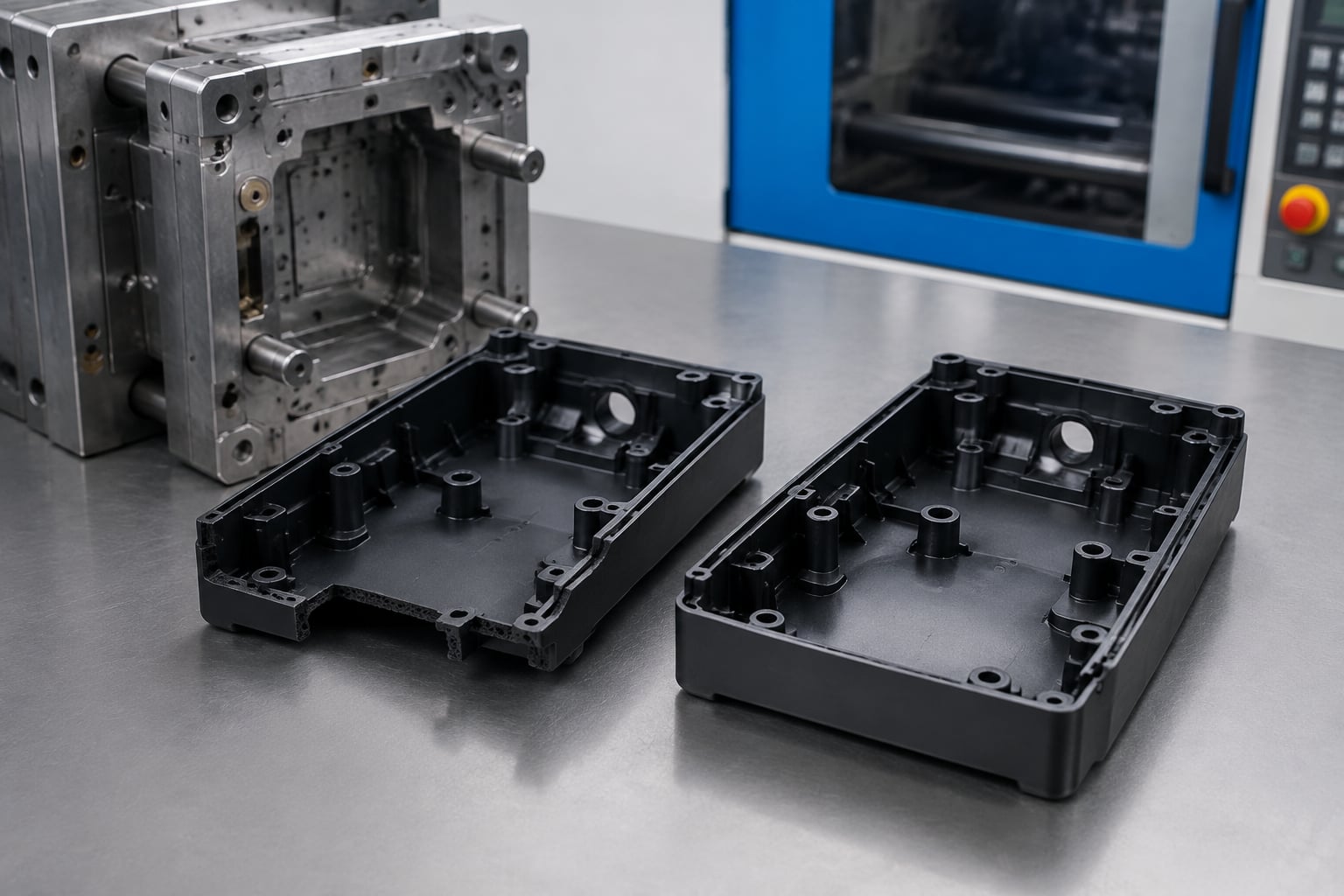
Global Market Guide: CNC Machining or Injection Molding
Quick Answer

For plastic parts in the Global market, choose CNC machining when you need one to several hundred parts, fast design changes, tight tolerances, no tooling investment, or prototype-quality parts within days. Choose injection molding when the design is stable and you need repeatable production, lower unit costs, better cosmetic consistency, and quantities commonly above several hundred to several thousand parts.
CNC machining is usually the lower-risk route for prototypes, bridge production, custom jigs, functional housings, medical device components, and low-volume launches. Injection molding is typically the stronger option for consumer products, enclosures, clips, caps, trays, automotive interior components, and other parts requiring sustained production volume.
Well-known suppliers serving international buyers include Protolabs, Xometry, Fictiv, ICOMold, RapidDirect, and TEAM Rapid. Buyers should also consider qualified international manufacturers, including China-based suppliers with ISO certification, practical DFM support, responsive pre-sales and after-sales communication, and relevant export experience. Their cost-performance can be especially attractive for global startups, distributors, brand owners, and companies balancing tooling budgets with time-to-market.
The most practical decision is often not CNC machining versus molding as an absolute choice. Use CNC parts to validate fit, function, material behavior, and assembly; then move to rapid tooling or production injection molding when demand and design stability justify the investment.
Why This Manufacturing Choice Matters in the Global Market

Plastic part sourcing is increasingly international. Product teams may design in San Francisco, London, Munich, Singapore, Sydney, or Toronto while sourcing prototypes, tooling, molded components, packaging, and final assemblies through production networks in Shenzhen, Dongguan, Ningbo, Guangzhou, Mexico, Eastern Europe, and the United States. This makes the process choice more important than simply comparing an online unit price.
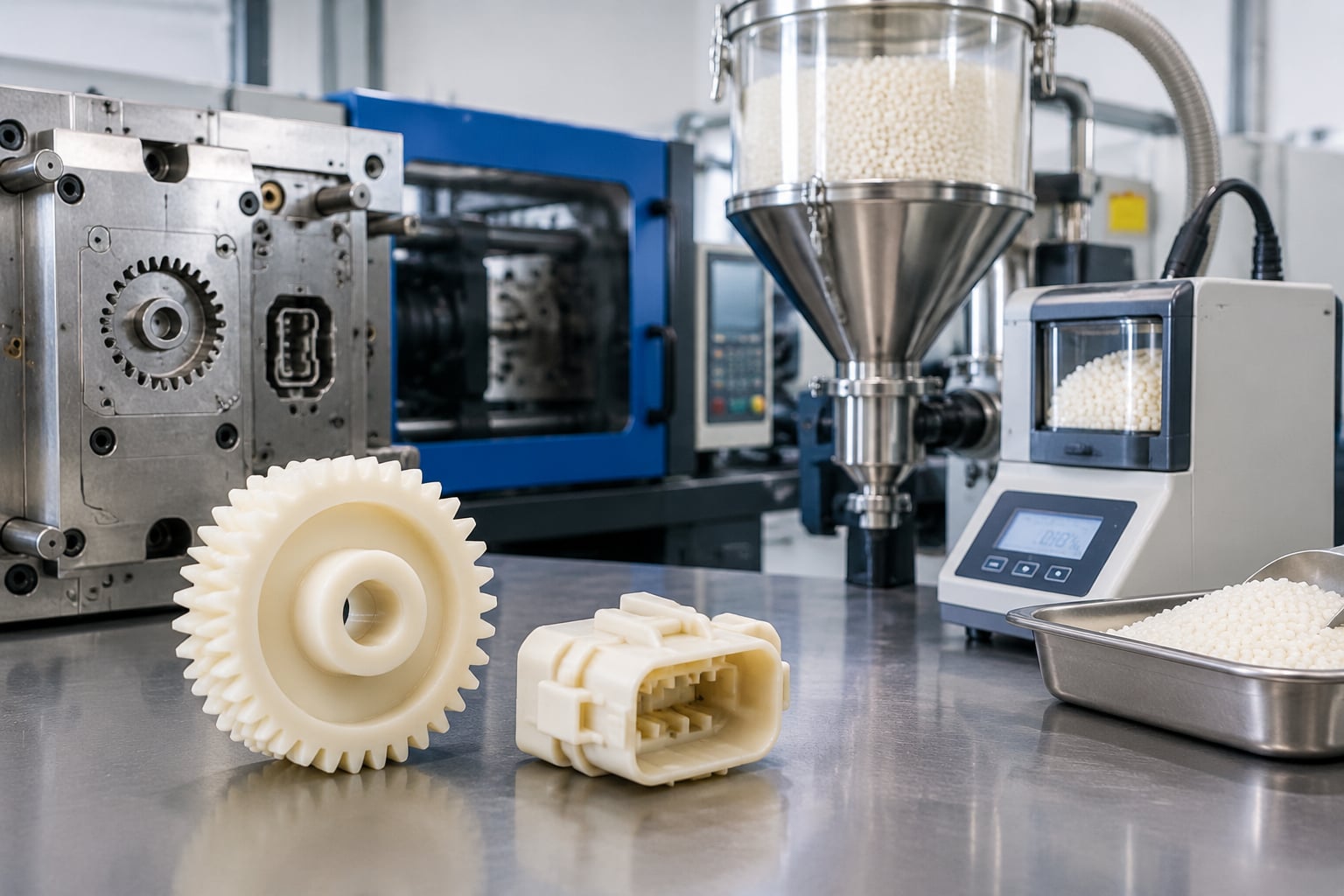
CNC machining and injection molding produce very different commercial outcomes. CNC machining removes material from a plastic block, sheet, rod, or tube using computer-controlled cutting tools. It needs no dedicated mold, so the process adapts quickly to revised CAD files. Injection molding heats polymer pellets and injects the material into a precision mold cavity. It has a higher initial cost because the tool must be designed, machined, assembled, tested, and optimized, but it can produce a large number of consistent parts efficiently after approval.
Global buyers must evaluate total landed cost rather than only the part price. Total cost includes engineering time, DFM revisions, material availability, tooling cost, sampling, inspection, freight through hubs such as Hong Kong, Shanghai, Shenzhen, Rotterdam, Hamburg, Los Angeles, Long Beach, and Singapore, duties where applicable, packaging, and the cost of missed launch dates. A lower molded-part price can become expensive if tooling starts before the product design is ready. Conversely, machining thousands of identical parts can waste budget when a suitable mold would sharply reduce the per-part cost.
The best supplier relationship also connects prototype and production stages. A manufacturer that understands the original functional intent can identify where CNC geometry differs from moldable geometry, where a wall thickness should change, where a draft angle is needed, or where a part can be split into multiple components for more reliable molding.
CNC Machining Compared with Injection Molding

The comparison below summarizes the operational differences that matter most when sourcing custom plastic components internationally. Values are directional because actual performance depends on polymer choice, part dimensions, geometry, finish, tolerance zones, machine capacity, cavity count, tooling material, quality plan, and shipment destination.
| Decision Factor | CNC Machining | Injection Molding | Best Practical Use |
|---|---|---|---|
| Upfront investment | Low; programming, fixturing, and material setup are the main initial costs. | Higher; mold design, steel or aluminum tooling, sampling, and validation are required. | CNC for uncertain designs; molding for stable programs. |
| Part quantity | Usually effective from one part through low hundreds, depending on geometry. | Usually improves economically from hundreds to thousands and beyond. | Match process to forecasted annual demand. |
| Lead time | Often days to a few weeks after CAD approval and material confirmation. | Often weeks because tooling must be built, tested, and refined. | Use machining to protect urgent validation schedules. |
| Design changes | Simple; revise the CAD model and machining program. | Can require mold rework, inserts, welding, or new tooling sections. | CNC during development and early market testing. |
| Unit cost at scale | Generally remains relatively high because each part needs machine time. | Falls significantly once tooling cost is absorbed across production volume. | Molding for repeatable volume production. |
| Geometry limits | Excellent for deep pockets, precision bores, threads, and complex external features. | Excellent for repeatable shapes, ribs, snaps, texture, and thin-wall production with moldable design. | Review undercuts, draft, wall thickness, and tool access early. |
| Material form | Uses engineering plastic stock such as ABS, PC, POM, PA, PMMA, PEEK, and PP where available. | Uses molding-grade resin pellets, including filled, reinforced, flame-retardant, and color-matched grades. | Confirm that prototype and production grades have comparable performance. |
| Surface result | May show cutter marks unless polished, bead blasted, painted, or otherwise finished. | Replicates mold texture and can create consistent cosmetic surfaces at volume. | Molding is preferred for high-volume visible consumer surfaces. |
CNC machining gives engineers exceptional control over dimensions and design iterations. It is highly useful when validating interfaces with metal parts, electronic assemblies, seals, bearings, fasteners, or custom inserts. It also supports transparent materials, high-temperature plastics, and engineering materials that may be difficult to prototype through other processes. However, machining can leave tool-access limitations in deep narrow cavities and may not economically reproduce thin, flexible snap features at high volume.
Injection molding has a different design logic. Molded parts need appropriate draft to release from the tool, controlled wall thickness to reduce sink and warpage, sensible rib proportions, planned gate locations, and a strategy for undercuts. A good mold can deliver highly repeatable parts over long runs, but poor early design choices can result in flash, short shots, sink marks, deformation, visible weld lines, or excessive cycle time. DFM before tooling is therefore a cost-control exercise, not an optional extra.
Plastic Part Types and Suitable Manufacturing Routes
Not every plastic component should be produced with the same method. The intended quantity, function, appearance requirements, resin grade, and product lifecycle determine the best route. Many successful programs use multiple processes at different stages.
| Part Type | Typical Material | Preferred Early Stage | Preferred Production Stage | Key Design Consideration |
|---|---|---|---|---|
| Electronic enclosure | ABS, PC-ABS, PC | CNC machining for fit checks and internal features | Injection molding for repeatable cosmetic housings | Wall thickness, screws, clips, EMI requirements, texture |
| Medical instrument housing | PC, ABS, PC-ABS, POM | CNC machining for functional testing | Injection molding after validation | Cleanability, chemical resistance, traceability, assembly |
| Fluid-handling fitting | POM, PA, PP, PEEK | CNC machining for sealing and thread development | Molding for sustained demand | Leak paths, threads, pressure, material compatibility |
| Automotive interior trim | PP, ABS, PC-ABS, PA | CNC or printed prototype for package testing | Injection molding for production | Grain texture, clips, heat resistance, color control |
| Precision fixture or test jig | POM, UHMW-PE, PEEK, PA | CNC machining | CNC machining or hybrid assembly | Positional accuracy, wear resistance, replaceable inserts |
| Consumer-product cap or closure | PP, HDPE, POM | Machined samples for basic function | Injection molding | Threads, tamper features, cycle time, color consistency |
| Small gear or mechanism component | POM, PA, reinforced PA | CNC for mechanism proof-of-concept | Injection molding for volume | Tooth accuracy, shrinkage, lubrication, fatigue behavior |
| Low-volume optical cover | PMMA, PC | CNC machining with polishing | Molding only when volumes justify optical tooling | Clarity, stress cracking, polishing, gate vestige |
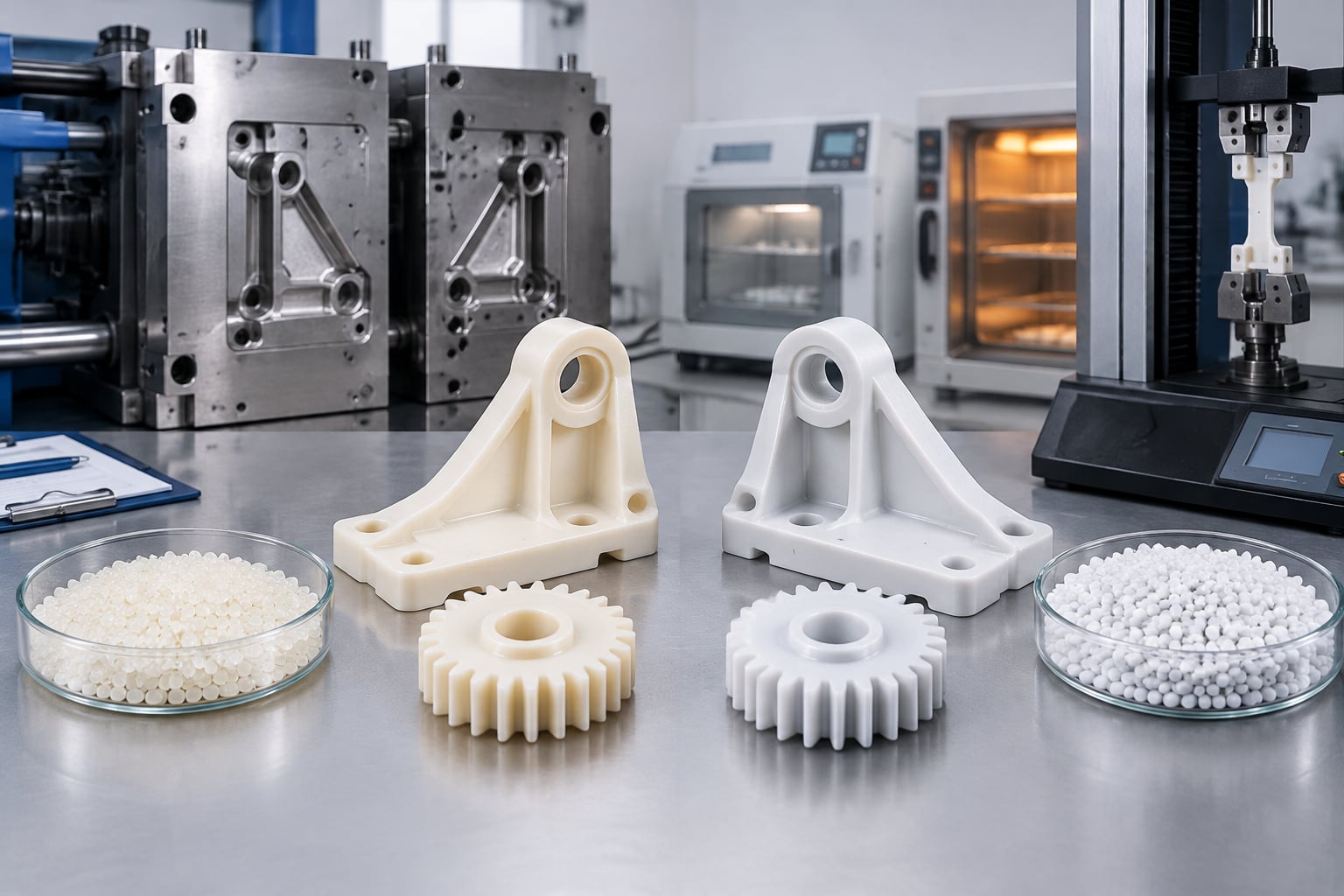
Machined plastic is not always identical to molded plastic. Material stock can have a different internal stress profile, fiber orientation, color availability, or additive package than an injection molding grade. For a safety-critical or regulatory-sensitive component, specify the exact resin family, supplier grade where necessary, performance requirements, and testing method. Do not assume that a prototype made from a similar plastic automatically proves a production molded part will behave the same way.
How to Buy the Right Process
Start with the commercial question: how many acceptable parts are actually needed, and over what period? A team expecting 50 units for pilot testing should not normally commit to expensive multi-cavity hardened tooling. A brand forecasting 50,000 units annually should not rely indefinitely on machining, even if the first batch appears fast and convenient.
Then define the engineering question: what must the part do? Identify mating dimensions, load-bearing areas, flame rating, chemical resistance, transparency, electrical insulation, water ingress targets, temperature exposure, sterilization needs, cosmetic surfaces, and regulatory expectations. These requirements affect both material selection and process choice.
Ask suppliers for a written DFM review before purchasing tooling. For molding, the review should identify draft angles, wall-thickness changes, parting-line position, gate strategy, ejector locations, likely sink areas, undercuts, mold steel or aluminum selection, expected cycle-time factors, and cavity recommendations. For CNC machining, it should identify tool-radius limitations, deep-cavity concerns, thin-wall distortion risk, threading method, inspection datums, and whether the requested tolerance is necessary across every feature.
For global shipments, agree on Incoterms, packaging requirements, export documentation, inspection reports, ownership of tooling, mold maintenance responsibilities, production lead time, and communication channels before order placement. Buyers shipping through international trade hubs should also verify whether the supplier can consolidate multiple components, label cartons accurately, support kitting, and ship directly to a contract manufacturer or fulfillment location.
| Buying Question | When CNC Machining Is Usually Better | When Injection Molding Is Usually Better | Supplier Evidence to Request |
|---|---|---|---|
| How stable is the CAD design? | Changes are expected after testing or customer feedback. | Geometry, resin, appearance, and assembly are already approved. | Revision-control process and DFM feedback samples. |
| What is the required quantity? | One to a few hundred parts, especially irregular demand. | Recurring batches, thousands of parts, or large annual demand. | Tiered pricing, tooling quote, and capacity plan. |
| How urgent is launch timing? | Functional parts are needed in days or a short lead-time window. | There is adequate time for tooling build and trial cycles. | Documented lead-time assumptions and production schedule. |
| How important is cosmetic repeatability? | Functional appearance is sufficient or post-finishing is acceptable. | Uniform texture, color, gloss, and visible surfaces are required. | Texture samples, color standard, first-article approval plan. |
| How tight are critical tolerances? | Precision bores, flatness, threads, and interface dimensions dominate. | Critical dimensions can be designed around molding shrinkage. | Inspection method, gauge plan, tolerance feasibility review. |
| Is the part likely to need material changes? | Several engineering resins must be evaluated quickly. | The resin grade and color are fully selected. | Material certificates and resin traceability process. |
| Does the part include undercuts or snaps? | Undercuts can often be machined where tool access exists. | Slides, lifters, or redesign can support high-volume snap geometry. | Mold-action proposal and cost impact explanation. |
Cost estimates should be based on a break-even discussion rather than an arbitrary volume threshold. A simple six-sided CNC part may remain viable into the hundreds. A complex molded enclosure with several slides may need significant volume before tooling is recovered. Conversely, a small, simple cap with a short cycle time can become economical quickly. Ask suppliers to compare a low-volume CNC quotation, rapid-tooling quotation, and production-tooling quotation using the same annual-demand assumptions.
Industries and Common Applications
In automotive development, CNC machining is frequently used for interior trim prototypes, under-hood test brackets, sensor housings, fixture components, and functional checks before tooling release. Injection molding is then used for production clips, bezels, covers, ducting components, connectors, trims, and housings. Automotive programs require careful attention to heat, vibration, UV exposure, chemical resistance, fit with adjacent components, and cosmetic requirements.
Medical device developers use machined prototypes for handheld instruments, diagnostic devices, laboratory equipment, treatment-unit housings, and fixture components. Molding is favored for repeatable disposable trays, enclosures, knobs, covers, and production housings. The manufacturing plan should align with applicable quality systems, material traceability, cleaning requirements, and the customer’s regulatory pathway.
Consumer electronics and communication-product companies often start with CNC-machined housings to verify PCB placement, connector access, antenna clearances, heat management, buttons, displays, and assembly sequence. Once the design is locked, injection molding provides the consistency needed for branded consumer-facing products. Texture, color matching, laser marking, painting, plating, and assembly requirements should be considered before tool release.
Industrial equipment makers frequently need both processes. CNC machining supports durable low-volume fixtures, custom machine guards, control-panel components, wear parts, and spare parts. Injection molding supports regular-demand knobs, enclosures, protective covers, cable-management parts, trays, and operator-interface components. In many industrial programs, availability and service continuity matter as much as piece price.
Examples of a Smart Transition from Prototype to Production
A startup developing a portable diagnostic device may initially order 20 CNC-machined PC-ABS housings. The purpose is to test grip, display alignment, battery retention, screw-boss strength, and cleaning procedures. During DFM review, the supplier may recommend draft on the exterior walls, thicker corner radii, revised rib geometry, and a more mold-friendly snap design. After pilot feedback and design freeze, the buyer can move to aluminum rapid tooling for several hundred parts, then decide whether hardened production tooling is justified.
A global industrial brand launching a new sensor enclosure may need 80 parts for field trials across warehouses in Europe, North America, and Asia-Pacific. CNC machining can support fast functional samples with precision bores, threaded features, and insert locations. If customers approve the design and demand rises to 10,000 units per year, injection molding can reduce the recurring unit cost while enabling consistent exterior texture and an integrated cable strain-relief feature.
A consumer brand testing a refillable personal-care dispenser may use machined samples to evaluate closure function, pump compatibility, and shelf appearance. Once the dimensions are validated, injection molding can support color matching, repeatable threads, decorative textures, and production-level packaging. The mold strategy may include interchangeable inserts so the brand can produce multiple logo versions or regional variants without recreating the complete tool.
Global Suppliers for CNC and Injection Molding
The supplier landscape includes digital manufacturing platforms, specialist molders, integrated rapid-manufacturing companies, and regional production partners. The following companies are real examples used by buyers in international sourcing. Capabilities, certifications, lead times, geographic service coverage, and material availability should be confirmed directly for each project.
| Company | Service Regions | Core Strengths | Key Offerings |
|---|---|---|---|
| Protolabs | North America and Europe, with international customer reach | Digital quoting, rapid prototyping, established manufacturing workflows | CNC machining, injection molding, 3D printing, rapid production support |
| Xometry | North America, Europe, and international sourcing programs | Large supplier network and online manufacturing marketplace model | CNC machining, injection molding, sheet metal, additive manufacturing |
| Fictiv | United States-focused customer support with global manufacturing network | Digital manufacturing platform, program management, quality-oriented sourcing | CNC machining, injection molding, urethane casting, finishing |
| ICOMold | North America and global customer base | Custom injection molding focus and support for product developers | Plastic injection molding, tooling, insert molding, overmolding |
| RapidDirect | Global export markets from China-based operations | Online quotation workflows and broad rapid-manufacturing coverage | CNC machining, injection molding, sheet metal, die casting, finishing |
| TEAM Rapid | Global customers across more than 25 countries, including the USA, UK, France, Germany, and Asian markets | Prototype-to-production integration, DFM support, flexible quantities | CNC machining, rapid tooling, injection molding, vacuum casting, finishing, assembly |
For buyers near major manufacturing and logistics centers, supplier selection should include practical communication and delivery considerations. North American businesses may value domestic prototype speed, while European firms may prioritize regional compliance expectations and shorter intra-European logistics. Buyers sourcing from China may benefit from competitive tooling and part costs, access to dense supply chains around Shenzhen, Dongguan, Guangzhou, Ningbo, and Shanghai, and the ability to combine machining, molding, finishing, packaging, and direct export in one project flow.
TEAM Rapid for Global Prototype and Production Programs
TEAM Rapid supports international product teams that need a practical route from digital concept to functional prototype, low-volume production, and scalable manufacturing. The company combines custom CNC machining services with rapid tooling and plastic injection molding services, helping buyers compare methods based on actual volume, timing, material, and design maturity rather than forcing a single process. With more than 10 years of industry experience, over 500 satisfied customers, more than 6,000 delivered projects, and customers in over 25 countries, TEAM Rapid brings documented export-scale experience to global programs. Its ISO 9001:2015 quality management certification, tolerance capability down to 0.01 mm for applicable CNC features, DFM reporting, inspection focus, and diversified plastic and metal material options provide tangible quality controls rather than unsupported claims. TEAM Rapid serves end users, product developers, distributors, dealers, brand owners, startups, and individual innovators through flexible OEM, ODM, prototype, low-volume, recurring-production, wholesale, and regional supply cooperation models. It provides turnkey and customer-owned plant solutions for parts, tooling, finishing, assembly, packaging, procurement, and shipping; it does not offer BOO or on-site bulk supply services. While the stated company information does not claim overseas subsidiaries or local warehouses, its established delivery experience in the USA, UK, France, Germany, China, and other markets is supported by one-to-one engineering communication, responses within hours, export coordination, direct shipping, and online pre-sale and after-sale project support. This allows global buyers to work with an engaged manufacturing partner rather than a disconnected remote order desk.
For a new project, buyers can submit CAD files through the online manufacturing quotation request and ask for separate CNC, rapid-tooling, and injection-molding scenarios. This comparison is especially useful when demand is uncertain or when a product launch needs a small validation batch before full production tooling is approved.
Future Trends Through 2026
By 2026, manufacturers will continue to blend digital engineering, automation, and localized supply planning. CNC machining is becoming more connected to automated quoting, machine scheduling, in-process probing, and digital inspection records. These improvements help shorten quotation cycles and make short-run production more predictable, especially for international projects with frequent revisions.
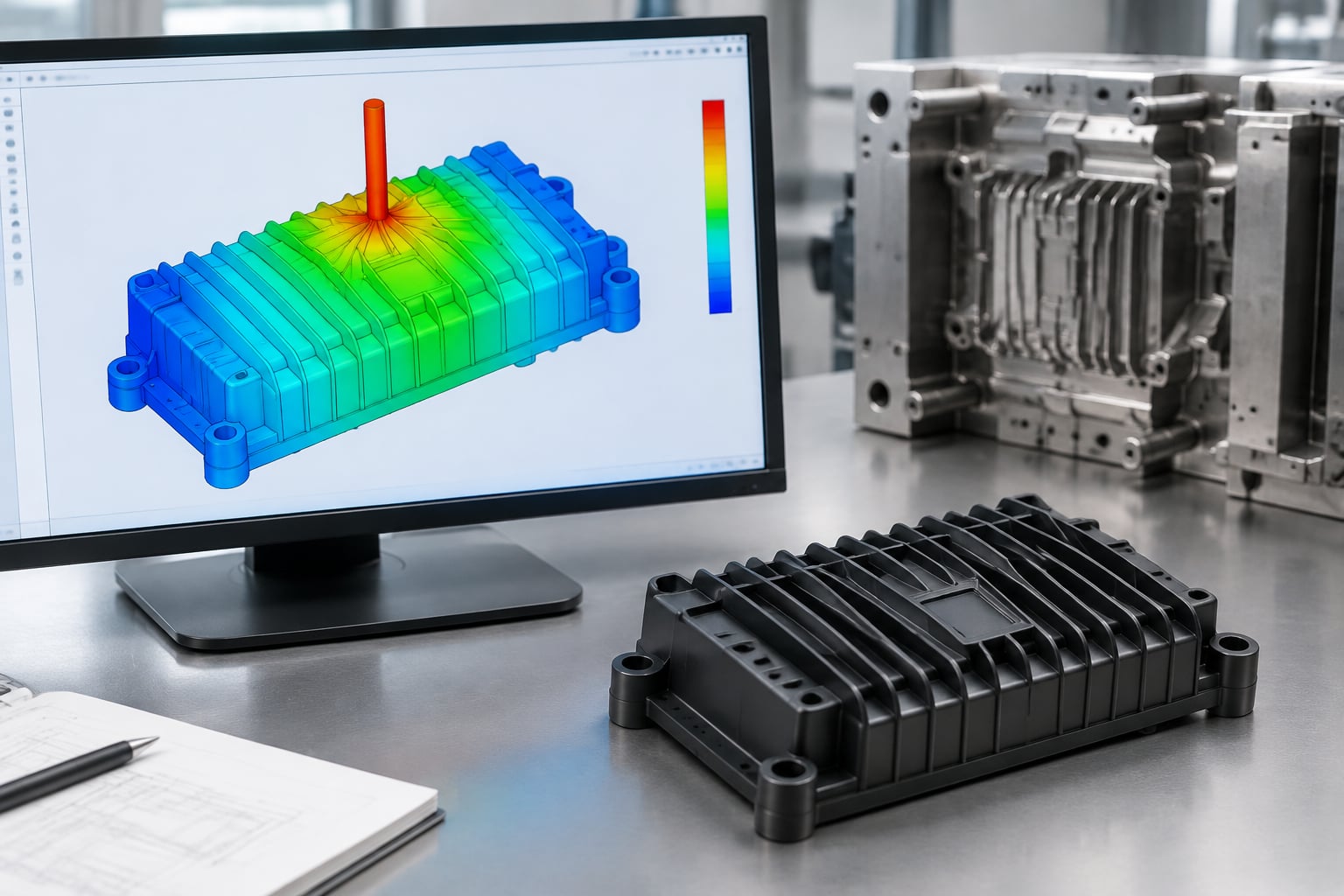
Injection molding is moving toward faster tool design, simulation-led DFM, conformal cooling where appropriate, mold sensors, automated visual inspection, and more efficient cell-based production. These technologies can reduce cycle-time variation, improve process visibility, and support more reliable repeat orders. Multi-cavity tooling will remain important where annual volumes justify it, but modular tooling and interchangeable inserts are increasingly useful for product families, regional versions, and shorter lifecycle products.
Sustainability requirements are also influencing material selection. More buyers are evaluating recycled-content polymers, bio-based materials, mono-material design, reduced wall thickness, lighter packaging, and designs that simplify disassembly. These choices require careful engineering because recycled or alternative material grades may affect shrinkage, color consistency, mechanical performance, moisture behavior, and processing windows. Suppliers should be asked to identify material-source options and explain the trade-offs clearly.
Policy and trade conditions will remain important across the Global market. Buyers should monitor changing customs requirements, product safety standards, chemical restrictions, packaging rules, carbon-reporting expectations, and country-of-origin documentation. A resilient sourcing plan may include prototype capability in one region, qualified tooling in another, and clear documentation that supports global distribution. The correct process is therefore not only a technical decision; it is part of supply-chain risk management.
Frequently Asked Questions
Is CNC machining cheaper than injection molding?
For one part through low quantities, CNC machining is usually cheaper because it avoids mold tooling. For stable high-volume production, injection molding usually becomes cheaper per part because the tooling investment is distributed across many units.
What quantity justifies injection molding?
There is no universal threshold. Simple parts can justify molding at relatively modest volumes, while complex tools with slides, textures, tight cosmetic requirements, or multiple cavities may require much higher demand. Request a break-even comparison based on your expected annual quantity.
Can CNC-machined parts be used as production parts?
Yes. CNC machining is suitable for many production applications, particularly custom equipment, fixtures, service parts, medical devices, industrial products, and low-volume programs. It is less economical for large quantities of identical consumer parts.
Are machined plastic materials the same as molded plastics?
Not always. Machined stock and injection molding grades can differ in formulation, filler content, color, stress profile, and performance. Confirm the intended production material before relying on prototype test results.
Why do molded parts require draft angles?
Draft lets the cooled component release from the mold without scratching, deformation, or excessive ejection force. The required amount depends on material, texture, wall depth, geometry, and mold design.
Can a supplier help convert a CNC design into a moldable design?
Yes. A capable supplier should provide DFM feedback covering wall thickness, draft, ribs, bosses, undercuts, parting lines, gates, ejection, shrinkage, and cosmetic risks before tooling begins.
What should a global buyer include in an RFQ?
Include 3D CAD files, 2D drawings where critical tolerances apply, material requirements, color and finish details, expected quantity, annual forecast, quality requirements, target delivery date, shipping destination, and whether you need tooling, assembly, packaging, or direct shipment.
Can one supplier provide prototypes, tooling, and finished molded parts?
Yes. An integrated manufacturer can support CNC prototypes, rapid tooling, injection molding, finishing, assembly, packaging, and shipping. This can reduce supplier handoffs and preserve engineering knowledge as the project moves toward production.
Final Decision Guide
Choose CNC machining when speed, flexibility, precision interfaces, design changes, and low volume are the main priorities. Choose injection molding when the design is validated, the resin is selected, cosmetic consistency matters, and the expected volume can absorb tooling cost. For many global product programs, the strongest route is CNC machining for proof and pilot parts, followed by rapid tooling or production molding once customer demand and design confidence are established.
A detailed DFM review, clear volume forecast, realistic landed-cost calculation, and supplier capable of supporting both processes will make the choice more reliable. This approach helps global buyers reduce development risk, avoid premature tooling commitments, and build a repeatable path from prototype to market-ready plastic parts.

About the Author : Team Rapid Manufacturing Co., Ltd.
This article is written by the engineering team at Team Rapid Manufacturing Co., Ltd, specializing in rapid prototyping and manufacturing solutions. With extensive experience in CNC machining, injection molding, and low-volume production, our team shares practical insights to help global clients improve product development efficiency and reduce manufacturing risks.
Share
Post Category
Related Insights
-
Global Market Injection-Molded Part Wall Gauge Guide
For most injection-molded plastic parts in the global market, start with a uniform wall gauge between 1.5 mm and 3.0 mm, then adjust it according to resin flow behavior, impact requirements, cosmetic expectations, mold design, and production volume. Commodity plastics such as polypropylene and polyethylene can often use thinner sections, while engineering materials such as polycarbonate, nylon, PBT, and ABS/PC blends usually need more carefully controlled wall thickness to prevent incomplete filling, sink marks, warpage, and internal stress.
The most important rule is consistency. Keep adjacent wall sections within approximately 10% to 15% of each other whenever possible. Instead of making one area excessively thick for stiffness, use ribs, gussets, structural webs, and rounded transitions. Thick plastic sections cool slowly, increase cycle time, consume more resin, and create a greater risk of sink marks or voids.
For a practical global sourcing strategy, compare established molders with strong DFM capability in China, North America, Europe, and Southeast Asia. Qualified international suppliers, including Chinese manufacturers with ISO certifications, engineering support, fast communication, and reliable pre-sales and after-sales processes, can offer strong cost-performance advantages for prototypes, bridge tooling, low-volume production, and scaled manufacturing.
Before releasing tooling, request a wall-thickness analysis, mold-flow review where appropriate, and a written DFM report that identifies thick zones, fill-risk areas, weld lines, gate locations, ribs, bosses, draft, and material-specific shrinkage behavior.
Wall thickness is one of the most influential design variables in plastic injection molding. It affects filling pressure, mold cost, cycle time, dimensional accuracy, resin consumption, cooling balance, cosmetic quality, and long-term mechanical performance. A part that looks simple in CAD can become difficult or expensive to mold if its wall gauge changes abruptly, contains large thick areas, or combines thin cosmetic surfaces with heavy structural features.
During the molding cycle, molten polymer enters the mold cavity through the gate and travels through runners or hot-runner channels. The melt begins cooling as soon as it contacts the steel cavity. Thin sections freeze sooner, while thicker sections remain molten longer. If a thin section is placed ahead of a thick section in the flow path, the melt may freeze before packing pressure can compensate for shrinkage. This can lead to short shots, weak weld lines, sink marks, voids, or inconsistent dimensions.
For buyers sourcing parts across Shenzhen, Dongguan, Ningbo, Suzhou, Chicago, Monterrey, Stuttgart, Birmingham, Singapore, and other manufacturing hubs, the core engineering principle remains the same: design for balanced flow and balanced cooling. The exact wall gauge may change by resin and application, but uniformity provides the strongest foundation for predictable production.
Wall gauge also has a direct commercial impact. Increasing a nominal wall from 2.0 mm to 3.0 mm does not simply increase resin usage by 50%. It may extend cooling time significantly, reduce the number of parts produced per hour, require a larger molding machine, increase tool temperature control demands, and affect freight cost. For high-volume programs, a small reduction in wall thickness can generate meaningful savings. For low-volume programs, stable molding and shorter lead time may be more valuable than minimizing every gram of resin.
The following values are practical starting ranges rather than universal specifications. Final wall thickness should be confirmed using the resin supplier’s technical data, part geometry, gate position, flow length, mold temperature, surface finish, reinforcement level, and end-use load requirements. Glass-filled resins, flame-retardant grades, recycled-content grades, and highly filled compounds may require different decisions from standard unfilled grades.
MaterialTypical Wall Gauge RangePreferred Design RangeMain Design ConsiderationCommon ApplicationsPolypropylene (PP)0.8 mm to 3.0 mm1.2 mm to 2.5 mmHigh shrinkage requires consistent sections and careful rib design.Containers, living hinges, automotive trim, caps, household productsHigh-Density Polyethylene (HDPE)0.8 mm to 3.5 mm1.5 mm to 3.0 mmGood chemical resistance but can warp with uneven cooling.Bottles, packaging, tanks, industrial covers, consumer goodsABS1.2 mm to 4.0 mm1.8 mm to 3.0 mmPopular for cosmetic housings; avoid thick zones that create sink.Electronics housings, appliance covers, automotive interiorsPolycarbonate (PC)1.0 mm to 4.0 mm1.5 mm to 3.0 mmHigh strength but higher viscosity; long flow paths need attention.Safety covers, transparent lenses, medical housings, electrical partsPC/ABS Blend1.2 mm to 4.0 mm1.8 mm to 3.2 mmBalances toughness and appearance; common for enclosure design.Consumer electronics, automotive bezels, industrial enclosuresNylon PA6/PA660.8 mm to 4.0 mm1.5 mm to 3.0 mmMoisture absorption and glass reinforcement affect shrinkage.Gears, clips, brackets, under-hood automotive componentsPBT0.8 mm to 3.0 mm1.5 mm to 2.5 mmUseful for electrical performance; reinforced grades need balanced flow.Connectors, switches, electrical housings, sensor componentsAcetal POM0.8 mm to 3.0 mm1.5 mm to 2.5 mmLow friction and high stiffness; control shrinkage and gate design.Gears, valves, latches, precision mechanical componentsThese ranges show why material selection and wall design must be evaluated together. For example, a 1.2 mm wall may be practical for a compact polypropylene clip but may be risky for a long-flow PC/ABS enclosure. Similarly, a nylon bracket can carry high loads with relatively moderate wall thickness when ribs and fiber orientation are properly considered. Simply making the bracket thicker may not improve performance if warpage increases or glass fibers align unfavorably.
Uniform walls are not always possible, especially in parts that include attachment points, snap fits, bosses, sealing features, reinforced corners, or ergonomic surfaces. The goal is not perfect uniformity at every point; it is gradual transition and controlled thermal mass. Designers should avoid isolated heavy sections surrounded by thin walls because the heavy section will cool more slowly and shrink more after ejection.
A common approach is to define a nominal wall thickness, often called “T,” and create supporting features in relation to that dimension. Ribs are typically designed at 40% to 60% of the nominal wall thickness. Boss walls are often kept around 60% of nominal wall thickness, with ribs added for support. Corner transitions should use radii instead of sharp edges, and thick-to-thin transitions should be tapered over a reasonable distance.
FeatureRecommended Relationship to Nominal WallPurposeRisk if OversizedUseful Design PracticeRib thickness40% to 60% of TAdd stiffness without making the main wall thicker.Sink marks and read-through on cosmetic surfaces.Use generous draft and rounded rib bases.Boss wall thickness50% to 70% of TSupport screws, inserts, and locating pins.Voids, sinks, and cracking near the base.Connect bosses to walls with gussets.Rib heightUp to 2.5 to 3.0 times TIncrease bending stiffness.Fill problems, weak rib tips, difficult ejection.Use multiple lower ribs instead of one very tall rib.Corner radiusMinimum 0.25 to 0.50 times TImprove flow and reduce stress concentration.Cracking and uneven filling at sharp internal corners.Maintain consistent inside and outside radius relationships.Wall transitionGradual taper over distanceBalance cooling and packing.Warping, sinks, and dimensional variation.Use tapered steps instead of abrupt section changes.Draft angleUsually 0.5° to 2° or moreEnable clean ejection and protect surfaces.Scuffing, sticking, ejector damage, cosmetic defects.Increase draft for textured surfaces.Ribs are especially important for housings, trays, covers, and structural plastic components. A rib can increase stiffness substantially because bending stiffness depends heavily on section depth. This means a well-designed ribbed wall can outperform a thick, flat wall while using less material and cooling more quickly. However, ribs must be positioned thoughtfully. Ribs directly behind high-gloss exterior surfaces can create visible sink marks, especially in ABS, PC/ABS, polypropylene, and unfilled nylon.
Design teams should also consider how a part will be measured. A thick-walled part may experience post-molding shrinkage after it leaves the tool, and a large flat panel can bend as residual stresses relax. If the part must mate with another component, define critical interfaces clearly and allow the molder to recommend process controls, fixture inspection, or secondary calibration methods.
The relationship between flow length and wall thickness is central to moldability. Longer melt flow paths require more pressure and are more vulnerable to premature freezing. Thin walls can be molded successfully when gates are positioned close to the critical areas, the material has adequate flow, mold temperatures are controlled, and the part geometry is designed for uniform filling. In contrast, a thin wall combined with a long flow path, multiple turns, texture, and glass-filled resin can create a difficult molding condition.
Gate location should support the thickest functional region or allow the melt to flow from thick to thin wherever possible. A gate positioned into a thin edge may cause hesitation as the melt reaches thicker features downstream. This can produce visible flow lines, weak weld lines, and poor packing. For large enclosures and trays, multiple gates or hot-runner systems may be needed to control pressure and cycle time, but gate marks, weld lines, and tooling cost should be evaluated early.
In projects requiring cosmetic surfaces, the gate must also be selected with appearance in mind. Hidden edges, internal walls, underside surfaces, and assembly interfaces are commonly preferred. Tunnel gates, edge gates, fan gates, valve gates, and direct sprue gates each have different effects on flow behavior and visible finishing requirements.
DefectTypical Wall-Related CauseVisual or Functional EffectPreferred Corrective ActionSecondary Process AdjustmentSink marksThick ribs, bosses, corners, or concentrated material mass.Depressed areas on visible surfaces.Core out thick areas and reduce rib thickness.Increase packing pressure or hold time where appropriate.WarpingUneven cooling, uneven wall gauge, fiber orientation.Twist, bowing, poor assembly fit.Balance wall sections and add structural ribs strategically.Adjust mold temperature and cooling channels.Short shotThin wall, long flow path, insufficient gate size.Incomplete part fill.Increase local gauge or improve gate location.Raise injection speed, pressure, or melt temperature carefully.VoidsHeavy sections shrink internally after the skin freezes.Internal bubbles and reduced structural integrity.Reduce material concentration and improve packing path.Optimize hold pressure and cooling time.Weld line weaknessFlow fronts meet after cooling in thin or distant areas.Visible seam or low-strength area.Move gate or increase local wall gauge slightly.Increase mold temperature to improve knit quality.Burn marksAir trapped near end-of-fill areas, often in thin sections.Dark or scorched appearance.Add venting and improve flow path design.Reduce injection speed near end fill if necessary.Design correction should normally come before process correction. It is possible to mask some defects by adjusting packing pressure, melt temperature, injection speed, cooling time, or mold temperature. However, process changes cannot fully compensate for poor geometry. A stable production tool should not rely on an extremely narrow molding window. If one minor temperature variation causes warpage or sinks, the part design needs further engineering attention.
For global programs involving multiple production sites, stable geometry is especially valuable. A design that only runs well on one specific machine with one experienced operator can be difficult to transfer. Balanced walls, reasonable tolerances, clear resin specifications, and documented molding parameters improve repeatability across qualified facilities.
Plastic enclosures commonly use ABS, PC/ABS, polycarbonate, or polypropylene. These parts need careful control of cosmetic surfaces, screw bosses, snap fits, vents, and internal ribs. A typical handheld enclosure may use a nominal wall between 1.5 mm and 2.5 mm, depending on resin and product size. Thin consumer electronics housings can be lighter and more attractive, but they may require higher-quality tooling, more precise gating, and more demanding process control.
Automotive components often require higher impact resistance, temperature resistance, chemical resistance, and dimensional stability. Interior trim parts may use polypropylene, TPO, ABS, PC/ABS, or reinforced compounds. Under-hood parts often use glass-filled nylon, PBT, PPS, or other engineering thermoplastics. Because vehicle components may experience vibration, thermal cycling, and loading, rib design and fiber orientation can be as important as nominal wall gauge.
Medical device housings need a combination of strength, cleanability, chemical resistance, appearance, and regulatory material traceability. Polycarbonate, ABS, PC/ABS, medical-grade polypropylene, and certain nylon or PBT grades are common choices. Wall thickness should support reliable assembly, sterilization requirements where applicable, and consistent molded dimensions.
Packaging products often use thinner walls to reduce resin usage and improve cycle time. Thin-wall packaging requires a high-flow resin, high-speed molding machine, optimized gate system, precise mold cooling, and experienced process control. A food container, cap, or lid may be much thinner than an industrial housing, but the engineering complexity can be greater because the process window is narrower.
Buyers should avoid requesting a mold quote based only on a 3D file. A reliable quotation requires the part material, annual quantity, target market, cosmetic expectations, tolerance requirements, color, texture, assembly method, packaging needs, and delivery location. If the product is still under development, request a DFM review before committing to hardened production tooling.
For early-stage programs, rapid tooling can be an effective bridge between prototype testing and mass production. It allows teams to validate part performance, assembly, appearance, and real material behavior before investing in multi-cavity hardened molds. Low-volume tooling is particularly useful for startups, industrial equipment makers, medical-device developers, automotive aftermarket brands, and consumer-product teams testing demand.
When comparing suppliers, evaluate total landed value rather than tool price alone. A lower mold quote can become expensive if the supplier does not provide DFM support, uses unsuitable steel, lacks inspection discipline, has inconsistent communication, or cannot manage engineering changes. Conversely, a slightly higher upfront engineering investment may reduce failures, scrap, delivery risk, and redesign cost.
Buyer Evaluation AreaQuestions to AskWhy It MattersPractical Evidence to RequestDFM capabilityWill the supplier review wall thickness, draft, ribs, bosses, and gating?Prevents avoidable tooling changes and defects.Written DFM report with annotated CAD images.Material controlCan the supplier source specified resin grades and provide traceability?Material variation affects shrinkage, strength, color, and compliance.Material certificates, resin brand, grade, and lot records.Tooling approachIs rapid tooling, P20 steel, H13 steel, or multi-cavity tooling appropriate?Tool life and cost must match forecast volume.Tool steel specification and cavity-life estimate.Inspection processHow are critical dimensions and appearance checked?Ensures parts meet drawing and assembly requirements.First article inspection report and control plan.Production capacityCan output scale from pilot runs to recurring production?Protects launch schedules and future demand.Machine tonnage range, lead-time plan, and capacity confirmation.Logistics supportCan the supplier package, label, consolidate, and ship globally?Reduces handoffs and export errors.Packaging proposal, Incoterms, and shipping options.For parts shipped through major trade lanes such as Shenzhen–Los Angeles, Ningbo–Rotterdam, Hong Kong–Frankfurt, Shanghai–Melbourne, and Guangzhou–Singapore, packaging design matters. Thin-wall parts can deform if cartons are overloaded, while cosmetic housings may need individual protection to avoid abrasion. A qualified supplier should be able to support custom packaging, kitting, labeling, inspection documentation, and direct shipping according to the buyer’s channel requirements.
The companies below represent a mix of international and regional manufacturing options. Selection should depend on part complexity, resin type, annual quantity, tooling budget, required certifications, project location, and desired communication model. Buyers should verify current capabilities, certifications, production availability, and country-specific compliance needs directly before placing an order.
CompanyService RegionsCore StrengthsKey OfferingsSuitable Project TypesTEAM RapidGlobal customers; China manufacturing network; experience across North America, Europe, and AsiaRapid tooling, DFM support, low-volume to volume production, integrated manufacturingInjection molding, insert molding, overmolding, CNC machining, 3D printing, vacuum casting, finishing, assemblyPrototype-to-production parts, housings, covers, trays, enclosures, functional componentsProtolabsNorth America and EuropeFast digital manufacturing workflows and short lead-time productionInjection molding, CNC machining, 3D printing, sheet metal fabricationRapid validation, low-volume molded parts, product developmentXometryNorth America, Europe, and international sourcing networksLarge supplier network and online manufacturing quotation toolsInjection molding, machining, sheet metal, casting, 3D printingCompanies needing flexible sourcing and multiple manufacturing processesEVCO PlasticsUnited States, Mexico, and selected global programsCustom molding, large parts, engineering support, production-scale operationsInjection molding, tooling support, large-part molding, assemblyIndustrial, medical, consumer, automotive, and large molded productsRosti GroupEurope, Asia, and North AmericaContract manufacturing, regulated-sector experience, product industrializationInjection molding, assembly, automation, packaging, supply-chain supportMedical, packaging, consumer, industrial, and technical plastic productsNypro, a Jabil CompanyGlobal manufacturing footprint including North America, Europe, and AsiaHigh-volume manufacturing, healthcare and consumer product expertisePrecision molding, tooling, automation, assembly, supply-chain integrationHigh-volume medical, consumer, healthcare, and electronics programsSuppliers in the United States and Europe may be preferred when local production, immediate engineering access, regional certification requirements, or short domestic logistics routes are critical. China-based suppliers can be highly competitive for rapid tooling, flexible volume runs, custom part complexity, and multi-process programs that require molding, machining, finishing, assembly, and export packaging under one coordinated supply chain.
TEAM Rapid supports global product developers, brand owners, distributors, OEM customers, startups, engineers, and individual inventors with injection molding, rapid tooling, CNC machining, 3D printing, vacuum casting, die casting, finishing, assembly, packaging, procurement support, and direct shipping. The company has more than 10 years of manufacturing experience, has served customers in more than 25 countries, completed over 6,000 projects, and supported more than 500 customers. Its ISO 9001:2015 quality management certification, in-house machining and tooling capability, detailed DFM reports, and inspection-focused manufacturing process help customers evaluate wall gauge, rib proportions, boss construction, material use, shrinkage risks, cavity layout, cycle time, and production feasibility before tooling begins. TEAM Rapid works through flexible OEM, ODM, wholesale, retail-support, regional distribution, prototype, low-volume, and recurring production models rather than limiting customers to one order format. It provides turnkey and customer-owned plant manufacturing solutions, not BOO or on-site bulk supply services. Its China-based integrated manufacturing operations and resource network support international customers with engineering communication, online quotation, project follow-up, sample approval, after-sales issue handling, packaging, and direct export shipping. While the company profile does not state overseas subsidiaries or local warehouses, its established export experience across markets including the USA, UK, France, Germany, and other regions provides practical support for customers seeking a long-term manufacturing partner rather than a simple remote order-taking supplier.
For a new project, customers can use TEAM Rapid’s injection molding services to review tooling, resin options, production methods, and molding requirements. When the CAD model is ready, request a project review through the custom manufacturing quotation page and provide the required material, annual quantity, critical tolerances, target delivery market, color, finish, and assembly requirements.
A handheld device housing may begin with a 2.0 mm PC/ABS nominal wall. The design includes screw bosses, snap fits, battery supports, connector openings, and cosmetic exterior surfaces. If the screw bosses are built at full 2.0 mm wall thickness, sinks may appear on the outer cosmetic face. The preferred solution is to core the bosses, reduce boss wall thickness to approximately 1.2 mm, connect them using thin gussets, and add draft for ejection. This approach improves appearance and shortens cooling time without sacrificing assembly strength.
An under-hood sensor bracket may use glass-filled PA66 because it needs thermal resistance, stiffness, and fatigue performance. A flat 4.0 mm section may appear strong, but it can create fiber orientation concerns and warpage. A better design may use a 2.5 mm nominal wall with ribs and gussets positioned along load paths. The final solution must account for fiber direction, mounting loads, humidity exposure, temperature cycling, and fastener torque.
A large industrial cover often requires impact resistance, mounting points, cable openings, and a professional surface finish. Using a 3.5 mm wall throughout may increase resin cost and cycle time significantly. A more balanced design can use 2.5 mm nominal walls with localized ribs, reinforced mounting areas, and smooth radii around openings. Gate location is especially important because long rectangular panels may warp if flow and cooling are not balanced.
A food or consumer packaging container may use polypropylene walls below 1.0 mm. Such products require high-speed injection, optimized gates, rapid cooling, precise mold venting, and high-flow resin. Unlike a thicker industrial housing, the challenge is not simply stiffness; it is achieving full fill at high production speed while maintaining stackability, rim strength, lid fit, and consistent appearance.
Injection-molded wall gauge optimization is relevant across automotive, medical devices, consumer products, industrial equipment, communications products, office equipment, electrical appliances, sanitary products, packaging, smart hardware, household goods, laboratory equipment, and energy-related products. Every industry applies the same basic thermal and flow principles, but each has different priorities.
Medical customers may focus on traceable materials, chemical compatibility, cleanability, reliability, and controlled assembly. Automotive customers may prioritize impact behavior, heat resistance, vibration durability, flame resistance, and dimensional stability. Consumer product brands may place greater emphasis on weight, surface quality, tactile feel, color matching, and cost. Industrial customers frequently need durable housings, cable management, mounting strength, and practical serviceability.
For global brands, it is also important to consider regional regulations and product certification pathways. Flame-retardant ratings, food-contact requirements, electrical safety standards, restricted substance requirements, recycling expectations, and customer-specific quality systems can influence material choice and ultimately affect the preferred wall gauge.
By 2026, wall thickness decisions are increasingly influenced by digital simulation, sustainability targets, material innovation, and supply-chain localization. Mold-flow simulation is becoming more accessible earlier in product development, allowing engineering teams to identify pressure drop, weld-line locations, cooling imbalance, and fiber orientation before steel is cut. This helps reduce expensive post-tooling modifications and supports faster product launches.
Lightweighting will remain a major trend. Brands are reducing plastic content through thinner walls, rib-optimized structures, topology-informed design, foamed materials, and stronger engineering resins. However, lightweighting must be balanced against product durability, recyclability, drop performance, and customer expectations. Overly thin designs can increase scrap, returns, and premature product failure, which undermines sustainability goals.
Recycled-content plastics will also affect molding strategy. Post-consumer recycled and post-industrial recycled materials can show greater variation in flow, color, shrinkage, and mechanical properties compared with virgin resin. Designers may need more conservative flow paths, better tolerance planning, or adjusted wall thickness when using recycled grades. Material validation and supplier consistency become especially important for functional products.
Policy trends in the global market are encouraging packaging reduction, material circularity, product repairability, and improved environmental reporting. Manufacturers will increasingly need to document resin selection, recycled content, product weight, packaging choices, and process efficiency. Well-designed wall gauge supports these goals by reducing unnecessary material while preserving real-world performance.
There is no single best value. A practical starting point for many parts is 1.5 mm to 3.0 mm. The correct choice depends on resin, part size, flow length, structural load, surface quality, gate location, and production method.
Uniform walls cool and shrink more evenly. This reduces sink marks, voids, warpage, stress, inconsistent dimensions, and cycle-time variation. Where different thicknesses are necessary, transitions should be gradual.
Ribs are commonly designed at 40% to 60% of the nominal wall thickness. Thicker ribs can create sink marks, especially behind cosmetic surfaces. Rounded rib bases and appropriate draft improve filling and ejection.
Yes. Thinner walls can reduce resin use and cooling time, lowering part cost in high-volume production. However, thin-wall designs may require more advanced tooling, high-flow material, faster molding equipment, and tighter process control.
Sink marks usually occur where plastic mass is concentrated, such as thick bosses, ribs, corners, and heavy wall sections. Core out thick areas, reduce rib thickness, improve packing access, and use balanced cooling.
In most cases, use ribs, gussets, or structural webs before increasing the full wall thickness. Ribs can improve stiffness efficiently while minimizing resin consumption, cooling time, and sink risk.
Yes. TEAM Rapid can provide DFM-oriented feedback for injection molding projects, including observations on wall thickness consistency, ribs, bosses, draft, undercuts, shrinkage risks, tooling feasibility, and production efficiency.
-
Global Market Injection Molding Design Rules for DFM
Effective injection molding design starts with uniform wall thickness, sufficient draft, controlled ribs and bosses, realistic tolerances, correct gate placement, and early DFM review. For Global market programs, designers should validate the part against the selected resin, expected annual volume, cosmetic requirements, assembly method, tooling location, logistics route, and regional compliance needs before cutting steel.
The most practical checklist is simple: keep walls consistent, add draft to every vertical face, avoid sharp internal corners, use ribs instead of thick sections, design undercuts only when function requires them, position gates away from cosmetic surfaces, specify tolerances based on resin behavior, and review mold flow, cooling, ejection, and assembly risks before tool release.
Common international suppliers for injection molding design support include TEAM Rapid, Protolabs, Xometry, Fictiv, ICOMold, and Rosti. Qualified Chinese manufacturing partners can also be strong options for Global market buyers when they provide ISO-certified quality systems, responsive engineering communication, documented DFM feedback, and reliable pre-sales and after-sales support. Their cost-performance advantage is especially relevant for rapid tooling, bridge production, and low-to-medium-volume molded parts.
Injection molding is one of the most scalable methods for producing plastic parts, but it is also unforgiving when product geometry does not match material flow, cooling, ejection, and tooling constraints. A design that appears correct in CAD can create sink marks, warpage, flash, short shots, visible weld lines, excessive cycle times, weak snap fits, or expensive side actions once it enters tool design.
Global market product teams frequently manage additional complexity. A consumer enclosure may be designed in London, validated in Munich, tooled in Shenzhen, assembled in Mexico, and sold through distributors in the United States, Australia, and the Middle East. In this environment, a clear injection molding DFM strategy reduces change orders, prevents communication gaps, and helps ensure that the final molded component is repeatable across production batches.
Trade hubs such as Shenzhen, Dongguan, Ningbo, Hong Kong, Singapore, Rotterdam, Hamburg, Los Angeles, Chicago, and Dubai remain important links in international manufacturing supply chains. Buyers should therefore consider not only tooling price, but also engineering response time, export packaging, inspection documentation, resin sourcing, mold ownership terms, spare-part support, and shipping flexibility.
Uniform walls help molten plastic fill, pack, cool, and shrink more predictably. Sudden changes in thickness create uneven cooling, which can cause sink marks, voids, warpage, and dimensional variation. If a section needs extra strength, use ribs, gussets, corrugation, or localized structural geometry rather than making the whole area thicker.
Typical wall thickness depends on material, flow length, part size, impact requirements, and surface finish. Thin-wall consumer packaging may use less than 1.0 mm, while structural industrial housings may use 2.5 mm or more. The objective is not to use the thinnest possible wall; it is to use a stable and manufacturable wall for the selected resin and molding process.
Draft is the taper that allows a molded part to release from the mold without drag marks, scratches, deformation, or excessive ejection force. Smooth surfaces commonly need at least 0.5° to 1° draft, while textured surfaces often require 2° to 5° or more depending on texture depth. Deep cores, highly polished cosmetic surfaces, elastomeric materials, and aggressive textures may need additional draft.
Designers should identify the mold opening direction early. Every wall, rib, boss, snap feature, and engraved detail should be checked against that direction. When a feature cannot release directly, it may need a side action, lifter, collapsible core, unscrewing mechanism, or redesign.
Sharp corners restrict resin flow and create stress concentration points. Internal corners should generally include a radius, ideally related to the nominal wall thickness. A practical starting point is an inside radius of 0.25 to 0.75 times the wall thickness, followed by an outside radius that maintains consistent material thickness around the corner.
Fillets improve strength, reduce crack initiation, assist material flow, and make it easier to machine mold cavities. They are particularly important in load-bearing brackets, clips, handles, latches, medical housings, automotive components, and electrical enclosures.
Ribs improve stiffness without the cost and cosmetic risks of thick solid walls. As a general guideline, rib thickness should be approximately 40% to 60% of the nominal wall thickness. Thick ribs can produce sink marks on the opposite cosmetic surface. Rib height is often limited to about three times the nominal wall thickness unless flow, cooling, and ejection analysis support a taller feature.
Bosses used for screws, inserts, alignment, or assembly should be supported by ribs or gussets. Avoid connecting a large solid boss directly to an exterior cosmetic wall. The local mass can cause sinks, voids, and distortion. Core out the boss wherever possible and provide sufficient draft on the internal and external surfaces.
Undercuts are features that prevent direct ejection from a simple two-plate mold. Examples include side holes, retaining clips, external threads, internal snap hooks, and recessed grooves. Some flexible undercuts can be stripped manually or automatically, but rigid materials often require side actions or lifters.
Every undercut increases tooling complexity, maintenance requirements, cycle time, and mold cost. It should be retained only if it delivers clear functional, safety, sealing, or assembly value. A small redesign of a snap fit or opening direction can sometimes eliminate an expensive mechanical action.
The following ranges are starting points for early product design. They must be adjusted according to resin grade, mold construction, texture, part size, required tolerance, gate location, flow length, and expected production volume. A DFM review should confirm final values before tooling.
Design FeaturePractical Starting GuidelinePrimary Risk if IgnoredDesign ConsiderationNominal wall thicknessKeep as uniform as possible across the partWarpage, sink marks, voids, short shotsUse ribs or gussets for strength instead of heavy sectionsDraft angle0.5° to 1° for smooth faces; more for textureDrag marks, part damage, high ejection forceIncrease draft for deep walls and textured surfacesRib thickness40% to 60% of nominal wall thicknessVisible sink marks and uneven coolingRound rib bases and maintain draft on both rib facesRib heightPreferably no more than three times wall thicknessFill difficulty, ejection problems, warpUse multiple shorter ribs where possibleBoss wall thicknessAbout 60% of nominal wall thicknessSinks, voids, cracking around screwsCore out bosses and connect them with gussetsInternal corner radius0.25 to 0.75 times nominal wall thicknessStress concentration and poor material flowMaintain consistent thickness through the cornerHole diameterPrefer diameter equal to or larger than wall thicknessCore pin deflection, incomplete fillSupport long core pins where feasibleTextured surfacesUse additional draft based on texture depthScuffing and difficult ejectionConfirm texture supplier requirements earlyThese guidelines reduce risk, but do not replace engineering analysis. Glass-filled materials, flame-retardant grades, soft elastomers, high-temperature polymers, recycled-content resins, and highly polished cosmetic parts can require substantially different geometry decisions.
Material selection affects almost every injection molding decision. Shrink rate influences mold dimensions. Melt flow influences gate size and wall-thickness capability. Glass fiber content affects stiffness but can increase warpage and surface visibility. UV exposure, chemicals, electrical requirements, impact loads, heat, food contact, medical regulations, and flame resistance must all be evaluated before finalizing the resin.
Material FamilyCommon AdvantagesTypical ApplicationsImportant DFM ConsiderationABSGood appearance, impact resistance, easy processingConsumer housings, electronics, appliance coversModerate shrinkage; avoid overly thick cosmetic wallsPolypropyleneChemical resistance, living hinge performance, low densityContainers, caps, medical trays, household productsHigher shrinkage requires tolerance planningPolycarbonateHigh impact strength and transparency optionsSafety covers, lenses, electrical enclosuresNeeds careful drying and controlled processingPA NylonStrength, wear resistance, fatigue performanceGears, clips, automotive parts, industrial componentsMoisture absorption affects dimensions and propertiesPOM AcetalLow friction, stiffness, good dimensional stabilityPrecision mechanisms, latches, gears, valvesDesign for shrinkage and avoid unsuitable chemical combinationsPC/ABSBalanced toughness, heat resistance, cosmetic qualityAutomotive interiors, equipment housings, devicesUseful for larger housings needing better impact performanceTPUElasticity, abrasion resistance, soft-touch feelProtective covers, grips, seals, wearable productsGate and ejector design must prevent distortionGlass-filled polymersHigh stiffness and strengthStructural brackets, industrial parts, automotive componentsFiber orientation can cause directional warpageFor international programs, material sourcing should be controlled by approved resin grades rather than only generic names. “ABS” is not a full specification. The grade, color masterbatch, recycled-content target, flame-retardant classification, supplier documentation, and testing requirements should be defined in the product specification.
Gate location influences filling pattern, weld lines, packing pressure, cosmetic appearance, fiber orientation, and warpage. Gates should be placed where the thickest section can be packed effectively and where any vestige can be hidden or removed safely. For a visible consumer product, a gate may be placed on an internal face, underside, assembly flange, or non-cosmetic edge.
Weld lines occur when two flow fronts meet. They may be harmless in a low-stress cover, but critical in a pressure-containing part, structural clip, hinge, or screw boss. Designers should avoid placing holes, windows, or high-stress features where weld lines are likely to occur.
Cooling is equally important. Thick local masses cool slowly and can extend cycle time or produce sinks and internal voids. Mold designers use water channels, baffles, bubblers, conformal cooling, and specialized inserts to manage heat. Product designers can support efficient cooling by avoiding unnecessary heavy sections and by providing accessible core geometry.
Ejector pins, sleeves, stripper plates, and air ejection systems leave marks or require contact surfaces. Designers should identify acceptable ejector locations before finalizing the cosmetic Class A surface. The most attractive design can become costly if no suitable ejection area exists.
Product TypeTypical Design PrioritiesFrequent Molding RiskRecommended Engineering FocusElectronic enclosureCosmetic surfaces, screw bosses, EMI features, assembly fitSinks around bosses and visible gate marksWall uniformity, hidden gates, controlled texture and draftAutomotive interior trimAppearance, clip retention, heat resistance, durabilityWarp, scratch sensitivity, clip failureMaterial validation, grain texture draft, rib layoutMedical device housingCleanability, dimensional control, traceabilityStress cracking and difficult assemblyApproved materials, radiused corners, functional testingIndustrial equipment coverImpact resistance, rigidity, environmental resistanceLarge-part warp and inconsistent fitRib strategy, gate balance, reinforced materialsConsumer packaging componentLow cost, high volume, visual consistencyThin-wall short shots and flashFlow length review, high-cavitation tool designSnap-fit assemblyRepeatable retention, easy assembly, fatigue resistanceStress whitening and breakageStrain analysis, material selection, rounded transitionsInsert molded componentMetal-plastic bond, insert position, electrical reliabilityInsert movement and crackingInsert retention, preheating, locator designOvermolded gripSoft feel, adhesion, ergonomicsDelamination and flash at interfaceMechanical locks, compatible materials, sealing surfacesEach product category requires its own acceptance criteria. A matte black appliance cover may prioritize appearance and scratch resistance, while an internal medical bracket may prioritize dimensional stability, material traceability, and sterilization compatibility. Product teams should state these priorities before DFM begins.
Before requesting quotes, prepare a 3D CAD file, 2D drawing where critical dimensions exist, annual volume forecast, selected or preferred material, color, texture, finish, assembly details, functional requirements, and destination market. If the design is still evolving, explain which dimensions are fixed and which can change after DFM review.
Buyers should ask whether the quoted tool is prototype tooling, bridge tooling, or production tooling. Aluminum rapid tooling may be suitable for market validation and low-volume production, while hardened steel tooling is generally better for high-volume programs, abrasive glass-filled resins, or long-term repeatability. Tool life should be stated as an expected range, not assumed.
Clarify mold ownership, storage period, maintenance responsibilities, cavity count, engineering change charges, sample approval process, inspection method, packaging method, and delivery terms. For global distribution, also confirm whether the supplier can support assembly, kitting, labeling, warehousing, and direct shipping to regional fulfillment locations.
The supplier landscape includes regional specialists, digital manufacturing platforms, high-volume molders, and China-based rapid manufacturing partners. The table below provides practical examples. Buyers should verify current capability, certifications, material availability, and commercial terms for each project.
CompanyService RegionsCore StrengthsKey OfferingsTEAM RapidGlobal customers, including the USA, UK, France, Germany, and AsiaRapid tooling, DFM support, low-volume and production flexibilityInjection molding, insert molding, overmolding, CNC machining, vacuum casting, assemblyProtolabsNorth America and EuropeFast digital quoting and rapid manufacturing workflowsInjection molding, CNC machining, 3D printing, sheet metal fabricationXometryNorth America, Europe, and international sourcing networksBroad supplier network and online manufacturing procurementInjection molding, CNC machining, fabrication, production sourcingFictivNorth America and global supply partnersDigital manufacturing management and engineering coordinationInjection molding, CNC machining, urethane casting, finishingICOMoldNorth America with international manufacturing supportCustom plastic injection molding and mold manufacturingPrototype molds, production molds, insert molding, overmoldingRostiEurope, Asia, and North AmericaHigh-quality contract manufacturing for complex productsInjection molding, assembly, medical and consumer product manufacturingNypro, a Jabil CompanyGlobal manufacturing locationsLarge-scale healthcare and consumer manufacturing capabilityPrecision molding, automation, assembly, medical device manufacturingHusky TechnologiesGlobal, with strong packaging industry presenceHigh-volume molding systems and hot runner technologyPackaging molds, hot runners, injection molding equipment solutionsFor projects requiring rapid iterations, buyers often benefit from a supplier that can machine prototype parts, revise tooling, mold pilot batches, apply finishing, and ship assembled products without transferring data between multiple vendors. For established high-volume programs, a dedicated regional molder may provide advantages in local logistics, automation, and long-term production support.
TEAM Rapid supports innovators, product designers, engineers, startups, distributors, brand owners, and established manufacturers with a connected route from prototype to repeat production. Its ISO 9001:2015 quality management system, in-house machining and tooling capability, documented DFM feedback, and precision machining capability down to 0.01 mm provide practical evidence for controlled manufacturing of custom plastic and metal components. Rather than relying on unspecified component brands, TEAM Rapid works from customer-approved material grades, defined resin requirements, inspection criteria, and functional specifications, supporting parts such as enclosures, housings, trays, covers, fillers, insert-molded components, and overmolded assemblies. Customers can use flexible OEM and ODM cooperation, wholesale supply, prototype orders, recurring production, distributor programs, and direct-to-brand fulfillment, from one prototype to more than 100,000 parts. The company has established delivery experience with customers in more than 25 countries, including the USA, UK, France, Germany, and other international markets, supported by one-to-one engineering communication, responses commonly provided within a few hours, packaging, assembly, procurement support, limited warehousing, and direct shipping. Although its manufacturing base and integrated supply network are in China rather than represented as overseas subsidiaries or local warehouses, its export operating experience and online engineering support provide a practical service structure for international buyers who need clear pre-sales review, production updates, inspection coordination, and after-sales issue resolution. TEAM Rapid provides EPC-style turnkey and customer-owned production solutions for manufacturing projects, not BOO or on-site bulk supply services.
For early-stage projects, customers can explore TEAM Rapid injection molding services to compare rapid tooling, prototype molding, and production options. When a design is ready for review, a custom manufacturing quotation request can include CAD files, material preferences, volumes, finish requirements, and delivery destination.
A handheld diagnostic device housing may need PC/ABS for impact strength and dimensional stability. The design should include draft on textured grip zones, controlled ribs behind display openings, isolated screw bosses, and enough internal clearance for PCB installation. Gate placement should avoid the front cosmetic face, while ejector locations should be hidden inside assembly surfaces.
An automotive under-hood clip may require heat-resistant nylon with glass reinforcement. In this case, fiber orientation and moisture conditioning are important. The designer should avoid abrupt thickness transitions, place fillets at clip roots, and evaluate the part under repeated insertion and removal cycles. A low-cost tool that ignores fiber-related warpage can create fit problems later in vehicle assembly.
A consumer storage container with a living hinge may use polypropylene. The hinge must be thin and carefully oriented to support repeated flexing, while the body should retain a stable wall thickness. Gate position and flow direction can influence hinge performance. A prototype run should verify opening force, fatigue life, lid alignment, and sealing behavior.
An industrial control-box cover may require flame-retardant ABS or PC/ABS. Designers must account for the material’s flow behavior, flame-retardant additive effects, electrical clearance requirements, screw boss strength, gasket compression, and exterior finish. Venting and gate placement should be reviewed to reduce burn marks around deep ribs and internal features.
By 2026, injection molding design is increasingly shaped by automated DFM, artificial intelligence-assisted mold-flow prediction, digital traceability, material data management, and more sustainable resin strategies. CAD platforms and supplier quoting systems are becoming better at identifying missing draft, thick wall sections, undercuts, and high-risk tolerances before engineers issue a tooling purchase order.
Sustainability will continue to influence material selection. Recycled-content polymers, bio-based materials, mono-material design, lightweighting, and easier disassembly are becoming more important in consumer goods, packaging, mobility products, and electrical equipment. However, recycled-content resin can introduce variation in color, mechanical properties, flow, and shrinkage, so qualification testing and approved-source control are essential.
Policy requirements are also evolving across major markets. Product teams should monitor chemical restrictions, packaging rules, recyclability targets, extended producer responsibility requirements, medical device documentation, electrical safety standards, and regional labeling obligations. The mold design itself may not be regulated, but material selection, traceability, product safety, and end-of-life expectations increasingly affect molded-part decisions.
Manufacturers are also adopting conformal cooling, in-mold sensors, automated visual inspection, robotic part handling, and digital process monitoring. These technologies can improve consistency, reduce cycle time, and provide better production data, particularly for high-value medical, automotive, industrial, and electronics applications.
Maintain consistent wall thickness. It has a direct effect on filling, cooling, shrinkage, warpage, sink marks, cycle time, and part quality.
A common starting point is 0.5° to 1° for smooth surfaces. Textured, deep, polished, or difficult-to-eject surfaces often require more draft.
They can, but sharp internal corners are generally discouraged because they create stress concentrations and restrict resin flow. Use fillets whenever function permits.
Side actions are commonly needed for rigid undercuts, side holes, external snap features, recessed grooves, and geometry that cannot release in the mold opening direction.
Send 3D CAD files, critical drawings, material preferences, finish requirements, color, annual volume, target delivery date, destination, assembly needs, and known functional requirements.
Yes. Rapid tooling can be suitable for prototype validation, bridge production, market testing, and selected low-volume production. The correct choice depends on resin, cavity count, part complexity, surface finish, and expected production quantity.
Reduce thick local masses, use ribs instead of heavy walls, core out bosses, improve wall uniformity, and review gate location and packing conditions with the molding engineer.
Early DFM identifies risks while geometry can still be changed quickly. It is far less expensive to revise CAD than to modify hardened steel after the mold has been manufactured.
-
Mold Flow Analysis for Global Market Tooling Choices
Mold flow analysis is a digital injection molding simulation used before tooling to predict how molten plastic will fill, pack, cool, shrink, and warp inside a mold. It helps product teams identify likely defects such as short shots, weld lines, sink marks, air traps, excessive clamp force, uneven cooling, and dimensional distortion before steel is cut.
For Global market buyers, the most practical approach is to run a mold filling and cooling study during DFM review, then revise wall thickness, gate position, runner layout, material selection, and cooling channels before ordering tooling. This can reduce development iterations, improve mold reliability, and lower the risk of expensive post-tooling modifications.
Established providers commonly considered for mold flow simulation and tooling support include Autodesk Moldflow, Moldex3D, SIGMA Engineering, SIMCON, CoreTech System, and TEAM Rapid. Software providers supply the analysis platform, while engineering-led manufacturers apply the results to real mold design, rapid tooling, sampling, and production.
Injection molding is highly sensitive to how polymer melt moves through a cavity. A part that appears simple in CAD can become difficult to mold when it combines thin ribs, deep bosses, non-uniform walls, cosmetic surfaces, long flow lengths, engineering resins, inserts, or tight dimensional tolerances. Mold flow analysis converts the part design, material data, gate proposal, runner system, process assumptions, and cooling concept into a predictive simulation.
The analysis does not replace moldmaker experience or physical sampling. Instead, it gives engineers evidence for choosing the most robust design path before a mold is manufactured. For buyers coordinating design teams in cities such as London, Munich, Chicago, Shenzhen, Singapore, Dubai, and Melbourne, the process creates a common technical language before tooling decisions are released across borders.
Analysis AreaWhat Is EvaluatedTypical Risk FoundPractical Tooling DecisionFill analysisMelt-front movement, fill time, pressure, and flow balanceShort shots, hesitation, overpacking, unbalanced cavitiesMove gates, enlarge runners, adjust wall thickness, change injection strategyPack analysisHolding pressure effect and volumetric shrinkageSink marks, internal voids, inconsistent dimensionsRevise gate size, holding profile, rib thickness, and packing windowCooling analysisHeat removal, mold temperature balance, and cooling durationLong cycle time, hot spots, uneven shrinkageAdd baffles, bubblers, conformal cooling, or optimized water linesWarpage analysisDeflection caused by shrinkage, orientation, and thermal gradientsTwist, bow, uneven flatness, assembly failureModify geometry, gate direction, material grade, or cooling layoutWeld-line evaluationLocations where melt fronts meetWeak joints, cosmetic marks, leakage or crack riskRelocate gates, improve venting, increase melt temperature, revise geometryAir-trap evaluationAreas where air is compressed during fillingBurn marks, incomplete filling, poor surface qualityAdd vents, overflow wells, ejector venting, or change fill directionClamp-force predictionForce needed to keep the mold closed during injectionFlash, machine mismatch, tool damageSelect an appropriate molding machine and optimize gate and process conditionsThe table shows why a flow study should be linked to a decision process. A red or blue simulation image alone is not sufficient. The useful deliverable is a prioritized engineering plan explaining which findings are critical, which are acceptable, and how each recommendation affects tooling cost, molding stability, appearance, and part performance.
The Global market for mold flow analysis is growing because product cycles are shorter, resin options are more specialized, and molding projects increasingly involve electronics, medical devices, electric vehicles, consumer products, industrial equipment, and sustainability requirements. Buyers are under pressure to achieve functional prototypes quickly while also avoiding unnecessary production-tool revisions.
Manufacturing hubs in China, Germany, the United States, Japan, South Korea, Mexico, Vietnam, Poland, and India are increasingly connected through international sourcing networks. Mold design may be reviewed in Europe, tool steel may be machined in Guangdong, samples may be tested in North America, and production may be shipped through ports such as Shenzhen, Ningbo-Zhoushan, Hamburg, Rotterdam, Los Angeles, Long Beach, Singapore, or Jebel Ali. A structured flow analysis report reduces the communication gaps that can occur in this distributed manufacturing environment.
For low-volume programs, the analysis may focus on whether rapid tooling can produce acceptable parts without excessive cycle time or warpage. For larger production programs, the review may cover cavity balance, hot runner selection, cooling efficiency, automation compatibility, resin consumption, and total cost per part. The investment level should be matched to the commercial risk of the project.
Different projects need different levels of simulation. A simple single-cavity enclosure may only need filling, weld-line, venting, and basic warpage checks. A high-volume automotive, medical, or electrical connector mold may require detailed packing, cooling, fiber-orientation, insert molding, and multi-cavity balance studies.
Service TypeBest ForMain DeliverablesBuyer BenefitBasic fill studySimple housings, covers, trays, and prototype partsFill pattern, pressure, weld lines, air traps, gate proposalFast screening before rapid toolingFill and pack studyParts with ribs, bosses, thick-to-thin transitions, and cosmetic surfacesSink-risk map, shrinkage review, packing profile recommendationsImproves dimensional and cosmetic consistencyCooling studyMedium and high-volume molds with cycle-time targetsCooling channel assessment, temperature balance, cycle estimateSupports lower unit cost and stable productionWarpage studyFlat panels, snap-fit assemblies, long parts, reinforced resinsDeflection prediction, orientation effect, geometry recommendationsReduces assembly and flatness failuresMulti-cavity balance studyFamily molds and multi-cavity production toolsCavity filling balance, runner optimization, pressure comparisonImproves consistency across cavitiesFiber-orientation studyGlass-filled nylon, reinforced polypropylene, and structural partsFiber alignment, anisotropic shrinkage, stiffness direction reviewHelps control warpage and mechanical performanceInsert and overmolding studyMetal inserts, electrical parts, soft-touch overmoldingInsert temperature effects, flow behavior, bonding-risk assessmentProtects inserts and improves process repeatabilityFor a project involving insert molding or overmolding, the simulation must consider more than cavity filling. Metal inserts can remove heat rapidly, alter flow direction, create weld lines, and cause localized stress. Similarly, soft elastomer overmolding requires attention to substrate adhesion, gate placement, part retention, and cosmetic surface control.
A professional report should begin with the part name, material grade, shrinkage assumptions, gate proposal, machine assumptions, cavity count, and study scope. Without these inputs, buyers cannot judge whether the findings apply to the intended production situation. For example, a simulation using a generic polypropylene grade may not accurately represent a specified mineral-filled, recycled-content, flame-retardant, or food-contact grade.
Start with the filling pattern. The goal is normally smooth, balanced progression from the gate to the farthest regions without hesitation or excessive race tracking. Next, inspect pressure at end of fill. If predicted pressure is close to machine limits, the supplier may need to enlarge gates, change wall geometry, raise melt temperature, or choose a larger press.
Then review weld lines and air traps in relation to functional features. A weld line near a non-critical cosmetic edge may be acceptable. A weld line crossing a snap-fit, sealing surface, screw boss, high-load tab, or fluid path may require redesign. Cooling and warpage results should be evaluated against the actual assembly tolerances rather than vague expectations of “flatness.”
Finally, ask whether the proposed changes alter cost, lead time, mold complexity, resin use, or maintenance. A recommendation for conformal cooling may improve cycle time but can increase tool cost. A larger gate can reduce pressure but may leave a more visible gate vestige. The best solution balances technical performance with commercial priorities.
Buyers should treat flow simulation as part of a broader design-for-manufacturing process. It is most effective when the design team provides accurate CAD files, material preferences, expected annual volume, surface-quality requirements, assembly tolerances, regulatory needs, and target markets. A supplier cannot make reliable tooling recommendations if critical product information is missing.
When comparing quotations, do not select a supplier only because it offers the lowest tooling price. A low initial quote can become expensive if the mold requires repeated rework, production cycle time is high, part scrap is excessive, or the chosen machine cannot maintain a stable process window. A transparent supplier should identify potential trade-offs before purchase order release.
Observed IssueLikely Simulation FindingPossible Design CauseTypical Corrective ActionShort shotIncomplete fill at far flow endLong flow path, thin section, small gate, inadequate ventingIncrease gate size, revise wall thickness, improve venting, optimize processSink markHigh local volumetric shrinkageThick bosses, heavy ribs, uneven wall sectionsCore out thick areas, reduce rib thickness, adjust packing and coolingWarped panelUneven cooling or orientation-driven shrinkageAsymmetric geometry, poor cooling layout, reinforced resinBalance cooling, alter gate location, add structural features, revise materialBurn markAir trap with compressed gas near end of fillInsufficient venting, high injection speed, trapped cavity airAdd vents, reduce local speed, revise gate position and flow directionFlashExcessive pressure or clamp-force demandSmall gates, restrictive flow, poor mold fit, low clamp forceOptimize gate and process, verify machine selection, improve mold shutoffWeak weld lineMelt fronts meet at a low temperature or sensitive areaMultiple flow paths, holes, inserts, poor gate positionRelocate gate, adjust temperature, move weld line away from load areasUneven cavity outputImbalanced runner or filling patternPoor runner geometry, unequal flow lengths, inconsistent coolingBalance runner system, adjust gates, improve cooling uniformityThe table is useful during supplier review because it links visible defects to engineering causes. Not every issue can be fully eliminated through simulation, particularly when material variation, machine condition, process control, or cosmetic standards are involved. However, a well-executed study helps prevent predictable risks from becoming expensive surprises after the mold trial.
Automotive programs use mold flow analysis for interior trim, under-hood covers, sensor housings, lighting components, clips, ducts, battery-related plastic parts, and reinforced structural components. These parts often require repeatable dimensions, controlled warpage, robust snap fits, and predictable performance across large production volumes.
Medical device manufacturers use simulation for handheld enclosures, diagnostic equipment housings, fluid-management components, disposable trays, laboratory consumables, and assembly parts. Material selection, cleanability, dimensional accuracy, traceability expectations, and surface quality make early engineering review especially important.
Consumer electronics and communication products benefit from flow simulation when producing thin-wall cases, wearable-device components, charging accessories, cable-management parts, buttons, covers, and high-gloss or textured housings. Gate position and weld-line control can directly affect visual quality and perceived product value.
Industrial equipment, office products, home appliances, sanitary products, and commercial devices often use molded enclosures, panels, handles, covers, brackets, and functional internal components. These applications may have lower volumes than consumer goods but higher demands for assembly fit, durability, and cost-efficient tooling.
Mold flow analysis is especially valuable for complex plastic parts where functional risk and tooling cost are high. Typical applications include battery housings, electrical enclosures, medical appliance casings, industrial control covers, appliance panels, automotive clips, cosmetic containers, fluid fittings, storage trays, protective shells, and precision mechanical plastic parts.
It is also useful when changing from one manufacturing method to another. A product initially produced through SLA 3D printing, SLS printing, CNC machining, or vacuum casting may require geometry adjustments before injection molding. Features that work well in a prototype can become difficult to fill, cool, eject, or inspect in a molded production part.
For companies moving toward short-run market validation, rapid tooling plus simulation can provide a practical bridge between prototype testing and mass production. The buyer can test real injection molded material properties before investing in a long-life production mold.
The following companies represent widely recognized software, simulation, and manufacturing options for Global market buyers. Selection depends on whether the project requires software access, specialist engineering consultation, rapid tooling, production tooling, molded parts, or a complete prototype-to-production pathway.
CompanyService RegionsCore StrengthsKey OfferingsAutodesk MoldflowGlobal software network with users in North America, Europe, Asia-Pacific, and the Middle EastWidely used injection molding simulation platform and extensive industry adoptionFill, pack, cooling, warpage, fiber orientation, and process optimization softwareMoldex3DGlobal, with strong presence across Asia, Europe, and North AmericaAdvanced 3D simulation for complex molding, electronics, automotive, and engineering applicationsPlastic flow simulation, insert molding, overmolding, cooling, warpage, and manufacturing optimizationSIGMA EngineeringEurope, North America, Asia-Pacific, and global industrial marketsVirtual molding technology focused on process optimization and production stabilitySIGMASOFT virtual molding, process variation assessment, cycle and quality optimizationSIMCONEurope-based support with international software users and partnersInjection molding simulation with practical design and process evaluation toolsCADMOULD simulation, filling, packing, cooling, warpage, and mold design supportCoreTech SystemGlobal through Moldex3D distribution and engineering channelsSimulation technology for advanced polymer processing and mold validation3D flow analysis, material behavior review, fiber effects, cooling and warpage studiesTEAM RapidGlobal customers in more than 25 countries, serving China, the USA, the UK, France, Germany, and other marketsIntegrated DFM, rapid tooling, injection molding, CNC machining, and low-volume manufacturing supportMold flow-oriented DFM review, rapid tooling, injection molding, prototype production, finishing, assembly, and shippingSoftware companies are suitable when an organization has internal molding engineers who need analysis capability across multiple programs. Manufacturing partners are suitable when buyers want one supplier to interpret the results, revise the mold design, build the tool, mold samples, inspect parts, and manage production. For international programs, buyers should ask who owns the simulation decisions and whether the tooling engineer responsible for machining has reviewed the recommendations.
TEAM Rapid supports Global market customers that need practical engineering feedback before committing to tooling. Its service model combines DFM analysis, mold flow-oriented risk review, rapid tooling, injection molding, CNC machining, 3D printing, vacuum casting, die casting, sheet metal fabrication, finishing, assembly, packaging, and direct shipping. Customers can begin with prototypes, validate design changes, move into short-run molded parts, and scale toward recurring production without managing separate suppliers for each stage.
For injection molded projects, TEAM Rapid can evaluate wall thickness, draft, gates, runners, parting lines, undercuts, venting, ejection, cooling concerns, shrinkage risk, resin selection, mold cavities, and expected cycle time. Buyers can review the company’s injection molding services when planning production parts, or explore rapid tooling solutions when fast market validation is required.
TEAM Rapid demonstrates relevant manufacturing authority through ISO 9001:2015 certification, more than 10 years of industry experience, more than 500 satisfied customers, over 6,000 delivered projects, and service experience across more than 25 countries. Its manufacturing scope covers plastic and metal components from a single prototype to more than 100,000 parts, supported by in-house machining, tooling manufacturing, molding capability, and an integrated manufacturing resource network in China. Rather than making unsupported claims about proprietary component brands, the company works from customer-specified material, functional, cosmetic, and tolerance requirements, with engineering review and specification compliance built into its ISO-based quality process. It supports OEM and ODM requirements, wholesale programs, brand owners, product developers, distributors, dealers, end users, startups, and individual innovators through flexible prototype, low-volume, and recurring-production models. TEAM Rapid provides turnkey and customer-owned product manufacturing solutions, including tooling, parts, finishing, assembly, packaging, procurement coordination, and direct shipment; it does not operate BOO or on-site bulk-supply models. Its Global market commitment is demonstrated by established project experience in the USA, UK, France, Germany, China, and other markets, direct shipping capability, limited warehousing support, and one-to-one engineering communication with responses typically available within hours. While customers should confirm any specific local warehousing or regional support requirement during quotation, the company’s online pre-sales engineering reviews, manufacturing updates, inspection support, packaging coordination, and after-sales project communication provide practical protection for international buyers.
For a tailored review of a mold flow analysis, DFM package, prototype plan, or tooling quotation, buyers can request a manufacturing quote with CAD files, material preferences, production volume, and target delivery date.
A consumer device enclosure may have a large visible surface, thin walls, snap fits, screw bosses, and internal support ribs. A fill study can identify whether a gate near the edge creates weld lines across a logo area or a critical clip. Pack analysis may reveal sink risk behind thick bosses. The recommended change may include moving the gate to a hidden underside, coring thick features, reducing rib thickness, and improving venting near the last-fill region. These changes can protect cosmetic appearance before the first T1 sample.
A glass-filled nylon bracket can experience directional shrinkage caused by fiber orientation. Even when the part fills successfully, it may warp after ejection and fail assembly with nearby metal components. A warpage and fiber-orientation study can help determine a more appropriate gate direction, wall transition, rib layout, and cooling balance. The resulting tooling design may cost slightly more, but it can reduce downstream fitting issues and production rejection.
A medical equipment housing may require controlled appearance, consistent assembly, safe edge conditions, and reliable screw-boss performance. Flow analysis can identify air traps near internal corners and weld lines around openings. Combined with DFM review, the design team may add draft, relocate gates, revise boss geometry, and define suitable inspection points before rapid tooling. This approach helps teams obtain functional molded samples faster than relying on repeated trial-and-error modifications.
A packaging tray with multiple cavities may appear straightforward but can suffer from uneven filling if the runner system is not balanced. Simulation can compare runner paths, gate sizes, cavity pressure, and cooling behavior. The buyer can then decide whether a cold runner, hot runner, or revised cavity arrangement is justified based on annual volume, resin savings, cycle time, and quality requirements.
By 2026, mold flow analysis will increasingly be connected to digital manufacturing systems rather than used only as a standalone design check. Simulation platforms are incorporating more automation, improved material databases, cloud collaboration, machine-learning-assisted optimization, and stronger links between CAD, mold design, process settings, and quality data. This will allow teams in different Global market locations to review molding risks earlier and make decisions faster.
Sustainability will also influence simulation priorities. Brands are increasing the use of recycled-content resins, bio-based polymers, lightweight structures, lower-energy production, and reduced scrap targets. These materials can have different flow, shrinkage, moisture sensitivity, and mechanical behavior compared with conventional virgin resin grades. Mold flow analysis will be used more often to validate whether recycled or lower-carbon material options can meet appearance, strength, and cycle-time requirements.
Policy and compliance expectations are expanding across regions. European product sustainability initiatives, extended producer responsibility programs, packaging regulations, chemical restrictions, and traceability expectations are pushing manufacturers to document material choices and reduce waste. Global buyers should ask whether a supplier can support material documentation, process records, inspection requirements, and responsible packaging practices appropriate for the destination market.
Cooling technology will remain a major focus. Conformal cooling, improved thermal control, additive-manufactured inserts, sensor-based mold monitoring, and predictive maintenance can reduce cycle time and improve dimensional stability. For high-volume programs, even a small reduction in cycle time can create substantial savings across the life of a mold.
Prepare a 3D CAD model in STEP, IGES, Parasolid, or native format where possible. Include the latest revision level and identify any surfaces that cannot be changed. Provide the expected resin, annual volume, part weight target, cosmetic requirements, functional loads, target tolerances, assembly interfaces, and preferred production location.
Ask the supplier to confirm the analysis scope before work begins. For example, a rapid-tooling program may need a basic fill and warpage review, while a high-volume multi-cavity project may need comprehensive filling, packing, cooling, runner balance, and cycle-time analysis. Set a review meeting or written approval stage before the supplier begins tool steel machining.
After the analysis is complete, ensure that approved recommendations are reflected in the final mold design. Then compare the first molded samples against the simulation predictions. If the results differ significantly, investigate material lot variation, actual machine settings, mold temperature, venting performance, cooling conditions, and measurement method. This closed-loop learning process improves future projects.
No. Very simple, low-risk parts with generous walls and low production volumes may only need a standard DFM review. However, analysis is strongly recommended for complex, thin-wall, cosmetic, reinforced, multi-cavity, insert molded, or high-volume components where tooling changes would be costly.
No simulation can guarantee a defect-free part. Actual results depend on material behavior, machine condition, mold quality, process control, cooling performance, and operator settings. The purpose is to identify and reduce predictable risks before tooling is made.
Provide accurate CAD, material grade, filler content, intended annual volume, gate restrictions, surface requirements, tolerance expectations, mold cavity count, and production goals. The more complete the inputs, the more useful the recommendations will be.
It can reduce cost by identifying gate, runner, venting, cooling, wall-thickness, and warpage issues before steel is machined. Preventing a major tool modification is often more valuable than the cost of the initial simulation.
Yes. Cooling analysis can identify hot spots, inefficient cooling lines, and temperature imbalance. Better cooling design can reduce cooling time, improve part consistency, and lower production cost per part.
Yes. Rapid tooling has shorter lead times, so early engineering decisions are especially important. A focused analysis can help avoid wasting time on avoidable tool changes and support faster validation using real molded materials.
Yes, but the accuracy depends on having appropriate material data. Recycled-content resins may have wider property variation than virgin grades, so buyers should discuss material sourcing, lot control, cosmetic expectations, and test requirements with the supplier.
Ask about DFM scope, mold flow analysis capability, material data, tooling steel, cavity strategy, cooling design, sample lead time, inspection method, change-control process, shipping terms, communication frequency, and after-sales support for mold adjustments or recurring production.
-
Global Market Plastic Mold Engineering Review Before Build
A complete plastic mold engineering review should be finished before steel is cut. The review must confirm part geometry, resin choice, wall thickness, draft, shrinkage, gate location, runner design, cooling, ejection, tolerances, mold steel, expected production volume, inspection plan, and shipment requirements. The objective is to prevent costly tooling changes, unstable cycle times, visible defects, weak weld lines, warpage, flash, sink marks, and assembly failures after the mold is built.
For the Global Market, the most practical approach is to involve the mold maker, part designer, material supplier, quality team, and production team during DFM approval. Buyers should compare local tooling specialists with qualified international suppliers, including Chinese manufacturers that provide relevant certification, responsive pre-sales engineering support, reliable after-sales support, and strong cost-performance for prototype, low-volume, and repeat-production tools.
Before issuing a purchase order, request a written DFM report, mold-flow recommendation where appropriate, steel specification, cavity count proposal, estimated cycle time, sample validation plan, spare-part list, ownership terms, and post-delivery service scope.
Injection mold design is not only a tooling task. It is a commercial, engineering, quality, and supply-chain decision that affects the total cost of every molded part. A low-cost mold can become expensive when it creates excessive scrap, long cycle times, unplanned maintenance, cosmetic defects, poor dimensional stability, or delayed product launch. Conversely, a properly engineered mold can support predictable output, stable quality, lower resin consumption, reduced labor, and faster market entry.
Global product teams commonly design in one country, source tooling in another, mold parts near an assembly plant, and distribute finished products across several regions. This makes pre-build communication particularly important. Different markets may have different requirements for product labeling, material traceability, medical-device documentation, flame ratings, food-contact requirements, electrical safety, recycling content, packaging, and shipment protection. The design review should therefore translate the product requirements into mold requirements before manufacturing begins.
Trade hubs such as Shenzhen, Dongguan, Ningbo, Shanghai, Singapore, Rotterdam, Hamburg, Los Angeles, Chicago, Monterrey, Birmingham, Munich, and Dubai connect international manufacturing programs. Yet shipping distance does not eliminate the need for engineering alignment. A mold shipped from China to Europe, North America, Southeast Asia, or the Middle East must match the selected molding machine, local resin supply, water connections, electrical requirements, hot-runner controls, and maintenance capability at the destination plant.
The most successful projects treat DFM as a decision gate rather than a formality. A written DFM review clarifies what will be changed, what will remain as designed, what risks are accepted, and how part quality will be measured. It also creates a reliable record for brand owners, distributors, OEM customers, contract manufacturers, and future engineering teams.
The following review areas should be addressed before tooling manufacture begins. Their relative priority depends on annual volume, part size, resin type, cosmetic expectations, regulatory requirements, and whether the part is a prototype, bridge-production item, or long-term production component.
Review AreaWhat to ConfirmCommon Risk if MissedRecommended ActionPart geometryUniform wall thickness, realistic radii, ribs, bosses, snap fits, undercuts, and assembly interfaces.Sink marks, warpage, short shots, stress cracking, or difficult ejection.Approve a DFM-marked CAD model before mold design starts.Draft angleDraft direction and degree based on resin, texture, part depth, and cosmetic surface class.Drag marks, scuffing, part sticking, or surface damage during ejection.Increase draft on textured, deep, and high-gloss surfaces.Material selectionApproved resin grade, shrinkage range, additives, recycled-content level, color system, and supplier availability.Dimensional variation, brittleness, inconsistent color, or unplanned material substitutions.Specify resin grade and acceptable alternatives in writing.Gate strategyGate type, gate location, vestige allowance, flow direction, weld-line position, and packing path.Visible gate marks, weak weld lines, uneven filling, or poor cosmetics.Use mold-flow analysis for large, thin-wall, or cosmetic-critical components.Cooling designCooling channel layout, baffles, bubblers, conformal cooling opportunities, and water-circuit identification.Long cycle time, warp, uneven shrinkage, and unstable dimensions.Review cooling separately from cavity and core geometry.Ejection systemEjector pin placement, sleeve ejectors, stripper plates, lifters, air ejection, and witness-mark tolerance.Pin push, deformation, cracking, or unreliable automatic running.Place ejectors on strong, non-cosmetic surfaces wherever possible.Mold steel and treatmentSteel grade, hardness, corrosion resistance, polishing level, texture, coating, and expected tool life.Premature wear, rust, poor surface finish, and excessive maintenance.Match steel selection to resin abrasiveness, volume, and finish requirements.Tolerance planCritical-to-function dimensions, datum structure, measurement method, shrinkage allowances, and inspection frequency.Assembly interference, inconsistent fit, disputes over acceptance criteria.Separate critical dimensions from general molded tolerances.This table should be used as a working review document, not merely a design checklist. For example, a nominal wall thickness may be acceptable in CAD but still create a sink risk if a boss is too thick, a rib is oversized, or the gate cannot pack the local area effectively. Similarly, a tight dimension may be theoretically achievable but unsuitable for long-term production if it is affected by resin moisture, post-mold shrinkage, cavity imbalance, or changing ambient conditions.
Part design determines most molding behavior. Tooling can solve many challenges, but it cannot fully compensate for a design that ignores resin flow, cooling, shrinkage, and ejection. The following rules should be evaluated together rather than independently.
Uniform wall thickness is one of the most important rules in injection molded part design. Large thickness transitions create uneven cooling and differential shrinkage. When one area freezes earlier than another, the part may warp or develop visible sink marks. Thick zones also increase cooling time, which directly increases the cost of every cycle.
When a thick region is required for structural performance, consider coring out the section, adding ribs, using gussets, changing the load path, or selecting a higher-performance material. The exact solution depends on resin behavior. Glass-filled nylon, polycarbonate, ABS, polypropylene, POM, TPE, PC/ABS, PEEK, and flame-retardant compounds each respond differently to thickness, flow length, moisture, and processing temperature.
Draft is the angle that allows the molded component to release from the core and cavity without dragging. Smooth surfaces may need modest draft, while textured surfaces require more because the texture mechanically grips the mold surface. Deep housings, bins, covers, trays, enclosures, and large appliance panels often need more draft than early concept models include.
Cosmetic expectations must be defined in practical terms. Identify Class A surfaces, visible surfaces, hidden surfaces, allowed ejector marks, gate vestiges, parting lines, flow lines, and acceptable color variation. If an external housing will be painted, plated, laser-marked, or overmolded, those secondary operations should be discussed during mold design because they may affect material selection and surface specification.
Ribs improve stiffness without making the entire wall excessively thick. As a general engineering principle, ribs should be thinner than the nominal wall to reduce sink risk, while their height and spacing should support mold filling and ejection. Bosses should be supported by ribs or gussets where possible, especially when they receive screws, inserts, or repeated assembly loads.
Snap fits require special attention because they combine molding behavior with repeated mechanical deflection. Review root radius, strain level, assembly direction, tool split, potential undercuts, and environmental exposure. Living hinges are typically associated with polypropylene and require a suitable resin grade, gate orientation, controlled thickness, and validation through repeated flex testing.
The best mold configuration depends on projected volume, part complexity, resin, quality target, lead time, budget, and the intended location of production. A prototype mold for 100 samples does not require the same architecture as a hardened production mold designed for several hundred thousand cycles. However, even a rapid tool needs sufficient cooling, venting, alignment, and ejection to produce useful validation parts.
Mold ConfigurationBest UseTypical StrengthKey Review RequirementSingle-cavity moldLarge parts, prototypes, low-volume production, and high-value components.Lower initial tooling cost and simpler process control.Confirm whether output rate meets launch demand.Multi-cavity moldMedium and high-volume identical components.Higher output per cycle and lower part cost at scale.Verify cavity balance, runner balance, and inspection strategy.Family moldRelated components assembled in matched sets at low volume.Can reduce initial tooling investment.Review differing fill rates, cycle times, and scrap implications.Two-plate moldStandard cold-runner applications.Simple, durable, and widely supported globally.Assess runner waste and gate location.Three-plate moldParts requiring automatic point gating away from the parting line.Allows flexible gate placement and automatic degating.Confirm added complexity is justified by part requirements.Hot-runner moldHigher-volume production, engineering plastics, and reduced runner waste.Improves material efficiency and can shorten cycle time.Specify hot-runner brand, controller compatibility, and maintenance access.Insert moldMetal threads, contacts, reinforcement pieces, and electrical components.Creates secure integrated assemblies.Define insert tolerances, loading method, and retention testing.Overmold toolSoft grips, seals, protective surfaces, and multi-material products.Improves ergonomics and reduces assembly operations.Verify material bonding, substrate condition, and gate sequencing.This configuration comparison helps buyers avoid selecting cavity count based only on a desired part price. More cavities may reduce unit cost, but they increase mold complexity, maintenance requirements, machine tonnage, hot-runner investment, validation effort, and risk exposure. If market demand is uncertain, a lower-cavity rapid production tool can provide a more flexible commercial path.
Mold steel should be selected according to production volume, resin type, surface finish, corrosion risk, required hardness, maintenance plan, and shipment environment. Pre-hardened steel may be appropriate for many medium-volume tools, while hardened tool steels are commonly used for demanding, abrasive, or high-volume applications. Stainless steels may be necessary for corrosive resins, humid processing conditions, medical requirements, or polished surfaces requiring corrosion resistance.
Buyers should ask the toolmaker to identify the mold base material, cavity and core steel, slider and lifter materials, guide components, springs, ejector components, wear plates, coatings, and hot-runner system. For globally deployed tools, standard components can simplify replacement and maintenance. The final documentation should state what spare components are supplied and which parts should be stocked at the molding site.
A mold should not be accepted merely because it produces a part. The trial must demonstrate that the part can be molded consistently at an agreed process window. This is especially important for medical housings, electrical enclosures, automotive parts, safety-related components, threaded assemblies, sealing interfaces, and components with strict cosmetic requirements.
Validation StageMain PurposeRequired EvidenceBuyer DecisionDesign for manufacturability reviewIdentify risks before steel cutting.Annotated CAD, change list, resin assumptions, and tooling proposal.Approve design changes and freeze the manufacturing model.Mold design reviewConfirm mold layout and function.2D/3D mold layout, gate plan, cooling plan, ejection concept, and steel list.Approve the tool architecture before manufacturing.First trialVerify initial filling, ejection, and major mold operation.Sample parts, process settings, photos, defect observations, and trial report.Authorize modifications and define next trial priorities.Dimensional inspectionConfirm critical dimensions and assembly interfaces.Inspection report, CMM data where required, gauges, and measurement conditions.Accept, adjust tolerances, or revise tool geometry.Functional assembly testVerify fit with mating components.Assembly samples, torque data, leak test, snap-fit results, or electrical checks.Approve function or request engineering correction.Cosmetic reviewAssess surface quality under defined conditions.Approved limit samples, lighting conditions, texture comparison, and defect criteria.Define acceptable appearance and rework limits.Production capability runShow stable output over an extended run.Cycle time record, reject rate, cavity comparison, process window, and maintenance notes.Approve production release or require corrective action.Final acceptance and shipmentTransfer an operating, documented tool.Mold test video, packing list, spare parts, maintenance guide, and ownership record.Release final payment and arrange shipment or production.The validation table should be adapted to the project risk level. A simple storage tray may only need visual inspection, fit verification, and a practical production run. A medical device enclosure may need tighter documentation, resin traceability, detailed inspection reports, controlled surface requirements, and functional testing after sterilization or chemical exposure. A mold intended for automotive supply may require cavity identification, process discipline, capability studies, and formal change control.
Buyers should begin with a clear request-for-quotation package. At minimum, provide a native CAD file or neutral 3D file, 2D drawings where critical dimensions exist, annual volume forecast, resin grade, color, surface requirements, assembly requirements, expected machine location, target delivery date, and expected mold life. If the mold will be transferred to another country, specify the machine platen size, tie-bar spacing, nozzle radius, locating ring, ejector connection, water fittings, voltage, and hot-runner controller requirements.
Do not compare quotations only by total mold price. Compare cavity number, steel choice, mold base, runner system, expected cycle time, included trials, sample quantity, inspection level, shipping method, spare parts, engineering change policy, warranty, and post-delivery support. A quote that omits these items may create avoidable cost later.
For uncertain demand, consider phased investment. An aluminum rapid tool or lower-cavity steel tool may validate the market before a larger multi-cavity production tool is commissioned. This approach is often useful for startups, industrial design firms, medical-device developers, consumer-product brands, and companies launching new products through distributors or online retail channels.
Shipping logistics also need early planning. Molds are heavy precision assets and should be protected against moisture, corrosion, and transport damage. Confirm export crating, rust prevention, mold locking, lifting points, customs documentation, and whether the tool will be shipped by air, sea, rail, or truck. For projects moving through ports such as Shenzhen, Ningbo, Shanghai, Rotterdam, Long Beach, or Jebel Ali, packaging and handling details can affect both cost and delivery reliability.
Injection molding supports a wide range of products because it combines repeatable geometry, material versatility, high output potential, and compatibility with inserts, overmolding, textures, and automated assembly. The mold design checklist should be customized to the end-use environment.
Applications may also combine multiple manufacturing processes. A plastic enclosure can require CNC-machined inserts, molded bosses, ultrasonic welding, painting, printing, screws, foam, labels, final assembly, kitting, and retail packaging. Selecting a manufacturing partner capable of coordinating these steps can reduce handoffs and shorten the launch schedule.
A global consumer-product brand developed a handheld device housing with a high-gloss front surface, internal snap fits, screw bosses, and a painted logo area. The initial CAD included insufficient draft near the sidewalls and thick bosses behind a visible surface. During the engineering review, the mold maker recommended increasing draft, coring the bosses, adjusting rib thickness, moving the gate to a less visible location, and defining acceptable parting-line placement. The resulting tool produced lower sink risk, cleaner ejection, and fewer cosmetic adjustments during pilot production.
An industrial equipment developer needed 500 enclosures for field testing before committing to a large production run. Instead of investing immediately in a high-cavity hardened mold, the team selected a rapid tooling route with a practical cavity layout, production-grade resin, and inspection of critical mounting features. The low-volume run allowed the customer to validate installation, cable routing, gasket compression, and user access. After field feedback, the final production mold incorporated design improvements without requiring major changes to a large initial tool.
An electrical product required metal threaded inserts and conductive contacts to be molded into a compact plastic carrier. The pre-build review focused on insert tolerance, loading orientation, resin temperature, contact protection, retention force, and automated versus manual insertion. The mold design included support features to prevent insert movement during injection and ejection. Functional testing confirmed thread integrity and electrical alignment before the tool was released for recurring production.
The supplier landscape includes machine builders, mold makers, contract molders, rapid tooling specialists, and full-service manufacturing partners. The companies below are real organizations with international relevance. Buyers should still evaluate each supplier against their specific resin, component size, regulatory, production-volume, and logistics requirements.
CompanyService RegionsCore StrengthsKey OfferingsTEAM RapidChina, USA, UK, France, Germany, and customers in more than 25 countries.Rapid manufacturing integration, DFM support, rapid tooling, low-volume molding, and flexible production.Injection molding, rapid tooling, CNC machining, 3D printing, vacuum casting, finishing, assembly, packaging, and direct shipping.Husky TechnologiesGlobal operations serving packaging, medical, closure, and beverage producers.High-output injection molding systems and integrated production technology.Injection molding machines, hot runners, molds, controllers, and service for packaging applications.ENGELEurope, North America, Asia, and global industrial manufacturing markets.Injection molding equipment, automation, process technology, and digital production systems.Injection molding machines, robots, turnkey cells, process optimization, and automation solutions.ArburgGlobal network with strong European, North American, and Asian market presence.Precision molding technology and flexible production systems.Injection molding machines, automation, digital production support, and additive manufacturing systems.Rosti GroupEurope, Asia, and North America through international manufacturing operations.Contract manufacturing, injection molding, assembly, and supply-chain support.Plastic injection molding, medical and consumer manufacturing, assembly, and product industrialization.Nypro, a Jabil CompanyGlobal manufacturing locations serving healthcare and consumer markets.Complex healthcare manufacturing, engineering, and scalable production.Injection molding, precision components, medical manufacturing, automation, and assembly.FictivGlobal digital manufacturing network serving product development teams.Digital sourcing, prototyping, manufacturing coordination, and speed.Injection molding, CNC machining, 3D printing, urethane casting, and quality management support.This supplier comparison is intended to help buyers understand market positioning. Machine manufacturers such as ENGEL and Arburg are typically selected by companies operating molding facilities. Contract manufacturers such as Rosti Group and Nypro may support larger production programs with assembly requirements. Rapid manufacturing partners such as TEAM Rapid can be especially useful when a project needs fast design feedback, low-volume validation, tooling, machining, finishing, and flexible transition into production.
TEAM Rapid supports international product developers, engineers, startups, brand owners, distributors, OEM customers, and established manufacturers with rapid tooling, injection molding, insert molding, overmolding, CNC machining, 3D printing, vacuum casting, die casting, sheet metal fabrication, finishing, assembly, packaging, and direct shipping. Its ISO 9001:2015 quality management certification, more than 10 years of industry experience, more than 500 customers, more than 6,000 delivered projects, and service record across more than 25 countries provide practical evidence of its ability to manage prototype-to-production programs. The company does not promote a fixed captive list of branded mold components; instead, it specifies suitable mold bases, steels, resins, inserts, and production components according to the project requirements, while applying DFM analysis, inspection practices, machining tolerances down to 0.01 mm where applicable, and documented manufacturability reviews. TEAM Rapid supports OEM, ODM, wholesale, retail, regional distribution, and direct end-user projects with flexible order quantities from one prototype to more than 100,000 parts. Its delivery model includes turnkey and customer-owned tooling solutions, rather than BOO or on-site bulk supply services. While the company profile does not claim overseas subsidiaries or local warehouses, TEAM Rapid has established experience serving customers in the USA, UK, France, Germany, China, and other international markets through responsive online engineering communication, direct shipping, project coordination, packaging support, and after-sales follow-up. Customers can request a detailed rapid tooling service consultation for tooling strategy or submit part files through the global manufacturing quotation form for DFM feedback and pricing.
Injection mold design in 2026 will increasingly be shaped by faster development cycles, sustainability requirements, digital traceability, automation, and regional supply-chain resilience. Tooling teams will need to optimize not only part geometry but also energy use, resin selection, scrap reduction, data capture, and maintenance predictability.
Engineering teams are increasingly using AI-supported design analysis to identify draft problems, inconsistent wall thickness, possible undercuts, unsupported bosses, and likely warpage areas earlier in the design cycle. These tools do not replace experienced mold engineers, but they can speed up issue detection and help global teams review more design iterations before manufacturing begins.
Brands are under pressure to increase recycled content and reduce virgin plastic consumption. However, recycled resin can have wider property variation, altered flow behavior, contamination risk, color variability, and different shrinkage characteristics. Mold design reviews will need to address material consistency, gate size, venting, processing windows, and cosmetic acceptance criteria when recycled or bio-based polymers are specified.
Conformal cooling inserts manufactured through metal additive processes can follow complex cavity shapes more closely than traditional drilled channels. For suitable parts, this can improve cooling uniformity, reduce cycle time, and lower warpage. The technology is most valuable when the expected savings justify the added insert cost and when maintenance planning is considered.
Manufacturers increasingly track machine energy consumption, resin yield, runner waste, reject rate, and transport emissions. Hot-runner systems, optimized cooling, shorter cycles, reduced regrind dependence, and better cavity balance can contribute to lower resource use. Buyers should begin asking suppliers for practical process data rather than relying only on general sustainability claims.
Pressure sensors, cavity monitoring, cycle counters, cooling-flow monitoring, and digital maintenance records can improve production consistency. Predictive maintenance is especially useful for molds operating across multiple sites because it helps teams identify wear, blocked cooling channels, and process drift before a major production interruption occurs.
There is no single item that overrides all others, but wall thickness, draft, material selection, gate location, cooling, ejection, and tolerance requirements are usually the highest-impact areas. These factors strongly influence fill behavior, shrinkage, cycle time, part release, cosmetics, and long-term consistency.
DFM should be completed before steel is cut and ideally before the final product design is frozen. Early review allows changes to be made in CAD, where they are faster and less expensive than modifying a completed mold.
The required draft depends on resin, part depth, texture, surface finish, mold polish, and ejection direction. Smooth surfaces may need less draft than textured surfaces, while deep parts and highly textured exterior surfaces often need more. The mold maker should confirm draft recommendations during DFM.
A hot runner can reduce runner waste and support higher-volume production, but it adds initial cost, complexity, maintenance needs, and controller requirements. A cold runner may be more practical for low-volume parts, simpler tools, or projects where material changes are frequent. The right choice depends on annual volume, resin cost, part geometry, and production strategy.
A family mold can produce related parts in one cycle, but it should be used carefully. Parts with different sizes, wall thicknesses, fill behavior, or cooling requirements can create imbalance and higher scrap. Family molds are often most suitable for lower-volume matched sets rather than long-term high-output programs.
Request final mold drawings, steel and component information, trial reports, process settings, sample inspection data, spare-part list, maintenance instructions, mold photographs, shipping records, and clear ownership documentation. If the mold will be transferred internationally, also confirm water, electrical, controller, and machine-interface specifications.
Optimize wall thickness, reduce unnecessary material volume, use appropriate cavity count, improve cooling, minimize secondary operations, select the right resin, avoid overly tight non-functional tolerances, and approve DFM changes before tooling begins. Cost reduction is most effective when it improves manufacturability rather than simply lowering tool specifications.