Injection Molding Knowledge
Knowledge Center

Knowledge Center
For the Global market, choose vacuum casting when you need realistic prototype parts, short runs, frequent design updates, and lower upfront tooling cost. Choose injection molding when the design is stable and you need repeatable parts at medium-to-high volumes with the lowest unit cost. Vacuum casting is usually the practical bridge between 3D printing and production tooling, while injection molding is the long-term choice for scalable commercial production.
Buyers may also consider qualified international suppliers, including China-based manufacturing partners with ISO-certified quality systems, detailed pre-sales engineering support, responsive after-sales communication, and favorable cost-performance. For global projects, this can reduce development expense while maintaining access to rapid prototyping, tooling, molding, finishing, assembly, packaging, and direct shipment.
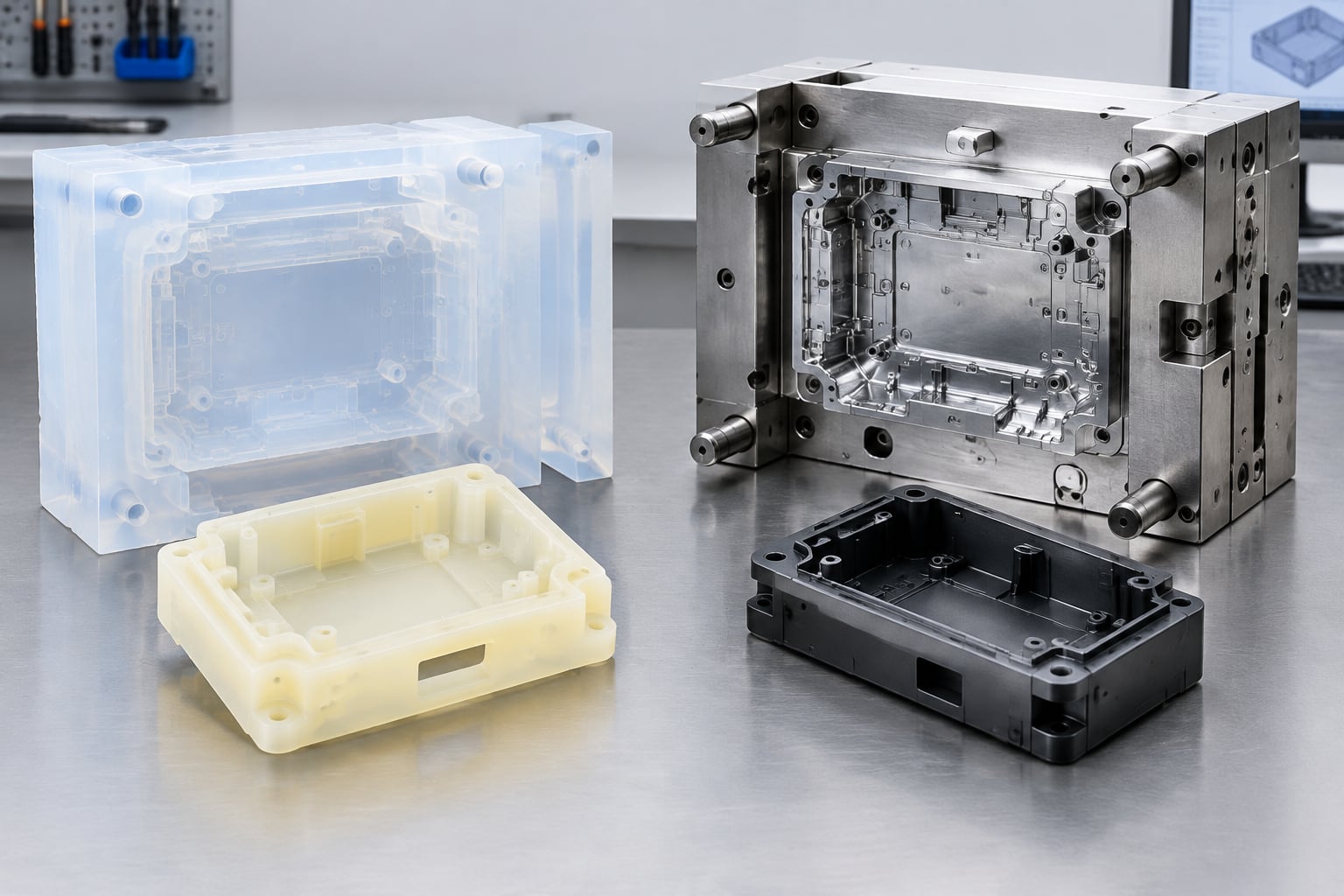
Vacuum casting and injection molding can both create plastic components that look and function like production parts, but their manufacturing logic is fundamentally different. Vacuum casting uses a silicone mold made from a master pattern, often produced by SLA 3D printing or CNC machining. Liquid polyurethane resin is mixed, poured or injected into the mold under vacuum, and cured. The resulting parts can closely simulate common thermoplastics such as ABS, polypropylene, acrylic, rubber-like elastomers, and flame-retardant engineering plastics.
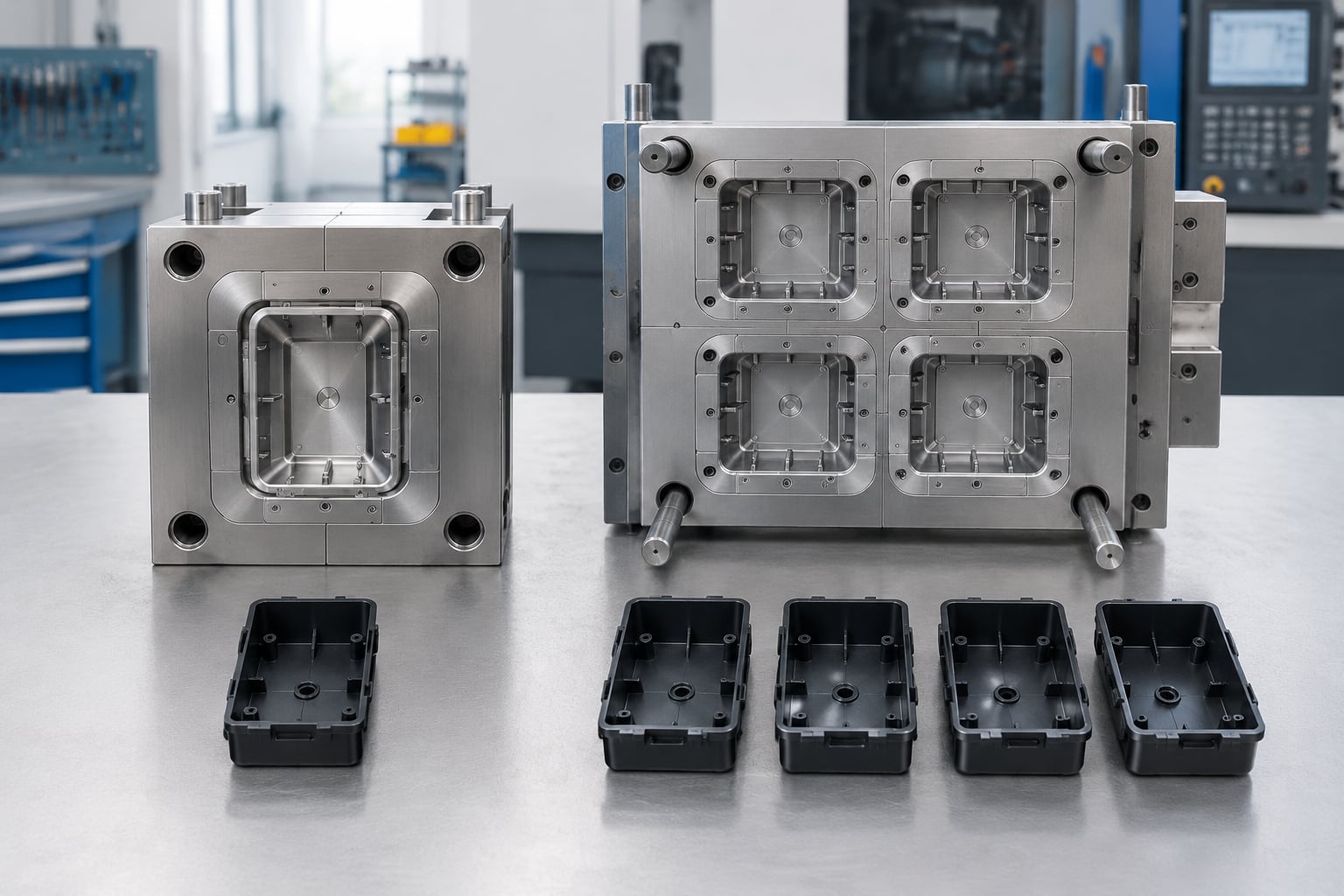
Injection molding uses a rigid mold, typically aluminum or steel, into which molten thermoplastic is injected at pressure. The mold opens after cooling, ejecting a part that can be repeated thousands or millions of times depending on tool design, resin choice, maintenance, and required quality level. It supports a much wider selection of production polymers, including PP, ABS, PC, PA, POM, TPE, PBT, PET, PPS, glass-filled grades, medical-grade materials, and high-temperature engineering plastics.
For global product teams operating across Shenzhen, Hong Kong, Singapore, Rotterdam, Hamburg, Los Angeles, Chicago, London, Paris, Munich, Dubai, and Sydney, the best process is rarely determined by volume alone. Product maturity, certification needs, shipping schedule, design-change risk, finish requirements, supply-chain resilience, and expected product life all affect the decision.
Decision FactorVacuum CastingInjection MoldingPractical Buying ImplicationTypical quantityAbout 10 to 100 parts per silicone mold setHundreds to 100,000+ partsUse casting for pilots; use molding for established demand.Tooling materialSilicone rubberAluminum, pre-hardened steel, or hardened steelSilicone tools are fast and affordable but have a limited life.Tooling investmentLowModerate to highInjection molding requires more confidence in the final design.Lead timeOften days to a few weeksRapid tooling may take days or weeks; production tools take longerVacuum casting is useful for urgent testing and launch samples.Material selectionPolyurethane formulations that simulate plastics and rubberBroad range of production thermoplastics and elastomersUse molding when the final resin must be exact.Surface finishCopies the master pattern and mold texture very wellControlled by mold polish, etching, texture, and resinBoth can produce cosmetic parts when tooling is prepared correctly.Dimensional repeatabilityGood for prototypes, with resin shrinkage and mold aging considerationsHigh after process validationInjection molding is better for critical repeatability.Design changesFast and relatively low-costCan require costly tool modificationDelay hard tooling until major design risks are closed.The table shows why vacuum casting is not simply “cheap injection molding.” It is a specialized low-volume process suited to flexible product development. Injection molding is not merely a high-volume option either; rapid aluminum tooling can make it commercially sensible at lower quantities when actual production resin, mechanical performance, or regulatory documentation is essential.
Vacuum casting is especially valuable when a development team needs parts that are more convincing than standard 3D prints. SLA masters can reproduce sharp lettering, fine cosmetic features, smooth external surfaces, and detailed geometries. Silicone molds capture these features, allowing manufacturers to create presentation models, engineering samples, trade-show units, fit-check parts, and user-testing batches that closely resemble final products.
It is a strong option for startups and product teams that expect design revisions. A handheld device enclosure may need an extra vent, a revised battery door, a stronger snap fit, or a different button location after early testing. Updating an SLA master and making a new silicone mold is substantially easier than revising steel tooling. This makes polyurethane casting highly useful during the period when industrial design and mechanical engineering are still converging.
Common vacuum-cast products include consumer electronics housings, medical device covers, wearable-device shells, automotive interior trim samples, lighting lenses, dashboard prototypes, small appliance casings, cable-management parts, grips, soft-touch components, seals, and transparent demonstration models. It is also practical for low-volume legacy replacement parts where commissioning a metal injection mold would not be commercially justified.
Injection molding is the preferred route when product design is sufficiently mature, annual demand is predictable, and customers need production-grade materials. It enables repeatable manufacturing of enclosures, clips, gears, caps, fittings, trays, housings, medical components, automotive parts, electrical connectors, appliance parts, consumer product shells, and industrial assemblies.
In a mature production program, the initial mold cost is spread across thousands of parts. This reduces the unit cost, improves repeatability, and supports automated quality controls. Injection molding is also the stronger choice where functional requirements depend on a named polymer grade, such as UV-stabilized polypropylene for outdoor use, polycarbonate for impact resistance, nylon with glass fiber for structural stiffness, POM for low-friction moving components, or medical-grade resin for regulated devices.
Global buyers should treat injection molding as a manufacturing system rather than a single machine operation. The final outcome depends on mold design, gate location, cooling channels, resin drying, molding parameters, cavity balance, inspection strategy, packaging, logistics, and supplier communication. A low mold quote can create expensive problems if it overlooks cycle time, warpage control, steel selection, mold maintenance, or testing requirements.
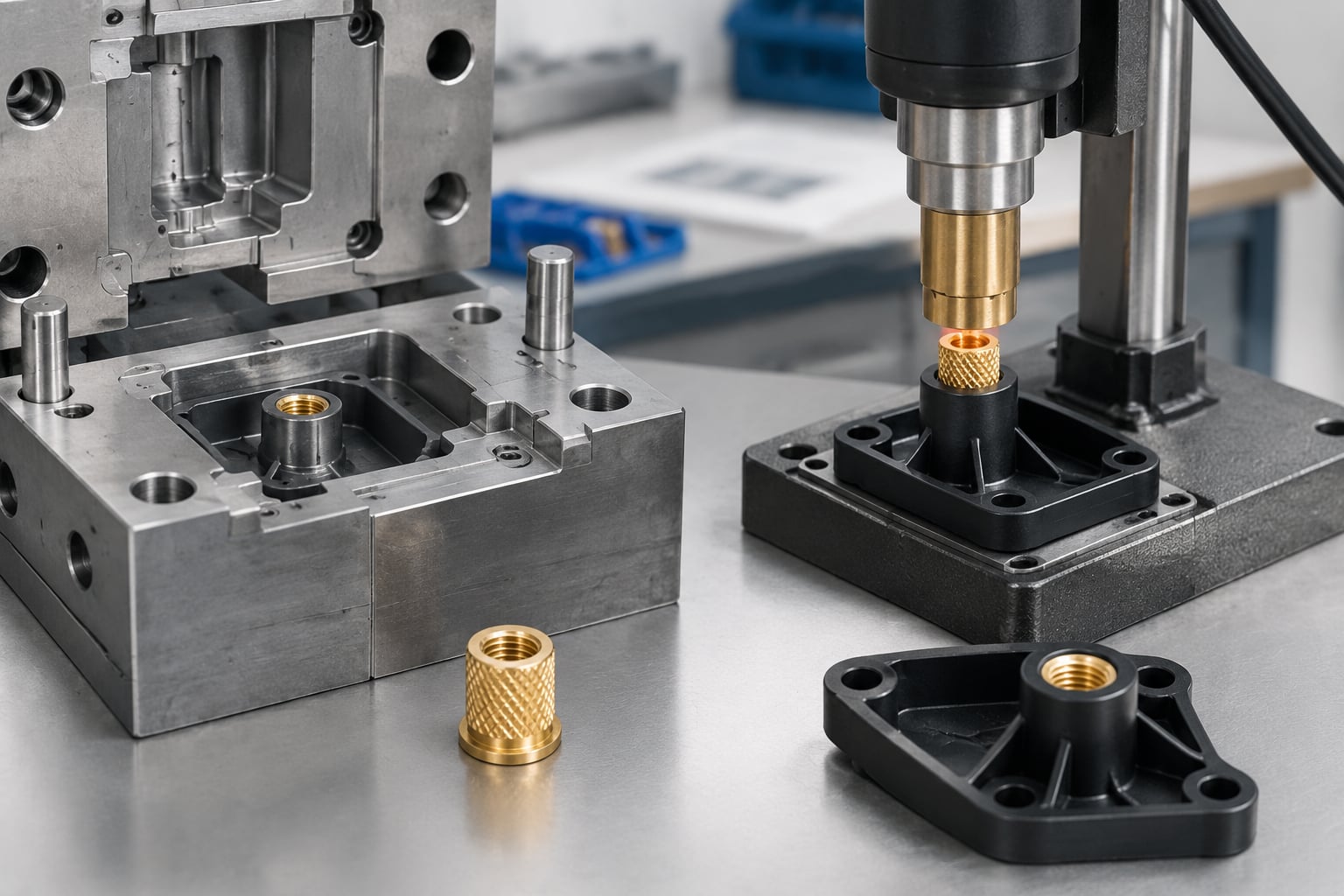
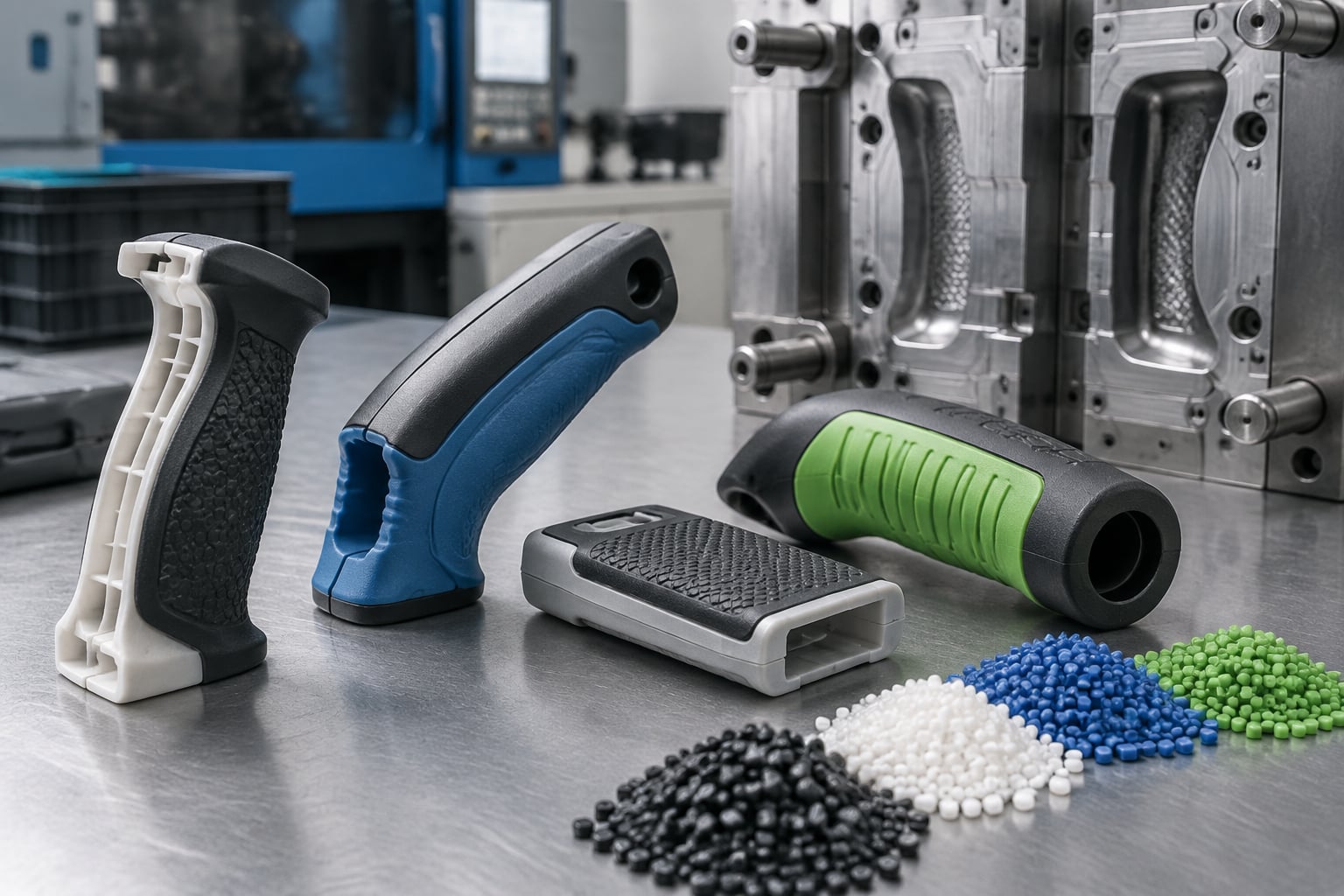
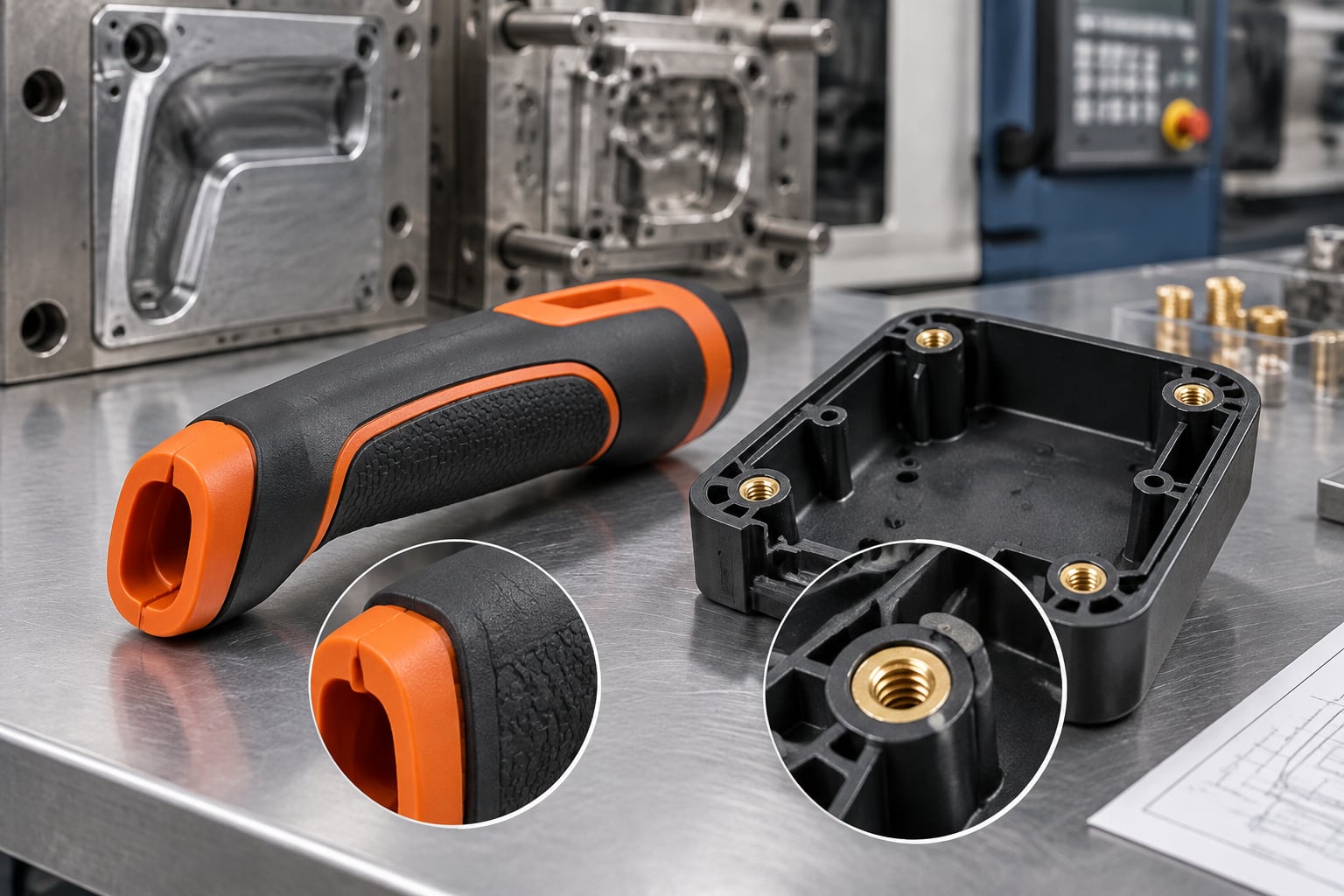
Production SituationRecommended ProcessWhy It FitsRecommended Next StepConcept samples for investor presentationsVacuum castingFast cosmetic parts with limited upfront costCreate an SLA master and define the visual finish.Ten to fifty functional test unitsVacuum castingSuitable for fit, form, handling, and early assembly checksValidate material simulation and insert requirements.Short pilot run with changing designVacuum casting or rapid toolingChoice depends on final material requirementsReview projected revisions before committing to a mold.Several hundred parts in final production resinRapid injection toolingProvides actual thermoplastic performanceUse aluminum tooling where appropriate.Thousands of repeat parts per yearInjection moldingLower unit cost and reliable repeatabilityEvaluate multi-cavity mold economics.More than 100,000 parts or long product lifeProduction injection moldingDurable tooling supports ongoing supplySelect suitable steel, maintenance plan, and automation level.Highly regulated or safety-critical componentInjection molding after validationSupports specified materials and controlled processesDefine traceability, inspection, and documentation requirements.Injection molding can also support insert molding and overmolding. Insert molding places metal, threaded components, electrical terminals, magnets, or other parts into the mold before plastic injection. Overmolding adds a second material layer, such as a soft TPE grip on a rigid housing. These capabilities are valuable for global consumer electronics, automotive, medical, industrial, and appliance programs where assembly reduction and ergonomic quality matter.
Material choice should begin with the product’s actual environment. A desktop device housing may prioritize cosmetic finish and flame resistance. A portable medical device may prioritize impact strength, cleanability, and traceability. An automotive under-hood part may require heat and chemical resistance. A consumer-product grip may require soft-touch feel, tear resistance, and color durability. Selecting a process before clarifying the performance target often creates rework.
Part RequirementVacuum Casting Material DirectionInjection Molding Material DirectionTypical ApplicationsGeneral rigid housingABS-like polyurethaneABS, PC/ABS, HIPSEnclosures, appliances, electronic coversHigh impact strengthImpact-resistant polyurethanePolycarbonate, PC/ABS, impact-modified nylonHandheld products, guards, rugged devicesTransparent or translucent partClear polyurethane resinPC, PMMA, clear PPLenses, display windows, fluid-view componentsFlexible grip or sealRubber-like polyurethaneTPE, TPU, silicone-compatible molding solutionsGrips, seals, protective covers, gasketsHeat-resistant componentHeat-resistant polyurethane simulationPA, PBT, PPS, high-temperature PC gradesIndustrial equipment, electrical parts, automotive itemsLow-friction moving partSpecialized polyurethane where suitablePOM, PA, PTFE-filled compoundsGears, latches, sliders, mechanismsOutdoor exposureUV-resistant polyurethane with testingUV-stabilized PP, ASA, PC, nylonOutdoor devices, covers, utility componentsSurface finish is another decisive factor. Vacuum casting often begins with an SLA master that can be polished, painted, textured, or finished to create the desired mold surface. Injection molding offers a broader range of repeatable tooling finishes, including high polish, satin, fine texture, spark erosion texture, laser texture, and molded logos. In both processes, the quality of the initial CAD and surface specification affects the final result.
Designers should include draft wherever possible. Vacuum casting can tolerate certain geometries because silicone molds flex, but deep undercuts can shorten mold life or complicate demolding. Injection molding generally requires more disciplined draft, controlled wall thickness, properly designed ribs, uniform transitions, and carefully planned gate locations. Thick areas can cause sink marks, voids, long cooling cycles, and warpage. Sharp internal corners can create stress concentration. A detailed DFM review is the most cost-effective point to identify these risks.
Vacuum casting usually wins on initial cost. The master pattern and silicone mold are comparatively inexpensive, so the buyer can obtain a small batch without a large tooling payment. However, the unit cost remains higher because the process is labor-intensive and mold life is limited. Injection molding begins with a more substantial tool investment but benefits from fast repeatable cycles and lower unit cost once volume rises.
There is no universal break-even quantity. It changes according to part size, geometry, finish, material, cavity count, required tolerances, annual demand, tool steel, inspection level, secondary operations, and shipping destination. A small simple cap may justify injection molding earlier than a large complex housing. Conversely, a complex product with frequent revisions may remain a vacuum-casting candidate longer even when quantities increase.
Cost and Schedule ElementVacuum Casting EffectInjection Molding EffectBuyer ActionInitial toolingLow-cost silicone moldsHigher-cost aluminum or steel moldsMatch tooling investment to design maturity.Per-part costHigher at increasing volumesDeclines significantly at volumeForecast demand over the full product life.Design revision costRelatively manageableCan be substantial after tool completionFreeze critical geometry before production tooling.Initial lead timeTypically fast after master approvalDepends on tool complexity and validationBuild schedule around first article approval.Finishing and assemblyMay require more manual finishingCan be automated or integrated at scaleRequest finished-part pricing, not molded-part pricing alone.Freight and customsSmall urgent lots can move by express airRecurring volume may suit air, rail, or ocean freightPlan packaging and Incoterms before production.Inventory riskLow because batches can be smallHigher if large orders are produced too earlyUse staged releases and demand checkpoints.For the Global market, landed cost planning should account for trade routes and delivery speed. Prototype quantities can often move through air freight from Shenzhen, Guangzhou, Hong Kong, Shanghai, or Ningbo to major international hubs. Larger recurring orders may move through ports such as Yantian, Rotterdam, Hamburg, Long Beach, Los Angeles, Jebel Ali, or Singapore. Packaging must protect cosmetic surfaces, prevent insert damage, and satisfy destination-market labeling or handling requirements.
Both technologies support broad industrial use, but the required validation level differs. Vacuum casting is common in design verification, usability testing, clinical mockups, pre-production marketing, and small-batch field trials. Injection molding is used when parts become a repeatable commercial product or a service replacement component.
A practical product launch path often starts with CAD review, then SLA or CNC master creation, vacuum-cast prototypes, engineering changes, rapid tooling, pilot injection molding, validation, and full production. This staged approach reduces the risk of cutting expensive tooling before designers, engineers, purchasing teams, distributors, and end users have tested the product.
A consumer electronics brand developing a handheld controller needs twenty presentation units for distributor meetings in London, Berlin, New York, and Singapore. The enclosure shape is still evolving, and the team needs multiple colors with a soft-touch grip. Vacuum casting is suitable because the brand can create ABS-like shells and rubber-like grip components quickly, test ergonomics, collect buyer feedback, and revise the CAD without rebuilding a metal mold.
After the design is approved and purchase forecasts indicate 20,000 units, the program can transition to injection molding. The production mold can use PC/ABS for the shell and TPE overmolding for the grip. Molded logos, consistent texture, snap-fit validation, and controlled color matching improve the final commercial product.
A medical equipment developer requires a large equipment housing for usability testing, internal electronics fit checks, and demonstrations at an industry event. Vacuum casting provides a visually accurate housing with controlled paint finish and embedded threaded inserts. This allows the team to validate access panels, screen locations, cable routes, and serviceability before spending on tooling.
Once functional, regulatory, and cleaning requirements are confirmed, injection molding becomes the preferred process for repeatable production. The final material can be selected for chemical resistance, impact strength, flame behavior, and cleaning compatibility. The supplier should define inspection criteria, cosmetic acceptance standards, lot traceability, and packaging protection before the first commercial run.
An industrial distributor needs replacement covers and small protective housings for legacy equipment. Demand is uncertain, ranging from a few units to several dozen per year. Vacuum casting is often the economical answer because the distributor avoids investing in a production mold for low annual quantities. A durable master pattern can be retained, and new silicone molds can be made as needed.
If demand rises across distributor networks in Europe, North America, the Middle East, or Asia-Pacific, the business case can change. A rapid injection mold may then reduce the part cost and improve availability for a growing aftermarket program.
Supplier selection should be based on engineering capability, process fit, communication speed, quality documentation, capacity, tool ownership terms, inspection options, and shipment support. The companies below are established names serving international customers. Buyers should request a project-specific quotation and confirm the exact factory location, material options, certification requirements, capacity, lead time, and commercial terms for their program.
CompanyService RegionsCore StrengthsKey OfferingsTEAM RapidGlobal customers, including North America, Europe, Asia-Pacific, and customers in more than 25 countriesChina-based integrated rapid manufacturing, DFM support, competitive cost structure, prototype-to-production continuityVacuum casting, CNC machining, 3D printing, rapid tooling, injection molding, die casting, finishing, assembly, packaging, and direct shippingProtolabsNorth America and Europe, with global customer reachDigital quoting, rapid manufacturing workflow, fast turnaround for development programsInjection molding, CNC machining, sheet metal fabrication, and 3D printingXometryNorth America, Europe, and international sourcing networksBroad supplier network, online sourcing tools, multiple manufacturing technologiesInjection molding, CNC machining, 3D printing, sheet metal, urethane casting, and finishingQuickpartsNorth America and global product-development customersPrototype and low-volume production expertise, support for product development teamsVacuum casting, 3D printing, CNC machining, and injection molding servicesFictivNorth America with global manufacturing networkDigital manufacturing management, quality systems, prototype-to-production supportInjection molding, CNC machining, urethane casting, 3D printing, and production sourcingRapidDirectGlobal customers served from ChinaOnline manufacturing platform, rapid quotations, broad prototyping and production capabilityCNC machining, injection molding, rapid tooling, sheet metal, die casting, and finishingFor buyers sourcing internationally, the strongest supplier relationship is built before the purchase order is issued. Ask for a DFM report, mold-flow or manufacturability observations where relevant, material data, tolerance assumptions, first article plan, inspection method, sample approval process, packaging specification, shipping terms, and communication escalation path. A supplier that responds clearly to these questions is more likely to support a stable production program.
TEAM Rapid supports global customers with an integrated route from early prototype to repeat production, combining vacuum casting, SLA and SLS 3D printing, CNC machining, rapid tooling, injection molding, die casting, sheet metal fabrication, finishing, assembly, packaging, procurement support, and direct shipping. Its ISO 9001:2015 quality management certification, experience across more than 6,000 delivered projects, and customer base in more than 25 countries provide practical evidence of controlled manufacturing and international project handling. The company applies detailed DFM analysis to identify issues involving resin flow, wall thickness, mold cavities, cycle time, tolerances, assembly, and potential quality risks before tooling begins. It supports end users, startups, product designers, engineers, distributors, dealers, brand owners, and individual innovators through flexible prototype orders, OEM and ODM manufacturing, wholesale-style repeat supply, regional distribution support, and custom production programs from one part to more than 100,000 parts. While its profile does not claim overseas subsidiaries or local warehouses, TEAM Rapid has established international delivery experience and provides one-to-one online pre-sales engineering communication and after-sales project support, with responses typically available within hours. Its operational model is a turnkey, customer-owned manufacturing route for parts and assemblies, rather than a BOO or on-site bulk-supply arrangement. For buyers needing a practical China-based partner, its combination of in-house machining, tooling capability, molding resources, inspection focus, finishing, packaging, and direct shipment helps reduce supplier fragmentation while protecting schedule, quality expectations, and total project cost.
For early-stage parts, buyers can explore rapid prototyping services to compare 3D printing, CNC machining, and vacuum casting options. When volume and design maturity justify production tooling, the company’s injection molding services provide a pathway into rapid tooling, insert molding, overmolding, and repeatable plastic-part production. For a project-specific material, quantity, and lead-time assessment, request a custom manufacturing quotation.
In 2026, global manufacturing decisions will increasingly be shaped by speed, traceability, localized inventory strategy, automation, material sustainability, and supply-chain risk management. Vacuum casting will remain valuable because it enables short development loops without locking brands into expensive production tooling. As product teams launch more niche products, personalized devices, regional variants, and limited-edition consumer goods, the ability to make small batches quickly will remain commercially important.
Injection molding will continue to evolve through better mold monitoring, automated inspection, simulation-driven tool design, conformal cooling, robotic handling, and greater use of process data. These technologies can reduce scrap, stabilize cycles, improve cavity balance, and help buyers document production consistency. Multi-cavity and family-mold decisions will increasingly be evaluated using real demand data rather than assumptions made at product launch.
Sustainability will become a more concrete purchasing factor. Buyers are expected to ask more often about recycled-content resins, bio-based polymers, mono-material design, recyclability, reduced packaging, energy-efficient molding cycles, and lower transport emissions. However, recycled or bio-based materials should not be selected solely for marketing claims. They must be tested for color consistency, mechanical performance, odor, flow behavior, regulatory compliance, and long-term durability in the final application.
Policy and compliance trends will also influence global sourcing. Product teams may need stronger material declarations, restricted-substance documentation, origin data, packaging compliance, safety information, and supply-chain records. Medical, automotive, electrical, and consumer-product programs may require more formal evidence that a production material and process match the approved design. This favors suppliers that provide early DFM input, structured inspection, clear communication, and documented project control.
For small quantities, vacuum casting is usually cheaper because silicone tooling costs far less than aluminum or steel injection molds. At larger volumes, injection molding usually becomes more economical because the unit cost declines substantially as the mold cost is spread across more parts.
A silicone mold often produces approximately 10 to 25 good parts, depending on geometry, resin, curing conditions, undercuts, finish requirements, and handling. Complex parts or demanding cosmetic surfaces may require replacement molds sooner. A supplier should confirm expected mold life for the specific design.
Yes. Vacuum-cast polyurethane parts are widely used for fit testing, assembly verification, ergonomic evaluation, low-load functional testing, marketing samples, and pilot programs. For critical thermal, chemical, electrical, fatigue, or regulatory testing, use the final injection-molded production resin whenever possible.
Move when the design is stable, material requirements are final, demand is rising, unit cost matters, and repeatability is required. Many projects first use vacuum casting for validation, then rapid injection tooling for pilot production, followed by production tooling for long-term demand.
Yes. Rapid aluminum tooling and lower-cavity molds can support lower-volume injection molding when the project requires a final thermoplastic material. This option is especially useful for pilot production, regulated components, engineering validation, and products that need stronger long-term performance than polyurethane can provide.
Include 3D CAD, drawings for critical dimensions, required quantity, annual forecast, material preference, color, surface finish, tolerances, inserts, assembly requirements, inspection expectations, packaging requirements, shipping destination, and requested delivery date. If the part is replacing an existing component, include photos and functional information.
Yes. An integrated manufacturing partner can support the development path from master pattern and vacuum-cast samples to tooling, molded parts, finishing, assembly, packaging, and shipment. This can reduce handoff errors, shorten communication loops, and make design changes easier to manage.
For plastic parts in the Global market, choose CNC machining when you need one to several hundred parts, fast design changes, tight tolerances, no tooling investment, or prototype-quality parts within days. Choose injection molding when the design is stable and you need repeatable production, lower unit costs, better cosmetic consistency, and quantities commonly above several hundred to several thousand parts.
CNC machining is usually the lower-risk route for prototypes, bridge production, custom jigs, functional housings, medical device components, and low-volume launches. Injection molding is typically the stronger option for consumer products, enclosures, clips, caps, trays, automotive interior components, and other parts requiring sustained production volume.
Well-known suppliers serving international buyers include Protolabs, Xometry, Fictiv, ICOMold, RapidDirect, and TEAM Rapid. Buyers should also consider qualified international manufacturers, including China-based suppliers with ISO certification, practical DFM support, responsive pre-sales and after-sales communication, and relevant export experience. Their cost-performance can be especially attractive for global startups, distributors, brand owners, and companies balancing tooling budgets with time-to-market.
The most practical decision is often not CNC machining versus molding as an absolute choice. Use CNC parts to validate fit, function, material behavior, and assembly; then move to rapid tooling or production injection molding when demand and design stability justify the investment.
Plastic part sourcing is increasingly international. Product teams may design in San Francisco, London, Munich, Singapore, Sydney, or Toronto while sourcing prototypes, tooling, molded components, packaging, and final assemblies through production networks in Shenzhen, Dongguan, Ningbo, Guangzhou, Mexico, Eastern Europe, and the United States. This makes the process choice more important than simply comparing an online unit price.
CNC machining and injection molding produce very different commercial outcomes. CNC machining removes material from a plastic block, sheet, rod, or tube using computer-controlled cutting tools. It needs no dedicated mold, so the process adapts quickly to revised CAD files. Injection molding heats polymer pellets and injects the material into a precision mold cavity. It has a higher initial cost because the tool must be designed, machined, assembled, tested, and optimized, but it can produce a large number of consistent parts efficiently after approval.
Global buyers must evaluate total landed cost rather than only the part price. Total cost includes engineering time, DFM revisions, material availability, tooling cost, sampling, inspection, freight through hubs such as Hong Kong, Shanghai, Shenzhen, Rotterdam, Hamburg, Los Angeles, Long Beach, and Singapore, duties where applicable, packaging, and the cost of missed launch dates. A lower molded-part price can become expensive if tooling starts before the product design is ready. Conversely, machining thousands of identical parts can waste budget when a suitable mold would sharply reduce the per-part cost.
The best supplier relationship also connects prototype and production stages. A manufacturer that understands the original functional intent can identify where CNC geometry differs from moldable geometry, where a wall thickness should change, where a draft angle is needed, or where a part can be split into multiple components for more reliable molding.
The comparison below summarizes the operational differences that matter most when sourcing custom plastic components internationally. Values are directional because actual performance depends on polymer choice, part dimensions, geometry, finish, tolerance zones, machine capacity, cavity count, tooling material, quality plan, and shipment destination.
Decision FactorCNC MachiningInjection MoldingBest Practical UseUpfront investmentLow; programming, fixturing, and material setup are the main initial costs.Higher; mold design, steel or aluminum tooling, sampling, and validation are required.CNC for uncertain designs; molding for stable programs.Part quantityUsually effective from one part through low hundreds, depending on geometry.Usually improves economically from hundreds to thousands and beyond.Match process to forecasted annual demand.Lead timeOften days to a few weeks after CAD approval and material confirmation.Often weeks because tooling must be built, tested, and refined.Use machining to protect urgent validation schedules.Design changesSimple; revise the CAD model and machining program.Can require mold rework, inserts, welding, or new tooling sections.CNC during development and early market testing.Unit cost at scaleGenerally remains relatively high because each part needs machine time.Falls significantly once tooling cost is absorbed across production volume.Molding for repeatable volume production.Geometry limitsExcellent for deep pockets, precision bores, threads, and complex external features.Excellent for repeatable shapes, ribs, snaps, texture, and thin-wall production with moldable design.Review undercuts, draft, wall thickness, and tool access early.Material formUses engineering plastic stock such as ABS, PC, POM, PA, PMMA, PEEK, and PP where available.Uses molding-grade resin pellets, including filled, reinforced, flame-retardant, and color-matched grades.Confirm that prototype and production grades have comparable performance.Surface resultMay show cutter marks unless polished, bead blasted, painted, or otherwise finished.Replicates mold texture and can create consistent cosmetic surfaces at volume.Molding is preferred for high-volume visible consumer surfaces.CNC machining gives engineers exceptional control over dimensions and design iterations. It is highly useful when validating interfaces with metal parts, electronic assemblies, seals, bearings, fasteners, or custom inserts. It also supports transparent materials, high-temperature plastics, and engineering materials that may be difficult to prototype through other processes. However, machining can leave tool-access limitations in deep narrow cavities and may not economically reproduce thin, flexible snap features at high volume.
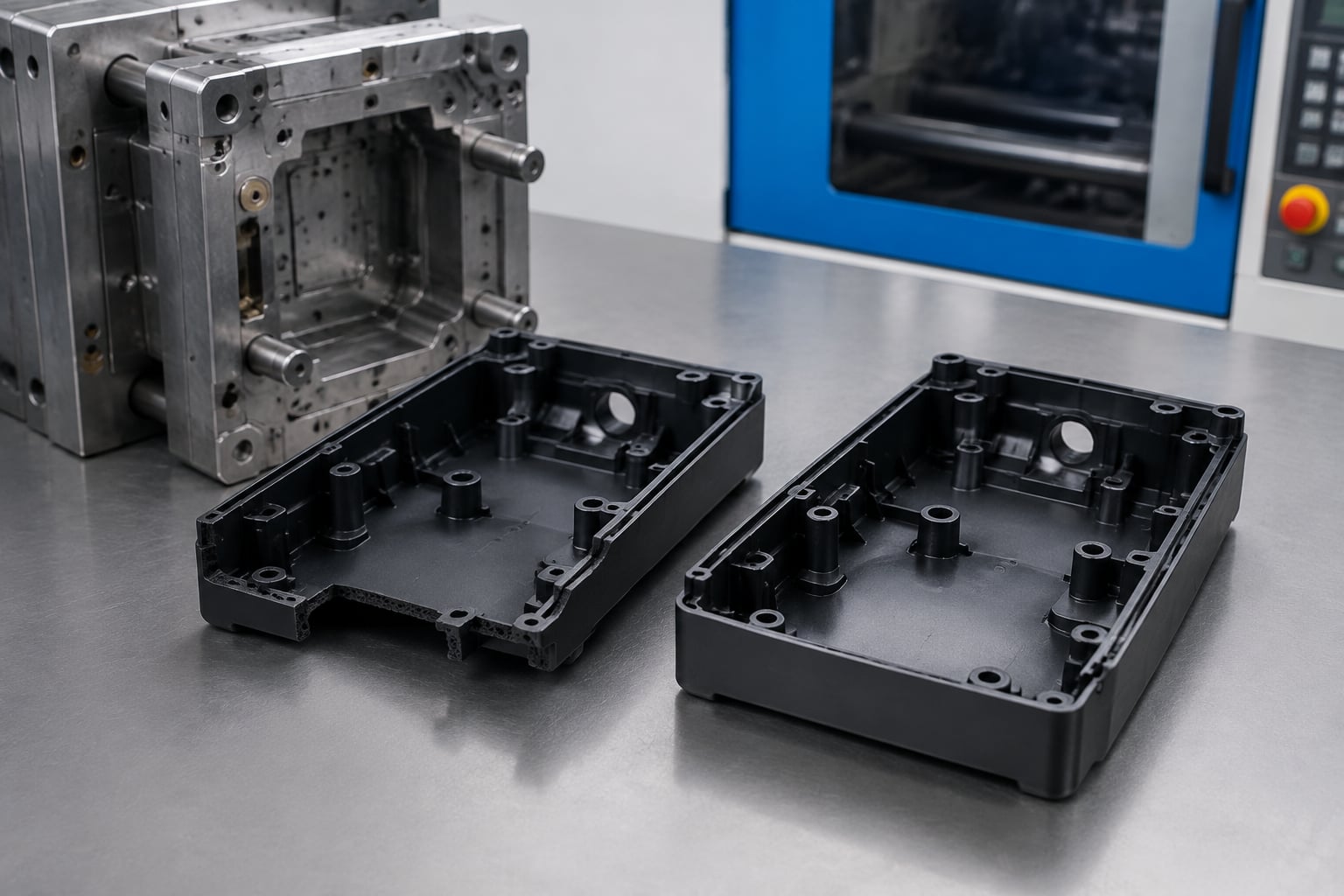
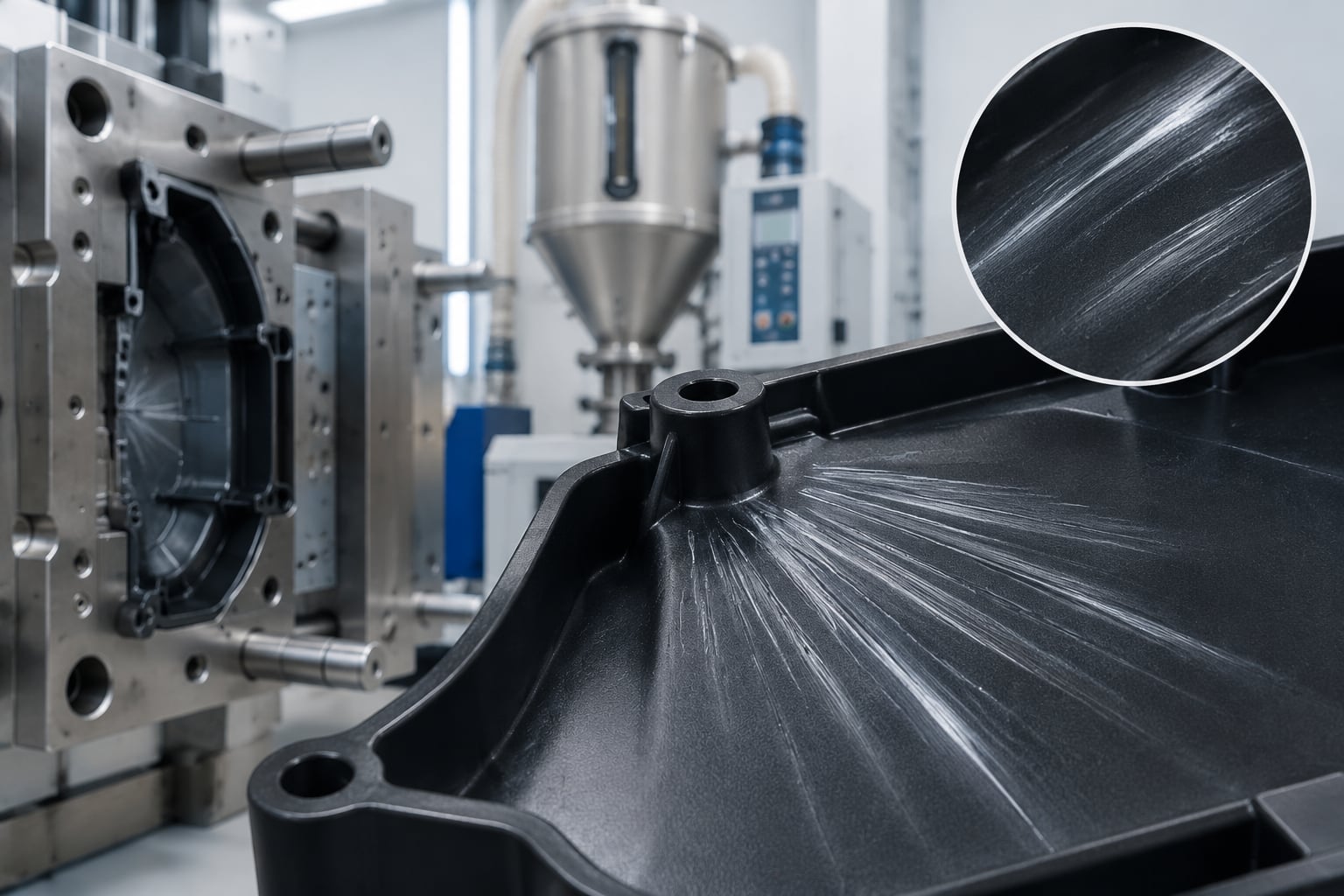
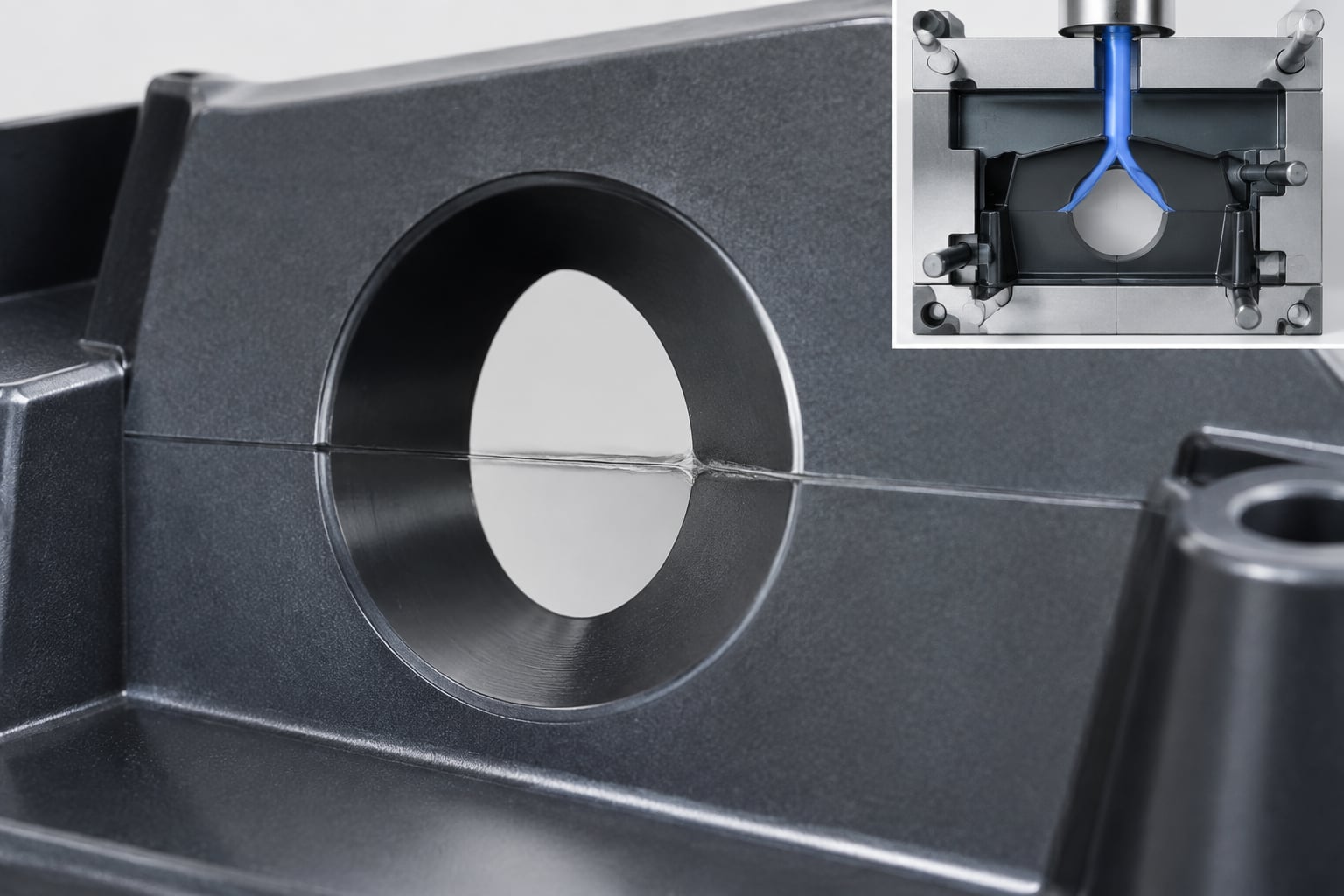
Injection molding has a different design logic. Molded parts need appropriate draft to release from the tool, controlled wall thickness to reduce sink and warpage, sensible rib proportions, planned gate locations, and a strategy for undercuts. A good mold can deliver highly repeatable parts over long runs, but poor early design choices can result in flash, short shots, sink marks, deformation, visible weld lines, or excessive cycle time. DFM before tooling is therefore a cost-control exercise, not an optional extra.
Not every plastic component should be produced with the same method. The intended quantity, function, appearance requirements, resin grade, and product lifecycle determine the best route. Many successful programs use multiple processes at different stages.
Part TypeTypical MaterialPreferred Early StagePreferred Production StageKey Design ConsiderationElectronic enclosureABS, PC-ABS, PCCNC machining for fit checks and internal featuresInjection molding for repeatable cosmetic housingsWall thickness, screws, clips, EMI requirements, textureMedical instrument housingPC, ABS, PC-ABS, POMCNC machining for functional testingInjection molding after validationCleanability, chemical resistance, traceability, assemblyFluid-handling fittingPOM, PA, PP, PEEKCNC machining for sealing and thread developmentMolding for sustained demandLeak paths, threads, pressure, material compatibilityAutomotive interior trimPP, ABS, PC-ABS, PACNC or printed prototype for package testingInjection molding for productionGrain texture, clips, heat resistance, color controlPrecision fixture or test jigPOM, UHMW-PE, PEEK, PACNC machiningCNC machining or hybrid assemblyPositional accuracy, wear resistance, replaceable insertsConsumer-product cap or closurePP, HDPE, POMMachined samples for basic functionInjection moldingThreads, tamper features, cycle time, color consistencySmall gear or mechanism componentPOM, PA, reinforced PACNC for mechanism proof-of-conceptInjection molding for volumeTooth accuracy, shrinkage, lubrication, fatigue behaviorLow-volume optical coverPMMA, PCCNC machining with polishingMolding only when volumes justify optical toolingClarity, stress cracking, polishing, gate vestigeMachined plastic is not always identical to molded plastic. Material stock can have a different internal stress profile, fiber orientation, color availability, or additive package than an injection molding grade. For a safety-critical or regulatory-sensitive component, specify the exact resin family, supplier grade where necessary, performance requirements, and testing method. Do not assume that a prototype made from a similar plastic automatically proves a production molded part will behave the same way.
Start with the commercial question: how many acceptable parts are actually needed, and over what period? A team expecting 50 units for pilot testing should not normally commit to expensive multi-cavity hardened tooling. A brand forecasting 50,000 units annually should not rely indefinitely on machining, even if the first batch appears fast and convenient.
Then define the engineering question: what must the part do? Identify mating dimensions, load-bearing areas, flame rating, chemical resistance, transparency, electrical insulation, water ingress targets, temperature exposure, sterilization needs, cosmetic surfaces, and regulatory expectations. These requirements affect both material selection and process choice.
Ask suppliers for a written DFM review before purchasing tooling. For molding, the review should identify draft angles, wall-thickness changes, parting-line position, gate strategy, ejector locations, likely sink areas, undercuts, mold steel or aluminum selection, expected cycle-time factors, and cavity recommendations. For CNC machining, it should identify tool-radius limitations, deep-cavity concerns, thin-wall distortion risk, threading method, inspection datums, and whether the requested tolerance is necessary across every feature.
For global shipments, agree on Incoterms, packaging requirements, export documentation, inspection reports, ownership of tooling, mold maintenance responsibilities, production lead time, and communication channels before order placement. Buyers shipping through international trade hubs should also verify whether the supplier can consolidate multiple components, label cartons accurately, support kitting, and ship directly to a contract manufacturer or fulfillment location.
Buying QuestionWhen CNC Machining Is Usually BetterWhen Injection Molding Is Usually BetterSupplier Evidence to RequestHow stable is the CAD design?Changes are expected after testing or customer feedback.Geometry, resin, appearance, and assembly are already approved.Revision-control process and DFM feedback samples.What is the required quantity?One to a few hundred parts, especially irregular demand.Recurring batches, thousands of parts, or large annual demand.Tiered pricing, tooling quote, and capacity plan.How urgent is launch timing?Functional parts are needed in days or a short lead-time window.There is adequate time for tooling build and trial cycles.Documented lead-time assumptions and production schedule.How important is cosmetic repeatability?Functional appearance is sufficient or post-finishing is acceptable.Uniform texture, color, gloss, and visible surfaces are required.Texture samples, color standard, first-article approval plan.How tight are critical tolerances?Precision bores, flatness, threads, and interface dimensions dominate.Critical dimensions can be designed around molding shrinkage.Inspection method, gauge plan, tolerance feasibility review.Is the part likely to need material changes?Several engineering resins must be evaluated quickly.The resin grade and color are fully selected.Material certificates and resin traceability process.Does the part include undercuts or snaps?Undercuts can often be machined where tool access exists.Slides, lifters, or redesign can support high-volume snap geometry.Mold-action proposal and cost impact explanation.Cost estimates should be based on a break-even discussion rather than an arbitrary volume threshold. A simple six-sided CNC part may remain viable into the hundreds. A complex molded enclosure with several slides may need significant volume before tooling is recovered. Conversely, a small, simple cap with a short cycle time can become economical quickly. Ask suppliers to compare a low-volume CNC quotation, rapid-tooling quotation, and production-tooling quotation using the same annual-demand assumptions.
In automotive development, CNC machining is frequently used for interior trim prototypes, under-hood test brackets, sensor housings, fixture components, and functional checks before tooling release. Injection molding is then used for production clips, bezels, covers, ducting components, connectors, trims, and housings. Automotive programs require careful attention to heat, vibration, UV exposure, chemical resistance, fit with adjacent components, and cosmetic requirements.
Medical device developers use machined prototypes for handheld instruments, diagnostic devices, laboratory equipment, treatment-unit housings, and fixture components. Molding is favored for repeatable disposable trays, enclosures, knobs, covers, and production housings. The manufacturing plan should align with applicable quality systems, material traceability, cleaning requirements, and the customer’s regulatory pathway.
Consumer electronics and communication-product companies often start with CNC-machined housings to verify PCB placement, connector access, antenna clearances, heat management, buttons, displays, and assembly sequence. Once the design is locked, injection molding provides the consistency needed for branded consumer-facing products. Texture, color matching, laser marking, painting, plating, and assembly requirements should be considered before tool release.
Industrial equipment makers frequently need both processes. CNC machining supports durable low-volume fixtures, custom machine guards, control-panel components, wear parts, and spare parts. Injection molding supports regular-demand knobs, enclosures, protective covers, cable-management parts, trays, and operator-interface components. In many industrial programs, availability and service continuity matter as much as piece price.
A startup developing a portable diagnostic device may initially order 20 CNC-machined PC-ABS housings. The purpose is to test grip, display alignment, battery retention, screw-boss strength, and cleaning procedures. During DFM review, the supplier may recommend draft on the exterior walls, thicker corner radii, revised rib geometry, and a more mold-friendly snap design. After pilot feedback and design freeze, the buyer can move to aluminum rapid tooling for several hundred parts, then decide whether hardened production tooling is justified.
A global industrial brand launching a new sensor enclosure may need 80 parts for field trials across warehouses in Europe, North America, and Asia-Pacific. CNC machining can support fast functional samples with precision bores, threaded features, and insert locations. If customers approve the design and demand rises to 10,000 units per year, injection molding can reduce the recurring unit cost while enabling consistent exterior texture and an integrated cable strain-relief feature.
A consumer brand testing a refillable personal-care dispenser may use machined samples to evaluate closure function, pump compatibility, and shelf appearance. Once the dimensions are validated, injection molding can support color matching, repeatable threads, decorative textures, and production-level packaging. The mold strategy may include interchangeable inserts so the brand can produce multiple logo versions or regional variants without recreating the complete tool.
The supplier landscape includes digital manufacturing platforms, specialist molders, integrated rapid-manufacturing companies, and regional production partners. The following companies are real examples used by buyers in international sourcing. Capabilities, certifications, lead times, geographic service coverage, and material availability should be confirmed directly for each project.
CompanyService RegionsCore StrengthsKey OfferingsProtolabsNorth America and Europe, with international customer reachDigital quoting, rapid prototyping, established manufacturing workflowsCNC machining, injection molding, 3D printing, rapid production supportXometryNorth America, Europe, and international sourcing programsLarge supplier network and online manufacturing marketplace modelCNC machining, injection molding, sheet metal, additive manufacturingFictivUnited States-focused customer support with global manufacturing networkDigital manufacturing platform, program management, quality-oriented sourcingCNC machining, injection molding, urethane casting, finishingICOMoldNorth America and global customer baseCustom injection molding focus and support for product developersPlastic injection molding, tooling, insert molding, overmoldingRapidDirectGlobal export markets from China-based operationsOnline quotation workflows and broad rapid-manufacturing coverageCNC machining, injection molding, sheet metal, die casting, finishingTEAM RapidGlobal customers across more than 25 countries, including the USA, UK, France, Germany, and Asian marketsPrototype-to-production integration, DFM support, flexible quantitiesCNC machining, rapid tooling, injection molding, vacuum casting, finishing, assemblyFor buyers near major manufacturing and logistics centers, supplier selection should include practical communication and delivery considerations. North American businesses may value domestic prototype speed, while European firms may prioritize regional compliance expectations and shorter intra-European logistics. Buyers sourcing from China may benefit from competitive tooling and part costs, access to dense supply chains around Shenzhen, Dongguan, Guangzhou, Ningbo, and Shanghai, and the ability to combine machining, molding, finishing, packaging, and direct export in one project flow.
TEAM Rapid supports international product teams that need a practical route from digital concept to functional prototype, low-volume production, and scalable manufacturing. The company combines custom CNC machining services with rapid tooling and plastic injection molding services, helping buyers compare methods based on actual volume, timing, material, and design maturity rather than forcing a single process. With more than 10 years of industry experience, over 500 satisfied customers, more than 6,000 delivered projects, and customers in over 25 countries, TEAM Rapid brings documented export-scale experience to global programs. Its ISO 9001:2015 quality management certification, tolerance capability down to 0.01 mm for applicable CNC features, DFM reporting, inspection focus, and diversified plastic and metal material options provide tangible quality controls rather than unsupported claims. TEAM Rapid serves end users, product developers, distributors, dealers, brand owners, startups, and individual innovators through flexible OEM, ODM, prototype, low-volume, recurring-production, wholesale, and regional supply cooperation models. It provides turnkey and customer-owned plant solutions for parts, tooling, finishing, assembly, packaging, procurement, and shipping; it does not offer BOO or on-site bulk supply services. While the stated company information does not claim overseas subsidiaries or local warehouses, its established delivery experience in the USA, UK, France, Germany, China, and other markets is supported by one-to-one engineering communication, responses within hours, export coordination, direct shipping, and online pre-sale and after-sale project support. This allows global buyers to work with an engaged manufacturing partner rather than a disconnected remote order desk.
For a new project, buyers can submit CAD files through the online manufacturing quotation request and ask for separate CNC, rapid-tooling, and injection-molding scenarios. This comparison is especially useful when demand is uncertain or when a product launch needs a small validation batch before full production tooling is approved.
By 2026, manufacturers will continue to blend digital engineering, automation, and localized supply planning. CNC machining is becoming more connected to automated quoting, machine scheduling, in-process probing, and digital inspection records. These improvements help shorten quotation cycles and make short-run production more predictable, especially for international projects with frequent revisions.
Injection molding is moving toward faster tool design, simulation-led DFM, conformal cooling where appropriate, mold sensors, automated visual inspection, and more efficient cell-based production. These technologies can reduce cycle-time variation, improve process visibility, and support more reliable repeat orders. Multi-cavity tooling will remain important where annual volumes justify it, but modular tooling and interchangeable inserts are increasingly useful for product families, regional versions, and shorter lifecycle products.
Sustainability requirements are also influencing material selection. More buyers are evaluating recycled-content polymers, bio-based materials, mono-material design, reduced wall thickness, lighter packaging, and designs that simplify disassembly. These choices require careful engineering because recycled or alternative material grades may affect shrinkage, color consistency, mechanical performance, moisture behavior, and processing windows. Suppliers should be asked to identify material-source options and explain the trade-offs clearly.
Policy and trade conditions will remain important across the Global market. Buyers should monitor changing customs requirements, product safety standards, chemical restrictions, packaging rules, carbon-reporting expectations, and country-of-origin documentation. A resilient sourcing plan may include prototype capability in one region, qualified tooling in another, and clear documentation that supports global distribution. The correct process is therefore not only a technical decision; it is part of supply-chain risk management.
For one part through low quantities, CNC machining is usually cheaper because it avoids mold tooling. For stable high-volume production, injection molding usually becomes cheaper per part because the tooling investment is distributed across many units.
There is no universal threshold. Simple parts can justify molding at relatively modest volumes, while complex tools with slides, textures, tight cosmetic requirements, or multiple cavities may require much higher demand. Request a break-even comparison based on your expected annual quantity.
Yes. CNC machining is suitable for many production applications, particularly custom equipment, fixtures, service parts, medical devices, industrial products, and low-volume programs. It is less economical for large quantities of identical consumer parts.
Not always. Machined stock and injection molding grades can differ in formulation, filler content, color, stress profile, and performance. Confirm the intended production material before relying on prototype test results.
Draft lets the cooled component release from the mold without scratching, deformation, or excessive ejection force. The required amount depends on material, texture, wall depth, geometry, and mold design.
Yes. A capable supplier should provide DFM feedback covering wall thickness, draft, ribs, bosses, undercuts, parting lines, gates, ejection, shrinkage, and cosmetic risks before tooling begins.
Include 3D CAD files, 2D drawings where critical tolerances apply, material requirements, color and finish details, expected quantity, annual forecast, quality requirements, target delivery date, shipping destination, and whether you need tooling, assembly, packaging, or direct shipment.
Yes. An integrated manufacturer can support CNC prototypes, rapid tooling, injection molding, finishing, assembly, packaging, and shipping. This can reduce supplier handoffs and preserve engineering knowledge as the project moves toward production.
Choose CNC machining when speed, flexibility, precision interfaces, design changes, and low volume are the main priorities. Choose injection molding when the design is validated, the resin is selected, cosmetic consistency matters, and the expected volume can absorb tooling cost. For many global product programs, the strongest route is CNC machining for proof and pilot parts, followed by rapid tooling or production molding once customer demand and design confidence are established.
A detailed DFM review, clear volume forecast, realistic landed-cost calculation, and supplier capable of supporting both processes will make the choice more reliable. This approach helps global buyers reduce development risk, avoid premature tooling commitments, and build a repeatable path from prototype to market-ready plastic parts.
Pre-production bridge tooling is the practical choice when a part has passed prototype testing but demand, design details, or long-term production forecasts are not yet stable enough to justify a hardened production mold. In the Global market, it is commonly used for pilot launches, engineering validation builds, regulatory samples, early customer orders, and low-volume production runs ranging from a few dozen to several thousand molded parts.
Use bridge tooling when you need injection-molded material performance, repeatable dimensions, cosmetic-quality surfaces, or functional testing that prototype processes cannot reliably provide. It is especially valuable when a product may still require small design changes after field feedback, or when the market opportunity requires parts before a conventional production tool can be completed.
For an actionable supplier shortlist, consider TEAM Rapid, Protolabs, Xometry, Fictiv, Xcentric Mold & Engineering, and RJC Mold. Qualified international suppliers, including Chinese manufacturers with ISO-based quality systems, relevant export experience, responsive pre-sales engineering, and dependable after-sales support, can be highly competitive for Global market buyers because bridge tooling often benefits from strong cost-performance and flexible production capacity.
Do not use bridge tooling as a default substitute for high-cavity, hardened steel production molds when demand is proven, annual volumes are high, and cycle-time economics dominate unit cost. Instead, use it as a managed transition stage: validate the product, confirm sales assumptions, stabilize the manufacturing specification, and then invest in long-life production tooling with less risk.
Pre-production bridge tooling, also called interim tooling, soft tooling, pilot tooling, or low-volume injection molding tooling, is a mold strategy positioned between prototype manufacturing and full-scale production tooling. The purpose is not simply to make parts quickly. Its purpose is to create real molded components under production-relevant conditions while preserving flexibility before a company commits to the larger capital expense and longer lead time of a production mold.
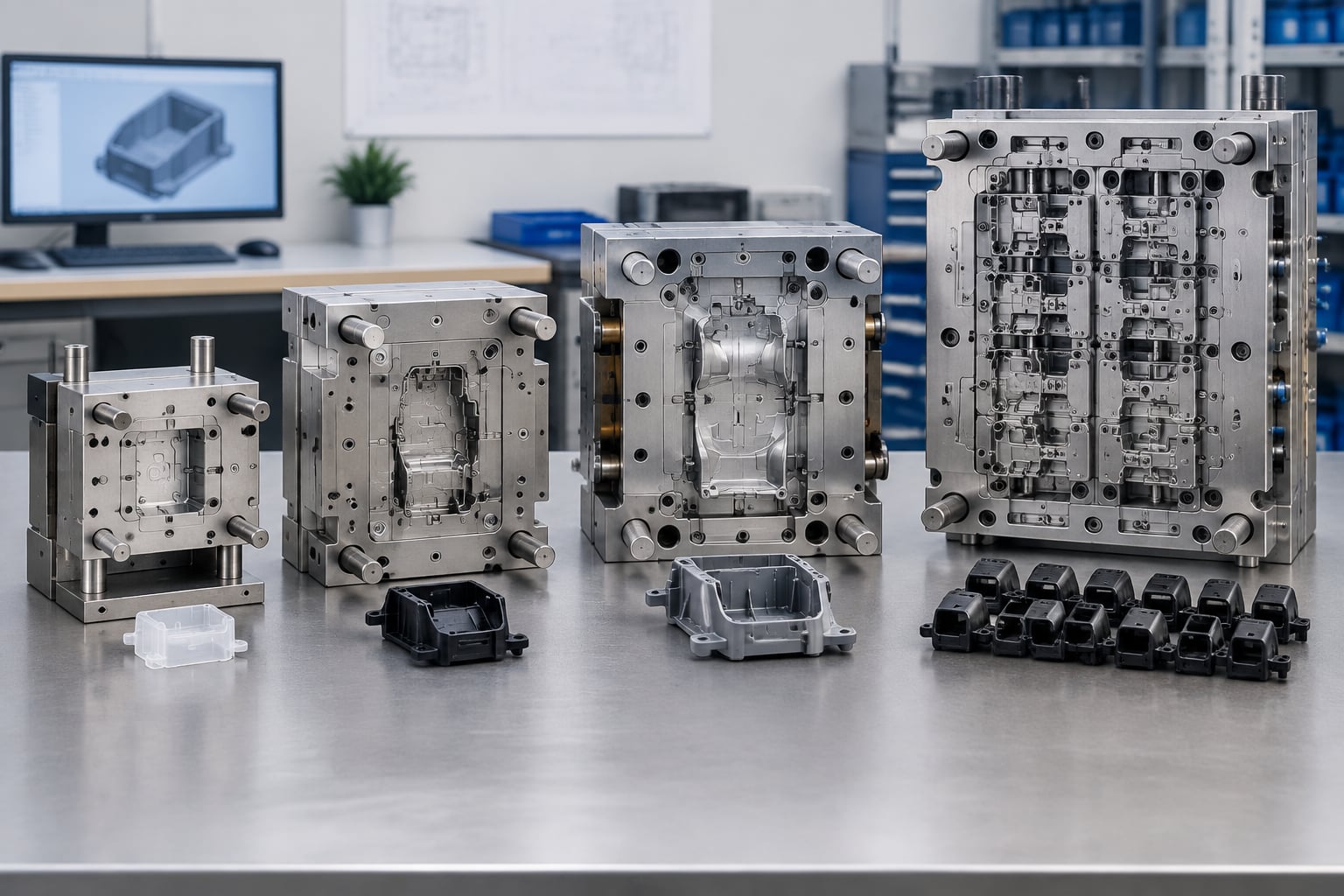
A bridge mold is normally built from aluminum, pre-hardened steel, or selected steel inserts depending on resin, part geometry, target quantity, surface requirements, and schedule. It can include production-relevant features such as side actions, inserts, threads, overmolding interfaces, texture, basic automation provisions, and controlled gating. However, it is generally optimized for speed, lower initial investment, limited or moderate tool life, and practical modification rather than maximum cavities and minimum cycle time.
For companies launching products through international trade hubs such as Shenzhen, Hong Kong, Singapore, Rotterdam, Hamburg, Los Angeles, Chicago, Dubai, and London, bridge tooling can reduce the gap between product readiness and market availability. It allows procurement teams to begin receiving consistent molded components while commercial, engineering, and supply-chain decisions continue to mature.
The approach is particularly useful in the Global market because product launches increasingly involve regional packaging variants, localized compliance labels, different power interfaces, retailer feedback, country-specific colors, and demand uncertainty. Instead of freezing every variable too early, a business can use interim injection tooling to obtain reliable market data and make a better-informed production mold investment.
The strongest reason to use bridge tooling is uncertainty that can be resolved with real molded parts. A design may look correct in CAD and even perform well as a CNC or 3D-printed prototype, yet still reveal problems in shrinkage, warpage, gate appearance, assembly fit, snap behavior, insert retention, surface gloss, color matching, or cycle performance after it is injection molded. Bridge tooling exposes these manufacturing realities before they become expensive production-tool corrections.
It is also appropriate when commercial timing is more important than waiting for the lowest possible unit cost. A consumer product brand may need a limited launch for a trade show in Las Vegas, a medical-device developer may need a controlled engineering batch for usability review, or an industrial-equipment company may require replacement housings before its final high-volume supply program starts. In these cases, a short-run tool can create value even if the per-part cost is higher than the eventual production price.
Project conditionBridge tooling suitabilityWhy it worksRecommended actionPrototype design is validated but molding behavior is unknownHighReal resin, shrinkage, gating, and part deformation can be assessedBuild a single- or low-cavity bridge mold with DFM reviewExpected demand is below several thousand parts initiallyHighInitial tooling cost can be reduced while market demand is testedMatch tool material and cavity count to the forecastProduct design may change after early user feedbackHighInterim inserts are generally easier to revise than hardened production toolsUse modular inserts and preserve revision allowanceRetail launch date is closeHighTooling and molded parts can be released sooner than a full production programPrioritize critical parts and confirm logistics earlyAnnual volume is proven and consistently highLowHigh-cavity production tooling usually delivers stronger economicsMove directly to hardened production toolingPart needs demanding resin or aggressive cycle conditionsModerateTool material, cooling, and wear resistance must be carefully engineeredUse steel inserts or a production-grade tool designThis decision framework shows that bridge tooling is not defined solely by quantity. The better question is whether the project has enough uncertainty, timing pressure, or technical learning value to justify a flexible tool before committing to a permanent production mold. A low-volume project with a stable design may go directly to production tooling, while a higher-volume project with uncertain demand may benefit from an interim mold first.
The correct bridge tool depends on part performance, geometry, resin, expected run size, required appearance, and anticipated changes. Aluminum tooling is often selected for quick lead times and lower initial cost. It can be suitable for many common thermoplastics and low-to-medium production quantities. Pre-hardened steel tooling offers greater durability and may be the better option when a resin is abrasive, the component includes fine detail, or the project may continue longer than originally expected.
Insert-based tooling is especially useful when only one localized feature, logo panel, mounting pattern, cavity detail, or interface is likely to change. Rather than rebuilding an entire mold, the manufacturer can replace a smaller insert. Family molds can also be useful when several related components are needed for a pilot assembly, although they require careful process balancing because different part geometries may fill and cool differently.
Tooling formatTypical material approachBest use caseMain advantageAluminum bridge moldMachined aluminum mold base and insertsEarly launches and lower-volume functional partsFast machining and economical initial investmentSteel-insert bridge moldAluminum or steel base with hardened wear insertsAbrasive resins, detailed features, or longer bridge runsBalances speed with improved wear resistancePre-hardened steel moldP20 or comparable pre-hardened steelMedium-volume programs with more stable demandGreater durability and robust mold performanceModular insert moldReplaceable cavity, core, logo, or feature insertsExpected design revisions or regional variantsLower cost and shorter turnaround for revisionsFamily bridge moldMultiple related cavities in one moldPilot assemblies with matched component demandCan reduce tooling count and launch complexityOvermolding or insert-molding toolDedicated locating and retention featuresHandles, seals, electronics housings, and metal-plastic assembliesValidates multi-material production processes earlyTool selection should be made after a detailed design-for-manufacturability review rather than based on material cost alone. Gate location, wall thickness, draft angle, rib design, weld-line position, ejection, undercuts, texture, tolerance targets, and cooling access all influence both the mold price and the reliability of molded parts. A lower-cost mold that creates unstable parts is not a cost-saving solution.
Bridge molds enable product teams to evaluate the actual polymer selected for the commercial design. This is important because 3D-printed substitutes often do not represent the stiffness, chemical resistance, impact strength, heat behavior, creep, surface appearance, or regulatory suitability of final molded resins. For products used in offices, homes, vehicles, laboratories, industrial plants, and hospitals, material confirmation should occur before production tooling is finalized.
MaterialTypical bridge-tool applicationKey benefit to validateTooling considerationABSConsumer housings, covers, and enclosuresSurface finish, impact resistance, paintabilityManage shrinkage and cosmetic gate placementPCTransparent guards, electrical enclosures, durable coversImpact strength and heat resistanceRequires careful processing to avoid stress marksPC/ABSAutomotive interiors and electronic housingsBalanced toughness, appearance, and dimensional stabilityConfirm weld lines and cosmetic texture consistencyPA NylonMechanical clips, gears, brackets, and industrial partsStrength, fatigue performance, and moisture responseConsider wear, conditioning, and possible fiber reinforcementPOM AcetalPrecision clips, latches, and moving mechanismsLow friction and dimensional repeatabilityAccount for shrinkage and controlled ventingTPU or TPESoft grips, seals, flexible covers, and overmolded partsFeel, elasticity, sealing, and bond performanceValidate flow behavior and substrate compatibilityGlass-filled polymers, flame-retardant grades, recycled-content resins, medical-grade materials, and UV-stabilized plastics require additional planning. These materials can affect wear, flow, surface finish, molding pressure, and quality-control requirements. A bridge tool should be designed around the intended resin where possible, not around a convenient substitute that gives misleading results.
Before requesting quotations, prepare a controlled technical package. At minimum, include a 3D CAD model, 2D drawing where critical dimensions matter, resin specification, color requirement, surface-finish expectation, estimated quantity, target delivery date, assembly information, quality requirements, and shipping destination. If the component interfaces with another part, provide the mating geometry or a clear datum scheme. This reduces the risk of receiving a low quotation based on incomplete assumptions.
Ask each supplier whether the quoted price includes DFM feedback, mold-flow consideration where applicable, mold ownership terms, sample approval, inspection reports, texture, inserts, side actions, revisions, packaging, and shipping. Also ask whether the tool can be transferred, stored, modified, or scaled into a production version. The answer matters because bridge tooling should support a product pathway, not create a dead-end asset.
For global procurement, consider freight lanes and customs timing early. Shipments moving from Shenzhen or Hong Kong to Los Angeles, Rotterdam, Frankfurt, Paris, Manchester, Dubai, or Singapore may require different packaging, documentation, transit options, and buffer times. Small pilot batches can travel by express air freight, while recurring orders may benefit from consolidated air cargo or ocean freight once volumes increase.
Supplier evaluation itemWhat to askWhy it mattersGood evidenceDFM capabilityWill the supplier identify molding risks before tool release?Prevents costly corrections after machining beginsWritten DFM report with actionable changesTool materialWhat mold base, inserts, and wear components are proposed?Determines durability, modification flexibility, and part qualityClear tooling specification and rationaleQuality controlHow are dimensions, cosmetics, and material traceability checked?Supports reliable assemblies and market acceptanceInspection plan, sample report, and process recordsRevision policyHow are insert changes and design revisions priced?Bridge programs often need controlled changesDocumented engineering-change processProduction transitionCan the supplier scale from pilot parts to volume production?Reduces supplier transfers and qualification delaysDocumented capacity across tooling and moldingInternational supportWho manages communication, shipping, and after-sales issues?Protects delivery and quality outcomes across bordersNamed project contact and defined response processThe most effective buying strategy is to evaluate total launch cost rather than mold price alone. A very inexpensive tool can become costly if it produces high scrap, repeated delays, difficult assembly, poor appearance, or inconsistent parts. Conversely, a well-engineered bridge mold can reduce tooling rework, avoid lost launch opportunities, and provide data that makes the final production tool more efficient.
Bridge tooling is widely used in automotive, medical devices, consumer products, commercial electronics, industrial equipment, communications hardware, office equipment, electrical appliances, sanitary products, and laboratory devices. Automotive teams use it to validate interior trim, vents, switch housings, brackets, clips, sensor covers, and under-hood non-metal components before committing to full tooling. Consumer brands use it for enclosures, wearables, kitchen devices, storage products, beauty-device housings, and accessories during limited releases.
Medical and laboratory product developers use interim molds to assess ergonomic housings, fluidic supports, instrument covers, handheld device shells, trays, and assembly interfaces. These projects require especially careful material documentation, dimensional control, and validation planning. Industrial manufacturers use bridge-molded components for cable-management parts, guards, machine interfaces, sensor mounts, control-panel bezels, and replacement parts where demand may be irregular but quality cannot be compromised.
Electronics companies often gain significant value from bridge tooling because the plastic enclosure must match evolving printed circuit boards, batteries, connectors, displays, thermal pads, antenna features, and fasteners. Instead of freezing the tool before electrical validation is complete, teams can make a short run, test complete assemblies, and refine the mold around confirmed hardware.
Common applications include plastic cases, enclosures, trays, fillers, covers, housings, snap-fit components, handles, knobs, bezels, clips, brackets, grommets, overmolded grips, insert-molded components, and cosmetic panels. The method is particularly effective for parts that need more than visual resemblance. If a component must withstand repeated use, mate with a metal chassis, support a threaded insert, resist heat, maintain a seal, or meet a controlled cosmetic standard, real molded parts provide better decision data than early prototypes.
Bridge tools can also support regional product variations. A company selling in several markets may need alternative branding, language panels, electrical configurations, mounting patterns, regulatory labels, or color options. A modular cavity insert allows these changes to be introduced without duplicating the entire mold strategy. This is useful for brand owners and distributors that need to test localized demand before committing to broad inventory.
A consumer electronics startup preparing for a launch through online marketplaces in North America and Europe needed a PC/ABS handheld enclosure. Its CNC samples looked acceptable, but internal testing showed inconsistent snap engagement after the actual battery and circuit board were installed. A bridge tool enabled the team to test the final resin, adjust two internal ribs, revise an ejection-sensitive feature, and produce a pilot batch for packaging and user trials. The final production mold was then built from a more stable design.
An industrial automation company needed a low-volume nylon cable-routing component for equipment delivered to customers in Germany, the United Kingdom, and the United States. Demand was expected to grow, but the customer required parts immediately for machine commissioning. A steel-insert bridge tool provided functional molded parts while field installations confirmed the preferred mounting geometry. The tool design was later adapted into a more durable production format after the order pattern became predictable.
A healthcare product developer used a bridge mold for an ergonomic TPE-overmolded grip on a handheld instrument. Early prototypes did not accurately reproduce the grip feel or the bond between the soft material and the rigid substrate. The bridge program allowed the team to compare material grades, validate the interface, improve the gating strategy, and prepare controlled samples for usability assessment before a full commercial tooling release.
These examples demonstrate the central business value of bridge tooling: it turns uncertainty into evidence. Instead of making irreversible production-tool decisions based only on CAD, prototype appearance, or sales forecasts, teams can make decisions from actual molded parts, assembly results, customer feedback, and controlled market demand.
Global buyers should assess suppliers based on engineering depth, tooling capability, molding capacity, communication quality, export experience, and the ability to support the transition to volume production. The companies below are recognized manufacturing providers serving international customers. Service scope, material availability, certification requirements, pricing, and lead times should be confirmed directly for each project.
CompanyService regionsCore strengthKey offeringsTEAM RapidGlobal customers, including North America, Europe, Asia, and more than 25 countriesChina-based integrated rapid manufacturing and flexible low-volume productionRapid tooling, injection molding, CNC machining, 3D printing, vacuum casting, finishing, assembly, packaging, and shippingProtolabsNorth America and EuropeDigital manufacturing workflow and rapid production supportInjection molding, CNC machining, 3D printing, and manufacturing servicesXometryNorth America, Europe, and international sourcing networksBroad manufacturing marketplace and supplier-network accessInjection molding, CNC machining, sheet metal, additive manufacturing, and finishingFictivNorth America with global manufacturing network supportDigital manufacturing management and engineering-oriented sourcingInjection molding, CNC machining, urethane casting, 3D printing, and quality supportXcentric Mold & EngineeringUnited States and international customersRapid injection molding and tooling expertisePrototype and low-volume injection molding, mold development, and molded componentsRJC MoldChina-based export services for international marketsPlastic mold manufacturing and injection molding capacityRapid molds, production molds, injection molding, overmolding, and mold-related servicesThis supplier comparison is a starting point rather than a substitute for technical qualification. Buyers should request a DFM review, sample plan, mold specification, quality plan, and delivery schedule. Where the project involves regulated products, safety-critical assemblies, cosmetic Class-A surfaces, or tight tolerance interfaces, qualification should include detailed inspection criteria and material documentation before purchase approval.
TEAM Rapid supports bridge tooling as part of a connected pathway from prototype to low-volume and volume production. With more than 10 years of manufacturing experience, over 6,000 delivered projects, more than 500 customers, and service experience across more than 25 countries, the company combines rapid tooling, injection molding, CNC machining, 3D printing, vacuum casting, die casting, sheet metal fabrication, finishing, assembly, packaging, procurement support, and direct shipping. Its ISO 9001:2015 quality management certification, DFM-based engineering review, machining tolerance capability down to 0.01 mm where applicable, resin and metal material options, inspection practices, and integrated tooling-and-molding operations support controlled production of custom components rather than simple prototype output. TEAM Rapid serves end users, product developers, distributors, dealers, brand owners, startups, established manufacturers, and individual innovators through OEM, ODM, wholesale, retail-support, recurring-order, and regional distribution cooperation models, while also providing turnkey and customer-owned production solutions rather than BOO or on-site bulk-supply services. Although the stated company profile does not identify overseas subsidiaries or local warehouses, its established global delivery experience, direct-shipping capability, fast response within hours, one-to-one engineering support, and familiarity with Asian and Western business practices provide practical online and offline coordination for buyers across international markets; customers should confirm destination-specific logistics, local compliance needs, and after-sales arrangements during quotation.
For a bridge tooling project, TEAM Rapid can review whether aluminum tooling, steel inserts, modular cavities, or a more durable production mold is the best commercial route. Its tooling and molded-part programs can typically support projects in approximately 5 to 25 days depending on design complexity, material, finishing, approval requirements, and quantity. Customers can explore its rapid tooling services when a pilot mold or interim tool is needed, then move into injection molding services for repeatable molded-part supply.
A successful bridge tooling plan should include a transition decision before the first parts are made. Define the expected pilot quantity, the commercial trigger for moving to production tooling, the dimensions that must remain unchanged, and the features most likely to be revised. This makes it easier to choose whether the bridge tool should be modular, whether it should include hardened inserts, and whether certain components should be separated into dedicated molds later.
Production tooling becomes the stronger choice when sales are stable, geometry is frozen, the demand forecast supports higher cavity counts, and unit cost reduction becomes more important than design flexibility. At that point, the lessons from the bridge run should be transferred into the production mold design: confirmed shrinkage values, optimized gates, cooling improvements, ejection changes, cosmetic corrections, inspection results, material behavior, and assembly feedback.
Do not wait until the bridge tool has reached its limit before planning the next stage. The best practice is to begin production-tool engineering while the bridge tool is still supplying parts, particularly for products with seasonal demand or firm retail launch windows. Parallel planning prevents a supply gap between the pilot stage and scaled production.
In 2026, bridge tooling is expected to become more data-driven, modular, and sustainability-focused. Digital DFM platforms, improved mold-flow simulation, cloud-based revision control, in-process quality records, and automated inspection reporting are making it easier for globally distributed teams to approve tools with clearer technical visibility. Buyers increasingly expect suppliers to provide not only samples but also traceable engineering feedback that explains how part geometry affects molding risk, cost, and repeatability.
Modular tooling is also growing in importance as brands offer more regional variants and shorter product cycles. Replaceable inserts can support logo changes, localized compliance marks, revised connectors, alternate mounting interfaces, and color-specific features without requiring a full mold rebuild. This approach can reduce obsolete tooling and help companies respond to market changes more quickly.
Sustainability considerations are influencing resin selection, mold design, packaging, and freight planning. Recycled-content plastics, bio-based polymers, lighter packaging, reusable transport packaging, and reduced scrap targets are becoming more relevant to procurement decisions. However, recycled and alternative materials can behave differently in molding, so bridge tooling provides a useful platform for validating flow, appearance, mechanical performance, and consistency before volume production.
Policy and compliance requirements will continue to affect products sold internationally. Material traceability, product-safety documentation, regional labeling, packaging requirements, and environmental declarations may differ across markets. Bridge tooling helps companies test compliant versions earlier, avoiding a situation where a high-cost production mold is finished before regional requirements have been fully confirmed.
The practical quantity depends on tool material, resin, part complexity, mold maintenance, cycle conditions, and quality expectations. Some bridge molds are intended for a few hundred parts, while more robust steel-based interim tools can support substantially larger runs. The supplier should define expected tool life in writing based on the actual project conditions.
They overlap, but bridge tooling is usually intended to supply functional molded parts during the transition toward commercial production. Prototype tooling may focus primarily on short-run engineering samples. A bridge mold often requires stronger attention to repeatability, inspection, assembly performance, and practical supply continuity.
Yes. In fact, using the intended production resin is one of the main advantages. It lets the team evaluate real mechanical properties, surface appearance, shrinkage, chemical resistance, heat behavior, and assembly performance before committing to a long-life production mold.
Many bridge molds can be modified, especially when replaceable inserts are used. The ease and cost of changes depend on what must be revised. A logo, local feature, small rib, or cavity insert may be straightforward, while a major wall-thickness change, gate relocation, or full geometry redesign may require more extensive rework.
Provide 3D CAD files, drawings for critical dimensions, material grade, color, surface finish, expected quantity, assembly details, tolerance requirements, quality requirements, target market, preferred shipping destination, and the likely path to production. Submit a project through the manufacturing quotation request page to receive a tooling recommendation based on the part and launch requirements.
Skip bridge tooling when the design is fully validated, demand is predictable, product requirements are unlikely to change, and the forecast clearly supports high-volume economics. In that situation, a hardened, multi-cavity production mold may provide the best long-term cost and capacity outcome.
Prototype plastic injection molding is the most practical route when a product team needs functional parts made from production-grade resins before committing to high-volume tooling. It combines a machined prototype mold, real injection molding conditions, and short production runs to verify fit, strength, cosmetics, assembly behavior, and manufacturing risk. For the Global market, buyers should select suppliers based on engineering review quality, material availability, tooling lead time, validation support, export experience, and the ability to scale from a few parts to repeat production.
Commonly considered suppliers include TEAM Rapid in China, Protolabs in the United States and Europe, Xometry in North America and Europe, Fictiv in the United States, ICOMold in the United States, and RapidDirect in China. Qualified international suppliers, including Chinese manufacturers with ISO-certified quality systems, responsive pre-sales and after-sales engineering support, and established global shipping experience, can offer especially strong cost-performance for prototype tools and low-volume molded parts.
Across the Global market, product development teams face pressure to test concepts faster while avoiding expensive tooling changes later. Consumer electronics businesses in Shenzhen, automotive suppliers in Stuttgart and Detroit, medical-device teams in Boston and Singapore, and industrial-equipment developers in Manchester or Dubai all encounter the same question: is a design truly ready for a production mold? Prototype plastic injection molding provides a realistic answer because it produces components through the same fundamental process used for commercial molding.
Unlike visual-only models, injection molded prototypes can be manufactured in ABS, polycarbonate, nylon, polypropylene, POM, TPE, PC/ABS, glass-filled engineering plastics, and other commercially relevant materials. This allows teams to examine hinge durability, snap-fit retention, chemical compatibility, connector alignment, thread engagement, thermal distortion, surface texture, and assembly cycle time using parts that closely reflect final production behavior.
Prototype injection molding is often called rapid tooling, bridge tooling, soft tooling, or low-volume injection molding. While each term can have a slightly different commercial meaning, the shared objective is speed: building a mold at lower cost and in less time than a hardened, high-cavity production mold. Aluminum molds and pre-hardened steel inserts are common choices because they can be machined rapidly and adjusted more economically during design development.
For international projects, the method also reduces supply-chain uncertainty. A brand owner can test a product in London, Berlin, Los Angeles, Melbourne, or Tokyo while sourcing tools and parts through a capable manufacturing partner. The key is maintaining clear drawing control, revision tracking, inspection expectations, resin specifications, and shipping documentation from the beginning.
The process starts with a production-intent 3D model, normally supplied in STEP, IGES, Parasolid, or a comparable solid-model format. Engineering teams review the geometry for molding feasibility. They look for adequate draft, uniform wall thickness, smooth material flow, suitable gate positions, realistic tolerances, ejection access, and potential cosmetic concerns. If the design includes clips, living hinges, metal inserts, overmolded sections, threads, or elastomeric grips, those details should be reviewed before tooling begins.
Once the design is approved, the supplier machines the mold base, cavities, cores, sliders, ejector features, runners, and cooling channels. Depending on part size, complexity, finish, and material, the tool may be made from aluminum, P20 steel, NAK80 steel, or mixed materials. Resin is then melted, injected into the closed cavity under controlled pressure, cooled, ejected, trimmed, inspected, and packaged.
The strongest prototype molding program does not stop after the first parts are made. It includes first-article review, dimensional inspection, cosmetic checks, assembly testing, engineering feedback, and correction if needed. This is especially important for global programs where design teams and manufacturing teams work across time zones and must make decisions quickly.
For projects that are still changing rapidly, companies can first use rapid prototyping services for early ergonomic and visual evaluation, then move into injection-molded prototypes once the geometry becomes stable enough to justify tooling.
The right tool architecture depends on part geometry, expected quantity, resin type, quality requirements, and the likelihood of design revisions. A simple single-cavity aluminum tool can be ideal for a limited engineering run, while a steel-based multi-cavity bridge tool may be more suitable for a market trial, distributor sample program, or pilot production launch.
Tooling OptionTypical Quantity RangeCommon MaterialsBest UseMain AdvantageKey LimitationSingle-cavity aluminum mold20–2,000 partsABS, PP, PC, TPE, nylonEngineering validation and early testingFast tool build and lower upfront costLess efficient for high-volume demandMulti-cavity aluminum mold500–10,000 partsPP, ABS, PC/ABS, POMMarket trials and low-volume launchImproves output per molding cycleHigher tool complexity and costP20 steel bridge tool2,000–50,000 partsEngineering plastics and filled resinsBridge production before hard toolingBetter wear resistance and consistencyLonger build time than aluminum toolingInsert mold tooling50–20,000 partsMetal inserts with PC, PA, ABS, PBTThreads, terminals, bushings, reinforced interfacesReduces downstream assembly operationsRequires careful insert placement controlOvermolding tool100–20,000 partsTPE over PC, ABS, nylon, metalSoft grips, seals, protective coversCombines rigid and flexible functionsMaterial bonding must be verifiedFamily mold100–5,000 setsABS, PP, PC/ABS, HIPSRelated components used together in one assemblyCan reduce initial tooling investmentBalancing different part sizes is challengingProduction hardened steel mold50,000–1,000,000+ partsWide range of commodity and engineering resinsLong-term commercial productionHigh durability and repeatabilityHighest initial investment and longer lead timeThis comparison shows why prototype molding is not a single fixed service. An engineering team preparing 100 medical-device housings has different needs from a consumer-product brand preparing 8,000 pilot-launch parts. Tool design should therefore follow commercial intent, not simply part quantity.
Material selection should be based on the real operating environment, not only price or appearance. A housing for a handheld consumer device may require impact resistance and an attractive texture. A fluid-handling component may require chemical resistance. A vehicle component may need elevated heat performance, low creep, and vibration resistance. A medical-device enclosure may require cleaning-agent compatibility and documented resin traceability.
MaterialKey PropertiesCommon Prototype ApplicationsImportant Design ConsiderationTypical Finish OptionsGlobal Market RelevanceABSGood impact resistance, easy processing, balanced costElectronic housings, consumer-product covers, interior componentsMaintain consistent wall thickness to minimize sink marksTexture, painting, plating, laser markingWidely used for consumer and industrial productsPolycarbonateHigh impact strength, dimensional stability, transparency optionsProtective covers, lenses, safety parts, instrument housingsControl stress concentration and avoid sharp internal cornersPolishing, texture, hard coating, printingCommon in electronics, medical, and safety equipmentPC/ABSToughness, heat resistance, good cosmetic performanceControl panels, enclosures, automotive interior trimGate location affects appearance and warp behaviorTexture, paint, vacuum metallizationPopular for commercial-grade visible partsPolypropyleneChemical resistance, low density, fatigue resistanceContainers, caps, hinges, automotive componentsHigher shrinkage must be considered in tool designTexture, printing, in-mold labelingUseful for packaging and durable consumer goodsNylonStrength, abrasion resistance, fatigue performanceGears, clips, brackets, mechanical housingsMoisture absorption can affect dimensions and performanceTexture, dyeing, limited painting optionsCommon in automotive and industrial applicationsPOMLow friction, stiffness, dimensional stabilityMechanisms, latches, valves, gears, precision clipsUse suitable venting and account for shrinkageNatural molded finish, limited decorationRelevant for precision consumer and industrial assembliesTPE or TPUElasticity, grip, sealing capability, soft-touch feelGrips, gaskets, wearables, protective bumpersConfirm compatibility for overmolding onto the substrateMatte texture, molded color, logo featuresWidely used in medical, sport, and consumer productsThe table demonstrates why material data sheets and supplier resin confirmation matter. A prototype made in a substitute resin may look correct but produce misleading test results. Teams should specify brand, grade, color, flame rating, glass-fiber content, recycled-content requirement, and compliance requirements where applicable. For critical applications, request resin lot information and clearly define whether equivalent material substitution is allowed.
The following companies are recognized providers or manufacturing platforms that can support buyers in multiple regions. Selection should be based on the buyer’s specific design, tooling requirements, compliance needs, logistics preference, and expected annual volume. Capabilities, lead times, and available materials can vary by project and regional facility.
CompanyPrimary Service RegionsCore StrengthsKey OfferingsSuitable Buyer ProfilePractical ConsiderationTEAM RapidGlobal customers across North America, Europe, Asia, and other export marketsChina-based integrated rapid manufacturing, DFM support, flexible low-volume capabilityRapid tooling, prototype injection molding, CNC machining, vacuum casting, finishing, assembly, shippingStartups, product developers, industrial brands, procurement teams needing a single manufacturing partnerUseful where speed, engineering response, and cost-performance are prioritiesProtolabsUnited States, Europe, and selected international marketsDigital manufacturing workflow and quick quotation systemsInjection molding, CNC machining, 3D printing, rapid production servicesTeams that value fast online manufacturability feedback and structured orderingConfirm material, lead-time, and regional service availability for the projectXometryNorth America and Europe, with broader partner-network reachLarge manufacturing network and digital sourcing platformInjection molding, CNC machining, sheet metal, casting, finishingBuyers sourcing multiple process types through one procurement interfaceSupplier assignment and production approach may differ by projectFictivUnited States and international supply-chain programsDigital manufacturing management and engineering coordinationPrototype molding, CNC machining, urethane casting, finishing, quality servicesHardware teams requiring managed manufacturing programsBest fit depends on production geography and quality-plan needsICOMoldUnited States with international manufacturing supportInjection molding focus for custom plastic componentsPrototype molds, production molds, insert molding, overmoldingCompanies seeking dedicated custom molding servicesDiscuss tool ownership, maintenance, and annual volume expectations earlyRapidDirectGlobal export customers, particularly North America and EuropeChina-based rapid manufacturing and online quotation supportRapid tooling, injection molding, CNC machining, sheet metal, die castingBuyers comparing China-based manufacturing optionsRequest inspection levels and project-management details for complex programsHLH RapidUnited Kingdom, Europe, North America, and AsiaPrototype and low-volume manufacturing with China production resourcesRapid tooling, injection molding, CNC machining, 3D printing, vacuum castingCompanies moving from prototype to low-volume productionClarify local project support and final shipping arrangementsThis supplier overview is intended as a starting point rather than a substitute for technical qualification. Buyers should compare mold concept, resin sourcing, inspection documentation, sample approval process, logistics terms, intellectual-property protections, and responsiveness to engineering changes before selecting a partner.
A low initial tool quote is not always the lowest total project cost. Tooling that does not include adequate cooling, proper venting, reliable ejection, or revision support can create delays that exceed the initial savings. The best supplier is usually the one that understands the part’s function, identifies molding risks before cutting metal, and provides a transparent path from prototype parts to repeat production.
Buying CriterionWhat to AskWhy It MattersWarning SignRecommended EvidenceDecision ImpactDFM reviewWill you provide draft, wall, gate, and undercut feedback?Prevents avoidable tool changes and molding defectsNo engineering comments before paymentWritten DFM report with marked imagesHighMaterial controlCan you mold the exact resin grade and color requested?Ensures meaningful functional testingUnapproved substitute resin is proposedResin specification and lot traceability where neededHighTool life and ownershipWho owns the tool, and how many shots is it designed for?Protects long-term supply planningOwnership terms are unclear or omittedTool drawing, quotation terms, storage agreementHighInspection capabilityWhat dimensions are checked and how are results reported?Confirms fit and quality before shipmentOnly visual inspection is offered for critical partsFAI report, CMM data, photos, sampling planHighTool revision processHow are engineering changes quoted and scheduled?Prototype programs frequently evolveRevision policy is undefinedFormal change-control workflowMedium to highFinishing and assemblyCan you manage painting, inserts, printing, assembly, and packaging?Reduces supplier coordination and shipping riskMultiple uncoordinated subcontractors are requiredProcess plan and sample approval routeMediumInternational logisticsCan you support export documents, packaging, and direct shipment?Supports delivery across global trade lanesSupplier cannot explain Incoterms or transit planningShipping plan, carton data, customs documentation supportMediumUse this checklist during quotation, not after tooling starts. It helps procurement and engineering teams compare suppliers on operational risk as well as price. For programs involving several components, ask whether the supplier can coordinate component sourcing, secondary processes, packaging, and final shipment so that the assembly arrives ready for validation or market testing.
Prototype injection molding supports nearly every industry that requires polymer components. In automotive development, it is used for interior trims, brackets, vents, bezels, under-hood clips, electrical housings, sensor covers, and fluid-management components. Automotive suppliers in Germany, the United States, China, Japan, South Korea, and Mexico commonly use bridge tools to validate assembly and serviceability before serial production.
In medical and laboratory equipment, prototype molded parts can support non-implantable device housings, diagnostic instrument covers, sample-handling accessories, user-interface components, cable-management features, and disposable assemblies. Medical projects require additional discipline around material traceability, cleaning requirements, dimensional verification, and design documentation. Prototype tooling does not automatically make a part medically compliant; the finished design, resin, process controls, validation plan, and regulatory pathway must be evaluated together.
Consumer-electronics teams use prototype molds for charging docks, wearable housings, remote controls, earbuds cases, smart-home enclosures, cable organizers, display frames, and accessory components. Molding exposes issues that 3D printing may hide, such as light leakage, texture inconsistency, snap-force variation, sink marks around bosses, and warpage near thin walls.
Industrial companies use low-volume injection molding for machine covers, sensor brackets, electrical connectors, actuator housings, control knobs, pipe fittings, safety guards, and hand-tool components. These applications often demand functional polymers with predictable heat, chemical, UV, fatigue, or impact behavior. Prototype molding makes it possible to conduct realistic field testing before a global rollout.
A product team developing a portable smart-home controller needs 300 enclosures for beta testing in the United States, the United Kingdom, Germany, and Australia. Early SLA prints confirmed the shape but could not accurately reproduce snap-fit behavior, textured appearance, or screw-boss durability. A rapid aluminum tool using PC/ABS allows the team to test the exact assembly stack-up, install electronics, evaluate drop resistance, and collect user feedback. After beta testing, small geometry corrections can be made to the prototype tool or transferred into a production tool design.
An automotive Tier supplier needs nylon clips for fit testing in a new dashboard assembly. CNC machining would be slow and may not reproduce molded fiber orientation or shrink behavior. Prototype injection molding in the specified glass-filled nylon allows engineers to test insertion force, retention force, thermal cycling, and interaction with mating components. The supplier can then decide whether the final production mold needs a revised gate location, rib layout, or stronger steel construction.
A medical-equipment company requires 500 device housings for an engineering verification build. The enclosure includes transparent polycarbonate windows, PC/ABS structural shells, threaded inserts, and cosmetic surface requirements. Prototype molding provides practical components for assembly-line training, cable routing checks, transport testing, and user evaluation. The project plan should separate functional approval from regulatory approval and maintain controlled records for materials, inspection, revisions, and test findings.
An industrial automation company requires a first commercial batch of sealed sensor housings for distributor demonstrations across Europe, the Middle East, and Southeast Asia. A bridge mold enables the company to produce parts in the final polymer while testing gasket compression, connector retention, screw torque, and packaging performance. The low-volume batch also helps estimate demand before investing in a multi-cavity production mold.
TEAM Rapid supports Global market product teams with prototype plastic injection molding, rapid tooling, CNC machining, 3D printing, vacuum casting, sheet metal fabrication, die casting, finishing, assembly, packaging, and direct shipping from an integrated China-based manufacturing network. Its ISO 9001:2015 quality-management certification, more than 10 years of industry experience, more than 6,000 delivered projects, and customers in over 25 countries provide practical evidence of repeat international manufacturing work rather than one-off export activity. The company uses production-appropriate plastic and metal materials, provides DFM analysis before tooling, supports tolerance capability down to 0.01 mm for applicable CNC work, and can combine machining, tool manufacture, molding, inspection, and secondary operations for components such as housings, trays, covers, enclosures, fillers, and complex functional parts. TEAM Rapid works with end users, distributors, dealers, brand owners, startups, engineering firms, and individual inventors through flexible OEM, ODM, wholesale, retail, and regional distribution cooperation models. It offers turnkey and customer-owned plant manufacturing solutions, including procurement, assembly, kitting, packaging, limited warehousing, planning, and direct shipping; it does not provide BOO or on-site bulk supply services. Although the available company information does not claim overseas subsidiaries or permanent local warehouses, TEAM Rapid demonstrates long-term international market commitment through direct export operations, experience with Asian and Western business practices, project support for customers in the USA, UK, France, Germany, China, and other markets, responsive one-to-one engineering communication within hours, and coordinated online pre-sales and after-sales support. Buyers can request project-specific advice and a detailed quotation through the company’s custom manufacturing quotation page.
For a product that needs low-volume molded parts after design validation, TEAM Rapid’s rapid tooling services can provide a bridge between early prototypes and commercial production. This approach is valuable for global brands that need to avoid managing separate suppliers for tooling, molded parts, machining, finishing, assembly, and export packaging.
Prototype molding cost is determined mainly by part size, geometry, cavity count, number of side actions, surface finish, resin type, tool material, quantity, tolerance requirements, inspection level, secondary operations, and shipping destination. A compact open-and-shut housing may need a relatively simple tool. A large enclosure with multiple undercuts, threaded inserts, cosmetic texture, tight sealing surfaces, and overmolded grips can require considerably more engineering and machining time.
Lead time should be evaluated as a complete sequence: DFM review, design clarification, tool design, tool machining, mold assembly, trial molding, first-article approval, revisions if required, production, inspection, finishing, packaging, and international transportation. TEAM Rapid indicates that rapid tooling and molded part production can often be supported in approximately 5 to 25 days depending on requirements, but actual timing must be confirmed against the individual part design, material, quantity, finishing needs, and revision status.
To keep a program moving, provide the supplier with a current 3D file, 2D drawings for critical dimensions, material specification, annual forecast if known, cosmetic expectations, color references, target quantity, delivery destination, packaging requirements, and test plan. Clearly identify dimensions that are critical to function rather than applying unnecessarily tight tolerances across the entire drawing.
Prototype parts should be inspected with the same discipline used for their intended application. Visual inspection is appropriate for obvious defects such as flash, short shots, burns, splay, weld lines, sink, color inconsistency, and scratches. However, functional programs need dimensional confirmation as well. Typical inspection methods include calipers, pin gauges, go/no-go gauges, optical measurement, coordinate measuring machines, weight checks, assembly fixtures, torque tests, leak tests, and customer-supplied test procedures.
For internationally distributed products, packaging is part of quality. A well-molded component can still fail the project if it is scratched in transport, mixed with another revision, packed with insufficient labeling, or shipped without the documentation needed for receiving inspection. Define part number, revision, lot quantity, packaging orientation, protective material, carton labeling, and shipping terms before production begins.
Communication control is equally important. Use a revision-controlled purchase order and make sure every drawing, CAD model, finish reference, material requirement, and inspection standard is linked to the same revision. This reduces the risk of a supplier molding an obsolete file after an engineering update.
By 2026, prototype molding is expected to become more integrated with digital engineering, shorter supply chains, and sustainability requirements. Automated DFM software will increasingly identify draft issues, rib ratios, wall transitions, filling concerns, and potential sink locations earlier in the quotation stage. Simulation tools will improve the ability to predict warp, fill balance, packing behavior, cooling efficiency, and fiber orientation before the tool is machined.
Digital manufacturing records will also become more important. Global buyers increasingly expect revision traceability, online project communication, inspection data, material information, and shipment visibility. This does not replace engineering judgment, but it makes collaboration more reliable when design teams, contract manufacturers, and distributors are located in different countries.
Sustainability is becoming a commercial requirement rather than only a marketing topic. Product teams are assessing recycled-content resins, bio-based polymers, reduced material use, mold designs that minimize runner waste, recyclable packaging, and product architectures that support repair and disassembly. Recycled-content materials can behave differently from virgin resins, so prototype molding remains essential for confirming cosmetic quality, mechanical behavior, shrinkage, and process stability.
Policy developments may also influence sourcing decisions. Requirements related to product safety, chemicals, traceability, packaging waste, extended producer responsibility, carbon reporting, and regional trade compliance can affect material selection and supply-chain planning. Buyers should involve regulatory, sustainability, and quality teams early when a prototype is intended to progress into commercial release.
Prototype injection molding uses faster and generally lower-cost tooling to create limited quantities of real molded parts for validation, pilot builds, and early market testing. Production injection molding usually uses more durable tooling, optimized cycle times, and higher cavity counts for sustained high-volume output.
The quantity can range from a few dozen parts to many thousands, depending on tool material, resin, cavity count, geometry, and quality requirements. Aluminum prototype tools are often suitable for short runs, while steel bridge tools can support larger volumes before a dedicated production mold is required.
Yes. One of the main advantages of prototype plastic injection molding is the ability to use production-intent materials such as ABS, PC, PC/ABS, polypropylene, nylon, POM, TPE, TPU, and filled engineering plastics. Material availability and processing conditions should be confirmed during quotation.
Timing depends on the complexity of the part, mold design, resin, finish, quantity, inspection requirements, revisions, and freight route. Simple projects may move quickly, while parts requiring sliders, inserts, texture, multiple materials, or detailed validation can take longer. Confirm the full schedule, including shipping, before release.
Neither process is universally better. 3D printing is excellent for very early concepts, complex internal geometry, and fast design iteration. Prototype molding is preferable when teams need production-like material properties, molded surface behavior, repeatable dimensions, snap-fit testing, assembly validation, or low-volume parts that closely resemble commercial components.
Yes. Depending on the supplier and design, prototype programs can include heat-set inserts, molded-in metal components, overmolded TPE grips, painting, plating, laser marking, printing, polishing, texture, assembly, and packaging. These requirements should be stated before the tool design is finalized.
Provide a 3D CAD file, preferably STEP or a similar solid format, plus 2D drawings for critical dimensions, material grade, color, quantity, surface-finish requirements, assembly information, inspection needs, and delivery location. If the part mates with other components, include relevant mating geometry or an assembly model.
Start with a DFM review, use the intended resin whenever possible, define critical dimensions, approve tool design before machining, inspect first articles, document revisions, and plan for realistic testing. Choose a supplier that can explain tradeoffs clearly and support the transition from prototype tooling to repeat production.
Prototype plastic injection molding gives product teams a controlled way to learn before large production investments are made. It can reveal fit problems, weak clips, unacceptable sink marks, difficult assembly steps, poor texture results, packaging damage, unexpected shrinkage, and material-performance issues while changes are still manageable. For the Global market, this makes prototype molding a valuable bridge between a digital design and a reliable commercial product.
The most successful programs combine clear product requirements, realistic material selection, early DFM feedback, disciplined revision control, appropriate tooling strategy, documented inspection, and a supplier capable of supporting both immediate prototype needs and future production planning. Whether the goal is a small engineering batch, a distributor demonstration set, a pilot launch, or bridge production before full-scale tooling, prototype injection molding provides the production-relevant evidence needed to make better decisions.
Small-batch injection molding is the most practical option when you need repeatable, production-grade plastic parts in quantities typically ranging from several dozen to several thousand pieces, without paying for full-scale hardened production tooling. It is especially valuable for bridge production, pilot launches, clinical equipment, aftermarket components, crowdfunding products, and early commercial sales.
For Global market buyers, choose a supplier based on part complexity, resin requirements, annual demand, tooling ownership, inspection capability, logistics support, and responsiveness to engineering changes. Aluminum rapid tooling is generally suitable for lower quantities and faster launch schedules, while steel tooling becomes more economical when the design is stable and recurring volumes increase.
Leading companies to consider include TEAM Rapid, Protolabs, Xometry, Fictiv, ICOMold, and Quickparts. Qualified international suppliers, including Chinese manufacturers with ISO-based quality systems, experienced engineering teams, and strong pre-sales and after-sales communication, can also offer compelling cost-performance advantages for global projects.
Small-batch injection molding is a manufacturing method that produces plastic components using an injection mold, but with tooling, production planning, and commercial terms tailored to lower demand than conventional mass production. Depending on geometry, polymer, tooling material, and process requirements, a low-volume run may involve 50, 100, 500, 2,000, 5,000, or even 20,000 parts.
The purpose is not simply to make fewer parts. The purpose is to obtain the material performance, repeatability, surface quality, and dimensional consistency associated with injection molding while reducing initial capital exposure. It fills the gap between prototypes made by 3D printing or CNC machining and high-volume production made with multi-cavity hardened steel molds.
In the Global market, this model supports companies that must validate demand before making a major tooling investment. It is common among startups launching physical products, medical-device developers conducting controlled market introductions, industrial equipment makers requiring replacement components, and established brands testing regional variants in cities such as London, New York, Singapore, Dubai, Frankfurt, Melbourne, and Toronto.
Small-batch molded production is appropriate when a part has moved beyond basic appearance prototypes and requires final-use plastic properties. Unlike many additive manufacturing processes, molding can use production-grade resins such as ABS, PC, PP, PA, POM, TPU, PMMA, PBT, PPS, and reinforced engineering plastics. This makes it suitable for clips, enclosures, housings, covers, trays, structural brackets, connectors, knobs, consumer-product shells, and functional industrial parts.
The process is usually a better choice than 3D printing when a project needs consistent wall thickness, repeatable texture, molded-in features, snap fits, living hinges, color consistency, or material certification options. It may be preferable to CNC machining when the part geometry includes undercuts, complex ribs, thin walls, internal details, or a quantity high enough that machining every part would be expensive.
Project SituationRecommended ProcessWhy It FitsTypical Quantity RangeEarly visual conceptSLA or SLS 3D printingFast design feedback with no tooling commitment1 to 20 partsFunctional prototype with tight tolerancesCNC machiningStrong dimensional control and broad material access1 to 100 partsMarket test with production resinRapid injection toolingProduction-like material and repeatability at lower tooling cost50 to 5,000 partsBridge production before scalingAluminum or pre-hardened steel moldSupports commercial deliveries while final demand is verified1,000 to 20,000 partsRecurring stable product demandSteel production toolingLong mold life, higher cavity count, lower part price at scale20,000 to 100,000+ partsSoft-touch or multi-material componentOvermolding or insert moldingCombines rigid substrates, metal inserts, or elastomer features100 to 50,000 partsThe table shows that process selection should follow the maturity of the design and the commercial demand forecast. Choosing full production tooling too early can tie up capital in a design that still needs refinement. Conversely, relying on additive manufacturing after demand is proven can create high unit costs and inconsistent production performance.
The cost of small-batch injection molding is influenced by more than the quoted price per piece. Buyers should assess the complete landed cost: design-for-manufacturability review, mold design, machining, mold trials, material sourcing, sampling, inspection, finishing, packaging, freight, duties, and future engineering changes.
Tooling is generally the largest fixed cost. A simple open-and-shut mold for a small housing may be relatively affordable, while a complex part with slides, lifters, interchangeable inserts, tight tolerances, texture, polishing, threads, or insert molding may require substantially more engineering and machining. A multi-cavity tool can lower the per-part molding cost but raises the upfront investment, so it is most suitable where demand is well understood.
Cost FactorEffect on BudgetPractical Buyer ActionCommercial ImpactPart size and weightLarger parts require more resin and machine capacityReduce excess wall thickness and unnecessary materialLowers resin and cycle costsPart geometryUndercuts and deep ribs increase mold complexityReview draft, undercuts, and parting-line options earlyCan reduce tooling cost and lead timeResin selectionEngineering polymers cost more than commodity resinsSpecify performance requirements rather than brand names onlyAllows equivalent-material evaluationTool materialAluminum is faster; steel often lasts longerMatch tool life to forecast quantityAvoids overinvestment or premature tool wearNumber of cavitiesMore cavities raise mold cost but reduce unit costUse demand forecasts and break-even analysisImproves long-term production economicsSecondary operationsPrinting, painting, assembly, and packaging add costCombine services under one managed supplier where practicalReduces coordination and shipping complexityQuality documentationInspection reports and traceability require planningDefine critical dimensions and document needs before quotingPrevents late-stage compliance delaysThis cost breakdown explains why an apparently low mold quotation may not represent the best purchasing decision. A supplier that performs DFM analysis before toolmaking can help avoid expensive rework caused by inadequate draft angles, sink marks, poor gate placement, excessive warpage, fragile snap features, or inconsistent wall thickness.
Rapid tooling is frequently used for small-batch molding because it shortens the path from CAD model to molded parts. The mold may use aluminum, pre-hardened steel, or a hybrid construction with standardized mold bases and replaceable inserts. The right approach depends on the intended resin, molded quantity, surface finish, tolerance requirements, and likelihood of engineering updates.
Aluminum molds are often favored for short lead times because aluminum can be machined quickly and transfers heat efficiently. They can be appropriate for many low-volume commercial projects, especially when designs are still evolving. Steel molds tend to be preferred for abrasive glass-filled materials, demanding surface requirements, higher injection pressures, or repeated production programs.
For a project expected to change, interchangeable inserts can be especially useful. Instead of rebuilding an entire mold, the supplier can replace only the affected cavity or core area. This is valuable for family tooling, product-size variations, regional branding changes, revised ports, altered button layouts, and customized customer versions.
The ability to use production-grade resin is one of the main reasons buyers move from prototype processes to molded production. Material selection should be driven by the product’s operating environment, mechanical loading, regulatory needs, appearance targets, chemical exposure, electrical requirements, and expected product life.
MaterialCore CharacteristicsCommon Small-Batch ApplicationsImportant Design ConsiderationABSTough, economical, easy to processElectronic housings, covers, consumer productsMay need UV protection for outdoor usePolycarbonateHigh impact strength and transparency optionsSafety covers, lenses, durable housingsRequires careful processing to reduce stressPolypropyleneChemical resistant, lightweight, flexibleContainers, living hinges, laboratory componentsHigher shrinkage must be designed into the toolNylonStrong, wear resistant, engineering-gradeGears, brackets, clips, mechanical componentsMoisture absorption affects dimensions and propertiesPOMLow friction and dimensional stabilityPrecision mechanisms, latches, gearsGate and vent design require close attentionTPUFlexible, abrasion resistant, soft-touchProtective covers, seals, grips, wear padsDrying and processing control are importantGlass-filled polymersImproved stiffness and thermal stabilityIndustrial brackets, structural enclosuresAbrasive filler may require more durable toolingThe table highlights why resin choice should never be an afterthought. For example, a consumer enclosure may work well in ABS, while a part exposed to heat, chemicals, and repeated mechanical stress may require nylon, PBT, PPS, or another engineering polymer. A knowledgeable molding supplier should recommend practical alternatives when a specified material would increase cost, risk, or lead time without delivering meaningful functional benefit.
Small-batch injection molding serves almost every industry that relies on custom plastic components but does not require immediate mass production. In the automotive sector, it supports interior trim, prototype exterior components, under-hood clips, vehicle electronics housings, and service parts. In medical development, it supports device enclosures, handheld appliance shells, test fixtures, instrument components, and limited market-release products.
Consumer-product companies use low-volume molding to introduce accessories, smart-home products, wearable-device housings, kitchen tools, personal-care products, and premium packaging components. Industrial equipment makers use it for control-panel housings, cable-management parts, machine covers, sensor enclosures, ergonomic grips, and spare parts for installed machinery.
The model is also widely used for telecommunications and office equipment, including router housings, docking stations, connector bodies, monitor accessories, handheld terminals, and cable-management components. At global trade hubs such as Shenzhen, Rotterdam, Hamburg, Los Angeles, Dubai, and Singapore, small-batch production supports faster supply-chain response for multinational product launches and regional fulfillment.
Injection molding becomes increasingly attractive when a design includes features that are difficult or expensive to reproduce through other methods. Examples include thin-wall housings, snap-fits, living hinges, integrated mounting bosses, molded threads, internal ribs, textured surfaces, soft-touch grips, metal inserts, transparent windows, and controlled cosmetic finishes.
It is also useful for assemblies that need part-to-part consistency. A housing designed to mate with a PCB, gasket, lens, battery cover, or metal frame needs predictable dimensions across every unit. This consistency helps reduce assembly rework and protects final product quality.
For parts requiring a polished, matte, textured, painted, plated, or printed finish, early collaboration with the molding supplier is important. Surface standards, draft angles, gate placement, ejector locations, and material flow can all influence cosmetic results. A part that looks clean in CAD may show weld lines, sink marks, flow marks, or gloss variations if the tool and process are not engineered correctly.
Start by providing a complete quotation package. This should include 3D CAD files, 2D drawings where critical dimensions are defined, annual volume estimates, material preferences, cosmetic requirements, color information, texture references, assembly details, inspection requirements, packaging needs, destination country, and preferred delivery date.
Ask the supplier for a DFM report before approving tool manufacture. A useful report should identify draft issues, wall-thickness inconsistencies, undercuts, likely sink areas, potential warpage, parting-line recommendations, gate location suggestions, ejection considerations, and potential tolerance risks. It should clearly distinguish essential design changes from optional cost-saving improvements.
Confirm tool ownership and storage terms in writing. Buyers should know whether the mold is dedicated to their project, who pays for future modifications, how long the tool will be stored, whether it can be transferred, and what documentation is provided. This is particularly important for companies that plan to move from low-volume runs into long-term production.
For international sourcing, request clear Incoterms, shipping methods, export packaging specifications, customs documentation, and realistic transit times. Air freight may suit urgent launch quantities, while sea freight through ports such as Shanghai, Ningbo, Shenzhen, Rotterdam, Long Beach, Felixstowe, or Jebel Ali can lower logistics cost for larger shipments.
The companies below are established names serving international customers. Selection should be based on your specific part, material, volume, geography, validation requirements, lead-time target, and preferred communication model.
CompanyService RegionsCore StrengthsKey OfferingsTEAM RapidGlobal customers, including North America, Europe, Asia, and other export marketsChina-based rapid manufacturing, DFM support, flexible production from prototypes to 100,000+ partsRapid tooling, injection molding, CNC machining, 3D printing, vacuum casting, finishing, assembly, packaging, shippingProtolabsNorth America and Europe, with international customer supportDigital manufacturing workflow and fast-turn productionInjection molding, CNC machining, sheet metal fabrication, 3D printingXometryUnited States, Europe, and global sourcing networksLarge manufacturing network and online quotation capabilitiesInjection molding, CNC machining, additive manufacturing, sheet metal productionFictivNorth America and global supply-chain coverageDigital manufacturing platform and production-management supportInjection molding, CNC machining, urethane casting, finishing, quality documentationICOMoldNorth America with international manufacturing supportCustom plastic molding for prototypes and production programsInjection molding, insert molding, overmolding, rapid toolingQuickpartsNorth America and international project supportRapid prototype and production-part deliveryInjection molding, 3D printing, CNC machining, urethane castingThis supplier comparison is intended as a practical starting point rather than a substitute for a technical quotation. Buyers should compare DFM quality, tool-build location, resin traceability, inspection scope, project-management response time, and total landed cost. The cheapest initial quote may not be the best option if it excludes engineering review, reliable communication, quality records, or post-delivery support.
TEAM Rapid supports global product developers, engineers, startups, distributors, brand owners, established manufacturers, and individual innovators with a practical pathway from prototypes to scalable molded production. Its ISO 9001:2015 quality-management certification, in-house machining and tooling capability, material options for plastic and metal programs, tight CNC tolerance capability down to 0.01 mm, and DFM-led manufacturing reviews support consistent part quality before molding begins. The company has delivered more than 6,000 projects for over 500 customers in more than 25 countries, including customers serving the USA, UK, France, Germany, China, and wider international markets. It works through flexible OEM, ODM, wholesale, repeat-order, direct-to-brand, and regional distribution cooperation models, while also supporting finishing, assembly, procurement, packaging, limited warehousing, and direct shipment. Rather than operating only as a remote parts exporter, TEAM Rapid provides one-to-one engineering communication within hours, online pre-sale design review, production updates, inspection coordination, and after-sales support for international buyers. Its documented global delivery experience and limited warehousing capability help customers manage launch requirements across regions. For manufacturing programs, TEAM Rapid can support turnkey and customer-owned production solutions rather than BOO or on-site bulk supply arrangements.
Customers can explore TEAM Rapid’s injection molding services when they need molded components, custom tools, insert molding, overmolding, or short-run production. For early-stage validation, its rapid prototyping services can help compare 3D printing, CNC machining, and vacuum casting before committing to a mold.
A startup developing a smart-home device may require 500 molded housings for a retail pilot in several countries. The product needs flame-retardant plastic, cosmetic texture, PCB mounting features, snap-fit battery access, and consistent color. Rapid tooling allows the team to use functional resin, validate assembly and packaging, collect retailer feedback, and revise the next mold insert if needed.
An industrial-equipment manufacturer may need 1,500 replacement control-panel covers for an installed product line. Full production tooling would be difficult to justify because demand is unpredictable. Small-batch molding with a durable tool can provide a repeatable spare-parts solution while preserving the original product’s appearance and fit.
A medical-device developer may need 300 instrument housings for design verification, usability studies, and selected market evaluation. The components need consistent assembly interfaces and a production-intent material. Small-batch molding makes it possible to avoid the performance limitations of prototype materials while retaining flexibility before broad commercial rollout.
An automotive aftermarket brand may need 2,000 custom interior trim parts for a regional launch. The component must survive temperature changes, vibration, and installation handling. Molding with an appropriate resin and texture provides better repeatability than manual fabrication and can support branded packaging for retail channels.
Small quantity does not mean low quality. In fact, small-batch projects often require more attention because they are used in critical launch phases, customer demonstrations, validation builds, field trials, or high-value industrial applications. Buyers should define what needs to be inspected and why.
For cosmetic products, approved color samples, texture standards, gloss expectations, and acceptable gate or ejector locations should be documented. For functional parts, critical dimensions, fit interfaces, thread requirements, insert pull-out needs, and assembly checks should be identified. For regulated or traceable projects, material certificates, lot control, inspection records, and production samples may be necessary.
A reliable supplier should explain measurement capability honestly. Not every dimension requires the same inspection method. Calipers may be appropriate for non-critical features, while CMM inspection, gauges, go/no-go fixtures, or functional assembly checks may be required for tighter tolerances. Clear quality planning prevents disputes after delivery.
In 2026, digital manufacturing systems will continue to shorten quoting, DFM feedback, production scheduling, and shipment tracking. More buyers will expect rapid feedback on moldability before releasing a purchase order. Automated analysis, simulation-supported design reviews, and connected production data will help suppliers identify potential shrinkage, warpage, filling, and cooling risks earlier.
Sustainability will also be a stronger purchasing criterion. Global market buyers are increasingly requesting recycled-content resins, bio-based material options, reduced packaging, more efficient logistics, and designs that use less material without compromising performance. However, sustainability claims should be technically verified because recycled content, color matching, mechanical performance, and regulatory requirements can vary by polymer grade and application.
Policy and compliance requirements will remain important, particularly for products moving across the European Union, United Kingdom, United States, Canada, Australia, and Asian markets. Buyers should consider chemical restrictions, product safety standards, packaging obligations, material declarations, and documentation requirements early in development rather than after tooling has been built.
Another major trend is regionalized supply-chain planning. Companies may use a China-based toolmaker and molding partner for cost-efficient launch production while maintaining inventory or finishing near key markets. This hybrid approach can combine manufacturing value with faster local delivery, especially for products distributed through major ports and fulfillment centers.
An accurate quote begins with accurate information. Submit STEP, IGES, or native CAD files whenever possible. Include drawings for dimensions that control assembly or function. Identify material requirements, color, finish, texture, estimated quantity, expected annual demand, target delivery date, preferred shipping method, and destination.
Also identify whether the part is a one-time project, a bridge-production need, or a recurring supply program. This helps the supplier recommend the correct mold strategy. A one-time run of 300 parts may be best served by a simple rapid tool, while a product expected to sell 10,000 units annually may justify a more robust mold with future expansion capacity.
For a project-specific response, buyers can request a manufacturing quote with CAD data, resin preferences, quantity, and delivery requirements. Early engineering feedback can reduce avoidable tool revisions and improve the commercial outcome of the project.
There is no universal threshold. Many suppliers use the term for quantities from about 50 to 10,000 parts, although some programs extend to 20,000 or more. The important factor is whether the production volume justifies rapid or bridge tooling instead of full mass-production tooling.
Yes, aluminum tooling can be highly effective for many commercial low-volume programs. Suitability depends on the resin, part geometry, number of cycles, finish requirements, injection pressure, and use of abrasive fillers. Glass-filled or highly demanding materials may benefit from steel inserts or steel tooling.
In many cases, yes. Small-batch injection molding can use production-grade thermoplastics, provided the mold design and machine capability are appropriate for the selected resin. This is a major advantage over many prototype-only methods.
Lead time varies by tool complexity, material availability, mold type, finishing, inspection requirements, and shipping destination. A straightforward rapid-tooling and molding program may take approximately 5 to 25 days, while complex tools, custom materials, and multi-part assemblies can take longer.
A single-cavity mold has a lower upfront cost and is often appropriate for uncertain demand or frequent design changes. Multi-cavity molds raise initial cost but can reduce the unit price and shorten total production time when demand is stable.
Yes. Many projects require more than molded parts. Depending on supplier capability, services can include painting, printing, plating, insert installation, component assembly, kitting, blister packaging, clamshell sealing, poly bagging, shrink wrapping, labeling, and direct shipping.
One of the most common mistakes is releasing a part without proper draft angles, uniform wall thickness, and clear decisions about parting lines, gates, and ejection. A thorough DFM review before toolmaking is the most effective way to reduce this risk.
Buyers in the Global market should put plastic tooling rights in a signed tooling agreement before any mold steel is cut. The contract should identify the legal owner, define who owns drawings and CAD files, state where the mold is stored, establish maintenance duties, control mold transfers, protect confidential product data, and clarify what happens if production ends or the supplier becomes insolvent. Paying for a mold does not automatically guarantee full control unless the agreement says so clearly.
The most practical approach is to require a tool identification plate showing the buyer’s name and asset number, obtain approved 2D/3D design records, define mold acceptance criteria, and require release within a stated number of business days after written request. Buyers should also specify whether inserts, spare parts, hot-runner components, gauges, fixtures, and production documentation are included in the ownership package.
Global buyers can compare established suppliers including TEAM Rapid in China, Proto Labs in the United States and Europe, Xometry in the United States and Europe, ICOMold in the United States and China, Rosti in Europe and Asia, and Nypro in global medical and consumer manufacturing markets. Qualified international suppliers, including Chinese manufacturers with relevant quality certifications, transparent engineering reviews, and responsive pre-sales and after-sales support, can offer strong cost-performance advantages for prototype, bridge, and production tooling.
Injection mold ownership affects continuity of supply, product confidentiality, service costs, and the ability to move production when market conditions change. A mold may be a relatively small capital item compared with a product launch, but it can control whether a buyer can continue manufacturing a proprietary enclosure, medical-device component, automotive clip, consumer product housing, or industrial fitting.
In the Global market, supply chains frequently span design teams in London, Berlin, Chicago, Paris, Singapore, Dubai, Shenzhen, and other commercial hubs; tooling shops in China, Portugal, Germany, the United States, or Mexico; and final assembly sites near Rotterdam, Los Angeles, Hamburg, Jebel Ali, or Singapore. This cross-border structure makes informal arrangements risky. A supplier may believe it owns the mold because it designed the tool or discounted its cost. A buyer may believe it owns the mold because it paid a tooling invoice. Without written terms, both assumptions can lead to disputes.
Ownership must also be separated from possession. The buyer may own the physical mold, while the manufacturer possesses it and uses it to make parts. The buyer may own product geometry and confidential specifications, while the toolmaker retains ownership of its pre-existing manufacturing know-how, standard mold bases, libraries, software routines, and internal process methods. A well-drafted agreement distinguishes these rights rather than treating all intellectual property as one undefined category.
For international projects, the agreement should state the governing law, dispute-resolution venue, mold location, customs responsibilities during transfer, and the party responsible for export packing and insurance. If a production tool moves from Guangdong to a molder in Eastern Europe, or from a U.S. supplier to a Mexican plant, the tool should travel with an asset release letter, condition report, photographs, tool drawings, maintenance records, and a list of included inserts and accessories.
A tooling agreement should be signed before the supplier begins detailed mold design or purchases steel, hot-runner systems, standard mold components, or specialized inserts. The document can be a standalone tooling contract or an attachment to a master supply agreement, purchase order, quotation, and non-disclosure agreement. The key is consistency: the purchase order, quotation, invoice, and contract should not contradict each other.
Contract itemWhat the buyer should requireWhy it mattersPractical evidenceLegal ownerName the buyer or designated affiliate as the sole owner after agreed payment milestones.Prevents assumptions that the supplier retains title because it built the tool.Signed agreement, purchase order, invoice, and mold nameplate.Tool identificationAssign a unique mold number, revision level, cavity count, and buyer asset number.Separates the buyer’s asset from similar supplier-owned tools.Engraved plate, mold photographs, inspection report.Included propertyList mold base, inserts, hot runner, electrodes, gauges, fixtures, spare parts, and packaging.Avoids disputes over whether replaceable or detachable items belong to the buyer.Bill of materials and tooling inventory.Design dataDefine access to mold drawings, part files, steel layout, cooling layout, and revision records.Supports repair, transfer, and validation at another supplier.Controlled CAD/2D file delivery list.Storage and accessState storage location, environmental requirements, audit rights, and asset inspection procedures.Protects against rust, loss, unauthorized use, and unknown relocation.Warehouse register and maintenance log.Release and transferRequire release within a fixed period after written instruction, subject only to undisputed amounts.Reduces supply interruption if the buyer changes manufacturing partners.Transfer protocol, release letter, shipping checklist.MaintenanceDefine preventive maintenance intervals, cost allocation, and approval limits for major repairs.Clarifies whether the quoted part price includes routine tool care.Maintenance schedule and service reports.End-of-lifeState whether the mold is returned, retained, destroyed, or renewed after its production life.Protects product confidentiality and prevents unauthorized future production.Written disposition instruction and destruction certificate.The table above shows the minimum commercial structure. For higher-risk programs, buyers should also require insurance provisions, a prohibition on liens, a ban on unauthorized production, supplier insolvency protections, and an audit mechanism. If the supplier intends to use the mold only for the buyer’s orders, the agreement should say that expressly. If the buyer permits shared tooling, cost recovery, or amortization through part pricing, the agreement must define when title transfers and what happens if expected volume is not achieved.
A mold is a physical asset, but it is built from technical information. The buyer’s product CAD model may be confidential and protected by contract, copyright, design rights, patent rights, or trade-secret law. The supplier may create mold flow studies, mold design files, electrode programs, machining strategies, inspection records, and process settings. These are not automatically owned by the same party.
Buyers should request a clear distinction between buyer-owned product IP and supplier background IP. Product-specific tooling files that are necessary to operate, repair, validate, or transfer the mold should be available to the buyer under an ownership assignment or a perpetual, transferable license. However, a supplier can reasonably retain ownership of its generic templates, internal machining methods, standard components, and proprietary process knowledge, provided those retained rights do not prevent the buyer from using the paid-for mold.
Production rights also deserve separate wording. The contract should prohibit the supplier from using the mold to make parts for any other customer, including substantially similar parts, unless the buyer gives written approval. This restriction is especially important for consumer electronics, packaging, medical devices, automotive components, branded household products, and products sold through distributors or online marketplaces.
Ownership modelTypical useBuyer benefitMain riskRecommended contract controlBuyer-funded, buyer-ownedCustom production molds for proprietary products.Highest transfer flexibility and asset control.Buyer pays the full upfront tool cost.Title, release timing, maintenance, and transfer terms.Supplier-funded amortized toolingLong-term supply programs with forecasted volume.Lower initial cash requirement.Ownership may never transfer if volume targets are missed.Define transfer date, volume threshold, and early termination payment.Shared-investment toolingNew product launches where buyer and supplier share risk.Can accelerate market entry.Unclear rights if either party exits the project.Specify percentage ownership and buyout formula.Supplier-owned catalog toolStandard caps, fittings, containers, or non-proprietary products.Very low startup cost.No exclusivity or portability.Confirm part specifications, capacity, and supply commitments.Customer-owned inserts in supplier mold baseInterchangeable product variants or bridge production.Lower cost for changing product geometry.Base ownership and transfer may be disputed.Inventory every component and define compatibility rights.Dedicated rapid toolLow-volume validation, pilot production, and market testing.Fast launch and lower initial investment.Tool life may not support high-volume production.Define expected shot count, materials, and upgrade path.Multi-customer family moldApproved common parts with shared geometries.Better unit economics for standardized components.Confidentiality and scheduling conflicts.Written allocation, confidentiality, and capacity conditions.The appropriate model depends on annual demand, product life, resin type, part complexity, geographic production plans, and the buyer’s need to switch suppliers. For a startup testing demand with 500 to 5,000 parts, a dedicated rapid tool may be commercially sensible. For a global automotive or medical program expected to run for years, buyer-funded ownership with controlled maintenance and documented transfer rights is usually more appropriate.
The Global market for injection tooling is increasingly shaped by shorter product cycles, regionalized supply chains, traceability requirements, rising resin-performance expectations, and pressure to reduce total landed cost. Buyers are no longer evaluating a mold only by its initial quoted price. They are comparing total output, tool life, repairability, cycle time, cavity balance, scrap rate, logistics exposure, engineering response speed, and the ability to support future revisions.
China remains a major source for rapid tooling and production molds because of mature toolmaking clusters in Shenzhen, Dongguan, Ningbo, Taizhou, Suzhou, and other industrial regions. European toolmakers remain strong in high-precision, technical, automotive, medical, and demanding multi-cavity applications, with important manufacturing centers in Germany, Portugal, Italy, Austria, and the Czech Republic. The United States, Mexico, and Canada provide advantages for programs requiring regional production, local engineering access, shorter transit times, or North American supply-chain alignment.
For buyers shipping through major ports and trade gateways, mold location can affect more than freight. A tool stored near Shenzhen Yantian, Ningbo-Zhoushan, Rotterdam, Hamburg, Long Beach, or Manzanillo may be easier to move to nearby molding capacity than a tool located in a remote facility with uncertain export processes. Tooling agreements should therefore identify the exact site rather than merely naming the supplier’s country.
Mold typeTypical applicationsOwnership items to identifyCommon technical concernSingle-cavity moldLarge housings, covers, prototypes, low-volume parts.Mold base, inserts, cooling circuits, gauges.Cycle time and warpage control.Multi-cavity moldCaps, clips, connectors, consumer components.All cavity inserts, cavity numbering, spare inserts.Cavity balance and consistent part quality.Family moldMatched product sets and assembly components.Each part insert, runner layout, revision ownership.Different filling behavior among parts.Hot-runner moldHigh-volume technical and cosmetic parts.Manifold, controllers, heaters, thermocouples, spares.Maintenance cost and compatible replacement parts.Insert molding toolThreaded inserts, terminals, electronic assemblies.Loading fixtures, insertion jigs, poka-yoke devices.Insert alignment and automated handling.Overmolding toolSoft-touch grips, seals, cable assemblies.First-shot and second-shot interfaces, transfer fixtures.Bonding consistency between materials.Unscrewing moldThreaded closures, fluid fittings, precision connectors.Motors, gear assemblies, controls, spare drive parts.Mechanical wear and cycle-time impact.Two-shot moldMulti-material buttons, seals, handles, optics.Rotary platen interface, transfer mechanism, full tool package.Machine compatibility and sequence validation.The table highlights why a simple phrase such as “the mold belongs to the customer” can be incomplete. A hot-runner tool may include expensive branded components, electrical controls, spare heaters, and process-critical wiring. An insert-molding program may depend on custom jigs that are as important as the mold itself. A two-shot mold may require a specific rotary press or platen configuration. Each item should be documented so the buyer understands what can be transferred and what must be replicated at a new facility.
Start by assessing whether the project is still likely to change. If product dimensions, snap fits, wall thicknesses, materials, or assembly interfaces are unstable, use prototype manufacturing, soft tooling, or rapid tooling before committing to a hardened production mold. This lowers the risk of paying for rework caused by late-stage design changes.
Ask for a design for manufacturability review before tool release. A useful DFM report should address draft angles, wall-thickness transitions, undercuts, gate location, ejector placement, weld lines, sink risk, venting, shrinkage, tolerances, cosmetic requirements, material flow, and probable cycle time. It should identify trade-offs rather than simply approving the existing model.
Buyers should also define mold acceptance. A robust acceptance process usually includes T0 or first-trial samples, dimensional inspection, cosmetic review, functional testing, material verification, process parameter records, and approval of production-intent samples. For technical applications, acceptance may include CMM results, capability studies, leak testing, torque testing, tensile testing, environmental aging, or assembly validation.
Do not accept a vague promise such as “tool will be good for 500,000 shots.” Tool life depends on steel selection, resin abrasiveness, glass-fiber loading, molding pressure, maintenance frequency, part geometry, and operating conditions. Ask the supplier to specify the expected validated production range, assumptions, maintenance intervals, and the steel grades used for core, cavity, slides, and wear components.
CompanyService regionsCore strengthsKey offeringsSuitable buyer profileTEAM RapidGlobal customers, including North America, Europe, Asia, and more than 25 countries.China-based rapid manufacturing, integrated tooling and molding, DFM support, flexible order volumes.Rapid tooling, injection molding, CNC machining, vacuum casting, 3D printing, finishing, assembly, packaging, and shipping.Startups, designers, OEMs, and companies moving from prototypes to low-volume or repeat production.Proto LabsUnited States and Europe, with global customer support.Digital manufacturing workflow and quick-turn production.Injection molding, CNC machining, sheet metal fabrication, and additive manufacturing.Buyers needing fast online quoting and defined manufacturing processes.XometryUnited States, Europe, and partner manufacturing networks.Large supplier network and broad process availability.Injection molding, CNC machining, additive manufacturing, sheet metal, and finishing.Companies seeking sourcing flexibility across multiple manufacturing processes.ICOMoldUnited States, China, and international customers.Custom injection molding and project support for varied production volumes.Injection molding, overmolding, insert molding, tooling, and part finishing.Product companies seeking dedicated custom plastic-part production.RostiEurope, Asia, and North America.Engineered polymer components and established manufacturing operations.Injection molding, technical molding, assembly, and supply-chain support.Medical, industrial, consumer, and technical product programs.Nypro, a Jabil companyGlobal manufacturing footprint.High-volume manufacturing scale and regulated product expertise.Precision molding, healthcare manufacturing, automation, and assembly.Large programs requiring integrated manufacturing and quality systems.Husky TechnologiesGlobal equipment, tooling, and support network.High-performance systems for packaging and closure production.Injection molding systems, hot runners, molds, controllers, and service.High-volume packaging, beverage, medical, and closure producers.The supplier comparison is not a substitute for technical qualification. Buyers should evaluate each candidate against material requirements, expected annual volume, mold complexity, capacity needs, inspection controls, regulatory requirements, shipping model, payment terms, and willingness to sign a buyer-protective tooling agreement. A company with a strong brand may still be unsuitable if it cannot support the intended part size, resin, required certifications, or transfer conditions.
Medical-device suppliers should define who owns molds, validation fixtures, process records, and inspection gauges while also maintaining document control, material traceability, and confidentiality. A medical housing, diagnostic cartridge component, handheld appliance shell, or device connector may be subject to strict revision management. The buyer should have access to evidence necessary for audits and product lifecycle support.
Automotive buyers should identify ownership of cavity inserts, revision history, gauges, checking fixtures, color chips, texture standards, and replacement components. Programs involving interior trim, under-hood components, electrical connectors, clips, or exterior parts often require durable tool steels, formal maintenance records, and clear responsibilities for engineering changes.
Consumer-product brands need protections against unauthorized production and gray-market leakage. For branded enclosures, kitchen products, personal-care devices, toys, electronics accessories, office equipment, and household goods, the contract should prohibit the sale, display, photography, reproduction, or transfer of parts and molds without written approval.
Industrial equipment producers should focus on continuity. A component that appears simple, such as a cable gland, cover, fluid connector, actuator housing, protective cap, or electrical enclosure, may stop an entire equipment assembly if the tool is unavailable. Ownership records, spare inserts, and transfer readiness are therefore business-continuity controls.
A startup developing a smart-home device may begin with SLA prototypes and CNC-machined samples, then use rapid tooling for a pilot run of 2,000 ABS or PC-ABS housings. In this situation, the agreement should identify whether the rapid tool is intended for only the pilot run, whether it can be modified for a revised product design, and whether the buyer receives the mold design records if the project moves to a hardened production tool.
A European consumer brand sourcing a polypropylene storage product from Asia may choose a multi-cavity tool to reduce unit cost. It should own the cavities, hot-runner system, spare heaters, control documentation, and inspection gauges. It should also require a prohibition on the supplier using similar cavity designs for a competing brand. If the brand later shifts final assembly to Poland, Turkey, or Mexico, the mold transfer process should already be contractually defined.
An industrial OEM producing a glass-filled nylon electrical enclosure may need hardened steel, optimized cooling, and preventative maintenance because abrasive resin can accelerate wear. The buyer should specify the approved resin grade, fiber percentage, colorant limitations, inspection points, expected shot count, maintenance frequency, and responsibility for replacing wear inserts. These technical details protect both the physical asset and part performance.
A medical-product company may own the mold while allowing the molder to retain proprietary automation methods. The agreement can grant the buyer the right to transfer the mold and product-specific documentation, while preserving the molder’s ownership of general robotic cell layouts and internal production methods. This balanced arrangement protects the buyer’s supply continuity without unfairly claiming unrelated supplier know-how.
A transfer should be planned as an engineering project, not handled as a freight task. First, confirm title and ensure all undisputed tooling invoices have been paid. Next, obtain a complete asset register: mold number, weight, dimensions, cavity count, shot count, steel grades, hot-runner specification, spare components, maintenance history, known defects, and last-approved process settings.
Before shipping, run a controlled sample lot where possible. Photograph the mold inside and outside, record the mold-open condition, document hydraulic and electrical connections, and inspect cores, cavities, slides, ejectors, water lines, and safety devices. Package the tool for export using corrosion protection, blocked moving elements, secure lifting points, and a crate suitable for the selected route.
At the receiving plant, conduct incoming inspection before production. Confirm that all listed components arrived, evaluate shipping damage, install the mold on a compatible machine, verify water and electrical connections, and run a new first-article inspection. The buyer should anticipate reasonable requalification work because machine, resin dryer, molding parameters, ambient conditions, and operator practices may differ between facilities.
Digital traceability will become more important in tool ownership management. Buyers are increasingly requesting QR-coded asset labels, cloud-based maintenance histories, controlled drawing repositories, shot counters, and digital approval records. These systems make it easier to verify where a mold is located, when it was serviced, how many cycles it has run, and whether a revision was authorized.
Artificial intelligence-assisted DFM and mold-flow analysis will help identify gate, cooling, shrinkage, and warpage risks earlier. The commercial impact is significant: better design decisions before machining can reduce tool modifications, resin waste, cycle time, and delayed launches. Buyers should ensure that critical DFM findings and approved change decisions are retained in the project record.
Sustainability will affect mold design and ownership decisions as brands use recycled polymers, bio-based resins, mono-material designs, and lighter components. Recycled-content materials can introduce variation in flow behavior, moisture sensitivity, color, and mechanical performance. Future tooling specifications will more often include resin source, acceptable material variation, regrind policy, venting needs, screw and barrel recommendations, and revalidation rules after material changes.
Policy trends will also increase focus on supply-chain transparency, product safety, producer responsibility, and carbon reporting. Global buyers may need clearer records of where molds and parts are produced, which materials are used, how scrap is managed, and whether the supplier can support documentation for destination markets. A tool ownership agreement should work alongside quality agreements, supplier codes of conduct, data-security provisions, and sustainability requirements.
TEAM Rapid supports international customers with an engineering-led path from prototype to scalable production, combining rapid tooling, injection molding, CNC machining, 3D printing, vacuum casting, finishing, assembly, packaging, and direct shipping from an integrated China manufacturing network. Its ISO 9001:2015 quality management certification, more than 10 years of manufacturing experience, delivery history of over 6,000 projects, and service to more than 500 customers in over 25 countries provide practical evidence for buyers requiring documented manufacturing discipline and global communication. For customer-owned tool programs, TEAM Rapid can provide DFM analysis before tool release, help optimize cavities, resin use, part performance, and cycle time, and support tooling and molded-part production in approximately 5 to 25 days depending on complexity. It serves end users, distributors, dealers, brand owners, startups, engineers, and individual innovators through OEM/ODM-style manufacturing support, prototype orders, wholesale production quantities, recurring supply arrangements, and regional distribution-oriented packaging and shipping coordination. The company does not claim overseas subsidiaries or local warehouse facilities in the provided company information; instead, its established international service model is based on direct project support, quick engineering responses within hours, experience working across Asian and Western business practices, limited warehousing, procurement support, contract packaging, and direct global shipping. Buyers can use its online quotation process and engineering communication before production, while production documentation, inspection, packaging, and shipment coordination provide practical after-sales continuity. TEAM Rapid provides turnkey manufacturing and customer-owned production solutions for parts and tools; it does not operate BOO projects or on-site bulk supply services.
For projects that require fast validation before committing to a production mold, explore rapid tooling services for international product development. Buyers can also submit part models, material requirements, expected volumes, and ownership requirements through the global manufacturing quotation request process.
Before issuing the purchase order, include the buyer legal entity and asset number; tool name and revision; part number; number of cavities; estimated tool life; resin grade; steel and hot-runner requirements; target cycle time; acceptance samples; inspection requirements; maintenance plan; storage address; confidentiality restrictions; insurance requirements; transfer procedure; and written confirmation that the supplier holds no lien over the mold after payment of undisputed sums.
The purchase order should also state whether the buyer requires export crating, freight booking, customs documents, mold trial samples, inspection reports, CAD files, 2D drawings, maintenance records, spare parts, and a final asset inventory. If any item is excluded, list it explicitly. Clear exclusions are as valuable as clear inclusions because they prevent late-stage surprises.
Not always. Payment is strong evidence, but ownership depends on the contract, quotation terms, invoice language, applicable law, and any supplier lien or retention-of-title provisions. The agreement should expressly state when title transfers and what assets are included.
A supplier may attempt to withhold a mold because of unpaid invoices, alleged contractual rights, or disputes over maintenance and transfer costs. A clear release clause should require transfer after payment of undisputed amounts and define the process, timing, and shipping responsibilities.
This should be negotiated separately from the physical mold. Buyers generally should own product-specific data and have access to the tool-specific documents needed to operate, maintain, repair, and transfer their asset. Suppliers may retain their pre-existing know-how and generic manufacturing methods.
Yes, when they are purchased for the buyer’s product or are required to maintain the tool and confirm part quality. List spare cores, cavities, ejector pins, slides, hot-runner parts, checking fixtures, gauges, and packaging in the tooling inventory.
The agreement should define whether the supplier will refurbish the tool, quote a replacement, return it, retain it in storage, or destroy it under written instruction. For proprietary products, obtain a destruction certificate if the buyer elects disposal.
Yes, provided the expected production life, material limitations, storage conditions, maintenance requirements, and transferability are documented. Rapid tools are often valuable for bridge production, functional testing, market launches, and low-volume manufacturing.
Maintenance intervals depend on tool construction, resin abrasiveness, shot count, operating conditions, and part complexity. The agreement should define preventive maintenance milestones, reporting requirements, and approval procedures for repairs beyond routine service.
Require the exact facility address in the agreement, a mold asset register, periodic photographs or audits, a storage log, and written notice before relocation. Digital shot counters and maintenance records provide additional evidence of actual tool use and condition.
The strongest protection is not a single ownership sentence; it is a complete operating framework. Identify the tool, define title, list every included asset, protect product IP, control unauthorized use, document maintenance, set acceptance standards, and establish a realistic release process. These steps help buyers preserve supply flexibility while giving manufacturers a clear basis for engineering, production, and long-term collaboration.
When selecting a supplier in the Global market, compare technical depth, DFM quality, tooling documentation, inspection capability, responsiveness, logistics readiness, and willingness to sign clear customer-owned tooling terms. A lower initial tooling price can be attractive, but a transparent agreement and reliable engineering support are usually worth far more over the product lifecycle.
China injection molding is a practical sourcing option for Global Market buyers who need competitive tooling costs, flexible production volumes, rapid engineering feedback, and access to broad plastic material choices. The best results come from selecting a supplier that can review DFM requirements, build and maintain tooling, validate first articles, control production quality, and coordinate export packaging and shipping.
For most projects, buyers should shortlist suppliers with demonstrated tooling capability, documented quality systems, transparent mold ownership terms, and experience shipping to their target regions. Established Chinese manufacturers such as TEAM Rapid, FOW Mould, TK Group, HLH Rapid, Richfields Plastics, and Rosti China are worth evaluating according to part complexity, annual volume, resin requirements, and destination-market compliance needs.
Qualified international suppliers, including China-based manufacturers with relevant certifications, responsive pre-sales engineering, and dependable after-sales support, can offer strong cost-performance advantages. They are especially suitable when buyers need prototype-to-production continuity, low-volume molding, rapid tooling, or an alternative to higher-cost domestic production.
Before placing an order, send a 3D CAD file, 2D drawing, annual forecast, resin specification, cosmetic standard, critical tolerance list, packaging expectation, and destination country requirements. Ask for a written DFM report, tooling proposal, sample approval plan, inspection approach, and a clear quotation separating mold cost, unit price, finishing, assembly, freight, and taxes.
China remains one of the most important manufacturing locations for injection molded plastic parts because it combines toolmaking capacity, resin supply networks, production labor, secondary processing, and export infrastructure. Major molding clusters around Shenzhen, Dongguan, Guangzhou, Ningbo, Taizhou, Suzhou, Shanghai, Xiamen, Qingdao, and Tianjin support projects ranging from a few bridge-production parts to multi-cavity tools running millions of cycles.
For Global Market buyers, the attraction is not simply a lower piece price. A capable China injection molding supplier can integrate mold design, CNC machining, EDM, wire EDM, polishing, texture coordination, mold assembly, molding trials, inspection, pad printing, painting, ultrasonic welding, assembly, packaging, and export logistics. This reduces the risk created by splitting the project among separate tool shops, molders, finishers, and freight providers.
China’s major ports also make international distribution practical. Shenzhen’s Yantian and Shekou terminals serve South China manufacturing; Ningbo-Zhoushan supports Zhejiang suppliers; Shanghai handles high-volume global container flows; and Qingdao, Xiamen, and Tianjin provide additional routing options. Buyers should still calculate the full landed cost, including ocean or air freight, customs duty, insurance, local transport, inventory holding, and possible tariffs.
The market is highly varied. Some factories specialize in low-cost commodity parts, while others focus on precision medical components, automotive connectors, optical plastics, consumer housings, or industrial equipment. The correct supplier is therefore the one whose equipment, engineering processes, quality discipline, and project scale match the specific product—not necessarily the factory with the lowest initial quotation.
Injection molding in China covers a wide range of plastic components. Product design, polymer behavior, mold steel selection, cavity count, surface finish, and production forecast all influence the recommended manufacturing approach. A low-volume enclosure for a market test may be best served by aluminum rapid tooling, while an automotive interior component may require hardened steel tooling, specialized texture control, and validation over a long production life.
Product TypeTypical MaterialsCommon ApplicationsKey Manufacturing ConsiderationElectronic enclosuresABS, PC, PC/ABS, flame-retardant gradesControllers, chargers, routers, smart devicesWall thickness, snap fits, cosmetic surface, EMI requirementsIndustrial housingsABS, nylon, PP, PBT, PCSensors, control boxes, machinery coversImpact resistance, inserts, sealing interfaces, dimensional stabilityMedical device componentsPC, ABS, PP, POM, medical-grade polymersHandheld instruments, laboratory devices, diagnostic equipmentTraceability, clean handling, resin documentation, validation needsAutomotive plastic partsPP, PA6, PA66, PBT, PC/ABSInterior trim, clips, ducts, covers, connectorsHeat resistance, durability, appearance, repeatable dimensionsConsumer product partsABS, PP, HIPS, TPE, silicone-compatible materialsAppliances, toys, kitchenware, personal productsColor consistency, texture, assembly fit, retail packagingInsert molded partsNylon, PBT, PC, ABS with metal insertsThreaded mounts, electrical components, handlesInsert retention, preheating, fixture design, cycle stabilityOvermolded componentsTPE, TPU, silicone-like elastomers over rigid plasticsGrips, seals, buttons, protective coversMaterial bonding, part positioning, gate location, shrink controlThis product mix shows why material choice must be considered early. A resin substitution may reduce cost, but it can also affect shrinkage, strength, chemical resistance, flame rating, surface appearance, and tool wear. Buyers should specify approved material manufacturers or acceptable equivalents when product performance or certification depends on a particular grade.
The following companies are examples of established providers that Global Market buyers may assess. Capabilities should always be confirmed directly because molding machine tonnage, tooling scope, certifications, export routes, and available production capacity can change by facility and project.
CompanyMain Service RegionsCore StrengthsKey OfferingsTEAM RapidChina, United States, United Kingdom, France, Germany, wider Global MarketPrototype-to-production integration, rapid tooling, DFM support, flexible volumesInjection molding, insert molding, overmolding, CNC machining, finishing, assembly, packagingFOW MouldChina, North America, Europe, Asia-PacificPlastic mold design and manufacturing for automotive and consumer applicationsInjection molds, multi-cavity molds, automotive tooling, plastic part productionTK GroupChina, Europe, North America, AsiaLarge-scale precision plastic component manufacturing and mold technologyPrecision molds, consumer electronics parts, medical-related plastic components, molding servicesHLH RapidChina, United Kingdom, Europe, North AmericaRapid manufacturing support for product development and lower-volume productionRapid tooling, injection molding, CNC machining, vacuum casting, 3D printingRichfields PlasticsChina, United States, Europe, Global MarketCustom plastic manufacturing with tooling and production supportInjection molding, mold manufacturing, plastic assemblies, finishing optionsRosti ChinaChina, Europe, North America, Asia-PacificEngineering-led injection molding for regulated and technical productsPrecision molding, manufacturing engineering, assembly, supply-chain supportSupplier comparison should go beyond company size. A specialized mold maker may deliver an excellent tool but not offer molding, while a production molder may prefer established high-volume programs. Buyers needing frequent design changes should look for a partner that can modify tools quickly and communicate engineering changes without ambiguity. Buyers with stable, high-volume demand should evaluate cavity strategy, automation, cycle-time optimization, preventive mold maintenance, and production backup plans.
A good sourcing decision begins with technical fit. Share a complete package rather than requesting a price from a single image or incomplete model. The supplier should be able to identify issues such as undercuts, weak snap features, non-uniform walls, sharp internal corners, insufficient draft, excessive length-to-thickness ratios, difficult ejection, potential sink marks, and tolerance conflicts caused by polymer shrinkage.
Ask whether the quoted mold will be aluminum, P20 steel, 718 steel, H13 steel, S136 steel, or another specified grade. The right answer depends on expected production volume, resin abrasiveness, glass-fiber content, surface requirements, and maintenance expectations. A low-volume rapid tool may be economical for functional verification, while a hardened steel tool can be more appropriate for recurring production and demanding resins.
Supplier Evaluation AreaQuestions for Buyers to AskWhat a Strong Answer Looks LikePotential Warning SignDFM engineeringWill you provide a formal design-for-manufacturing review?Written comments on draft, gates, wall thickness, shrinkage, ejection, and tooling riskQuotation issued with no technical reviewMold ownershipWho owns the tool after payment, and how is it stored?Clear ownership clause, mold identification, maintenance terms, and release procedureVague language about tool access or transferMaterial controlCan you use the named resin grade and provide lot information if needed?Approved resin sourcing, documented substitutions only, retained material recordsUnapproved “equivalent” material changesQuality inspectionWhat checks are completed before shipment?First-article inspection, dimensional checks, visual standards, sampling plan, reportsNo inspection documentation beyond verbal confirmationTool trial processHow many trial rounds are included and what samples are supplied?Defined T1/T2 process, sample quantity, change-control pathway, approval recordUnclear sample responsibilities and revision chargesProduction capacityWhat machine tonnage and production scheduling apply?Machine fit, planned cycle time, capacity estimate, realistic lead-time commitmentCapacity promised without equipment detailsExport supportCan you manage packaging, documents, and shipment coordination?Export-ready packing, labeling review, shipping options, commercial documentationPackaging and shipping discussed only after productionFor Global Market projects, communication discipline is equally important. Insist that CAD revision numbers, approved samples, color standards, inspection reports, packaging instructions, and shipment details are controlled in writing. If a drawing changes after tooling begins, obtain a documented engineering change quotation and revised delivery schedule before approving the modification.
Plastic resin is a functional engineering choice, not merely a purchasing line item. ABS is widely used for housings and consumer products because it balances impact performance and appearance. Polycarbonate is often selected for impact resistance and transparency. Nylon provides strength and wear resistance but requires attention to moisture and shrinkage. Polypropylene supports chemical resistance and living hinges, while POM is useful for low-friction mechanical parts.
Buyers should define color with a physical chip, Pantone reference where appropriate, or a signed master sample. For cosmetic parts, specify acceptable flow lines, gate witness marks, ejector marks, gloss level, texture reference, weld line criteria, and allowable color variation. For functional components, prioritize critical dimensions, assembly interfaces, torque requirements, leak performance, pull-out force, and environmental resistance.
Material FamilyUseful PropertiesTypical UsesBuyer Specification NotesABSGood impact resistance, processability, cosmetic potentialEnclosures, appliance housings, consumer productsDefine color, surface texture, UV requirement, flame rating where neededPCHigh impact strength, heat resistance, transparency optionsProtective covers, electrical housings, lensesConfirm stress-crack resistance and transparency expectationsPC/ABSBalanced toughness, heat resistance, appearanceElectronics, automotive interior parts, instrument housingsSpecify required fire rating and cosmetic classPPLow density, chemical resistance, flexible hinge performanceContainers, caps, automotive trim, consumer productsAccount for larger shrinkage and possible warpagePA6 or PA66Strength, wear resistance, thermal performanceGears, clips, structural parts, automotive componentsState glass-fill level, moisture conditioning, and dimensional requirementsPOMLow friction, stiffness, good wear behaviorMechanisms, latches, gears, valvesReview snap geometry and tight tolerance zones carefullyTPE or TPUSoft-touch grip, flexibility, elastic recoveryHandles, seals, overmolded grips, protective elementsConfirm hardness, bond compatibility, color, and compression performanceQuality assurance should match the risk of the product. For a promotional consumer item, visual inspection and dimensional spot checks may be sufficient. For a device enclosure containing electrical components, buyers may require material flame ratings, fit validation, assembly trials, and more detailed records. Medical, automotive, aerospace, food-contact, and safety-related products may require additional documentation, process controls, traceability, or customer-specific validation. Never assume that a supplier’s general quality certification automatically certifies a finished part for a regulated end use.
China injection molding suppliers serve a broad industrial base. Consumer electronics manufacturers use molded cases, bezels, battery doors, cable organizers, and internal supports. Industrial equipment brands source sensor housings, protective covers, terminal blocks, handles, fan components, and control-panel parts. Medical product developers use molded components for diagnostic equipment, laboratory devices, handheld instruments, and non-implantable appliance housings.
Automotive and mobility projects frequently require clips, trims, ducts, brackets, connector bodies, housings, and interior components. These programs usually demand more disciplined material control, visual requirements, long-term mold durability, and stable production scheduling. Commercial product brands may need low-volume market launch parts, while established distributors may require repeatable replenishment orders, barcode labeling, retail-ready packaging, and consolidated international shipments.
China-based molding is also useful for startups and engineering teams that need a staged path from proof-of-concept to market release. The first stage may involve CNC machining or 3D printing for fit checks. The next stage can use vacuum casting or rapid tooling for functional testing. Once demand is confirmed, production tooling can be developed with optimized cavities, automation, and dedicated quality controls.
A product team developing a compact smart-device enclosure may begin with CNC-machined samples to confirm board fit, button travel, connector access, and assembly screws. After design approval, a rapid injection mold can produce small batches in PC/ABS for pilot users and early sales. Feedback from this phase can reveal issues with snap-fit fatigue, gate location, texture appearance, or packaging damage. The revised design can then move to a production mold when volume and specifications stabilize.
An industrial equipment company may require an IP-oriented plastic housing with brass threaded inserts, a gasket channel, mounting features, and resistance to shop-floor handling. The molder should review insert placement, weld lines near fastening points, draft on textured surfaces, shrinkage around thick bosses, and sealing-surface flatness. A first-article inspection should verify critical assembly interfaces before the customer commits to a production release.
A medical-device developer may need several hundred to several thousand molded housings for clinical evaluation or a controlled launch. This type of project benefits from detailed resin confirmation, controlled cosmetic standards, dimensional inspection records, and documented engineering changes. The buyer should also specify whether components need particular handling, labeling, packaging cleanliness, or traceability practices before shipment.
For aftermarket automotive accessories, molded trim pieces and mounting brackets often require a balance between appearance, heat resistance, and cost. The supplier should assess UV exposure, vehicle temperature conditions, clip retention, assembly variation, texture matching, and packaging protection. Production samples should be fitted to representative vehicles or fixtures before final production approval.
TEAM Rapid supports Global Market customers with an engineering-led manufacturing route from prototype through repeat production. Its ISO 9001:2015 quality management system, in-house machining and tooling capability, molding resources, and more than 10 years of experience help customers control the transition from CAD model to custom plastic component. Rather than claiming unspecified proprietary component brands, TEAM Rapid works to customer-defined resin grades, drawings, tolerances, and inspection requirements, supported by DFM analysis that addresses draft, wall thickness, resin consumption, cavity planning, cycle time, and potential tooling risks before production. With more than 6,000 delivered projects and over 500 customers in more than 25 countries, the company supports end users, distributors, dealers, brand owners, engineering firms, startups, and individual inventors through OEM, ODM, wholesale, prototype, low-volume, recurring-production, and regional distribution cooperation models. Its China-based manufacturing network, limited warehousing support, direct shipping capability, and experience serving customers launching products in China, the United States, the United Kingdom, France, Germany, and other markets provide practical international service continuity. Buyers receive one-to-one engineering communication, rapid online quotation and technical feedback, production updates, inspection coordination, packaging support, and after-sales follow-up rather than a disconnected remote-export transaction. TEAM Rapid can also coordinate turnkey and customer-owned production tooling solutions for customers building their own supply pathway; it does not operate BOO models or on-site bulk-supply services.
For projects requiring bridge production, TEAM Rapid’s China injection molding service combines rapid tooling, conventional molding, insert molding, overmolding, finishing, and assembly support. This approach is useful when a buyer needs to validate the market before investing in high-volume tooling, or when annual demand is too variable for a rigid mass-production model.
TEAM Rapid can support parts ranging from a single prototype to more than 100,000 pieces, depending on project requirements. Typical rapid tooling and molded-part production can be supported in approximately 5 to 25 days, while selected prototype processes may be completed more quickly. Customers can also combine injection molding with CNC machining, SLA or SLS 3D printing, vacuum casting, die casting, sheet metal fabrication, painting, plating, anodizing, assembly, kitting, blister packaging, clamshell sealing, poly bagging, shrink filming, and direct shipping.
There is no meaningful universal unit price for injection molded parts because the total cost is determined by mold complexity, material, annual volume, machine size, labor content, cycle time, finish requirements, inspection level, assembly, packaging, and logistics. Buyers should compare quotations using the same assumptions. A very low part price may rely on a lower-grade resin, fewer quality checks, a longer production schedule, or omitted packaging and freight costs.
Cost DriverHow It Affects PriceHow Buyers Can Control ItTrade-Off to UnderstandMold complexitySlides, lifters, unscrewing features, and complex ejection increase tool costSimplify undercuts and review DFM earlyLower tooling cost may require design changesCavity quantityMore cavities increase mold cost but can reduce unit costMatch cavities to realistic demand forecastsOverbuilding capacity ties up capitalResin gradeEngineering polymers and certified grades cost more than commodity plasticsSpecify performance requirements, not unnecessary premium gradesCheaper resin may affect safety or durabilityPart geometryThin walls, deep ribs, tight tolerances, and inserts raise processing difficultyUse uniform walls and practical tolerance zonesDesign simplification can affect aesthetics or functionSurface finishHigh polish, texture, painting, printing, and plating add labor and control needsApply premium finish only to visible areasReduced finishing can change brand appearanceProduction volumeHigher volumes spread tooling cost across more partsUse phased orders if demand is uncertainSmall batches usually have higher unit pricesFreight and packagingProtective packing, air freight, and destination duties affect landed costPlan carton density, shipping mode, and consolidation earlyCheapest packaging may increase damage riskFor commercial evaluation, ask suppliers to quote at several annual-volume tiers. For example, request pricing for pilot volume, low-volume production, and forecast production. This makes the effect of cavities, material ordering, setup time, and logistics visible before committing to a particular tool design.
A structured workflow protects both buyer and supplier. The process should begin with design review rather than a purchase order issued solely against a preliminary quotation. Tooling work should only begin after the technical file, commercial terms, mold concept, and revision status are agreed.
Project StageSupplier ActivityBuyer Approval PointTypical DeliverableRFQ reviewChecks CAD, drawing, resin, volume, and manufacturing risksConfirms commercial and technical scopeQuotation, initial DFM comments, lead-time estimateDFM and mold conceptDefines gates, parting line, ejection, cavity count, and mold structureApproves design direction before cutting steelDFM report and mold-flow-related recommendations where applicableTool manufacturingMachines mold components, performs EDM, polishing, fitting, and assemblyReceives progress updates for critical programsTooling schedule and production statusFirst trialMolds T1 samples and records process observationsReviews samples, dimensions, appearance, and assembly fitSample photos, inspection report, physical samplesTool correctionAdjusts tool based on approved engineering feedbackSigns off revised sample requirementsChange record and T2 sample planProduction releaseRuns approved parts under agreed process and inspection planApproves first article or pre-shipment standardProduction records, inspection report, packing detailsShipment and supportPackages, labels, prepares export documents, and coordinates dispatchConfirms shipping method and destination documentationCommercial invoice, packing list, shipment informationFor a new supplier relationship, a pilot order is often the most sensible first step. It enables the buyer to evaluate communication, dimensional consistency, cosmetic quality, packaging discipline, and schedule performance before placing a larger recurring order.
In 2026, the China injection molding sector is expected to continue moving toward faster engineering cycles, greater automation, more data-driven process control, and stronger sustainability expectations. Buyers will increasingly request digital DFM feedback earlier in development, especially for projects involving multiple product variants, tight launch windows, or expensive engineering resins.
Automation will remain important for stable high-volume programs. Robotic part handling, insert loading, in-mold labeling, automated visual inspection, and connected production monitoring can reduce handling variation and improve repeatability. However, automation should be selected based on production volume and product geometry; for low-volume or frequently changing programs, flexible manual or semi-automated cells can remain more economical.
Sustainability will affect resin selection, packaging design, and supplier evaluation. Global Market buyers may increasingly ask for recycled-content options, bio-based material alternatives, resin traceability, reduced packaging volume, reusable transit packaging, and better scrap management. These options must be technically verified because recycled or alternative materials can affect color, mechanical behavior, shrinkage, odor, regulatory status, and long-term consistency.
Policy and compliance pressures will also increase attention to product safety, chemical restrictions, packaging waste rules, carbon reporting requests, and supply-chain transparency. Buyers selling into Europe, North America, the United Kingdom, or other regulated markets should define their compliance requirements at the RFQ stage. A molder can support the manufacturing evidence requested, but the brand owner remains responsible for confirming that the complete finished product meets the applicable destination-market obligations.
Another trend is regional inventory planning. Rather than ordering a full year of stock, some buyers will use staged production and shipment schedules supported by limited warehousing, consolidated freight, and forecast-based replenishment. This model can reduce cash tied up in inventory while preserving the cost advantages of consolidated manufacturing in China.
Yes. Rapid tooling, aluminum tooling, and lower-cavity tools can make China injection molding practical for pilot runs, bridge production, startup launches, and low-volume industrial components. The best choice depends on part geometry, resin, finish, expected revisions, and forecast demand.
Lead time depends on mold size, complexity, material, surface finish, slides, lifters, cavity count, and revision cycles. TEAM Rapid can support certain tooling and molded-part projects in approximately 5 to 25 days, while complex production molds may require longer planning and validation.
Send a 3D CAD file in STEP, IGES, X_T, or another accepted format, plus a 2D drawing showing critical dimensions and tolerances. Include resin grade, color, annual volume, finish requirements, assembly details, packaging needs, and target delivery country.
Many China injection molding suppliers can provide both services. This is often beneficial because the same engineering team can connect mold design decisions with molding performance, part quality, maintenance, and future revisions.
Use a purchase order and tooling agreement that states the buyer owns the mold after agreed payment, identifies the mold with a unique number, defines storage and maintenance terms, and explains the procedure for tool release or transfer if required.
Request documents appropriate to the product risk, such as a first-article inspection report, dimensional inspection report, material confirmation where required, approved color or cosmetic standard, packing list, and pre-shipment photos. Regulated products may require additional customer-defined documentation.
Yes. Buyers can submit CAD models, drawings, material requirements, expected quantities, finishing needs, and destination details through the TEAM Rapid quotation request page. The team can review manufacturability and recommend a suitable route from rapid prototype and tooling through injection molding, finishing, assembly, packaging, and shipment.
For the global market, choose a plastic injection molding partner that can prove its tooling capability, resin traceability, quality-control process, engineering support, production capacity, and export reliability before you commit to a mold. The best choice is not always the lowest quoted unit price; it is the supplier that reduces total risk across DFM review, mold construction, sampling, inspection, packaging, shipping, and repeat orders.
Start with suppliers that have a documented quality system, clear mold ownership terms, measurable dimensional-control procedures, and experience serving your industry. For global programs, prioritize companies that can support prototype validation, bridge tooling, low-volume molding, and scalable production without forcing a supplier change at every stage.
Well-known international manufacturers worth considering include TEAM Rapid in China, Protolabs in the United States and Europe, Xometry in the United States and Europe, Rosti in Europe and Asia, EVCO Plastics in North America, and Nypro, a Jabil company, across global manufacturing markets. Qualified Chinese manufacturing partners can also be a strong option when they combine internationally recognized quality practices, responsive pre-sales and after-sales support, export experience, and competitive cost performance.
Before placing a production order, request a DFM report, material specification, preliminary mold-flow assumptions where applicable, sample inspection plan, tolerance confirmation, packaging proposal, production lead time, and shipping terms. These documents reveal much more than a quotation alone.
Injection molding is a repeatable manufacturing process, but repeatability only appears when the mold, material, machine settings, process controls, and inspection methods work together. A supplier may produce an attractive first sample while still being unable to maintain the same dimensions, appearance, and assembly fit over thousands of cycles. This is why global buyers should evaluate the complete manufacturing system rather than choosing only on mold price or quoted cycle time.
The global market has made supplier selection more complex and more flexible. Product teams in Berlin, London, Chicago, Singapore, Dubai, Sydney, Shenzhen, and Toronto can source molded parts from several regions, compare tooling costs, and manage projects through digital collaboration. At the same time, distance adds requirements around technical communication, customs paperwork, logistics planning, part protection, supplier responsiveness, and corrective-action support.
Global trade routes also shape the decision. Manufacturers near Shenzhen, Dongguan, Ningbo, Shanghai, and Hong Kong can provide efficient access to major Chinese export hubs. European buyers may value local production near Germany, the Czech Republic, Poland, France, or the United Kingdom for shorter transport distances. North American buyers may prefer molding near Chicago, Milwaukee, Monterrey, Atlanta, or Southern California when demand is volatile or when domestic replenishment is important. The right region depends on demand volume, part complexity, local-content expectations, speed requirements, and total landed cost.
A capable plastic molding manufacturer should help you make decisions before tooling begins. It should identify weak ribs, undercuts, sharp corners, insufficient draft, inconsistent wall thickness, unrealistic tolerances, and difficult cosmetic surfaces. Good supplier involvement at this stage can eliminate expensive tool modifications later.
A dependable molding source should provide more than press time. For most engineered products, the preferred partner is able to support design-for-manufacturing analysis, mold design, steel selection, mold machining, molding trials, dimensional inspection, finishing, assembly, and international shipping. The exact range of services will vary, but a coordinated process reduces handoffs and helps control accountability.
Ask whether the supplier can support both development and production. A startup may need ten prototype parts for a fit check, then 500 units for a pilot launch, followed by 20,000 units after market validation. An established manufacturer may require recurring orders with stable quality documentation. A supplier that can accommodate each phase helps avoid costly requalification when demand changes.
CapabilityWhy It MattersWhat to Ask the SupplierDFM engineering reviewPrevents avoidable mold changes, warpage, sink marks, and difficult ejection.Will you provide a written DFM report before mold approval?Tooling design and manufactureTool design determines part consistency, maintenance needs, and production speed.What steel, gate system, cooling design, and expected mold life are proposed?Material controlResin grade, drying, additives, and color control affect performance and appearance.Can you provide resin grade confirmation and material traceability?Process validationDocumented settings improve repeatability during production and reorders.How are first articles, process parameters, and change controls managed?Inspection capabilityMeasurement verifies critical dimensions, cosmetic quality, and assembly function.Which inspection tools and sampling plans apply to my part?Assembly and packagingIntegrated downstream work reduces handling errors and supply-chain complexity.Can you perform inserts, labeling, kitting, final assembly, and export packaging?Export logistics supportReliable documentation and packing prevent delays at ports and destination customs.Which Incoterms, shipping options, and export documents can you support?This capability checklist is useful because each item affects the total project outcome. For example, a low-cost mold with inadequate cooling may produce a longer cycle time, unstable dimensions, and higher unit costs for the life of the program. Similarly, a supplier without material traceability may create compliance or product-liability problems if a resin substitution occurs without approval.
Plastic injection molding supports a wide range of product categories, from simple caps and clips to technical housings, medical device components, electrical enclosures, automotive interior parts, industrial covers, trays, handles, structural brackets, and consumer-product shells. The process is suitable when a part requires repeatable geometry, a consistent surface finish, and scalable unit economics.
Product requirements determine the best molding method. Standard single-shot molding is often sufficient for a basic housing or bracket. Insert molding is appropriate when threaded inserts, terminals, pins, or other components must be permanently captured in plastic. Overmolding is used when a soft thermoplastic elastomer grip is molded over a rigid substrate. Family molds can produce related components in one tool, while multi-cavity tools increase output for stable, high-volume demand.
Process TypeTypical ProductsMain AdvantageImportant Buying ConsiderationSingle-shot injection moldingHousings, covers, clips, containers, bracketsEfficient option for most rigid thermoplastic components.Confirm draft angle, wall thickness, gate location, and cosmetic-surface requirements.Rapid toolingPilot-run parts, market-test products, bridge-production componentsShortens the path from design validation to limited production.Confirm expected tool life and whether the tool is suitable for future scale-up.Insert moldingThreaded inserts, electrical connectors, metal-reinforced componentsReduces secondary assembly and improves retention.Specify insert tolerances, loading method, pull-out requirements, and inspection points.OvermoldingSoft-touch grips, sealed interfaces, ergonomic handlesCombines rigid and flexible materials in one component.Verify material bonding compatibility and substrate handling during molding.Multi-cavity moldingCaps, fittings, small consumer parts, high-volume componentsRaises output and can reduce per-part cost at scale.Balance cavity filling and define cavity-specific quality monitoring.Family moldingMatched product sets, enclosure halves, small assembliesCan reduce initial tooling investment for related parts.Evaluate fill balance because different part sizes may affect consistency.Two-shot moldingSealed buttons, dual-color components, functional gripsCreates multi-material parts with fewer assembly steps.Assess tooling complexity, cycle time, and material compatibility early.Material selection is equally important. ABS is commonly used for durable consumer housings. Polycarbonate offers impact resistance and dimensional stability. Polypropylene is valued for chemical resistance and living hinges. Nylon can provide strength and wear resistance, while glass-filled nylon supports more demanding structural applications. POM is often chosen for low-friction moving components. TPU and TPE are useful for flexible grips, seals, and protective features. Medical, food-contact, flame-retardant, UV-stabilized, recycled-content, and electrically conductive grades require additional documentation and process care.
The companies below illustrate different sourcing models available to international buyers. Some specialize in rapid production and digital quoting, while others operate large-scale production networks for regulated or high-volume programs. Suitability depends on part design, annual volume, regulatory requirements, budget, and desired geographic footprint.
CompanyService RegionsCore StrengthsKey OfferingsTEAM RapidGlobal customers, with manufacturing resources in China and export support to North America, Europe, Asia, and other marketsRapid tooling, engineering-led DFM support, low-volume to production-scale flexibility, competitive China-based manufacturing costsInjection molding, insert molding, overmolding, CNC machining, 3D printing, vacuum casting, finishing, assembly, packaging, and direct shippingProtolabsNorth America and EuropeFast digital manufacturing workflow and rapid production support for product development teamsInjection molding, CNC machining, sheet metal fabrication, and 3D printingXometryUnited States, Europe, and broad partner-network coverageLarge manufacturing network and online sourcing platform for diverse part requirementsInjection molding, CNC machining, 3D printing, sheet metal, urethane casting, and finishingRostiEurope, Asia, and North AmericaTechnical polymer molding, complex assembly, and support for industrial and consumer programsInjection molding, multi-shot molding, assembly, supply-chain services, and product industrializationEVCO PlasticsNorth America, with international customer supportLarge-part and custom injection molding experience with broad resin-processing capabilityCustom molding, tooling support, engineering, assembly, decorating, and logistics servicesNypro, a Jabil CompanyGlobal manufacturing locations across major marketsComplex, high-volume programs and regulated-product manufacturing within a large global organizationPrecision molding, healthcare manufacturing support, automation, assembly, and supply-chain integrationICOMoldUnited States-focused sourcing with overseas manufacturing optionsAccessible custom molding programs for startups, product developers, and small-to-medium production requirementsCustom injection molding, prototype tooling, production tooling, and mold-related servicesThis comparison should be treated as a starting point rather than a final supplier shortlist. A large global manufacturer may be ideal for a regulated, high-volume medical program, while a flexible rapid manufacturer may be better for a product launch involving several iterations, low initial volume, and a need for combined CNC, molding, finishing, and assembly services.
Injection molding quotations are often difficult to compare because suppliers may include different assumptions. One quotation may include a hardened steel mold, hot runner, spare inserts, first article inspection, and export packaging. Another may quote a lower initial cost but exclude engineering changes, texture, inspection reports, mold maintenance, shipment preparation, or even the final resin grade. Ask every supplier to quote against the same technical package.
The most useful quote package includes a 3D CAD model, 2D drawing with critical dimensions, annual quantity estimate, target resin and color, cosmetic requirements, material compliance needs, expected use environment, preferred mold life, packaging specifications, and destination location. If the design is not finalized, ask for a DFM-led preliminary quote and clearly mark the tooling assumptions.
Quote ElementQuestions to AskRisk if Not ClarifiedMold constructionIs the tool aluminum, pre-hardened steel, or hardened steel? Is it single cavity or multi-cavity?Unexpected limits on tool life, quality consistency, or output capacity.Mold ownershipWho owns the mold after payment? Can it be transferred? Where will it be stored?Disputes over future production rights and tool access.Material gradeWhat exact resin manufacturer, grade, color specification, and additive package are included?Performance variation, certification issues, or unauthorized substitutions.Part tolerancesWhich dimensions are critical, and what process capability is expected?Assembly failures caused by unrealistic or undocumented requirements.Sampling and inspectionHow many first articles are included, and what reports will be supplied?Unclear acceptance criteria and delayed production approval.Secondary operationsAre printing, painting, ultrasonic welding, insert installation, or assembly included?Hidden costs and multiple-supplier coordination problems.Lead timeDoes the timeline begin after DFM approval, deposit, material arrival, or final design freeze?Incorrect launch planning and missed market windows.Shipping termsIs pricing EXW, FOB, CIF, DDP, or another Incoterm? Who manages duties and customs clearance?Surprise landed costs and avoidable logistics delays.Cost should be evaluated across tooling cost, piece price, scrap rate, inspection burden, transport cost, import duties, inventory carrying cost, and the financial impact of delayed market entry. A supplier offering faster tooling and strong DFM support may reduce total cost even if its initial quote is not the lowest.
Begin by classifying your program. A prototype or market-validation project needs speed and flexibility. A low-volume industrial product needs reliable tooling, tight tolerances, and controlled change management. A high-volume consumer product needs multi-cavity tooling, cycle-time optimization, reliable resin supply, and predictable shipping. A medical or automotive component requires added attention to material control, documentation, traceability, validation, and process discipline.
Then evaluate suppliers through direct technical communication. A useful test is to send a realistic CAD file and ask for a DFM response. Strong engineers will identify parting-line implications, draft concerns, gate positions, ejector-pin marks, weld-line risks, sink areas, steel-safe dimensions, undercuts, material concerns, and proposed revisions. A vague response that only repeats your requested quantity is a warning sign.
Use a phased approach when possible. Start with a prototype or rapid-tooling stage, inspect the samples, test the assembly, gather user feedback, and confirm the design before investing in high-cavitation production tooling. This approach is particularly valuable for startups, brand owners, and companies entering new markets where demand forecasts are uncertain.
Buyers should also ask about communication coverage. Global projects often involve design teams in one time zone, procurement in another, and end markets in a third. A supplier that provides prompt engineering feedback, organized records, clear approval gates, and named project contacts can prevent a small technical question from becoming a weeks-long delay.
Injection molding is used across nearly every product category that requires repeated plastic parts. Automotive applications include interior trim, switch housings, air-duct components, sensor enclosures, clips, under-hood parts, and lighting-related assemblies. Consumer products include appliance components, personal-care packaging, toys, tools, sporting goods, kitchenware, and electronic-device cases.
In medical-device manufacturing, the process supports equipment housings, handheld diagnostic-device components, instrument covers, trays, handles, and selected single-use products when appropriate material and quality requirements are met. Industrial equipment uses molded guards, control-panel housings, cable-management components, fixtures, fittings, machine covers, and durable brackets. Communications and electrical products rely on precision enclosures, connector-related components, battery housings, and protective shells.
The best supplier will understand the practical requirements of your sector. Automotive buyers may prioritize durability, cosmetic consistency, and long-term production control. Medical customers may need tighter documentation and material controls. Consumer brands may emphasize color matching, tactile finish, premium appearance, packaging, and launch speed. Industrial customers may focus on functional tolerances, chemical resistance, UV resistance, and economical low-volume production.
Typical custom molded parts include cases, enclosures, trays, covers, housings, fillers, bezels, clips, retainers, knobs, handles, brackets, caps, containers, and functional mechanical components. Most parts benefit from uniform walls, adequate draft, rounded internal corners, practical rib geometry, and carefully selected gate locations. A part that looks simple in CAD may become difficult to mold if it contains deep ribs, unsupported walls, hidden undercuts, or highly polished cosmetic faces near the gate.
For enclosures, define which exterior surfaces are customer-facing and whether visible ejector-pin marks, gate vestiges, parting lines, flow lines, or weld lines are acceptable. For mechanical components, identify the dimensions that control assembly fit and clarify how those dimensions will be inspected. For threaded interfaces, consider whether molded threads, metal inserts, or post-machining offer the best long-term performance.
For outdoor products, specify UV exposure, temperature range, moisture conditions, and expected service life. For electrical applications, identify flame-retardancy, insulation, conductivity, or shielding needs. For wearable or handheld products, consider texture, grip, skin-contact requirements, drop resistance, and aesthetic expectations. Clear application information enables a supplier to recommend better materials and more suitable tooling solutions.
A consumer electronics startup developing a handheld device may begin with CNC-machined prototypes to validate assembly and ergonomics. Once the design stabilizes, rapid tooling can produce several hundred molded housings for beta units and market testing. After feedback confirms the design, the company can move to production tooling with optimized gates, texture, and multi-cavity output. This pathway reduces the risk of paying for a production mold before the product has been tested in the field.
An industrial equipment manufacturer may need 2,000 chemical-resistant covers per year, with periodic design updates. In this case, a flexible manufacturer with DFM support, low-volume molding capability, and machining resources may provide better value than a high-volume-only supplier. The buyer should focus on resin compatibility, critical mounting dimensions, insert retention, packaging protection, and reorder consistency.
A global brand launching a consumer appliance accessory may require a polished surface, color control, barcode labeling, retail packaging, and shipment to several regional distribution centers. The preferred supplier should be able to coordinate molding, cosmetic finishing, assembly, kitting, packaging, quality checks, and direct international shipping. Managing these steps through one accountable manufacturing partner can reduce the risk of mismatched parts and packaging delays.
A medical-equipment developer may need a small batch of instrument housings with stable fit around internal electronics. The supplier should support careful DFM review, prototype testing, controlled resin selection, dimensional reports, and documented change approval. The focus is not merely producing a visually acceptable shell; it is producing parts that assemble predictably and support the final device’s functional requirements.
North American molding providers can offer shorter domestic transit times, easier on-site communication, and familiar regulatory or purchasing processes for buyers based in the United States, Canada, and Mexico. They may be especially suitable where local manufacturing, frequent engineering changes, or rapid replenishment is a priority. Cities such as Chicago, Milwaukee, Detroit, Monterrey, and Los Angeles remain important manufacturing and logistics areas for molded-product programs.
European providers offer advantages for buyers serving markets in Germany, France, the United Kingdom, Italy, the Netherlands, Poland, and the Nordic countries. European sourcing can simplify regional distribution and reduce transport time for products sold through EU or UK channels. Manufacturers close to ports such as Rotterdam, Hamburg, Antwerp-Bruges, and Felixstowe can also support efficient international shipment planning.
Chinese suppliers are highly relevant for global buyers seeking fast tooling, broad process coverage, cost-efficient production, and flexible low-volume manufacturing. Manufacturing centers around Shenzhen, Dongguan, Ningbo, Suzhou, Shanghai, and Xiamen have developed strong ecosystems for tooling, molding, machining, finishing, assembly, and export logistics. The key is to select a supplier with proven engineering communication, defined quality procedures, clear mold ownership, and transparent production controls rather than choosing solely by the lowest online price.
TEAM Rapid supports global product teams with an engineering-led route from prototypes to repeat production, combining in-house machining, tooling manufacturing, molding capability, and an integrated China-based manufacturing resource network. Its ISO 9001:2015 quality-management certification, detailed DFM reports, manufacturability analysis, tight CNC tolerance capability down to 0.01 mm, controlled material options, and inspection-focused production process provide practical evidence for customers needing reliable custom plastic and metal parts. The company serves end users, distributors, dealers, brand owners, startups, engineers, and individual product developers through flexible OEM, ODM, wholesale, retail, regional distribution, and project-based manufacturing models, from one prototype to more than 100,000 parts. TEAM Rapid has delivered more than 6,000 projects for over 500 customers in more than 25 countries, including customers connected to the United States, United Kingdom, France, Germany, China, and other global markets. Its service assurance is built around rapid online engineering response within a few hours, direct project communication, export-ready packaging and shipping support, and coordinated offline manufacturing operations in China rather than fragmented supplier handoffs. It offers EPC, turnkey, and customer-owned plant solution support where relevant to manufacturing projects, and does not operate BOO or on-site bulk supply services. This operating model gives international buyers a practical long-term manufacturing partner with proven export experience, responsive pre-sales and after-sales coordination, and a clear pathway from design review through delivery.
For projects requiring a fast transition from design to molded components, TEAM Rapid can support rapid tooling and molded-part production in approximately 5 to 25 days depending on design, material, tooling complexity, and order quantity. The company also offers 3D printing, vacuum casting, CNC machining, die casting, sheet metal fabrication, finishing, assembly, procurement support, limited warehousing, packaging, kitting, and direct shipping. This integrated model is useful when a product contains both plastic and metal components or when a buyer wants to avoid managing multiple disconnected vendors.
Customers can explore custom injection molding services for global product programs when they need rapid tooling, insert molding, overmolding, or repeat production support. For an initial manufacturing review, buyers can also request a tailored molding quotation with CAD files, material preferences, target quantities, and destination requirements.
By 2026, injection molding procurement will increasingly be shaped by faster digital engineering, higher traceability expectations, material sustainability, and regional supply-chain resilience. Buyers will expect suppliers to provide earlier design feedback, more transparent production status, and better documentation around materials, inspection, and change control.
Artificial intelligence-assisted DFM tools and process-monitoring systems will help manufacturers identify potential warpage, filling imbalance, sink marks, and cycle-time inefficiencies earlier. These systems will not replace experienced mold designers or process engineers, but they can speed up technical reviews and help teams compare design alternatives before steel is cut.
Sustainability will remain a major purchasing factor. More customers will request recycled-content resins, bio-based materials, mono-material designs that improve recyclability, lower-packaging waste, and reduced energy use per part. However, sustainability claims must be tested against real product requirements. Recycled-content resin may behave differently from virgin material, and manufacturers should verify mechanical properties, color consistency, odor, moisture sensitivity, and regulatory suitability before approving it for production.
Policy trends will also affect supplier selection. Product traceability, chemical compliance, packaging rules, extended producer responsibility programs, and carbon-reporting requirements are likely to influence material documentation and supply-chain reporting. Global buyers should prepare by requesting clearer resin records, country-of-origin information, packing data, and documented change-control procedures.
Another 2026 trend is the continued use of hybrid sourcing models. Companies may develop tooling in one region, produce initial batches in another, and maintain a secondary source for resilience. This can reduce disruption risk, but it requires disciplined mold documentation, compatible material specifications, shared inspection criteria, and clear intellectual-property protections.
Compare total landed cost, engineering communication, lead time, production volume, quality requirements, logistics risk, and the need for local inventory. Local suppliers may offer shorter transport times and easier in-person collaboration. Overseas suppliers can offer strong cost performance and broad manufacturing capability when they provide reliable engineering support, quality controls, and export coordination.
Send a 3D CAD model, 2D drawing when available, target material, color, annual quantity, critical dimensions, surface-finish requirements, assembly details, packaging needs, destination country, and expected launch date. State whether the project is prototype, pilot production, or full production.
Lead time depends on mold size, number of cavities, steel selection, undercuts, surface texture, required tolerances, and supplier workload. Simple rapid tooling can be completed relatively quickly, while hardened multi-cavity production molds require more time for design, machining, fitting, sampling, and validation.
Mold ownership should be written into the purchase agreement. Clarify whether the buyer owns the mold after payment, where the tool is stored, how maintenance is handled, whether the supplier can use it only for authorized production, and what happens if the buyer requests transfer.
Yes. Rapid tooling, simplified mold designs, and carefully chosen cavity counts can make molding practical for pilot runs and low-volume programs. The best approach depends on the part geometry, expected design changes, desired material, and forecast demand. For very low quantities, CNC machining, 3D printing, or vacuum casting may be more appropriate.
Request the DFM report, material specification, first article inspection report, dimensional inspection results for critical features, appearance approval standards, change-control process, and packing details. Regulated applications may require additional documentation depending on the product and destination market.
Improve the design before tooling by using consistent wall thickness, adequate draft, practical tolerances, minimized undercuts, and material choices matched to the real application. Consider cavity count carefully, avoid unnecessary cosmetic requirements, and select a supplier that can identify cost-saving DFM opportunities before mold construction.
Before approving your molding partner, confirm that the supplier understands the application, has reviewed the part for manufacturability, can provide the required resin and quality documentation, has defined mold ownership, and can meet the real delivery schedule. Verify that its production capacity matches your expected volume and that it can handle inspection, finishing, assembly, packaging, and shipping requirements.
A successful global injection molding project depends on early engineering alignment and clear commercial terms. Select the supplier that communicates openly, documents assumptions, protects your tooling and design requirements, and provides a scalable path from prototype to production. That approach creates better parts, more stable supply, lower lifecycle cost, and a smoother route to market.
To receive a useful injection molding quote in the Global market, send a production-ready 3D CAD file, 2D drawing where critical dimensions apply, annual and batch volumes, resin grade, color, finish, quality requirements, tooling expectations, packaging needs, destination, and target delivery date. Compare suppliers using total landed cost, mold ownership, cavity count, cycle-time assumptions, resin source, inspection plan, lead time, engineering support, and change-control terms—not only unit price.
For a practical shortlist, compare TEAM Rapid, Protolabs, Xometry, ICOMold, Fictiv, and Nicolet Plastics. Qualified international suppliers, including established Chinese manufacturers with ISO certification, strong engineering communication, and responsive pre-sales and after-sales support, can offer particularly strong cost-performance for prototype, bridge-tooling, and production programs.
An injection molding quotation is not simply a price for plastic parts. It is a commercial and technical plan covering part design, mold construction, resin preparation, molding parameters, inspection, finishing, packing, logistics, and risk allocation. Two suppliers may quote the same STEP file but assume different mold steel, cavity quantity, resin grade, dimensional tolerances, cycle times, quality documentation, and shipping terms. The lower initial quote can become more expensive if it excludes engineering changes, texture, fixtures, secondary operations, inspection reports, replacement inserts, or freight.
The Global market includes mature manufacturing centers in North America, Europe, China, Southeast Asia, Japan, South Korea, Mexico, and India. Buyers commonly source from manufacturing clusters around Shenzhen, Dongguan, Ningbo, Suzhou, Shanghai, Qingdao, Guangzhou, Singapore, Penang, Ho Chi Minh City, Monterrey, Chicago, Detroit, Stuttgart, Milan, and Rotterdam-connected logistics routes. Location affects labor cost, resin availability, toolmaking capacity, transit time, currency exposure, import duties, communication hours, and service expectations.
For example, a buyer launching a consumer electronics enclosure may prefer a rapid-tooling supplier in China for fast iterations and cost efficiency, while a medical device company may prioritize validated documentation, traceability, domestic regulatory support, and closer supplier audits. Neither approach is automatically better. The correct choice depends on volume, design maturity, compliance obligations, working capital, time-to-market, and the cost of a delayed launch.
A complete injection molding service program should clarify the transition from prototype samples to bridge production and repeatable volume manufacturing. The quotation should also identify what will happen if your design changes after mold cutting, because engineering revisions are a normal part of product development.
The best way to avoid vague or incomparable pricing is to issue one clear request-for-quotation package to every supplier. Do not rely on screenshots, rough dimensions, or a single rendered image where functional surfaces matter. A supplier needs enough information to assess moldability, determine gate and ejector locations, select materials, estimate cycle time, and establish the right tooling strategy.
RFQ ItemWhat to ProvideWhy It Changes the Quote3D CAD modelSTEP, IGES, Parasolid, or native CAD file with current revision status.Determines part geometry, draft, undercuts, wall thickness, shutoffs, slides, lifters, and mold complexity.2D drawingCritical dimensions, GD&T, datum scheme, tolerance zones, and inspection points.Defines measurement effort, tooling precision, sampling requirements, and manufacturing risk.Material specificationExact resin family, grade, manufacturer preference, color, additives, UL rating, and recycled-content requirement.Resin price, shrinkage, mold design, drying conditions, surface quality, and cycle time can change substantially.Production forecastPrototype quantity, initial batch, annual demand, expected product life, and reorder frequency.Guides cavity count, mold steel, automation level, and whether rapid tooling or hardened tooling is economical.Cosmetic requirementsSPI finish, VDI texture, gloss level, color standard, weld-line limits, and visible-surface definition.Impacts polishing, texture, gate location, material choice, process control, and reject criteria.Secondary operationsInsert molding, overmolding, printing, painting, plating, ultrasonic welding, assembly, and packaging.Changes fixture needs, labor content, quality checks, lead time, and total delivered price.Commercial termsDestination, Incoterms, requested payment structure, sample approval process, and mold ownership terms.Prevents confusion around freight, duties, storage, engineering changes, and ownership after program completion.This RFQ checklist matters because a nominal “ABS black” request may represent many different grades with different flow, impact resistance, flame performance, shrinkage, and approved supplier lists. Likewise, a stated tolerance of ±0.05 mm may be practical on a small machined datum feature but unrealistic across a large, thin molded panel. Invite the supplier to identify risks rather than expecting every requirement to be accepted without engineering review.
When requesting a formal price, include your desired sampling stage. For example, distinguish between first-off samples for fit testing, T1 samples after initial tooling trials, color and texture approval samples, pre-production approval parts, and full production lots. This makes the quote easier to manage after purchase order release.
There is no single mold type that fits every product. The right option balances investment, output, expected lifetime, allowable design changes, and launch speed. Rapid tooling is commonly used for functional validation, market trials, and low-volume bridge production. Hardened production molds are designed for longer service life and stable output when demand is established.
Tooling or Production TypeTypical UseCommercial AdvantageKey LimitationAluminum rapid toolingPrototype and low-volume productionFast machining, lower initial investment, practical for design validation.May have lower durability than hardened steel for long production runs.Pre-hardened steel toolingBridge production and medium-volume programsGood balance between cost, tool life, and engineering flexibility.Lead time and modification cost are higher than simple aluminum tooling.Hardened steel production moldHigh-volume, long-life programsSupports durable operation, higher output, and robust repeatability.Requires greater upfront investment and disciplined design freeze.Single-cavity moldLarge parts, low demand, or early launchLower tool cost and simpler debugging.Higher part cost because output per cycle is limited.Multi-cavity moldStable medium- to high-volume programsReduces unit cost by producing multiple parts in each cycle.Requires balanced filling, stronger quality controls, and higher mold investment.Family moldLow-volume assemblies with related componentsCan reduce initial tooling expense by molding multiple different parts together.Output imbalance can complicate inventory and cycle optimization.Insert or overmolding toolMetal inserts, soft-touch grips, seals, and multi-material partsCreates integrated functional assemblies and can reduce downstream assembly.Requires careful insert control, bonding validation, and more complex tooling.Ask every supplier to state the proposed tooling material, mold base specification, cavity count, runner type, gate type, expected cycle time, expected tool life, cooling approach, mold-maintenance responsibility, and mold storage terms. A quote that only says “tooling included” is not sufficient for a serious sourcing decision.
Hot-runner systems can reduce runner waste and improve automation for some high-volume parts, but they add cost and maintenance complexity. Cold-runner molds may be more appropriate for lower-volume products, frequent resin changes, or projects where initial tooling investment is tightly controlled. The correct decision should be based on annual resin savings, cycle-time impact, color-change frequency, and total program duration.
A strong quote comparison separates one-time costs from recurring costs. One-time costs usually include DFM review, mold design, machining, mold components, trials, sample preparation, fixtures, and surface texture. Recurring costs include resin, molding, labor, quality inspection, scrap allowance, finishing, packaging, freight, and inventory handling. If suppliers use different assumptions, their unit-price comparison is misleading.
Comparison FactorQuestion to AskWhat a Strong Quote ShowsTool ownershipWho owns the mold after payment, and can it be transferred?Clear ownership, transfer procedure, maintenance duties, and storage conditions.Cavity strategyHow many cavities are included and why?Capacity calculation tied to forecast volume, cycle time, and target unit cost.Material controlIs the quoted resin a named grade or a generic equivalent?Specified grade, approved substitutions, lot traceability, and resin documentation where required.Quality planWhat is inspected during first article and production?Defined sampling plan, critical dimensions, cosmetic criteria, records, and nonconformance process.Lead timeDoes the lead time begin at PO, design approval, material receipt, or mold approval?Milestones for DFM, mold design, T1, revisions, sample shipment, and production release.Engineering changesHow are design changes priced and scheduled?Written revision-control process with change impact assessment before work begins.LogisticsAre freight, customs, duties, insurance, and packaging included?Named Incoterm, delivery location, packaging method, and transparent landed-cost assumptions.Be cautious when a quotation is dramatically lower than all others. It may be valid, but it may also exclude mold trials, part sorting, final inspection, engineering support, specified resin, texture, post-processing, export packaging, or freight. Ask the supplier to confirm inclusions and exclusions line by line. You should also request sample photographs, mold-flow advice when appropriate, dimensional reports, and a proposed project schedule before making a final decision.
For global sourcing, exchange-rate movement, shipping disruptions, import documentation, and customs delays can influence actual cost. Buyers shipping through ports such as Shenzhen Yantian, Shanghai, Ningbo-Zhoushan, Los Angeles, Long Beach, Rotterdam, Hamburg, Singapore, and Jebel Ali should clarify whether the supplier is quoting EXW, FOB, CIF, DAP, or DDP. Incoterms do not replace a detailed statement of who manages freight claims, customs paperwork, and destination charges.
The companies below represent different sourcing models. Availability, technical fit, pricing, and certifications should be verified for each specific project, material, and destination. The goal is not to find a universally best supplier; it is to identify suppliers whose tooling, engineering, capacity, and commercial model match your product stage.
CompanyService RegionsCore StrengthsKey OfferingsTEAM RapidGlobal customers, including North America, Europe, Asia, and more than 25 countries served.Rapid manufacturing integration, China-based cost performance, DFM support, fast response, and flexible quantities.Rapid tooling, injection molding, CNC machining, 3D printing, vacuum casting, finishing, assembly, packaging, and shipping.ProtolabsNorth America and Europe, with digital manufacturing operations serving international buyers.Fast online quotation, speed for prototype and low-volume manufacturing, process standardization.Injection molding, CNC machining, 3D printing, sheet metal fabrication, and quick-turn production.XometryNorth America, Europe, and international network-based sourcing.Large manufacturing network, online procurement tools, broad process access.Injection molding, machining, sheet metal, additive manufacturing, finishing, and production sourcing.ICOMoldUnited States-focused customer support with global manufacturing capability.Custom mold development, overseas production coordination, and broad resin selection.Injection molding, insert molding, overmolding, rapid tooling, production molds, and molded components.FictivNorth America and global manufacturing supply network.Digital sourcing workflow, engineering collaboration, supplier management, and quality oversight.Injection molding, CNC machining, urethane casting, sheet metal, 3D printing, and production management.Nicolet PlasticsUnited States and international customers requiring North American production support.Engineering-led molding, automation, quality systems, and complex production programs.Custom injection molding, tooling support, assembly, automation, and engineered plastic components.Rosti GroupEurope, Asia, and North America through multi-region manufacturing operations.Global manufacturing footprint, complex molded assemblies, regulated and industrial applications.Injection molding, contract manufacturing, assembly, automation, and supply-chain services.For early-stage businesses, a supplier that can machine prototype parts, make rapid tools, mold low volumes, finish components, and pack shipments can reduce handoffs and shorten the learning cycle. For established brands, it may be more important to select a supplier with documented process validation, supplier-quality reporting, multi-site continuity plans, and regional inventory capability. Your supplier shortlist should therefore reflect the actual maturity of the product—not only the projected annual volume.
Injection molding supports an exceptionally wide range of products, but every sector has different priorities. Automotive buyers may focus on temperature resistance, dimensional stability, PPAP-style documentation, appearance, and long-term supply. Medical-device teams may require traceable material, controlled processing, clean handling, validation records, and strict change notification. Consumer product companies often prioritize fast launches, visual consistency, soft-touch surfaces, snap-fit reliability, and competitive landed cost.
Common applications include electronic housings, battery covers, connectors, cable-management parts, appliance panels, cosmetic caps, dispensers, automotive trim, sensor enclosures, industrial guards, machine covers, medical instrument housings, trays, laboratory consumables, retail fixtures, sporting goods, hand tools, structural clips, seals, knobs, handles, and packaging components. Insert molding is often used for threaded inserts, electrical terminals, magnets, shafts, and reinforcement hardware. Overmolding is common for soft-touch grips, seals, protective edges, and multi-material user interfaces.
For each application, define the operating environment. State exposure to UV light, cleaning chemicals, outdoor weather, heat, cold, vibration, impact, food contact, electrical requirements, or flame resistance. A supplier cannot responsibly recommend polypropylene, ABS, PC, nylon, POM, TPU, TPE, PPS, PEEK, or glass-filled resin without understanding those conditions.
A startup developing a handheld electronic device needs 1,500 black PC-ABS housings for an initial launch, followed by a possible annual demand of 25,000 units. The design includes snap fits, a USB opening, internal bosses, a textured exterior, and a laser-marked logo. A good quote request should specify whether the first 1,500 pieces are a market-validation batch or the first production order. The supplier may recommend a one- or two-cavity rapid tool initially, then transition to a hardened multi-cavity tool after the design and demand are confirmed. The buyer should compare texture cost, logo treatment, cosmetic acceptance standard, assembly fit, packaging, and freight—not just the molded-part price.
An industrial equipment manufacturer needs a glass-filled nylon housing used near heat, vibration, and chemical exposure. The part has threaded brass inserts and requires pressure testing after assembly. The RFQ should identify the resin grade, insert supplier, torque requirement, moisture-conditioning expectation, test pressure, critical sealing dimensions, and lot traceability requirements. A lower-cost quote that uses an unspecified nylon grade or omits insert-pull testing may create a major field-failure risk. The strongest proposal explains mold steel, insert-loading method, inspection points, and any anticipated warpage control measures.
A product team needs 300 instrument housings for clinical evaluation in white PC-ABS with a controlled matte texture. The program may change after user testing. Here, speed and modification flexibility may be more valuable than investing immediately in a long-life production mold. The buyer should request DFM feedback on wall thickness, screw bosses, draft, parting-line placement, and cosmetic surfaces. Clear sample approval criteria, dimensional reporting, controlled packaging, and revision tracking are essential before parts are supplied to clinical sites.
TEAM Rapid supports global product teams with ISO 9001:2015 quality management, in-house machining and tooling capability, molding resources, and more than 6,000 delivered projects for over 500 customers in more than 25 countries; rather than claiming undisclosed branded mold components, it specifies customer-approved materials and suitable production components according to project needs, then applies DFM review, dimensional inspection, process controls, and manufacturing standards aligned with the agreed specification. Its practical cooperation model serves innovators, engineers, end users, distributors, dealers, brand owners, startups, and established manufacturers through OEM and ODM production, wholesale supply, prototype orders, recurring low-volume orders, and regional distribution-oriented fulfillment, with quantities ranging from a single prototype to more than 100,000 parts. TEAM Rapid does not represent itself as operating undisclosed overseas subsidiaries or local warehouses; its demonstrated international commitment is its established export record, direct engineering communication across Asian and Western business practices, rapid response within hours, coordinated online pre-sales review, project follow-up, after-sales issue handling, packaging, limited warehousing, and direct shipping for global buyers. For projects requiring broader production transfer, procurement coordination, or customer-managed manufacturing capacity, it supports turnkey and customer-owned production-cell solutions rather than BOO or on-site bulk supply services. Buyers can submit project details through the custom manufacturing quote request page to receive a manufacturability-focused review before tooling is released.
TEAM Rapid is especially relevant when a project needs to move quickly from CNC prototypes, SLA or SLS printed parts, or vacuum-cast validation samples into rapid tooling and molded production. Typical prototype lead times can be as short as 2 to 8 days depending on requirements, while rapid tooling and molding programs can be supported in approximately 5 to 25 days. This integrated pathway can reduce supplier handoffs during development, especially for enclosures, covers, trays, housings, fillers, functional components, insert-molded parts, and overmolded assemblies.
In 2026, injection molding procurement will become more data-driven, more sustainability-focused, and more demanding in terms of traceability. Buyers are increasingly asking suppliers to document resin origin, recycled content, restricted-substance compliance, carbon-related data, regrind policy, and packaging reduction. Regulations vary by destination, but global brands are under growing pressure to improve material transparency and reduce avoidable waste.
Digital DFM tools, mold-flow simulation, automated visual inspection, in-mold sensors, process monitoring, and AI-assisted quotation are becoming more accessible. These technologies can help identify sink marks, warpage, weld-line exposure, short-shot risk, and cycle-time inefficiency before production issues become expensive. However, software does not replace experienced tooling engineers. A useful 2026 quote includes human review of gate placement, steel-safe dimensions, cooling, ejection, shutoffs, and realistic tolerance capability.
Sustainability will also influence tooling decisions. Hot runners, optimized runner systems, lightweight part design, thinner but structurally reinforced walls, recycled-content resins, bio-based polymers where appropriate, and local or regional inventory strategies can reduce material waste and transport impact. Buyers should ensure that any recycled or alternative resin is validated for mechanical performance, appearance, regulatory compliance, and processing consistency before it is approved for critical use.
Supply-chain resilience remains important. Many global buyers are qualifying more than one source, maintaining molds with documented maintenance histories, holding selected safety stock, and creating transfer plans for critical products. The most valuable molding partner will be one that can communicate engineering tradeoffs quickly, document decisions clearly, and support a realistic continuity plan.
Send a current 3D CAD file, expected quantity, resin grade, color, finish, destination, and target delivery date. Add a 2D drawing for critical dimensions and identify any inserts, threads, overmolding, printing, assembly, or special inspection requirements.
Simple parts may receive preliminary feedback quickly, while complex parts with slides, inserts, tight tolerances, multiple materials, or high-volume tooling require a more detailed engineering review. The most reliable quote follows DFM assessment rather than a purely automated price estimate.
Choose aluminum rapid tooling when speed, lower initial cost, and design flexibility are priorities. Choose steel tooling when the design is stable and output, durability, repeatability, and long-term unit cost justify the larger initial investment.
A complete quote should identify tooling cost, sample trials, resin, molding, secondary operations, inspection, packaging, freight assumptions, taxes or duties where applicable, lead time, payment terms, mold ownership, and exclusions.
Use consistent wall thickness, adequate draft, fewer undercuts, practical tolerances, standard resin grades, simplified finishes, and cavity counts matched to real demand. Request DFM feedback before cutting the mold, because early design changes are usually less expensive.
Yes. A capable rapid manufacturing partner can provide CNC prototypes, 3D printing, vacuum casting, rapid tooling, injection molding, finishing, assembly, packaging, and shipping. This approach can simplify product development and reduce the risk of transferring incomplete design information between suppliers.
Ask who legally owns the mold after payment, where it will be stored, how long storage is included, who pays for maintenance, whether it can be transferred, and what documents or spare parts will be supplied if production moves to another manufacturer.
The most reliable way to reduce injection molding cost is to make cost decisions before steel is cut: simplify geometry, maintain consistent wall thickness, reduce undercuts, choose commercially available resin grades, set realistic tolerances, and match the mold strategy to the expected production volume. A low-cost mold is not always the lowest-cost solution; the right answer depends on total part cost, reject risk, cycle time, tool life, logistics, and the likelihood of design changes.
For buyers in the Global market, start by requesting a DFM review before approving tooling, then compare at least three supplier quotations using the same annual-volume assumptions, resin specification, cosmetic standard, and inspection plan. Consider rapid tooling for validation and low-volume launch, then move to production tooling when demand and design stability are proven.
Established suppliers such as Protolabs, Xometry, ICOMold, Fictiv, Rosti, and TEAM Rapid can be evaluated according to project needs. Qualified international manufacturers, including Chinese suppliers with ISO-aligned quality systems, documented engineering support, and responsive pre-sales and after-sales communication, are also practical options because their cost-performance can be compelling for prototype, bridge, and recurring production programs.
Injection molding is highly economical when parts are repeatable, volumes are sufficient, and the mold is engineered for stable cycles. The financial challenge is that a large share of the investment is committed before the first production part is molded. Tooling architecture, gate location, cooling layout, ejection method, steel selection, surface texture, cavity count, and part geometry all affect the initial investment and the long-term unit price.
In the Global market, companies frequently compare suppliers across manufacturing centers in Shenzhen, Dongguan, Ningbo, Suzhou, Singapore, Chicago, Toronto, Munich, Birmingham, Rotterdam, and Mexico City. The quote comparison can be misleading if one supplier includes hardened tooling, full inspection, texture, freight preparation, and sampling while another quote excludes these items. A meaningful cost-reduction program therefore evaluates the complete manufacturing route rather than the mold price alone.
The basic cost model includes five categories: design and engineering, mold construction, resin and additives, molding labor and machine time, and post-molding operations. Freight, duties, storage, packaging, quality inspection, assembly, and revision risk can also be significant. A good supplier helps the buyer identify which cost category has the greatest leverage for the expected production quantity.
For example, reducing a part weight by 8% may create a recurring resin saving for every molded piece. Shortening the cycle by four seconds may increase output significantly during a large production run. Removing one side action may reduce tool complexity, maintenance exposure, and lead time. By comparison, choosing a cheaper mold base may save money only once while creating recurring quality and uptime risks.
Every injection molded component has a unique cost profile, but several variables consistently influence total spend. Buyers should review them as connected choices rather than isolated line items. A highly polished surface may require a premium steel grade. A tight tolerance can require more tool fitting, processing control, measurement, and scrap management. A high-performance resin can require elevated mold temperatures and longer cycle times.
Cost DriverHow It Raises CostPractical Cost-Control MethodBest Time to ActPart geometryDeep ribs, uneven walls, sharp corners, and complex shapes increase tooling and molding difficulty.Use uniform walls, generous radii, practical draft, and simplified feature transitions.Concept and CAD reviewUndercutsSlides, lifters, unscrewing systems, and manual inserts increase mold cost and maintenance.Redesign clips, holes, and openings to release with straight-pull tooling where possible.DFM stageResin selectionEngineering polymers, filled materials, flame-retardant grades, and custom colors can increase price.Match properties to actual operating requirements and confirm approved alternatives.Material specificationWall thicknessThick sections use more resin and lengthen cooling time.Core out thick areas and replace mass with ribs or gussets where strength permits.Part designCavity countMore cavities require larger molds, more machining, and more complex balancing.Select cavities based on forecast volume, machine availability, and required delivery rate.Tooling strategySurface finishHigh polish, detailed texture, and cosmetic masking requirements add mold and inspection work.Apply cosmetic requirements only on visible customer-facing surfaces.Appearance reviewTolerance requirementsVery tight tolerances increase process control, metrology, and rejection risk.Apply critical tolerances only to interfaces that affect fit, function, or safety.Drawing releaseThis table shows why cost reduction should begin with engineering. A supplier cannot fully compensate for a design that requires difficult mold actions, excessive material mass, or tolerances beyond the functional need. The highest-value review is normally a joint discussion between the product designer, quality owner, procurement team, and mold engineer.
Design for manufacturability, commonly called DFM, converts a CAD model into a part that can be molded predictably. The goal is not merely to make a part moldable; it is to make it moldable with a stable process, reasonable tooling investment, acceptable appearance, and repeatable dimensional performance.
Consistent wall thickness is one of the strongest ways to reduce injection molding expenses. Thick-to-thin transitions create uneven cooling, sink marks, voids, warpage, and longer cycles. When a design needs stiffness, use ribs, gussets, corrugation, or a boxed structure instead of making the full wall heavier. Typical wall thickness depends on resin, part size, impact requirements, and cosmetic expectations, but consistency matters more than selecting one universal number.
Draft helps the molded part release without scuffing, deformation, or excessive ejector force. Smooth surfaces may need modest draft, while textured areas generally need more. Adding draft early can prevent expensive tool changes, cosmetic defects, and labor-intensive part handling. Areas that appear vertical in CAD can become a major issue when they have texture, deep ribs, or a long draw depth.
Undercuts are not always avoidable, especially on closures, housings, connectors, and retention features. However, they should be treated as a deliberate cost decision. A side action can be justified for a high-volume component with no viable alternative. For a low-volume enclosure, a minor redesign that allows straight-pull molding may save substantial tooling cost and reduce maintenance.
Ribs improve stiffness, but oversized ribs can cause sink marks opposite the rib. A common approach is to keep rib thickness below the nominal wall thickness and use appropriate radii at the rib base. The correct dimensions depend on resin shrinkage, appearance requirements, and loading conditions. Mold-flow assessment or experienced DFM feedback is especially useful for large flat covers, instrument housings, and consumer-product shells.
Assembly costs often hide outside the molding quotation. Molded-in snaps, alignment pins, screw bosses, hinge features, and poka-yoke geometry may eliminate additional fasteners or labor. However, overly complicated snap designs can introduce undercuts or fatigue risks. The best design reduces total assembly cost while remaining serviceable, durable, and easy to mold.
Tooling should be selected according to demand uncertainty, product life, dimensional requirements, resin abrasiveness, and planned production cadence. A startup validating a new device does not need the same tool architecture as an appliance company ordering hundreds of thousands of identical housings annually. Choosing too much tooling too soon consumes capital; choosing insufficient tooling for a mature product can raise the unit cost and delay delivery.
Tooling ApproachSuitable Volume RangeTypical StrengthCost ConsiderationCommon Uses3D printed prototype toolingVery limited trialsFast visual and early functional evaluationLowest entry cost but limited durability and accuracyConcept checks and simple prototype samplesAluminum rapid toolingLow to medium volumeFast manufacturing and efficient heat transferGood bridge option when designs may still changeMarket testing, pilot production, bridge programsPre-hardened steel toolingMedium volumeBalanced durability, price, and repeatabilityAppropriate for recurring commercial ordersEnclosures, covers, trays, consumer componentsHardened production toolingHigh volumeLong tool life and support for demanding resinsHigher initial investment but lower long-run riskAutomotive, appliances, industrial equipmentFamily moldRelated low-volume partsCan mold matching components in one cycleMay create balancing and scheduling compromisesProduct kits and matched left-right componentsMulti-cavity moldStable high volumeHigher output per molding cycleRequires higher tool investment and careful balanceCaps, fittings, repeat components, packaging partsInsert or overmolding toolSpecialized applicationsCombines plastic with metal or another polymerAdditional handling is offset by fewer assembliesHandles, seals, electrical and medical componentsThe table provides a planning framework, not a substitute for a moldability review. A 5,000-part program with a highly abrasive glass-filled resin may require a different tool material than a 30,000-part polypropylene part. Similarly, a product requiring fast delivery into the Global market may benefit from a rapid tool even when its long-term demand eventually justifies hardened steel.
Material selection should begin with function, regulations, environment, and expected life. Buyers sometimes pay for properties the part does not need, such as extreme heat resistance, chemical resistance, flame performance, ultraviolet stability, or impact strength. Conversely, selecting an inexpensive resin that cannot meet real use conditions often creates costly field failures, returns, or redesigns.
Commodity materials such as polypropylene, polyethylene, ABS, and general-purpose polystyrene can offer favorable economics for appropriate applications. Engineering materials such as PC, PA, POM, PBT, PPS, and high-temperature polymers support more demanding environments but may require higher processing temperatures, controlled drying, specialized tool steel, or tighter molding controls. Filled materials can improve stiffness and dimensional stability but may increase tool wear and affect surface appearance.
When seeking lower plastic injection molding expenses, ask the supplier to compare material alternatives against measurable requirements: tensile strength, impact resistance, heat deflection temperature, chemical exposure, electrical characteristics, food-contact needs, biocompatibility where applicable, and cosmetic appearance. This permits a controlled comparison rather than a vague request for “cheaper plastic.”
Material CategoryCost PositionUseful PropertiesCost-Saving OpportunityTypical ApplicationsPolypropyleneLowChemical resistance, fatigue resistance, low densityLightweight parts and living hinges can reduce material and assembly needs.Containers, caps, housings, laboratory consumablesPolyethyleneLowToughness, moisture resistance, chemical resistanceUseful for durable non-cosmetic parts where precision demands are moderate.Caps, protective components, packaging itemsABSModerateBalanced impact strength, surface finish, machinabilityPractical choice for many painted or textured housings.Consumer shells, electronic enclosures, handlesPolycarbonateModerate to highImpact resistance and transparency optionsUse only where impact, clarity, or heat performance is required.Guards, lenses, equipment coversNylonModerate to highWear resistance, strength, fatigue resistanceUse targeted reinforcement instead of overbuilding all features.Gears, clips, automotive and industrial partsPOMModerateLow friction and dimensional stabilityCan reduce secondary lubrication or metal component use.Mechanisms, valves, precision moving partsGlass-filled engineering resinHighStiffness, thermal performance, strengthOptimize geometry first because filler can increase tool wear and processing costs.Structural brackets, equipment componentsThe table highlights a key principle: material price per kilogram is only one part of the decision. Density, cycle time, drying requirements, scrap rate, tool wear, and achievable wall thickness influence the final piece price. A lower-density material may reduce part mass; a stronger resin may permit thinner walls; a more stable material may reduce dimensional rejects. The correct comparison is total delivered part cost.
After tooling is complete, cycle time becomes a primary driver of unit economics. The molding cycle includes clamping, filling, packing, cooling, mold opening, ejection, and sometimes robot handling. Cooling is often the longest portion, which is why wall thickness and cooling-channel design affect both quality and cost.
Cycle-time improvements should not be pursued by simply reducing cooling until parts deform. The aim is a validated process window that delivers stable dimensions and appearance. Proper cooling circuits, balanced runners, correct gate sizing, optimized packing pressure, controlled mold temperature, and consistent resin drying can reduce variation. Automation can also lower handling cost, especially for high-volume parts or components that require immediate packaging to avoid scratches or contamination.
Scrap is another hidden expense. Short shots, flash, splay, sink, warpage, burns, and color variation may each indicate a design, tooling, material, or process issue. A supplier should document first-article results, identify critical dimensions, maintain process parameters, and provide inspection evidence appropriate to the product risk. For a non-critical promotional item, a basic sampling plan may be enough. For a medical-device housing or safety-relevant industrial component, traceability and controlled validation are more important.
Supplier selection affects cost, engineering risk, project speed, and communication quality. The following companies are recognized participants in prototype, tooling, and injection molding supply chains. Buyers should verify current regional coverage, certifications, resin availability, export terms, and technical suitability for their individual program before placing an order.
CompanyService RegionsCore StrengthsKey OfferingsBest FitTEAM RapidGlobal customers across more than 25 countries, with China-based manufacturing and international shipping supportIntegrated prototyping, DFM, rapid tooling, molding, machining, finishing, assembly, and competitive China-based pricingRapid tooling, injection molding, CNC machining, vacuum casting, die casting, packaging, and shipment coordinationStartups, product developers, and global buyers moving from prototype to low-volume or recurring productionProtolabsNorth America and Europe, with online manufacturing access for international customersFast digital quotation and accelerated production workflowsInjection molding, CNC machining, sheet metal fabrication, and 3D printingTeams needing rapid prototype and bridge-production feedbackXometryNorth America, Europe, and international digital sourcing networksBroad supplier network and online manufacturing platformInjection molding, CNC machining, additive manufacturing, sheet metal, and finishingBuyers comparing multiple manufacturing processes and capacitiesICOMoldUnited States and international manufacturing customersCustom plastic injection molding focus with support for varied order sizesCustom molds, production molding, insert molding, and overmoldingCompanies seeking a dedicated custom molding sourceFictivUnited States, Asia, and global supply programsDigital manufacturing management and quality-focused sourcingInjection molding, CNC machining, urethane casting, and 3D printingEngineering teams requiring program visibility and multi-process supportRostiEurope, North America, and Asia manufacturing locationsComplex molding, assembly, and regulated-product experienceInjection molding, clean manufacturing support, assembly, and supply-chain servicesEstablished companies with complex, quality-sensitive programsThis supplier comparison is intended to make procurement conversations more concrete. Large global platforms may offer speed and geographic reach, while specialized molders can provide deeper process focus. China-based integrated manufacturers can be especially attractive when tooling, molded parts, machining, finishing, assembly, and export packaging need to be coordinated through one supplier.
Request quotations with enough information for suppliers to make comparable assumptions. Send a current 3D file, 2D drawing where critical dimensions apply, expected annual volume, resin and color requirements, cosmetic surfaces, texture specifications, assembly requirements, testing needs, packaging instructions, destination country, and target production timing. If the part is still evolving, say so. A transparent supplier can recommend rapid tooling or prototype methods rather than building a costly production mold prematurely.
When comparing quotes, ask whether the price includes mold design, steel type, mold base, cavities, sliders or lifters, hot or cold runner system, mold trials, T1 samples, texture, surface finish, inspection reports, resin certification, packaging, export documentation, tool maintenance, spare inserts, and mold storage. Also clarify who owns the tool and how tool transfer will be handled if future production changes location.
For shipping lanes serving the Global market, logistics planning matters. Buyers importing through ports such as Los Angeles, Long Beach, Rotterdam, Hamburg, Felixstowe, Singapore, Jebel Ali, and Sydney should decide whether air freight is needed for first articles and whether sea, rail, or consolidated freight is more suitable for production. The molded-part price can be excellent but lose its advantage if cartons are poorly optimized or if production schedules require repeated urgent air shipments.
Cost-optimized injection molding is relevant across many industries because molded plastics offer repeatability, low mass, corrosion resistance, electrical insulation, and complex geometry. The best approach changes with the product environment and commercial model.
For all of these applications, the lowest cost is achieved when the molding design reflects real functional requirements. A device housing that will be painted may not require premium mold polish on every surface. A non-visible bracket may use a different resin than the external cover. A product expected to change after field testing should not necessarily begin with a high-cavity hardened mold.
A product team developing a handheld electronics enclosure initially specified thick walls, high-gloss finishing on all surfaces, several side-action openings, and multiple separate internal brackets. During DFM review, the walls were cored to a more consistent thickness, internal ribs were optimized, the side openings were redesigned for straight-pull molding, and cosmetic requirements were limited to user-facing surfaces. Mold complexity decreased, the cooling time improved, and the internal brackets were integrated into the housing design. The result was lower tooling investment and fewer assembly steps without compromising fit or appearance.
An industrial equipment company needed several hundred housings for field trials across multiple countries. Because the electronics layout was still subject to change, a hardened multi-cavity mold would have created unnecessary revision risk. The company used rapid tooling and molded functional resin parts for qualification. Once the mounting pattern and cable entry positions were validated, it upgraded the tooling strategy for recurring orders. The staged approach preserved capital and prevented expensive tool modification.
A supplier needed a durable molded component exposed to heat, vibration, and fluids. The initial request used an expensive reinforced resin with tight tolerances throughout the drawing. Engineering review separated critical fit zones from non-critical areas, adjusted datum strategy, and validated an alternative material grade that still met operating conditions. The mold steel and gate design were selected to manage the filled resin. Cost was reduced by avoiding over-specification while protecting actual performance requirements.
TEAM Rapid supports customers in the Global market from digital concept through prototype, tooling, molded production, finishing, assembly, packaging, and direct shipping. Its ISO 9001:2015 quality management certification, in-house machining and tooling capability, tolerance capability down to 0.01 mm for relevant CNC work, and experience across more than 6,000 delivered projects provide practical evidence of controlled manufacturing rather than simple order brokerage. The company works with diverse plastic and metal materials selected for functional requirements and uses DFM reports to identify concerns involving wall thickness, draft, shrinkage, resin consumption, cavity utilization, cycle time, and dimensional risk before production begins. TEAM Rapid serves end users, product designers, distributors, dealers, brand owners, startups, established manufacturers, and individual innovators through flexible OEM and ODM support, wholesale and recurring production arrangements, prototype orders, regional distribution cooperation, and custom project-based manufacturing. Its China-based operations support customers in more than 25 countries with fast online quotation responses, one-to-one engineering communication, inspection coordination, export packaging, and direct shipping; the company does not claim overseas subsidiaries or local warehouses not stated in its operating profile, but it has established international delivery experience and communication practices for customers in the USA, UK, France, Germany, and other markets. Its customer support is designed around pre-sale design review, online and offline project communication, tool and sample feedback, production follow-up, and after-sales issue resolution. TEAM Rapid provides EPC, turnkey, and customer-owned plant solutions where manufacturing coordination is required; it does not operate BOO or on-site bulk supply service models.
For buyers seeking a practical path from validation to production, TEAM Rapid can provide custom injection molding services alongside CNC prototypes, 3D printing, vacuum casting, rapid tooling, die casting, sheet metal fabrication, finishing, and assembly. This integrated approach can reduce supplier handoffs, shorten communication loops, and make design changes more manageable before a product enters larger-volume production.
Customers can also request a detailed feasibility review through the custom manufacturing quotation page. Sharing CAD data, annual demand, material requirements, destination, and target timing enables a more accurate tool recommendation and a clearer comparison between rapid tooling, production tooling, and alternative prototyping processes.
In 2026, injection molding cost management is increasingly connected to digital engineering, regional supply resilience, sustainability requirements, and automated quality control. Companies that build these factors into early product development are better positioned to control both direct molding costs and commercial risk.
Manufacturers are expanding the use of AI-assisted design analysis, simulation, and quoting tools to identify sink, warpage, flow imbalance, material overuse, and excessive cycle time earlier. These tools do not replace experienced mold engineers, but they can accelerate the first review and help designers compare alternatives before committing to a tool design.
Brand owners are under greater pressure to reduce virgin plastic use and document environmental performance. Post-consumer recycled, post-industrial recycled, and bio-based materials may offer sustainability benefits, but they must be validated for mechanical performance, color consistency, odor, shrinkage, and supply availability. Cost optimization requires realistic testing because recycled-content variability can affect scrap and process stability.
Electric and hybrid injection molding machines, improved insulation, efficient dryers, process monitoring, and optimized cooling systems can lower energy use. For high-volume programs, energy consumption is becoming a more visible part of supplier selection, especially where carbon reporting requirements or customer sustainability targets apply.
Rather than relying on one production location, many buyers are using a mix of regional production, China-based tooling, and dual-source qualification. The best approach depends on order volume, customs exposure, freight volatility, intellectual-property requirements, and required response time. A global sourcing plan should measure total landed cost rather than factory price alone.
Medical, automotive, industrial, and electrical-product programs increasingly require clearer material records, inspection evidence, lot traceability, and documented change management. These controls may add direct cost, but they reduce recall exposure, warranty claims, and unexpected qualification delays. Buyers should specify the appropriate evidence level instead of applying either excessive or inadequate quality controls.
The fastest high-impact action is a DFM review before mold construction. Simplifying undercuts, controlling wall thickness, adding adequate draft, and removing unnecessary tight tolerances can reduce both tool cost and per-part cost.
Aluminum tooling often has a lower initial cost and faster manufacturing lead time, making it useful for prototypes, bridge production, and low-volume programs. Steel tooling generally offers better durability for higher volumes, abrasive materials, and long-term repeat production. The better option depends on part quantity and expected design stability.
More cavities increase mold investment but can reduce unit cost by producing more parts per cycle. A high-cavity tool is economical when demand is stable and volume is sufficient to recover the higher tooling expense. For uncertain demand, a lower-cavity tool may be financially safer.
No. A lower-cost resin may require thicker walls, have a longer cycle, produce higher scrap, or fail functional testing. The correct comparison includes material weight, density, processing requirements, mechanical performance, appearance, and expected product life.
Rapid tooling is suitable when a design needs market testing, pilot production, engineering validation, or low-volume supply before demand is proven. It is especially useful when product revisions remain likely and capital needs to be protected.
Provide a 3D CAD model, 2D drawing for critical dimensions, projected quantity, resin and color, surface finish, texture, assembly requirements, inspection needs, packaging instructions, delivery destination, and requested timeline. State whether the design is final or still under review.
Use suppliers that provide clear DFM feedback, documented quotations, sample approval processes, material controls, inspection records, responsive communication, export packaging, and defined responsibility for tooling ownership and changes. Review total landed cost and lead time, not only the initial mold price.
Before approving a mold, confirm that the design has been reviewed for draft, wall consistency, undercuts, ribs, bosses, gate location, ejection, shrinkage, and assembly. Confirm that the selected resin meets actual use conditions without unnecessary over-specification. Match tool steel, cavity count, runner system, and automation level to the production forecast. Define cosmetic surfaces and critical dimensions clearly. Finally, choose a supplier that can explain the cost drivers, document quality expectations, and support the product through prototype, tooling, production, packaging, and shipment.
Reducing injection molding cost does not mean selecting the cheapest quotation. It means making informed design and manufacturing decisions early enough to prevent avoidable mold complexity, material waste, quality losses, and supply-chain disruption. With disciplined DFM, appropriate tooling, optimized resin use, and a capable manufacturing partner, buyers in the Global market can improve both product economics and launch reliability.
Per-unit injection molding prices in the Global market typically range from less than US$0.10 for simple high-volume parts to more than US$20 for complex, low-volume, tight-tolerance components. The final price depends mainly on mold cost, annual quantity, material, part weight, cavity count, cycle time, finishing, inspection requirements, and shipping destination.
For a simple polypropylene cap produced in quantities above 100,000 pieces, the molding price may be US$0.05–US$0.25 per part after tooling is amortized. A medium-sized ABS enclosure at 5,000 pieces may cost US$1.50–US$6.00 per part, while a complex glass-filled nylon or medical-grade component can cost substantially more. The most practical way to reduce cost per molded part is to increase production volume, simplify geometry, reduce unnecessary wall thickness variation, select an appropriate resin, and use a multi-cavity mold where demand supports it.
Buyers should compare local molders with qualified international suppliers. Chinese manufacturers with ISO-certified systems, responsive engineering support, transparent DFM feedback, and reliable pre-sales and after-sales service can offer strong cost-performance advantages, especially for rapid tooling, low-volume production, and projects moving from prototype validation to production.
Well-known suppliers worth evaluating include TEAM Rapid, Protolabs, Xometry, ICOMold, EVCO Plastics, and The Rodon Group. The best choice depends on project volume, lead time, resin specification, export requirements, and the degree of engineering support needed before tooling release.
Injection molding cost per part is not a single fixed figure. It is a combination of one-time costs and recurring production costs. Tooling is usually the largest initial investment, while resin, machine time, labor, quality control, secondary operations, packaging, and logistics drive the recurring cost of every molded unit.
A practical cost model is:
Per-unit molded part price = tooling amortization + material cost + machine and labor cost + secondary operation cost + quality cost + packaging and freight allocation + supplier margin.
For example, a US$12,000 aluminum rapid tool used to produce 10,000 parts adds approximately US$1.20 of tool amortization to each part. If the same tool produces 100,000 parts, the tooling allocation falls to about US$0.12 per part. This is why injection molding becomes increasingly economical as production volume rises.
Manufacturers may quote tooling separately or spread tooling into the part price. Separate tooling quotes are often clearer for repeat orders because the buyer can see the true recurring cost after the mold is paid. Bundled pricing can be useful for pilot programs, but buyers should verify whether the quoted price includes mold ownership, mold maintenance, expected tool life, replacement inserts, and future modification costs.
The following table shows common pricing elements that affect the unit cost of custom injection molded parts. These ranges are directional only; actual quotes vary by country, material market, machine size, part design, required certifications, and delivery terms.
Cost ComponentTypical Influence on Unit PriceWhat Raises the CostWhat Helps Reduce the CostTooling amortizationVery high at low volume; low at high volumeComplex mold, sliders, lifters, polished cavities, many insertsHigher volume, simpler parting line, fewer side actionsPlastic resinOften 10%–50% of recurring part costPEEK, PPS, medical grades, flame-retardant and glass-filled polymersPP, PE, standard ABS, optimized wall thickness, lower scrap rateMachine timeDepends on press size and cycle durationLong cooling time, large part size, thick walls, slow automationEfficient cooling, balanced runner, shorter cycle, suitable press sizeLabor and handlingHigher for manual operationsHand trimming, hand-loaded inserts, manual inspection and assemblyAutomation, molded-in features, simplified handlingSecondary processingCan exceed molding cost for cosmetic partsPainting, plating, printing, laser marking, ultrasonic weldingTexture in the mold, molded color, integrated snap fitsQuality assuranceVaries by industry and documentation level100% inspection, CMM reports, traceability, medical documentationRisk-based inspection plan, stable process capability, clear tolerancesPackaging and logisticsImportant for international projectsAir freight, fragile packaging, low-density large parts, urgent deliverySea freight, optimized carton design, regional inventory planningMaterial price should never be assessed only by resin cost per kilogram. A low-cost resin that causes warpage, slow cycle time, excessive rejection, poor surface finish, or assembly failures can create a higher total part cost than a slightly more expensive material. Buyers should evaluate material selection together with mechanical performance, dimensional stability, environmental exposure, regulatory needs, and intended production volume.
The table below illustrates how quantity changes the economics of molding. It assumes a moderately sized consumer or industrial plastic part with conventional geometry, standard resin, basic packaging, and no unusually demanding finishing requirement. It is not a substitute for a project-specific quotation.
Production QuantityTypical Tooling StrategyIndicative Per-Part Price RangeBest Use Case100–500 piecesPrototype machining, 3D printing, or simple bridge toolingUS$8.00–US$60.00+Design testing, investor samples, functional evaluation500–2,000 piecesRapid aluminum tooling or soft steel toolingUS$3.00–US$20.00Pilot launches, market testing, replacement components2,000–10,000 piecesRapid production tool or entry-level production moldUS$1.00–US$10.00Low-volume commercial production and regional launches10,000–50,000 piecesSteel production tool, one to four cavitiesUS$0.40–US$5.00Established products with predictable demand50,000–250,000 piecesMulti-cavity hardened steel moldUS$0.12–US$2.50Consumer products, appliances, automotive subcomponents250,000–1,000,000+ piecesHigh-cavitation automated production toolingUS$0.03–US$1.20Caps, closures, housings, high-volume packaged goodsAt very low volume, injection molding is often selected for material authenticity, functional testing, insert molding, cosmetic requirements, or customer approval rather than for the absolute lowest unit price. In these cases, rapid tooling can bridge the gap between 3D-printed prototypes and full-scale production. At higher volume, a carefully engineered steel mold with optimized cooling, automation, and multiple cavities can reduce the per-unit price dramatically.
Design decisions made before tooling have a direct effect on both mold investment and recurring unit cost. The most expensive issues are often preventable during DFM review. Wall thickness variation, unsupported deep ribs, sharp internal corners, difficult ejection, excessive undercuts, and cosmetic surfaces located on complex parting lines can require more costly tooling and longer cycle times.
Wall thickness should be as uniform as practical. Thick sections increase cooling time, which increases machine cost and can create sink marks, voids, and warpage. Ribs should strengthen the part without becoming so thick that they create visible sink on exterior surfaces. Draft angles help parts eject reliably and reduce mold wear. A standard draft angle may be sufficient for smooth surfaces, but textured surfaces often need additional draft.
Undercuts deserve special attention. A simple snap feature may be molded with flexible material behavior or a minor mold adjustment, while a deep undercut can require a side action, slider, collapsible core, unscrewing mechanism, or manual insert. Each option affects both the upfront tooling budget and the ongoing cycle time.
Part consolidation can reduce total cost if it eliminates assembly operations, screws, seals, or separate components. However, combining too many functions into one molded part can increase mold complexity and raise rejection risk. The best design balance is usually found through DFM analysis before the tool is cut.
Resin selection influences price, performance, compliance, and production stability. Standard commodity resins are usually economical and widely available, while engineering polymers cost more but may be required for thermal resistance, chemical exposure, mechanical strength, flame resistance, electrical insulation, or medical compatibility.
MaterialRelative Material CostKey AdvantagesCommon ApplicationsPolypropylene (PP)LowGood chemical resistance, fatigue resistance, lightweightCaps, containers, living hinges, automotive trimPolyethylene (PE)LowMoisture resistance, toughness, cost efficiencyBottles, packaging parts, trays, protective coversABSLow to mediumGood appearance, impact resistance, easy processingConsumer enclosures, appliance housings, electronicsPolycarbonate (PC)Medium to highImpact strength, clarity, dimensional stabilitySafety covers, lenses, electrical housingsPA/NylonMediumWear resistance, strength, heat performanceGears, clips, automotive and industrial componentsGlass-filled nylonMedium to highHigh stiffness, strength, heat resistanceStructural brackets, engine-bay parts, mechanical housingsPOM/AcetalMediumLow friction, precision, fatigue resistanceGears, valves, clips, precision moving partsPEEKVery highExceptional chemical, thermal, and mechanical performanceAerospace, medical, semiconductor, demanding industrial partsColorants, flame retardants, UV stabilizers, conductive additives, recycled-content requirements, and glass or mineral fillers can change both material price and moldability. Filled resins may increase wear on tooling, particularly at gates and runners. For long production programs, hardened inserts and appropriate tool steel may offer better long-term economics.
A small PP clip weighing 4 grams may use only a few cents of resin, yet its actual production price depends on the tool configuration and quantity. If a four-cavity mold runs a short cycle and produces 500,000 pieces per year, the molding price can be very low. If the same clip is ordered in a quantity of 1,000, the tool cost becomes the dominant factor.
A medium ABS electronics enclosure may require cosmetic texture, threaded brass inserts, ultrasonic welding features, and controlled color matching. The resin cost may be moderate, but insert loading, inspection, assembly, and cosmetic acceptance criteria can make the complete delivered unit several times more expensive than a simple molded cover.
An automotive-grade glass-filled nylon bracket may require strict dimensional control after moisture conditioning, specified resin traceability, and functional testing. Its unit price can remain competitive at volume, but the mold must withstand abrasive filler and maintain stable dimensions across long production runs.
Medical device housings frequently need documented material sourcing, clean handling, consistent coloration, tight visual standards, and controlled packaging. These requirements are valuable because they protect product quality, but they must be included in early cost planning rather than added after tooling is built.
The suppliers below serve international customers and represent different purchasing models, from digital manufacturing platforms and prototype specialists to high-volume production molders. Buyers should confirm resin grades, tool ownership, compliance documentation, capacity, delivery terms, and the location of production before placing an order.
CompanyService RegionsCore StrengthsKey OfferingsTEAM RapidGlobal; customers in more than 25 countries, including North America and EuropeRapid tooling, DFM support, China-based cost efficiency, flexible volumesInjection molding, rapid tooling, insert molding, overmolding, CNC, finishing, assemblyProtolabsNorth America and Europe, with international digital orderingFast online quoting, prototype and bridge-production speedInjection molding, CNC machining, 3D printing, rapid manufacturingXometryNorth America, Europe, and global sourcing networkDigital sourcing platform and broad manufacturing networkInjection molding, machining, sheet metal, additive manufacturingICOMoldUnited States and international customersCustom plastic injection molding and mold-making supportPrototype molds, production molds, insert molding, overmoldingEVCO PlasticsNorth America and selected international programsLarge-part molding, engineering support, production capacityCustom injection molding, tooling, assembly, logistics supportThe Rodon GroupUnited States and export customersHigh-volume small plastic part production and automationCustom injection molding, high-cavitation tooling, packaging supportNypro, a Jabil CompanyGlobal manufacturing footprintRegulated product manufacturing and large-scale programsHealthcare, packaging, consumer, industrial molding and assemblyFor buyers in major trade and manufacturing hubs such as Shenzhen, Hong Kong, Singapore, Rotterdam, Hamburg, Los Angeles, Chicago, Detroit, London, Paris, Dubai, and Melbourne, supplier selection should include freight route analysis as well as manufacturing price. A lower molded-part quote can lose its advantage if packaging density is poor, lead times are unclear, or air freight becomes necessary because planning was delayed.
Local injection molding suppliers can be attractive when frequent on-site meetings, domestic compliance requirements, short truck-delivery routes, or immediate engineering collaboration are essential. They may also simplify communication for highly regulated projects requiring local audits or customer-specific documentation.
International suppliers can provide significant value when they combine capable tooling, stable process control, export experience, and responsive project management. China remains a major global manufacturing hub for tooling and plastic parts because of integrated machining, mold making, molding, finishing, packaging, and logistics resources around regions such as Shenzhen, Dongguan, Guangzhou, Ningbo, Shanghai, and Qingdao.
The correct comparison is not simply domestic price versus overseas price. Buyers should compare total landed cost: tooling, part price, material grade, inspection level, packaging, export documentation, duties, freight, delivery lead time, rework risk, and communication support. A supplier that identifies design issues early can save more money than a lower initial quotation from a supplier that does not provide DFM feedback.
TEAM Rapid supports innovators, engineers, startups, distributors, brand owners, product developers, and established manufacturers with a practical path from prototype to scalable production. Its ISO 9001:2015 quality management certification, more than 10 years of manufacturing experience, more than 6,000 delivered projects, and service record across more than 25 countries support a disciplined approach to custom plastic and metal part production. The company combines in-house machining, tooling manufacturing, injection molding capability, material management, inspection, finishing, assembly, packaging, and shipping, enabling customers to source cases, enclosures, trays, covers, housings, fillers, and complex functional components through OEM, ODM, wholesale, direct project supply, and regional distribution cooperation models. TEAM Rapid does not claim overseas subsidiaries or local warehouses that are not stated in its published company profile; instead, its established international operating experience is supported by fast one-to-one engineering responses, detailed DFM reports, export-oriented communication with Asian and Western business practices, direct shipping, and pre-sales and after-sales project support for customers in the Global market. Its service is structured around customer-owned tooling and turnkey manufacturing solutions, including EPC-style project coordination where applicable, rather than BOO or on-site bulk supply services.
For low-volume production or changing product designs, TEAM Rapid can provide rapid tooling and molded part production in approximately 5 to 25 days depending on complexity and requirements. Its engineering team evaluates wall thickness, draft, parting line, gating, resin use, cycle time, mold cavity strategy, and design risks before tooling. This helps customers control injection molding cost per part before committing to production.
Customers seeking a quotation can review TEAM Rapid’s injection molding services for process options, material guidance, and production support. For a project-specific assessment, buyers can submit CAD files, annual demand, material requirements, color, surface finish, inspection needs, and destination details through the custom manufacturing quote request page.
Injection molding supports nearly every industry that needs repeatable plastic components. Automotive programs use molded interior trim, clips, air-management parts, electrical housings, under-hood brackets, and exterior components. Consumer electronics rely on enclosures, battery covers, buttons, transparent windows, cable-management parts, and device accessories.
Medical and laboratory products use housings, diagnostic device components, fluid-management parts, instrument covers, disposable components, and protective cases. Industrial equipment manufacturers use durable housings, guards, gears, knobs, connectors, seals, and machine interfaces. Consumer goods producers use packaging, caps, storage products, toys, kitchen products, personal care items, and sporting goods.
For each industry, the best molding strategy depends on volume and risk. A startup testing a new device may choose rapid tooling to avoid excessive early capital expense. An established brand with steady annual demand may invest in multi-cavity hardened tooling to minimize recurring unit cost.
Before approving a mold design, request a DFM report and ask the supplier to identify specific cost drivers. Verify whether the part needs slides, lifters, hand loads, texture, hot runner systems, inserts, complex ejection, or high-polish surfaces. Ask whether a design adjustment can remove a side action or shorten the cycle time without affecting performance.
Specify critical tolerances only where they are functionally necessary. Overly broad tight-tolerance requirements can increase mold construction, inspection, processing, and rejection costs. Consider whether a standard commercial tolerance is acceptable for non-mating surfaces.
Choose the cavity count based on forecast demand, not only on the lowest current order quantity. A single-cavity mold may be suitable for low-volume programs, while a multi-cavity tool can pay for itself when demand is stable. However, a tool with too many cavities can be unnecessarily expensive if market demand remains uncertain.
Use molded-in color or texture where possible rather than painting. Design snap fits, living hinges, or locating features that reduce assembly work. Consolidate components only where it lowers total cost and does not create an overly complex tool. Finally, plan packaging around shipping efficiency, particularly for international deliveries through ports such as Shenzhen Yantian, Hong Kong, Ningbo-Zhoushan, Shanghai, Rotterdam, Long Beach, and Hamburg.
By 2026, the Global market is expected to place greater emphasis on traceability, recycled-content reporting, energy efficiency, digital process monitoring, and supply-chain resilience. Brand owners are increasingly asking suppliers to document material origin, recycled resin percentage, carbon-related data, and compliance with regional packaging and product regulations.
Automation will continue to reduce labor-intensive handling through robotic part removal, vision inspection, automated insert loading, in-mold labeling, and connected quality systems. Mold sensors and machine data collection will help molders identify cycle instability, pressure variation, cooling issues, and maintenance needs before defects become costly.
Sustainability will affect both material selection and design. Recycled polypropylene, recycled ABS blends, bio-based polymers, lightweighting, mono-material construction, and design-for-disassembly are becoming more important. However, recycled-content materials must be validated for color consistency, mechanical performance, odor, shrinkage, and processing stability before full production approval.
Nearshoring and regional inventory strategies will remain relevant, but global sourcing will continue because advanced mold manufacturing, material options, and integrated production resources remain concentrated in established manufacturing centers. The strongest procurement strategy will often combine international production capability with realistic logistics planning, clear ownership of tooling, and transparent quality controls.
A normal price can range from under US$0.10 for a simple high-volume part to more than US$20 for a low-volume, complex, finished, or tightly controlled component. The tooling investment and annual quantity are usually the biggest pricing variables.
Tooling costs must be distributed across fewer parts. A mold costing US$10,000 adds US$10 per part at 1,000 units but only US$0.10 per part at 100,000 units, before material and processing costs are included.
Increase volume where demand allows, simplify the geometry, remove unnecessary undercuts, maintain consistent wall thickness, select a cost-effective resin, reduce secondary operations, and use DFM feedback before cutting the mold.
Yes. Aluminum rapid tooling can be suitable for prototypes, bridge production, low-volume commercial runs, and fast market validation. For very high volumes, abrasive filled materials, or long-term production, hardened steel tooling is often a better investment.
It can be included, but buyers should request both the separate tool price and the recurring part price. This makes it easier to compare suppliers, estimate future reorder pricing, and understand mold ownership.
Provide a 3D CAD file, 2D drawing where available, material grade, color, finish, annual quantity, target order quantity, critical tolerances, assembly needs, packaging requirements, testing requirements, and shipping destination.
Yes. A one-stop partner can coordinate rapid prototyping, DFM, mold making, injection molding, finishing, assembly, packaging, and direct shipping. This can reduce supplier-management time and improve accountability across the product launch process.
In the Global market, a plastic injection mold typically costs from US$1,500 for a simple rapid aluminum tool to more than US$100,000 for a hardened, multi-cavity production mold with automation, complex slides, hot runners, or strict validation requirements. For many commercial plastic parts, buyers should expect approximately US$5,000 to US$25,000 for a practical low-to-medium-volume mold and US$20,000 to US$80,000 for a durable production tool.
The most important cost factors are part size, geometry, resin type, annual quantity, number of cavities, mold steel, surface finish, tolerance, undercuts, slides, lifters, hot runner systems, testing requirements, and expected mold life. A low initial tool price is not automatically the lowest total project cost if the mold has slow cycles, excessive scrap, difficult maintenance, or poor dimensional repeatability.
For buyers seeking a balance between cost, speed, and production reliability, consider suppliers such as TEAM Rapid in China, Protolabs in the United States and Europe, Xometry in North America and Europe, Fictiv in the United States, and ARRK in Europe and Asia. Qualified international suppliers, especially Chinese manufacturers with ISO certification, engineering support, transparent DFM feedback, and dependable pre-sales and after-sales communication, can offer strong cost-performance advantages for global projects.
For an accurate quotation, provide a 3D CAD file, annual volume forecast, resin specification, required finish, target tolerance, color requirements, assembly details, and destination market. Buyers can request an early manufacturability review through TEAM Rapid’s rapid tooling services before committing to a production tool.
Injection molding is one of the most efficient ways to manufacture repeatable plastic components at scale, but the tooling investment can vary dramatically. A mold is not simply a metal block with a cavity. It is a production system containing core and cavity inserts, cooling channels, ejector mechanisms, guide components, gates, runners, vents, interlocks, slides, lifters, sensors, and sometimes hot runner manifolds. Each decision changes the initial purchase price and the cost per molded part.
Global buyers commonly compare mold quotes from manufacturing centers in China, the United States, Mexico, Germany, the United Kingdom, Portugal, Turkey, Vietnam, India, Japan, South Korea, and Eastern Europe. China remains a major tooling and molding hub because it combines machining capacity, mature supply chains, toolmaking labor, standard mold components, steel availability, surface-finishing capability, and proximity to major export ports such as Shenzhen, Hong Kong, Ningbo, Shanghai, Qingdao, and Xiamen. North American and European suppliers may offer closer project management, regional logistics, local regulatory familiarity, and shorter shipping routes for domestic programs.
The correct sourcing decision depends on total landed cost rather than the quoted mold price alone. Total cost should include DFM revisions, mold manufacturing, sample trials, shipping, customs duties where applicable, molded part price, packaging, quality inspection, repair support, inventory strategy, and the financial effect of delayed market launch. A US$10,000 mold that produces stable parts for five years can be more economical than a US$6,000 tool that requires frequent repair or cannot meet cosmetic requirements.
For global product launches, buyers should also distinguish between prototype tooling, bridge tooling, low-volume production molds, and mass-production molds. The most appropriate option is tied to the certainty of the design and the expected sales volume. Early-stage startups often benefit from fast aluminum tooling or soft steel tooling, while established brands with stable demand may justify hardened steel, multi-cavity molds, automation, and hot runner systems.
The following estimates are broad planning ranges in US dollars for the Global market. Actual costs depend on the detailed part design, resin, toolmaker location, certification requirements, mold dimensions, and production specification. These figures are useful for budget preparation, not as substitutes for a formal engineering quotation.
Tooling TypeTypical Price RangeExpected Production VolumeCommon MaterialsTypical Lead TimeBest UseSimple prototype insertUS$1,500–US$5,00050–1,000 partsAluminum, P20 inserts5–15 daysDesign validation and fit testingRapid aluminum moldUS$3,000–US$12,000500–10,000 parts7075 aluminum, steel inserts10–25 daysBridge production and market testingLow-volume steel moldUS$8,000–US$25,0005,000–100,000 partsP20, 718H, NAK8020–45 daysCommercial low-volume programsProduction single-cavity moldUS$15,000–US$50,00050,000–500,000 partsH13, S136, 420 stainless steel30–70 daysStable consumer and industrial partsMulti-cavity production moldUS$35,000–US$150,000+250,000–millions of partsH13, S136, hardened tool steel45–100 daysHigh-volume packaging and consumer productsComplex hot-runner moldUS$60,000–US$250,000+500,000–millions of partsPremium hardened steels and hot runner systems60–140 daysHigh-output parts with resin-saving requirementsThese ranges illustrate why buyers should avoid asking only, “What does a mold cost?” A small cosmetic enclosure with snaps, side openings, texture, multiple bosses, and a tight assembly tolerance can cost more than a much larger but geometrically simple tray. Tool complexity, rather than physical size alone, is usually the strongest pricing influence.
The first major cost driver is part geometry. Straight-pull parts can be molded with simpler opening and ejection actions. Parts containing side holes, undercuts, internal threads, clips, side windows, or complex retention features may need slides, angle pins, lifters, unscrewing mechanisms, collapsible cores, or secondary operations. Every moving mold component adds machining, assembly, testing, maintenance, and potential production risk.
Part size also matters because large molds require larger mold bases, more steel, larger CNC machines, longer machining time, heavier handling equipment, and injection presses with higher clamp force. A compact electronic housing may run in a 100-ton press, while a large automotive trim panel can require a much larger tool and press. Mold size affects freight costs as well, particularly when shipping tooling between continents.
Material selection affects both the molded part and the mold itself. Commodity resins such as polypropylene, polyethylene, ABS, and general-purpose polystyrene are generally easier on molds than abrasive glass-filled nylon, mineral-filled polypropylene, polycarbonate blends, PEEK, PPS, or flame-retardant engineering resins. Abrasive or corrosive materials may require hardened or stainless tool steel, special coatings, improved venting, stronger wear components, and more disciplined maintenance.
The required finish can significantly change the quote. A basic SPI finish may be economical, while high-gloss polishing, optical clarity, leather grain texture, laser etching, EDM texture, chrome plating, or strict color-matching adds processing steps. Cosmetic parts often require more careful gate location, uniform cooling, controlled packing pressure, and stricter visual inspection to prevent sink marks, flow lines, weld lines, jetting, flash, burn marks, and color variation.
Cost DriverLower-Cost ConditionHigher-Cost ConditionWhy Cost ChangesBuyer ActionPotential SavingsPart geometryStraight-pull walls and simple ribsUndercuts, side holes, internal threadsSlides, lifters, or special mechanisms are neededRemove unnecessary undercuts during DFMLower tooling complexityCavity countOne cavityFour, eight, sixteen, or more cavitiesMore inserts, cooling circuits, and balancing workMatch cavities to real annual demandLower upfront investmentMold steelAluminum or P20 steelH13, S136, hardened stainless steelPremium steels improve durability and corrosion resistanceSelect steel based on resin and mold lifeAvoid over-specificationSurface finishFunctional matte surfaceMirror polish or detailed texturePolishing and texture control require skilled laborSpecify cosmetic zones only where neededReduced polishing timeCooling designStandard drilled channelsConformal cooling or complex bafflesAdvanced cooling requires extra engineering and machiningEvaluate cycle-time savings against investmentLower part cost at volumeRunner systemCold runnerHot runner manifoldHot runners need precision components and thermal controlsUse hot runners when resin waste justifies themLess scrap and faster automationTolerance requirementGeneral commercial toleranceTight fit, sealing, or optical toleranceMore precise machining and trials are requiredApply tight tolerances only to critical dimensionsLower machining and inspection costTooling quotes should also clarify whether the price includes mold design, mold-flow review, DFM analysis, steel certification, standard components, hot runner brand, texture, samples, trial runs, inspection reports, export packaging, spare inserts, mold maintenance instructions, and mold ownership. A quote that appears less expensive may exclude testing, shipping, texture, resin, or revisions. Buyers should compare scope line by line.
Prototype molds are intended for early verification. They are often built quickly from aluminum or pre-hardened steel and can support engineering-grade resins. Their purpose is to confirm assembly, ergonomics, color, material behavior, and market response before major production investment. Prototype tooling is especially useful when 3D printing cannot represent the final resin properties, snap fit performance, living hinge behavior, or surface appearance.
Bridge tooling fills the gap between prototype and mass production. It allows a company to manufacture hundreds or thousands of parts while sales forecasts, regulatory approvals, and product revisions are still developing. A bridge mold can be designed for faster delivery and reasonable durability, often with interchangeable inserts that make future modifications less expensive.
Production tooling is built for repeatability, durability, and output. It may include hardened steel, multi-cavity layouts, hot runners, automated part removal, cavity pressure sensors, specialized cooling, and detailed preventive maintenance planning. Although the initial price is higher, its per-part economics can be substantially better for stable demand.
Family molds are another option, producing multiple related parts in one tool. They can reduce initial investment for matched components, such as left and right covers or several parts of a small assembly. However, family molds require careful balancing because each cavity may fill and cool differently. They are generally less suitable for very high-volume products where individual part demand varies.
Global buyers should assess more than the supplier’s website, quoted price, or stated lead time. A capable toolmaker should review the CAD model and provide practical DFM feedback on draft angles, wall thickness, gate location, rib dimensions, screw bosses, shrinkage, sink risk, parting line, ejector placement, weld line visibility, and likely tooling challenges. This early feedback is a strong indicator of whether the supplier is operating as an engineering partner rather than simply accepting files.
Ask where the mold will be built, where parts will be molded, what inspection equipment is used, how samples are approved, and who owns the mold. Buyers should also ask whether tooling is stored free of charge, whether maintenance is included, how engineering changes are quoted, and whether the supplier can ship tools or molded products globally. For regulated medical, automotive, electrical, food-contact, and industrial applications, confirm documentation and material traceability requirements before manufacturing begins.
CompanyPrimary Service RegionsCore StrengthsKey OfferingsSuitable Buyer ProfilePractical ConsiderationTEAM RapidGlobal; customers in more than 25 countriesChina-based rapid manufacturing, DFM support, competitive tooling and molding economicsRapid tooling, injection molding, CNC machining, vacuum casting, assembly, packaging, direct shippingStartups, product developers, OEMs, low-volume and scalable production buyersUseful when speed, flexible volume, and integrated sourcing are prioritiesProtolabsUnited States, Europe, global online customersDigital quoting, rapid manufacturing workflows, fast prototype-to-production supportInjection molding, CNC machining, 3D printing, sheet metalTeams needing fast online manufacturability feedbackPricing may be higher for some production programsXometryUnited States, Europe, global sourcing networkLarge manufacturing partner network and online quotation toolsInjection molding, machining, sheet metal, additive manufacturingBuyers wanting sourcing flexibility and broad process accessConfirm which production partner will manage quality and toolingFictivUnited States, China-linked global manufacturing networkDigital manufacturing platform and program managementInjection molding, CNC machining, urethane casting, finishingTechnology companies and product teams requiring managed sourcingReview project-specific lead times and manufacturing locationARRKEurope, North America, AsiaProduct development experience, prototype and production manufacturingTooling, injection molding, prototyping, engineering supportAutomotive, medical, industrial, and premium product programsWell suited to complex development projects requiring extensive supportRosti GroupEurope, Asia, North AmericaGlobal injection molding and contract manufacturing capabilityPlastic molding, assembly, industrialization, supply-chain supportEstablished brands requiring recurring production and assemblyGenerally better aligned with structured production programsRutland PlasticsUnited Kingdom and European customersUK-based technical molding and product development supportInjection molding, tooling coordination, assembly, quality supportUK and European industrial or consumer product buyersUseful for regional communication and UK logisticsThis supplier list is not a ranking and does not replace supplier qualification. Buyers should request comparable quotations, verify production capabilities, review sample parts, and confirm project-specific commercial terms. For international sourcing, logistics through Shenzhen, Hong Kong, Shanghai, Ningbo, Rotterdam, Hamburg, Los Angeles, Long Beach, Felixstowe, and Dubai can influence freight timing and landed cost.
The most effective cost reduction happens before steel is cut. A well-prepared design can eliminate expensive side actions, reduce mold size, improve cooling, shorten cycle time, and simplify assembly. Designers should use consistent wall thickness where possible, add appropriate draft, avoid unnecessarily deep ribs, maintain practical corner radii, and reduce cosmetic requirements on hidden surfaces. Even small geometry changes can save thousands of dollars in tooling and prevent recurring production defects.
Choose the tool life based on actual demand. If a product is expected to sell 2,000 units before a redesign, a hardened eight-cavity mold is usually not economical. Conversely, if projected annual demand is 500,000 parts, an inexpensive single-cavity rapid tool may create high part costs, long production schedules, and unacceptable risk. The mold should match the commercial plan rather than an optimistic or uncertain forecast.
Use a phased strategy when appropriate. Begin with a single-cavity bridge tool, validate the market, then duplicate or upgrade the tool after sales data is available. This approach protects capital for startups and reduces risk when design changes are likely. Interchangeable mold inserts can also allow the same mold base to support revised versions, color variants, or closely related product sizes.
Request a DFM report before approving the final quote. The report should explain parting line options, draft issues, wall thickness concerns, gate recommendation, ejection method, expected shrinkage, critical dimensions, likely cosmetic defects, and any features requiring slides or lifters. TEAM Rapid offers engineering-led support intended to identify manufacturing risks before tooling, helping customers improve performance, reduce resin use, optimize cavity count, and improve cycle time.
Design DecisionRecommended PracticeCommon Costly MistakeImpact on Mold PriceImpact on Part PriceEngineering BenefitDraft angleUse adequate draft on vertical walls and textured surfacesDesigning near-zero draft wallsReduces polishing and ejection complexityReduces scuffing and rejection riskMore reliable part releaseWall thicknessKeep walls as uniform as practicalMixing thick and thin sections without transitionMay reduce cooling complexityShorter cycles and fewer sinksBetter dimensional stabilityUndercutsUse snap features designed for straight pull when possibleAdding side openings without reviewAvoids slides and liftersFewer maintenance interruptionsSimpler, more robust mold actionRibs and bossesUse recommended ratios to nominal wall thicknessOversized ribs that cause sink marksReduces corrective machining and trialsImproves appearance and consistencyLower sink and warp riskTolerancesApply tight control only to functional interfacesSpecifying tight tolerance everywhereLowers machining and validation costLess inspection burdenFocuses control on critical dimensionsFinish zonesDefine visible cosmetic areas clearlyRequiring mirror polish on all surfacesReduces polishing laborLess cosmetic rejectionClear acceptance standardMaterial choiceConfirm final resin before tool steel selectionChanging from ABS to glass-filled nylon after toolingAvoids premature tool wear upgradesPrevents dimensional surprisesCorrect shrinkage and processing setupInjection molding supports nearly every major product sector because it combines repeatable geometry, broad material selection, surface finish options, and efficient unit economics. Consumer electronics use molded housings, buttons, charging cases, internal supports, cable-management components, and protective covers. Automotive manufacturers use clips, trim elements, under-hood components, connectors, vents, bezels, and functional brackets. Medical device companies use enclosures, diagnostic instrument components, treatment-unit covers, single-use parts, and equipment interfaces.
Industrial equipment manufacturers use molded guards, handles, control housings, fittings, trays, caps, cable guides, and durable structural components. Communication product suppliers use antenna housings, device cases, connector bodies, mounting brackets, and weather-resistant enclosures. Household appliance brands rely on injection molding for knobs, covers, internal frames, water-system components, and exterior panels.
Packaging, personal-care, office equipment, sanitary products, lighting, toys, sporting goods, laboratory equipment, and electrical products also depend heavily on molding. The key is matching resin performance to the application. Polypropylene is often selected for chemical resistance and living hinges; ABS for impact strength and appearance; polycarbonate for toughness; nylon for mechanical strength; POM for low-friction mechanisms; TPU for flexible grips; and glass-filled engineering plastics for demanding structural parts.
A simple polypropylene storage cap may require a modest single-cavity or multi-cavity tool depending on sales volume. Its geometry can be straightforward, but high-volume production may justify a hot runner and many cavities. A consumer electronics enclosure may need multiple tools for front and rear housings, internal brackets, buttons, transparent light pipes, and silicone-overmolded features. The tooling budget should account for the complete assembly, not just the largest visible shell.
An automotive clip might be small but expensive to develop if it requires tight retention force, high-temperature nylon, glass reinforcement, or demanding validation. A medical enclosure may require medical-grade resin traceability, controlled color, clean cosmetic surfaces, serialization support, and documented inspection. A household appliance cover may need texture matching, large mold dimensions, and ribs designed to prevent warpage.
ApplicationTypical ResinLikely Tool ComplexityIndicative Tooling RangeImportant RequirementRecommended Tool StrategySmall electronics enclosureABS, PC-ABSMediumUS$8,000–US$30,000Cosmetic finish and snap-fit accuracySteel bridge tool with interchangeable insertsIndustrial control housingPC-ABS, nylonMedium to highUS$15,000–US$50,000Flame resistance and assembly toleranceProduction steel tool with detailed DFMAutomotive clip or bracketPA66 GF, POMMediumUS$10,000–US$40,000Mechanical performance and tool wear resistanceHardened steel inserts for abrasive resinMedical device coverPC, ABS, medical-grade polymersMedium to highUS$20,000–US$70,000Traceability, appearance, dimensional controlValidated production tool and inspection planLarge appliance panelHIPS, ABS, PPHighUS$30,000–US$100,000+Warp control and surface appearanceLarge steel mold with optimized coolingPackaging closurePP, HDPEHigh volumeUS$25,000–US$150,000+Cycle speed and cavity balanceMulti-cavity hot-runner production moldSoft-touch hand gripPP with TPE or TPUHighUS$20,000–US$80,000Overmold adhesion and ergonomicsTwo-shot or insert-overmolding solutionThe figures above should be interpreted as planning guidance. Multiple smaller molds may be more practical than a single complex family tool if different components have different demand volumes, colors, materials, or quality requirements. During quotation, it is wise to ask for alternative concepts, such as one cavity versus two cavities, cold runner versus hot runner, aluminum versus steel, and bridge tooling versus hardened production tooling.
A startup developing a handheld consumer device needed 2,000 units for early market entry. The product included a front shell, rear shell, battery door, internal support, and transparent indicator window. Rather than investing immediately in high-cavity hardened production molds, the team selected rapid tooling for the primary housings and used CNC machining for a small number of early internal components. The initial tooling investment was controlled, parts were molded in production-grade materials, and the customer could validate assembly and sales response. After user feedback identified a button-position change, only selected inserts required modification.
An industrial equipment supplier required a durable enclosure for a control unit sold into multiple global regions. The housing needed flame-retardant PC-ABS, consistent texture, gasket sealing surfaces, threaded brass inserts, and tight alignment with an internal PCB assembly. The mold design used a steel base, side actions for connector openings, and controlled cooling around thick bosses. The buyer spent more on DFM and tooling preparation, but avoided repeated part warpage and sealing failures during production. This is an example where the lowest tool quote would not have represented the best lifetime value.
A medical product development team needed a small batch for functional testing and pilot market review. Because the product design was still evolving, an aluminum rapid mold was selected instead of hardened production steel. The approach enabled molded parts in the intended resin, allowing better assessment of sterilization compatibility, assembly, tactile feel, and dimensional behavior than would have been possible with prototype-only methods. Once the design was frozen, the tool strategy could be upgraded for repeatable production.
TEAM Rapid supports global buyers with a one-stop path from prototype to scalable production, combining rapid tooling, injection molding, CNC machining, 3D printing, vacuum casting, die casting, sheet metal fabrication, finishing, assembly, packaging, material management, and direct shipping. Its ISO 9001:2015 quality management certification, more than 10 years of industry experience, more than 6,000 delivered projects, and customers in more than 25 countries provide practical evidence of established export-oriented manufacturing capability. The company applies DFM-based engineering review to assess draft, wall thickness, cavity opportunities, cycle time, resin consumption, and tooling risks before production, while its in-house machining, toolmaking, molding capability, and integrated China manufacturing network support projects from a single prototype to more than 100,000 parts. TEAM Rapid works with end users, distributors, dealers, brand owners, startups, engineers, and individual product developers through flexible OEM, ODM, wholesale, project-based production, and regional cooperation models. Its support includes responsive online pre-sales engineering communication, sampling, inspection, packaging, assembly, procurement coordination, and after-sales project follow-up. The company profile does not claim overseas subsidiaries or local warehouses, so buyers should treat its commitment as a globally experienced, China-based manufacturing partner with direct international shipping rather than assume physical local stock operations. For customers requiring manufacturing-cell planning, TEAM Rapid can support EPC-style turnkey and customer-owned plant solutions through its manufacturing resources; it does not operate BOO models or on-site bulk supply services.
For buyers comparing a rapid tool with a production mold, TEAM Rapid can provide practical alternatives based on volume, resin, lead time, and product maturity. Its rapid tooling and molding programs can commonly support tooling and molded part production in approximately 5 to 25 days, depending on project complexity. Customers seeking a project-specific estimate can submit drawings, material requirements, expected quantity, target market, and quality needs through the online injection molding quotation request.
In 2026, mold buyers are increasingly focused on total manufacturing resilience rather than only unit price. Supply chain disruptions, freight volatility, regional trade policies, carbon reporting expectations, and changing import requirements are encouraging companies to maintain flexible sourcing options. Many brands are using dual-region production strategies, combining Asian toolmaking strength with regional molding, assembly, or warehousing where demand justifies it.
Automation is becoming more relevant even for moderate production volumes. Robotic part removal, vision inspection, automatic insert loading, cavity pressure monitoring, and digital production records can improve consistency while reducing labor sensitivity. These systems may increase the mold and equipment investment, but they can reduce defect rates and support traceability for automotive, medical, electrical, and industrial products.
Sustainability is also affecting tooling decisions. Recycled-content resins, bio-based plastics, regrind management, lightweighting, hot runner systems, cycle-time reduction, and energy-efficient presses are increasingly evaluated during product development. However, recycled materials can have variable flow behavior, while glass-filled, flame-retardant, and recycled formulations may increase tool wear. Buyers should confirm whether the mold steel, gate design, venting, and cooling system are appropriate for the final resin grade rather than specifying material late in the project.
Digital mold simulation and AI-supported manufacturability analysis are improving earlier identification of sink marks, warp, weld lines, filling imbalance, and cooling bottlenecks. These technologies can help reduce trial-and-error costs, especially for large or appearance-critical components. The practical takeaway for buyers is simple: invest in an early DFM and process review. It is usually less expensive to revise CAD than to modify hardened steel after trials.
For a straightforward small plastic part, a practical initial budget is often US$3,000 to US$12,000 for rapid tooling and US$8,000 to US$25,000 for a low-volume steel tool. Complex parts, multi-cavity tools, large parts, and parts with side actions can cost substantially more.
Quotes differ because suppliers may use different mold steels, cavity counts, runner systems, standard components, quality levels, lead times, included services, labor rates, and assumptions about mold life. Always compare the complete scope, not only the total price.
Yes, aluminum molds can be suitable for prototypes, bridge production, and certain low-to-medium-volume programs. They are often faster and less expensive to manufacture. For very high volumes, abrasive materials, or demanding tolerances, hardened steel tooling is typically more durable.
Provide 3D CAD files in formats such as STEP or IGES, 2D drawings for critical dimensions, material grade, color, annual and total volume, cosmetic requirements, tolerance requirements, assembly details, target market, packaging needs, and desired delivery date.
Yes, a family mold can produce related parts in one cycle. It can reduce the initial tooling investment, but it may complicate balancing, processing, quality control, and production scheduling. Separate molds are often better when part volumes differ significantly.
Reduce unnecessary undercuts, use adequate draft, maintain consistent wall thickness, avoid overly tight tolerances on non-critical features, limit high-polish areas, select a realistic cavity count, and finalize the resin before tooling. A DFM review is the best starting point.
Mold ownership should be stated clearly in the purchase order and supplier agreement. Buyers should confirm ownership, storage terms, maintenance responsibilities, export rights, access to mold files, and procedures if production is transferred.
Simple rapid tools can be completed in approximately 5 to 25 days depending on design and material requirements. Conventional production molds may require 30 to 100 days or longer, particularly when they include multiple cavities, hot runners, advanced cooling, or complex side actions.
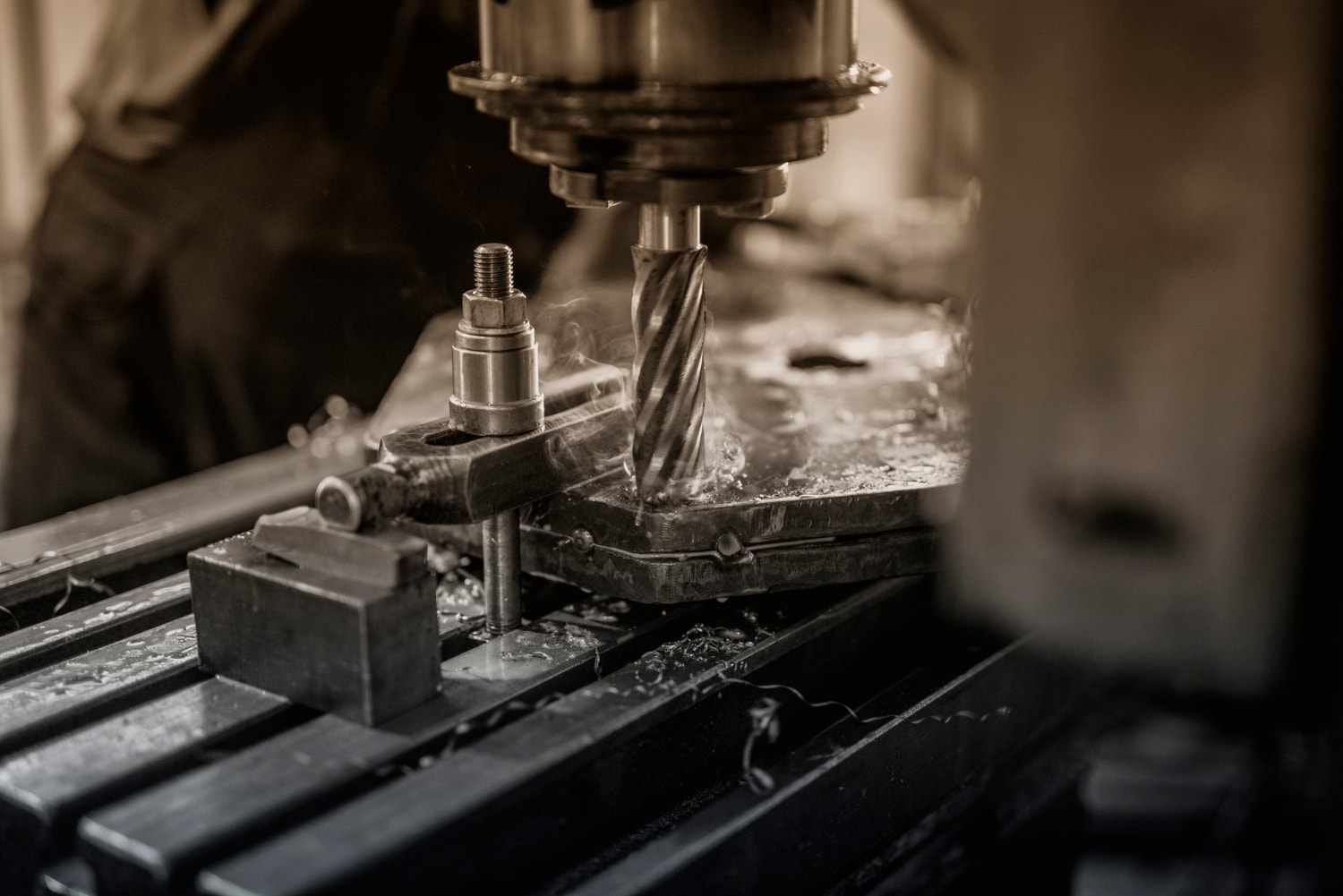
Talk to our engineering team about design optimization, material selection, cost reduction, and production planning. We support global customers from prototype to production with fast, reliable manufacturing solutions.